Notice of Claim of Defective Goods Template

Free Word download β€’ Edit online β€’ Save & share with Drive β€’ Export to PDF

1 pageβ€’15–25 min to fillβ€’Difficulty: Standard
Learn more ↓
FreeNotice of Claim of Defective Goods Template

At a glance

What it is
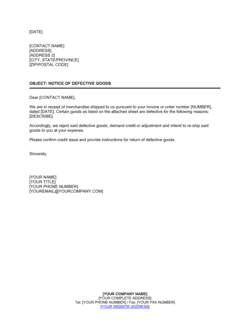
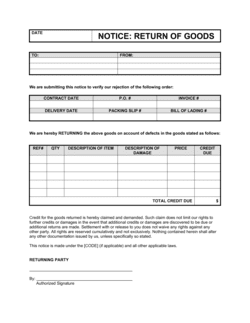
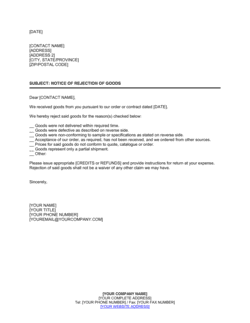
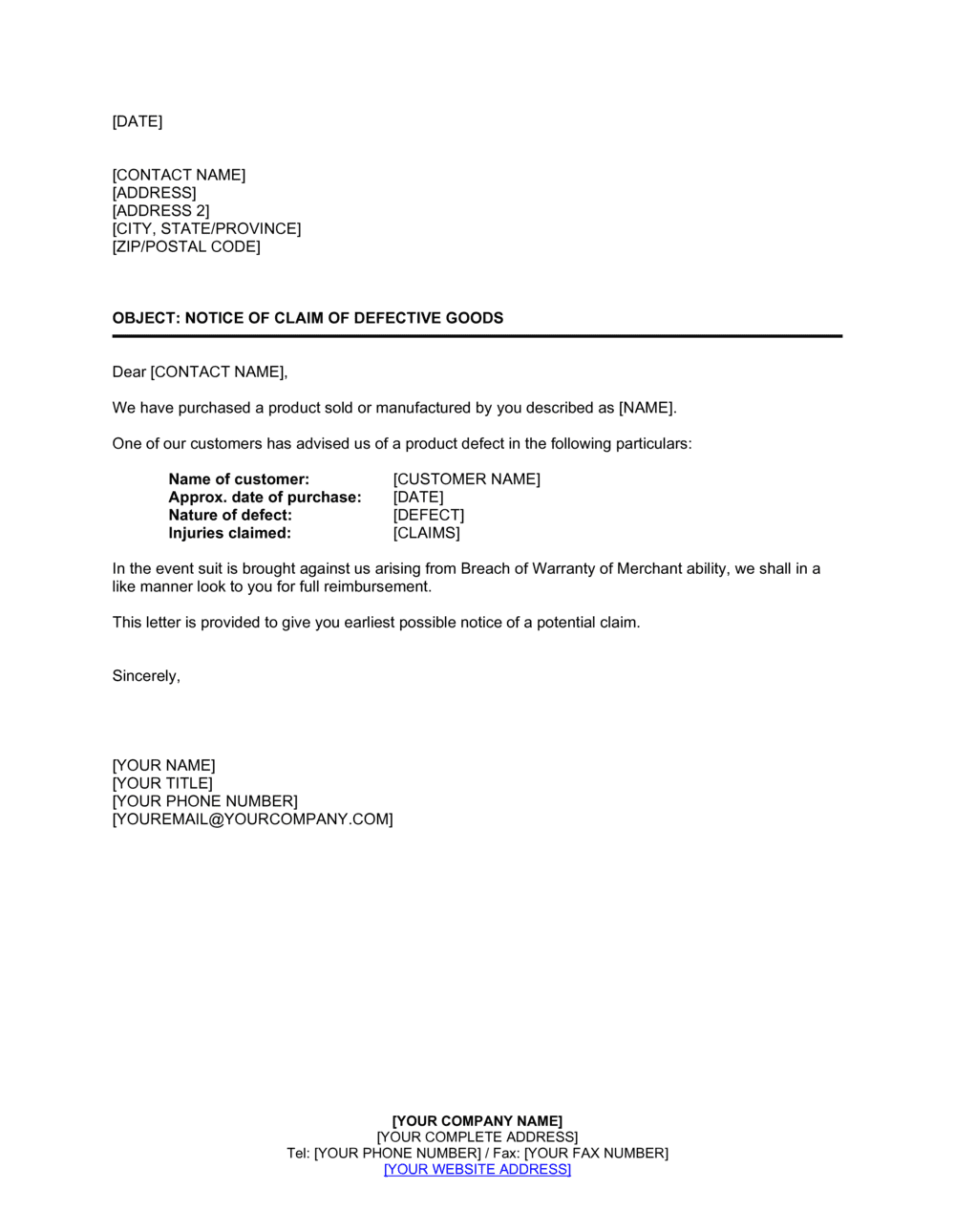
A Notice of Claim of Defective Goods is a formal business letter sent by a buyer to a supplier or vendor to document the discovery of defective, non-conforming, or damaged goods received under a purchase order or supply agreement. This free Word download gives you a ready-to-edit letter you can complete in minutes and export as PDF to send to your supplier.
When you need it
Use it as soon as defective or non-conforming goods are discovered upon receipt or during inspection β€” before returning the goods, initiating a chargeback, or escalating to a formal dispute. Timely written notice is often required under the terms of supply contracts and commercial law to preserve your right to a remedy.
What's inside
Buyer and supplier identification, purchase order and invoice references, a specific description of the defects discovered, the quantity and value of affected goods, the remedy requested (replacement, credit, or refund), a response deadline, and return or hold instructions.

What is a Notice of Claim of Defective Goods?

A Notice of Claim of Defective Goods is a formal business letter sent by a buyer to a supplier or vendor to document the discovery of defective, damaged, or non-conforming products received under a purchase order or supply agreement. It identifies the specific items affected, describes the nature of the defects with supporting evidence, states the financial value of the claim, and requests a defined remedy β€” replacement, credit memo, or refund β€” within a set deadline. Beyond prompting a resolution, the letter creates a written record that preserves the buyer's contractual and legal rights and satisfies the notice requirements found in most commercial supply contracts and applicable law.

Why You Need This Document

Without a formal written notice, a supplier has no documented obligation to act β€” and you have no paper trail if the dispute escalates. Most commercial supply contracts and statutes such as the UCC in the United States require prompt written notice of defects as a prerequisite to any remedy; failing to send one on time can extinguish your right to replacement, credit, or refund entirely. Verbal complaints or informal emails rarely satisfy contractual notice requirements and are difficult to produce as evidence in a chargeback process, mediation, or legal proceeding. A properly completed notice of claim β€” sent within days of discovering the defect, backed by photos and inspection records β€” puts the supplier on formal notice, starts the cure period clock, and positions you to escalate quickly if they fail to respond.

Which variant fits your situation?

If your situation is…Use this template
Goods arrived visibly damaged during shippingNotice of Claim of Defective Goods
Supplier delivered the wrong items or wrong quantitiesNotice of Non-Conforming Goods
Requesting a formal return authorization before sending goods backReturn Merchandise Authorization (RMA) Letter
Escalating an unresolved defective goods dispute to a formal demandDemand Letter
Cancelling a purchase order due to repeated defective deliveriesPurchase Order Cancellation Letter
Reducing payment to reflect accepted non-conforming goods at a lower valueDebit Note
Documenting a product defect that caused injury or property damageProduct Liability Claim Letter

Common mistakes to avoid

❌ Delaying the notice past the inspection or warranty period

Why it matters: Many supply contracts and commercial statutes (such as the UCC in the US) require prompt written notice of defects. Waiting weeks after discovery can extinguish your right to a remedy entirely.

Fix: Send the notice within 2–5 business days of discovering the defect. If your contract specifies an inspection period, send it before that window closes.

❌ Vague defect descriptions with no supporting evidence

Why it matters: A letter stating only 'the goods are defective' gives the supplier grounds to dispute the claim or request additional information, adding weeks to resolution.

Fix: Describe the specific defect type, the percentage of units affected, and attach photos or an inspection report as exhibits with every notice.

❌ Returning goods without a written RMA from the supplier

Why it matters: Unauthorized returns can be refused at the supplier's dock, lost in transit, or used as grounds to claim the damage occurred during return shipping β€” not at origin.

Fix: State clearly in the letter that goods are held and will not be returned without a written RMA. Wait for written authorization before arranging any return shipment.

❌ Omitting the reservation of rights clause

Why it matters: Without it, accepting a partial credit or replacement for some units may be construed as a full settlement, waiving your right to pursue the remaining claim.

Fix: Include standard reservation-of-rights language in every notice and in any follow-up correspondence until the claim is fully resolved in writing.

The 9 key clauses, explained

Header and party identification

In plain language: Identifies the sending company, the recipient supplier or vendor, the date, and the subject line referencing the specific purchase order or invoice number.

Sample language
[BUYER COMPANY NAME] | [ADDRESS] | [DATE] To: [SUPPLIER COMPANY NAME], Attn: [CONTACT NAME / ACCOUNTS OR SALES DEPARTMENT] Re: Notice of Claim β€” Defective Goods | PO #[PURCHASE ORDER NUMBER] | Invoice #[INVOICE NUMBER]

Common mistake: Omitting the purchase order and invoice numbers in the subject line. Without these references, the supplier's accounts or customer service team cannot locate the transaction quickly, causing delays.

Opening statement of claim

In plain language: Clearly states that the buyer is formally notifying the supplier of a defective goods claim, establishing the letter's legal purpose in the opening sentence.

Sample language
We are writing to formally notify you that the goods received under Purchase Order #[PO NUMBER], dated [ORDER DATE], do not conform to the agreed specifications and are hereby the subject of a defective goods claim.

Common mistake: Opening with a complaint narrative instead of a direct statement of claim. Burying the claim purpose weakens the letter's standing as formal notice and delays the supplier's response.

Description of goods received

In plain language: Identifies the specific items in question by product name, SKU, quantity ordered, and quantity received, with reference to the original PO.

Sample language
The shipment comprised [QUANTITY] units of [PRODUCT NAME / SKU: XXXXXX], delivered on [DELIVERY DATE] via [CARRIER NAME], tracking number [TRACKING NUMBER].

Common mistake: Describing goods by general category ('the parts') instead of using specific SKUs, product names, and quantities. Vague descriptions allow the supplier to dispute which items are subject to the claim.

Description of defects discovered

In plain language: Describes the specific nature of the defects β€” visible damage, functional failure, wrong specifications, or non-conformance β€” with enough detail to support the claim.

Sample language
Upon inspection on [INSPECTION DATE], [QUANTITY] units ([X]% of the shipment) were found to exhibit the following defects: [SPECIFIC DEFECT DESCRIPTION, e.g., cracked housing, incorrect voltage rating, missing components]. Photos and inspection records are attached.

Common mistake: Stating only that goods are 'defective' without describing the specific defect. Suppliers will request further detail before acting, adding days or weeks to resolution.

Statement of financial impact

In plain language: States the dollar value of the affected goods to quantify the claim and establish the financial basis for the requested remedy.

Sample language
The [QUANTITY] affected units represent a total invoiced value of $[AMOUNT] based on the agreed unit price of $[UNIT PRICE] per Invoice #[INVOICE NUMBER].

Common mistake: Omitting the dollar value of the claim. Without a stated amount, the supplier has no financial frame for the remedy request and may offer a partial credit without explicit basis.

Requested remedy

In plain language: States clearly what the buyer is requesting β€” full replacement, a credit memo, a refund, or repair β€” and by what date.

Sample language
We request [full replacement of the affected units / issuance of a credit memo for $[AMOUNT] / a full refund of $[AMOUNT]] within [15 / 30] days of this notice. Please confirm receipt and provide your proposed resolution plan in writing.

Common mistake: Requesting multiple remedies without stating a preference or priority. Presenting 'replacement or refund or credit' without ranking them gives the supplier discretion to choose the option least favorable to the buyer.

Disposition of defective goods

In plain language: Instructs the supplier on whether to issue a return merchandise authorization (RMA) for pick-up, or whether the buyer will hold the goods pending resolution.

Sample language
The affected goods are currently held at [BUYER ADDRESS / WAREHOUSE LOCATION] awaiting your return instructions. Please issue a Return Merchandise Authorization (RMA) within [5] business days. We will not dispose of or return the goods without written authorization.

Common mistake: Returning goods to the supplier before receiving written authorization. Unauthorized returns can be refused, lost in transit, or used by the supplier to argue the goods were damaged by the buyer.

Reservation of rights

In plain language: States that the buyer reserves all contractual and legal rights, including the right to pursue further remedies if the supplier does not resolve the claim within the stated period.

Sample language
This notice is without prejudice to any and all rights and remedies available to [BUYER COMPANY NAME] under the purchase agreement, applicable warranty, and governing law. Failure to respond within the stated period may result in further action including chargeback, engagement of legal counsel, or termination of the supplier relationship.

Common mistake: Omitting the reservation of rights entirely. Without it, a supplier may argue that acceptance of a partial remedy waived the buyer's right to pursue the full claim.

Closing and signature block

In plain language: Closes with a professional request for written confirmation, provides a contact name and details for the supplier's response, and includes the sender's name and title.

Sample language
Please confirm receipt of this notice in writing and direct your response to [NAME], [TITLE], at [EMAIL] or [PHONE]. We look forward to a prompt resolution. Sincerely, [SIGNATORY NAME] [TITLE] [BUYER COMPANY NAME]

Common mistake: Closing without providing a specific contact and response channel. Suppliers who cannot identify who to respond to or how will delay, which the buyer may later need to dispute.

How to fill it out

  1. 1

    Enter buyer and supplier details

    Add your company name, address, and the date at the top. Enter the supplier's full legal name and the name of the appropriate contact β€” accounts payable, sales, or a named account manager.

    πŸ’‘ Send to the supplier's accounts or sales department by name, not just a generic email address β€” named recipients respond faster.

  2. 2

    Reference the purchase order and invoice

    Enter the PO number, original order date, and invoice number in both the subject line and the opening paragraph. These are the supplier's primary lookup keys.

    πŸ’‘ Attach a copy of the original PO and invoice to the letter so the supplier has everything needed to verify the claim without requesting documents separately.

  3. 3

    Describe the goods received

    List each affected product by name, SKU, quantity ordered, and quantity received. Include the delivery date, carrier, and tracking number.

    πŸ’‘ If multiple SKUs are affected, use a short table within the letter body rather than a run-on sentence β€” it is faster to read and harder to dispute.

  4. 4

    Describe the specific defects

    State exactly what is wrong with the goods β€” visible damage, functional failure, incorrect specifications, or missing components. Include the date of inspection.

    πŸ’‘ Attach timestamped photos and an inspection report as exhibits. Visual evidence reduces back-and-forth and accelerates the supplier's internal approval for a remedy.

  5. 5

    State the dollar value of the claim

    Calculate the invoiced value of the affected units (quantity Γ— unit price) and state it explicitly. Cross-reference the invoice number.

    πŸ’‘ If some goods in the shipment were acceptable, calculate the claim value only for affected units β€” claiming the full shipment value when only a portion is defective weakens your credibility.

  6. 6

    Specify the remedy and deadline

    Choose one primary remedy β€” replacement, credit memo, or refund β€” and state a specific response deadline (typically 10–30 days from the letter date).

    πŸ’‘ Net 15 is appropriate for straightforward claims with clear defects. Allow Net 30 only for high-value or complex situations requiring supplier inspection.

  7. 7

    Add disposition and return instructions

    State where the defective goods are being held and that you will not return or dispose of them without a written RMA from the supplier.

    πŸ’‘ Holding goods at a documented location strengthens your claim β€” it signals good faith and prevents the supplier from arguing you destroyed evidence of the defect.

  8. 8

    Send and log the letter

    Send by email with read receipt, or by certified mail for high-value claims. Log the send date, recipient, and method in your supplier file.

    πŸ’‘ For claims above $5,000, send by both email and certified mail on the same day to create two independent delivery records.

Frequently asked questions

What is a notice of claim of defective goods?

A notice of claim of defective goods is a formal written letter a buyer sends to a supplier to document the discovery of defective, damaged, or non-conforming products received under a purchase order. It identifies the specific defects, states the value of the affected goods, requests a remedy β€” replacement, credit, or refund β€” and preserves the buyer's legal and contractual rights to pursue that remedy.

When should I send a defective goods notice?

Send the notice as soon as defects are discovered during receipt inspection or upon opening the shipment β€” typically within 2 to 5 business days of delivery. Many supply contracts and commercial statutes require prompt written notice of defects as a condition of making a valid claim. Waiting more than a few weeks risks losing your right to a remedy under the contract or applicable law.

Does a defective goods notice need to be signed?

No formal signature is legally required for a defective goods notice to be effective. However, the letter should be sent from and signed by an authorized representative of the buyer β€” a procurement manager, operations director, or business owner β€” so the supplier can verify the authority of the person making the claim. Electronic signatures are sufficient for most business-to-business purposes.

What remedy can I request in a defective goods notice?

Common remedies include full replacement of the defective units, a credit memo reducing the outstanding balance owed, a cash refund for goods already paid, or repair of the defective items at the supplier's expense. Choose one primary remedy and state it clearly. If replacement is not practical due to lead times, request a credit or refund instead. Avoid listing all possible remedies without indicating a preference.

Should I return the defective goods before sending the notice?

No. Hold the defective goods at your location and state this clearly in the notice. Returning goods without a written Return Merchandise Authorization (RMA) from the supplier risks the return being refused, lost, or disputed. The notice itself should request an RMA and confirm that the goods will remain held until you receive written return instructions.

What documentation should I attach to the notice?

Attach a copy of the original purchase order, the supplier's invoice, timestamped photos of the defects, and any incoming inspection report or quality-control checklist completed at receipt. For high-value claims, a third-party inspection report significantly strengthens your position and speeds up the supplier's internal approval process.

What happens if the supplier does not respond to the notice?

If the supplier does not respond within the deadline stated in the notice, your next steps typically include sending a follow-up demand letter, initiating a chargeback through your payment provider if goods were paid by credit card or trade account, or escalating to legal counsel. The notice itself forms the evidentiary foundation for any subsequent dispute, arbitration, or legal claim.

Can I use this letter for goods damaged during shipping?

Yes, if the seller bears responsibility for shipping under the purchase terms (e.g., DDP or CIF incoterms). If the buyer arranged and paid for shipping independently, the claim for transit damage should be directed to the carrier rather than β€” or in addition to β€” the supplier. State clearly in the notice how and when the damage was discovered and whether the outer packaging was intact at delivery.

How this compares to alternatives

vs Demand Letter

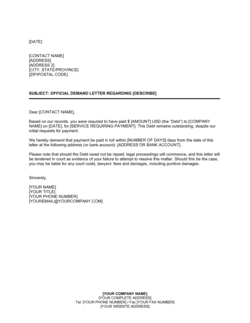
A defective goods notice is a prompt, commercially-oriented first step that opens the claims process and requests a remedy cooperatively. A demand letter is an escalated document β€” typically drafted with legal language β€” sent after the notice has been ignored or a remedy refused. Use the notice first; escalate to a demand letter only if the supplier fails to respond within the stated deadline.

vs Purchase Order Cancellation Letter

A purchase order cancellation letter terminates an unfulfilled or ongoing order. A defective goods notice addresses a shipment already received and seeks a remedy for goods already delivered. If defective deliveries are recurring and you want to end the supplier relationship, send a defective goods notice for the current shipment and a separate cancellation letter for open orders.

vs Debit Note

A debit note is an accounting document that reduces the amount owed to the supplier by the value of returned or rejected goods. It is the financial instrument that follows a defective goods notice once the remedy has been agreed. Send the notice first to establish the claim; issue the debit note once the supplier confirms acceptance of the return or credit.

vs Product Liability Claim Letter

A product liability claim letter is used when defective goods cause injury, property damage, or consequential losses β€” and seeks compensation beyond a simple replacement or refund. A defective goods notice covers the standard commercial remedy for non-conforming products with no downstream harm. If the defect caused measurable third-party damage, a product liability claim or legal counsel is appropriate.

Industry-specific considerations

Manufacturing

Defective components arriving at a production line trigger immediate claims to avoid line stoppages; notices reference batch numbers and technical specifications.

Retail and E-commerce

Defective merchandise must be claimed before being listed for sale or returned to customers; notices support chargeback documentation with payment processors.

Construction and Trades

Defective materials on a job site can delay project timelines; notices are sent to materials suppliers and cross-referenced to subcontract schedules.

Food and Beverage

Defective packaging, mislabeled ingredients, or out-of-spec products require urgent notice due to food safety regulations and short shelf-life windows.

Template vs pro β€” what fits your needs?

PathBest forCostTime
Use the templateAny buyer sending a first-time defective goods claim to a supplier for a standard commercial transactionFree15–30 minutes
Template + professional reviewHigh-value claims above $10,000 or situations involving a supply agreement with specific notice requirements$100–$300 for a brief legal or contracts review1–2 days
Custom draftedClaims involving consequential damages, international suppliers, or where legal proceedings are anticipated$500–$2,000+3–7 days

Glossary

Defective Goods
Products that fail to meet the quality, safety, or specification standards agreed upon in the purchase order or supply contract.
Non-Conforming Goods
Goods that do not match the description, quantity, or specifications stated in the purchase order, even if not physically damaged.
Purchase Order (PO)
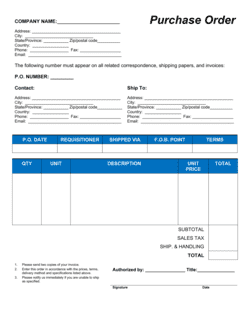
A buyer-issued document authorizing a purchase, specifying goods, quantities, agreed price, and delivery terms β€” the primary reference document for a defective goods claim.
Rejection of Goods
The formal refusal by a buyer to accept delivered goods that do not conform to the contract, typically required within a specific timeframe.
Cure Period
A defined window β€” often 10 to 30 days β€” during which the supplier is permitted to replace, repair, or refund the defective goods before further action is taken.
Credit Memo
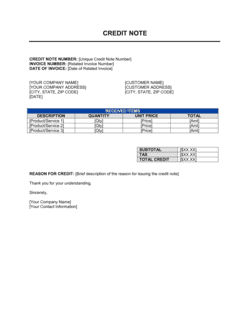
A document issued by the supplier reducing the amount owed by the buyer β€” a common remedy when replacing defective goods is impractical.
Inspection Period
The time window after delivery during which the buyer is contractually permitted to inspect goods and reject any that are defective or non-conforming.
Warranty (Express)
A seller's written promise that the goods will conform to specific standards of quality, performance, or fitness for a stated period.
Merchantability
An implied warranty under commercial law that goods sold are fit for the ordinary purpose for which they are used.
Return Merchandise Authorization (RMA)
A supplier-issued reference number and instruction set authorizing the buyer to physically return defective goods for replacement or credit.

Part of your Business Operating System

This document is one of 3,000+ business & legal templates included in Business in a Box.

  • Fill-in-the-blanks β€” ready in minutes
  • 100% customizable Word document
  • Compatible with all office suites
  • Export to PDF and share electronically

Create your document in 3 simple steps.

From template to signed document β€” all inside one Business Operating System.
1
Download or open template

Access over 3,000+ business and legal templates for any business task, project or initiative.

2
Edit and fill in the blanks with AI

Customize your ready-made business document template and save it in the cloud.

3
Save, Share, Send, Sign

Share your files and folders with your team. Create a space of seamless collaboration.

Save time, save money, and create top-quality documents.

β˜…β˜…β˜…β˜…β˜…

"Fantastic value! I'm not sure how I'd do without it. It's worth its weight in gold and paid back for itself many times."

Managing Director Β· Mall Farm
Robert Whalley
Managing Director, Mall Farm Proprietary Limited
β˜…β˜…β˜…β˜…β˜…

"I have been using Business in a Box for years. It has been the most useful source of templates I have encountered. I recommend it to anyone."

Business Owner Β· 4+ years
Dr Michael John Freestone
Business Owner
β˜…β˜…β˜…β˜…β˜…

"It has been a life saver so many times I have lost count. Business in a Box has saved me so much time and as you know, time is money."

Owner Β· Upstate Web
David G. Moore Jr.
Owner, Upstate Web

Run your business with a system β€” not scattered tools

Stop downloading documents. Start operating with clarity. Business in a Box gives you the Business Operating System used by over 250,000 companies worldwide to structure, run, and grow their business.

Start freeΒ Β·Β No credit card required