Demand Letter Template

Free Word download β€’ Edit online β€’ Save & share with Drive β€’ Export to PDF

1 pageβ€’20–25 min to fillβ€’Difficulty: Standard
Learn more ↓
FreeDemand Letter Template

At a glance

What it is
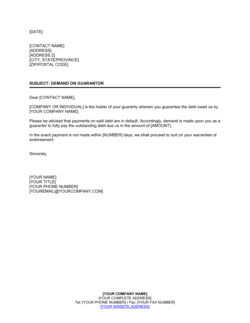
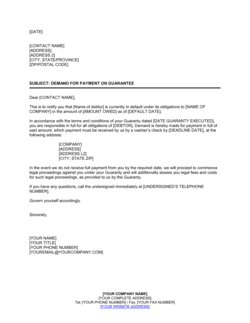
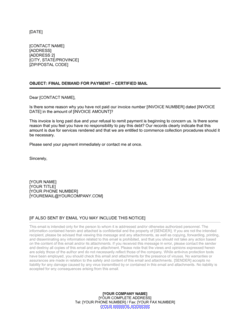
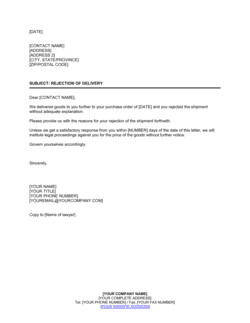
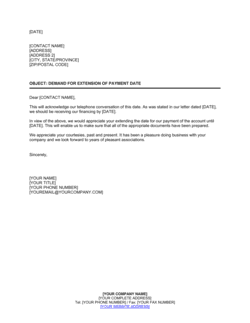
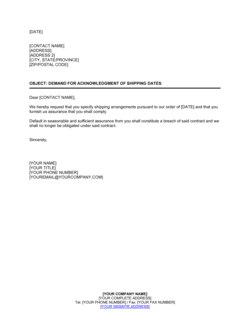
A Demand Letter is a formal written notice sent by a creditor, business, or their counsel to a debtor or opposing party, asserting a legal claim and demanding payment, performance, or another specific remedy by a stated deadline. This template is a free Word download you can edit online and export as PDF β€” covering the factual basis of the claim, the exact amount owed, the response deadline, and the consequences of non-compliance.
When you need it
Send it when informal follow-up has failed and you need a formal, documented record of your claim before escalating to small claims court, a collections agency, or full litigation. Many courts require evidence that a demand was made before a case can proceed.
What's inside
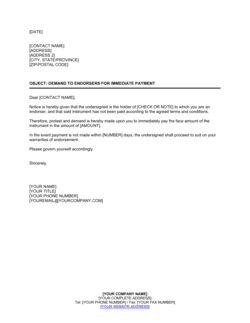
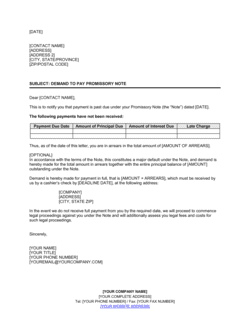
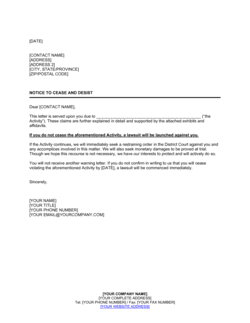
Date and parties block, factual summary of the dispute, specific demand with dollar amount or requested action, response deadline, consequences of non-compliance, and a professional closing with sender contact details.

What is a Demand Letter?

A Demand Letter is a formal written notice sent by a creditor, business owner, or their counsel to a debtor or non-performing party, asserting a specific legal claim and demanding payment, performance, or another defined remedy by a stated deadline. It sets out the factual basis for the claim, identifies the legal theory β€” breach of contract, unjust enrichment, property damage β€” states the exact amount or action demanded, and describes the legal consequences that will follow if the recipient does not comply. Unlike an informal payment reminder, a demand letter creates a documented legal record that can be submitted as evidence in court and, in many jurisdictions, is a statutory prerequisite to filing certain types of claims.

Why You Need This Document

Unpaid invoices, broken agreements, and property damage cost small businesses and individuals billions of dollars each year β€” not because the claims are invalid, but because creditors never formally assert them. An informal email chain is easy to ignore; a dated, certified demand letter with a specific deadline and stated legal consequences is not. Courts look for evidence that you gave the other party a reasonable opportunity to resolve the dispute before filing β€” a demand letter provides that evidence. It also resets the dynamic with the recipient: many debtors who ignore payment reminders pay promptly when they receive a letter that names the court where you intend to file and calculates the full amount including interest and costs. For the fifteen minutes it takes to complete this template, a demand letter is one of the highest-leverage tools available to anyone owed money or a remedy they haven't received.

Which variant fits your situation?

If your situation is…Use this template
Collecting an unpaid invoice from a business clientDemand Letter for Payment
Demanding a tenant pay overdue rent or vacateNotice to Quit / Pay or Vacate
Requesting a party stop infringing your trademark or copyrightCease and Desist Letter
Pursuing a breach of contract before filing suitBreach of Contract Demand Letter
Claiming reimbursement from an insurance companyInsurance Demand Letter
Notifying a contractor of defective work requiring remediationNotice of Defective Work
Demanding return of a security deposit after tenancy endsSecurity Deposit Demand Letter

Common mistakes to avoid

❌ Using a vague or approximate demand amount

Why it matters: Recipients and their counsel immediately challenge figures that aren't supported by a clear calculation. An unsupported number stalls negotiation and weakens your position in court.

Fix: Itemize every component β€” principal, interest rate and period, and any documented fees β€” and show the arithmetic. If the contract specifies a late fee, include it and cite the clause.
❌ Setting an open-ended or vague deadline

Why it matters: Phrases like 'promptly' or 'within a reasonable time' give recipients an indefinite window and signal you won't actually follow through on consequences.

Fix: State a specific calendar date as the deadline and confirm it is at least 7 days from the letter's postmark date to be considered reasonable.

❌ Sending without certified mail or proof of delivery

Why it matters: A recipient who claims they never received the letter can defeat your timeline in court or arbitration, undermining the purpose of the entire exercise.

Fix: Always send via certified mail with return receipt requested. Keep the return card and tracking confirmation on file with a copy of the dated letter.

❌ Threatening consequences you cannot or will not pursue

Why it matters: Empty threats β€” such as criminal prosecution for a civil debt or immediate asset seizure β€” are legally problematic and destroy your credibility if the matter goes to court.

Fix: Only threaten actions you are genuinely prepared to take: filing in small claims court, engaging a collections agency, or filing a mechanic's lien. Be specific and accurate.

❌ Writing an emotional or accusatory letter

Why it matters: Hostile language triggers defensive responses, reduces the chance of voluntary payment, and reflects poorly on the sender if the letter is admitted as evidence.

Fix: Keep every sentence factual, professional, and in the third person. If you're too close to the situation to write calmly, draft it, wait 24 hours, and revise before sending.

❌ Sending the letter without first checking the statute of limitations

Why it matters: A demand letter sent after the limitations period has expired is unenforceable β€” the threat of litigation is hollow and the recipient's attorney will know it immediately.

Fix: Confirm the statute of limitations for your type of claim in your jurisdiction before drafting. For written contracts in most US states, it runs 3–6 years from the breach date.

The 9 key clauses, explained

Date, sender, and recipient block

In plain language: Identifies who is sending the letter, who is receiving it, and the exact date β€” establishing the timeline for the response deadline.

Sample language
[DATE] | From: [SENDER FULL NAME / COMPANY NAME], [ADDRESS] | To: [RECIPIENT FULL NAME / COMPANY NAME], [ADDRESS]

Common mistake: Using a trade name instead of a legal entity name. If the matter proceeds to court, the party named in the demand letter must match the plaintiff on the filing.

Subject line and reference

In plain language: States the nature of the demand and references any relevant contract, invoice number, or account number so the recipient can locate the underlying records immediately.

Sample language
RE: Demand for Payment β€” Invoice #[INVOICE NUMBER] dated [DATE] β€” Amount Due: $[AMOUNT]

Common mistake: Omitting reference numbers entirely. Without them, the recipient's accounts-payable or legal team cannot quickly verify the claim, which delays response and weakens the paper trail.

Factual background

In plain language: Summarizes the events giving rise to the claim β€” the agreement, what was delivered or performed, and how the other party failed to meet their obligation.

Sample language
On [DATE], [SENDER] and [RECIPIENT] entered into a [TYPE OF AGREEMENT] under which [SENDER] agreed to [DESCRIPTION OF PERFORMANCE]. [SENDER] fully performed its obligations on [DATE]. Despite [NUMBER] attempts to collect payment, [RECIPIENT] has failed to remit the agreed amount of $[AMOUNT].

Common mistake: Writing an emotional or accusatory narrative instead of a factual chronology. Courts and opposing counsel discount letters that read as venting rather than as documentation of a legal claim.

Legal basis for the claim

In plain language: States the legal theory β€” breach of contract, unjust enrichment, negligence, etc. β€” that entitles the sender to the remedy demanded.

Sample language
[RECIPIENT]'s failure to remit payment constitutes a material breach of the [AGREEMENT NAME] dated [DATE] and entitles [SENDER] to recover the outstanding balance plus applicable interest and costs.

Common mistake: Skipping the legal basis entirely and jumping straight to the demand amount. Without asserting a legal theory, the letter reads as a collections reminder rather than a formal legal notice.

Specific demand and amount

In plain language: States exactly what the sender is demanding β€” a dollar amount, a specific action, or both β€” with no ambiguity.

Sample language
Accordingly, [SENDER] demands payment of $[AMOUNT], representing $[PRINCIPAL] in outstanding principal, $[INTEREST] in accrued interest at [RATE]% per month from [DATE], and $[FEES] in collection costs.

Common mistake: Demanding a rounded or approximate figure without showing how it was calculated. Recipients and their counsel immediately challenge unsupported numbers, stalling resolution.

Response deadline

In plain language: Sets a specific calendar date β€” not a vague timeframe β€” by which the recipient must comply or respond.

Sample language
You must remit full payment to the account details below no later than [SPECIFIC DATE], which is [NUMBER] days from the date of this letter.

Common mistake: Writing 'immediately' or 'as soon as possible' instead of a specific date. Vague deadlines are unenforceable and signal to the recipient that no real escalation is imminent.

Consequences of non-compliance

In plain language: Describes what the sender will do if the demand is not met by the deadline β€” filing suit, reporting to a credit bureau, referring to a collections agency, or seeking attorney's fees.

Sample language
If payment is not received by [DATE], [SENDER] will have no alternative but to pursue all available legal remedies, including filing a claim in [COURT NAME], which may result in a judgment against you, additional court costs, and attorney's fees where permitted by law.

Common mistake: Threatening consequences you have no intention or ability to follow through on. Courts and opposing counsel notice when threatened actions never materialize β€” it undercuts your credibility in any subsequent proceeding.

Payment and contact instructions

In plain language: Provides the exact payment method, account details, or mailing address, and a contact name for the recipient to reach out with questions or to negotiate.

Sample language
Payment may be made by [METHOD] to [ACCOUNT DETAILS / MAILING ADDRESS]. Direct any questions or responses to [CONTACT NAME] at [EMAIL] or [PHONE NUMBER].

Common mistake: Omitting payment instructions entirely. A recipient who wants to pay but has no clear method is more likely to let the deadline pass than to chase down the sender's banking details independently.

Professional closing and signature

In plain language: Closes the letter formally, includes the sender's printed name, title, and company, and optionally notes that a copy has been sent to counsel or retained on file.

Sample language
Sincerely, [SENDER NAME] | [TITLE] | [COMPANY NAME] | cc: [COUNSEL NAME / FILE REFERENCE]

Common mistake: Closing with an aggressive or threatening sign-off. A professional tone throughout β€” including the closing β€” keeps the door open for settlement and reflects better on the sender if the letter is later submitted as evidence.

How to fill it out

  1. 1

    Identify the correct legal names of both parties

    Enter the full registered legal name of both the sender and recipient β€” not trade names or nicknames. Confirm the recipient's current mailing address and, if known, their registered agent address.

    πŸ’‘ For business recipients, look up their registered agent address in the state's Secretary of State database β€” serving the registered agent creates a stronger proof-of-delivery record.

  2. 2

    Gather all supporting documentation before writing

    Collect the original contract or agreement, all invoices, proof of delivery or completion, prior payment correspondence, and any prior collection attempts. These documents are your factual foundation.

    πŸ’‘ List every document you reference in the letter in a 'Enclosures' line at the bottom β€” it signals thoroughness and makes your claim harder to dispute.

  3. 3

    Write the factual background as a neutral chronology

    Describe the agreement, what you did, when you did it, and exactly how the recipient failed to perform. Use dates and dollar amounts throughout. Keep the tone factual and professional.

    πŸ’‘ Write in the third person β€” 'Claimant delivered the goods on [DATE]' β€” to sound more formal and reduce the emotional temperature of the letter.

  4. 4

    State the legal basis for your claim

    Identify the legal theory: breach of contract, unjust enrichment, or negligence. You do not need to cite statutes, but naming the legal theory signals that you understand your rights.

    πŸ’‘ If the original contract includes an attorney's fees clause, cite it here β€” it significantly increases settlement pressure on the recipient.

  5. 5

    Calculate and itemize the full amount demanded

    Break the demand into principal, accrued interest at the contracted rate, and any documented collection costs. Show the math explicitly so the recipient cannot dispute the total.

    πŸ’‘ If your contract specifies an interest rate on overdue balances, use that rate. If not, use the statutory pre-judgment interest rate for your jurisdiction.

  6. 6

    Set a specific response deadline

    Choose a deadline between 7 and 30 days from the letter date depending on urgency. Write the exact calendar date β€” not '10 days from receipt' β€” and confirm it gives you enough time to act if the deadline passes.

    πŸ’‘ 14 days is the most common deadline for standard payment demands; 7 days signals urgency and is appropriate when the statute of limitations is approaching.

  7. 7

    Send via certified mail and retain proof

    Send the final letter by certified mail with return receipt requested, and optionally by email with read receipt. Keep the signed green card, tracking number, and a copy of the letter in your records.

    πŸ’‘ Courts treat a certified mail return receipt as near-conclusive proof of delivery. Email alone is often disputed.

Frequently asked questions

What is a demand letter?

A demand letter is a formal written notice sent by a creditor or injured party to a debtor or opposing party, asserting a legal claim and demanding a specific remedy β€” typically payment of a dollar amount β€” by a stated deadline. It creates a documented record of the dispute and is typically the final step before small claims court, a collections agency, or full litigation. Many courts and arbitration bodies require evidence that a demand was made before a case can proceed.

How long should I give the recipient to respond?

The standard range is 7 to 30 days from the letter date. Fourteen days is the most common deadline for routine payment demands. Seven days is appropriate when urgency is genuine β€” such as when the statute of limitations is approaching. Thirty days is reasonable for complex contractual disputes where the recipient may need time to consult counsel. Always state a specific calendar date rather than a number of days.

Do I need a lawyer to send a demand letter?

Not for straightforward payment demands. A well-drafted template is sufficient for collecting unpaid invoices, requesting return of a deposit, or pursuing a clear breach of contract. Engage a lawyer when the amount is substantial (typically above $10,000–$25,000), the legal theory is complex, the opposing party is represented by counsel, or when a letter on law-firm letterhead is likely to produce a faster settlement. A lawyer-drafted demand letter typically costs $200–$500 and is often worth it for larger claims.

What should I do if the recipient ignores the demand letter?

If the deadline passes without payment or a substantive response, follow through on the consequences you stated in the letter. For amounts under your state's small claims limit (typically $5,000–$25,000), file in small claims court β€” it is fast, inexpensive, and does not require an attorney. For larger amounts, refer the matter to a collections attorney or file in civil court. Do not send a second demand letter with a new deadline; it signals weakness.

What is the difference between a demand letter and a cease and desist letter?

A demand letter requests payment or performance of a specific obligation β€” money owed, a contract fulfilled, or property returned. A cease and desist letter demands that the recipient stop a specific behavior β€” trademark infringement, harassment, breach of a non-compete, or defamation. Both are pre-litigation tools, but they address different types of claims. A single letter can combine both demands when the situation calls for it.

How should I send a demand letter to prove it was received?

Send the letter by certified mail with return receipt requested and retain the signed green card and USPS tracking confirmation on file. Many senders also send a copy by email with a read-receipt request as a backup. Email alone is frequently disputed by recipients. The certified mail return receipt is treated by most courts as near-conclusive proof that the letter was delivered on the stamped date.

Can a demand letter be used against me in court?

Yes β€” demand letters can be submitted as evidence by either party. This is why tone and accuracy matter. Factual, professional language demonstrates that you acted reasonably and in good faith. Exaggerated claims, threats you cannot back up, or demands for amounts you cannot justify can undermine your credibility with a judge or arbitrator. Write every demand letter as if it will be read aloud in court.

Does sending a demand letter stop the statute of limitations clock?

No. Sending a demand letter does not toll β€” pause or reset β€” the statute of limitations in most jurisdictions. The clock continues to run from the date of the original breach or injury. If you are approaching the limitations deadline, file suit immediately rather than waiting for a response to your letter. The demand letter and the lawsuit filing are not mutually exclusive.

How this compares to alternatives

vs Cease and Desist Letter

A cease and desist letter demands that the recipient stop a specific harmful behavior β€” infringement, harassment, or breach of a restrictive covenant β€” rather than pay a sum of money. A demand letter is focused on collecting a quantified debt or enforcing a specific obligation. Some disputes require both: one paragraph demanding payment, another demanding the harmful conduct stop.

vs Collections Letter

A collections letter is an informal, often repeated reminder from a creditor asking for payment. A demand letter is a formal legal notice asserting a specific legal claim, citing the basis, and threatening defined legal consequences by a hard deadline. Courts treat them differently β€” a collections letter rarely satisfies a statutory demand requirement; a demand letter typically does.

vs Late Payment Notice

A late payment notice is a courteous reminder sent shortly after a due date passes β€” it preserves the business relationship and invites the payer to resolve the oversight. A demand letter is the formal escalation step used when reminders have failed, and it signals that legal action is the next step. Send reminders first; send the demand letter when they stop working.

vs Notice of Default

A notice of default formally declares that a party has breached a contract and triggers cure periods, acceleration clauses, or other contractual remedies built into the agreement. A demand letter is typically sent before or alongside a notice of default and focuses on the specific remedy sought. For loan agreements and leases, the notice of default is the operative legal trigger; the demand letter sets the payment expectation.

Industry-specific considerations

Professional Services

Consultants and agencies use demand letters to collect overdue project invoices before engaging a collections attorney or filing in small claims court.

Construction and Trades

Contractors send demand letters as the documented precursor to filing a mechanic's lien, which typically requires evidence that payment was formally requested.

Real Estate and Property Management

Landlords use demand letters to formally request unpaid rent, lease-violation remediation, or reimbursement for property damage before initiating eviction proceedings.

Retail and E-commerce

Sellers and vendors use demand letters to collect from delinquent wholesale buyers or to demand a refund for defective goods received from a supplier.

Template vs pro β€” what fits your needs?

PathBest forCostTime
Use the templateCollecting unpaid invoices under $10,000, straightforward breach of contract, or small claims preparationFree15–30 minutes
Template + professional reviewClaims between $10,000 and $50,000, complex contractual breaches, or when the recipient is already represented by counsel$200–$500 for a lawyer review or redraft on firm letterhead1–2 days
Custom draftedHigh-value claims above $50,000, regulated industries, or disputes where litigation is likely and the letter will be a key exhibit$500–$1,500+2–5 days

Glossary

Demand Letter
A formal written notice asserting a legal claim and requesting payment, performance, or remedy by a specified deadline before further legal action is taken.
Pre-Litigation Notice
Any formal communication sent to a party before filing a lawsuit, intended to resolve a dispute and create a documented record of the attempt.
Response Deadline
The specific date by which the recipient must comply with or respond to the demand β€” typically 7 to 30 days from the letter's date.
Creditor
The party owed money or performance β€” the person or entity sending the demand letter.
Debtor
The party who owes money or has an obligation to perform β€” the recipient of the demand letter.
Breach of Contract
A failure by one party to fulfill an obligation set out in a binding agreement, giving the non-breaching party the right to seek damages.
Statute of Limitations
The legal deadline by which a lawsuit must be filed; sending a demand letter does not toll the statute, so timing matters.
Proof of Delivery
Documentation β€” such as certified mail receipts or delivery confirmation β€” proving the demand letter was received by the intended party.
Mitigation of Damages
The legal obligation on the non-breaching party to take reasonable steps to reduce their own losses rather than allow them to accumulate.
Attorney's Fees Clause
A contract provision that allows the prevailing party in a dispute to recover their legal costs from the losing party β€” often cited in demand letters to increase settlement pressure.

Part of your Business Operating System

This document is one of 3,000+ business & legal templates included in Business in a Box.

  • Fill-in-the-blanks β€” ready in minutes
  • 100% customizable Word document
  • Compatible with all office suites
  • Export to PDF and share electronically

Create your document in 3 simple steps.

From template to signed document β€” all inside one Business Operating System.
1
Download or open template

Access over 3,000+ business and legal templates for any business task, project or initiative.

2
Edit and fill in the blanks with AI

Customize your ready-made business document template and save it in the cloud.

3
Save, Share, Send, Sign

Share your files and folders with your team. Create a space of seamless collaboration.

Save time, save money, and create top-quality documents.

β˜…β˜…β˜…β˜…β˜…

"Fantastic value! I'm not sure how I'd do without it. It's worth its weight in gold and paid back for itself many times."

Managing Director Β· Mall Farm
Robert Whalley
Managing Director, Mall Farm Proprietary Limited
β˜…β˜…β˜…β˜…β˜…

"I have been using Business in a Box for years. It has been the most useful source of templates I have encountered. I recommend it to anyone."

Business Owner Β· 4+ years
Dr Michael John Freestone
Business Owner
β˜…β˜…β˜…β˜…β˜…

"It has been a life saver so many times I have lost count. Business in a Box has saved me so much time and as you know, time is money."

Owner Β· Upstate Web
David G. Moore Jr.
Owner, Upstate Web

Run your business with a system β€” not scattered tools

Stop downloading documents. Start operating with clarity. Business in a Box gives you the Business Operating System used by over 250,000 companies worldwide to structure, run, and grow their business.

Start freeΒ Β·Β No credit card required