Claim for Damage on Shipped Goods Template

Free Word download • Edit online • Save & share with Drive • Export to PDF

1 page20–30 min to fillDifficulty: StandardSignature requiredLegal review recommended
Learn more ↓
FreeClaim for Damage on Shipped Goods Template

At a glance

What it is
A Claim for Damage on Shipped Goods is a formal written demand submitted by a shipper, consignee, or cargo owner to a carrier, freight broker, or insurer to recover the value of goods damaged, lost, or destroyed during transit. This free Word download gives you a structured, legally defensible template you can edit online and export as PDF to file with any domestic or international freight carrier.
When you need it
Use it as soon as you discover damage, shortage, or loss upon delivery — or within the time limit set by the carrier's tariff or bill of lading, whichever is shorter. Filing promptly preserves your recovery rights; delay or informal notification frequently bars the claim entirely.
What's inside
Claimant and carrier identification, shipment details with bill of lading reference, description and valuation of damaged or lost goods, supporting documentation checklist, demand for specific compensation, and a signature block with certification of accuracy.

What is a Claim for Damage on Shipped Goods?

A Claim for Damage on Shipped Goods is a formal written demand submitted by a shipper, consignee, or cargo owner to a freight carrier, freight broker, or cargo insurer requesting financial reimbursement for goods that were lost, damaged, or destroyed while in the carrier's custody during transit. It functions both as a commercial instrument — identifying the shipment, describing the loss, and quantifying the amount owed — and as a legal prerequisite that must be filed within strict statutory or contractual deadlines before any court action or insurance recovery can proceed. A properly completed claim establishes the factual and evidentiary record that determines whether you recover the full invoice value or walk away with nothing.

Why You Need This Document

Without a timely, formally documented freight damage claim, your legal right to recover for transit losses can be permanently extinguished — regardless of how clear the carrier's fault is. Under US federal law, the 9-month filing window under the Carmack Amendment is unforgiving, and many carrier tariffs impose deadlines as short as 60 days. An informal email or phone complaint does not satisfy the legal filing requirement. Beyond preserving your recovery rights, a complete, well-organized claim — with a referenced bill of lading, commercial invoice, exception-noted delivery receipt, and dated photographs — dramatically shortens carrier settlement timelines and reduces the risk of partial denial. This template gives you a structured, defensible document that meets carrier requirements, references the correct statutory authority, and preserves your reservation of rights so a partial payment cannot be used to close out your full claim.

Which variant fits your situation?

If your situation is…Use this template
Claiming for goods visibly damaged at the time of deliveryClaim For Damage On Shipped Goods (Visible Damage)
Reporting concealed damage discovered after delivery and unpackingConcealed Damage Claim Letter
Goods never arrived and are confirmed lost by the carrierFreight Loss Claim Letter
Claiming against a cargo insurance policy rather than the carrierCargo Insurance Claim Form
Disputed or denied claim requiring formal escalationDemand Letter for Freight Claim Denial
International shipment governed by a bill of lading and COGSAInternational Cargo Damage Claim
Filing a claim against a freight broker rather than the operating carrierFreight Broker Liability Claim Letter

Common mistakes to avoid

❌ Missing the filing deadline

Why it matters: US domestic freight claims must be filed within 9 months of delivery under the Carmack Amendment; many carrier tariffs impose shorter windows of 60–180 days. Filing even one day late extinguishes the right to recover regardless of how strong the underlying claim is.

Fix: File the claim immediately upon discovering damage — even an incomplete submission preserves the filing date. Mark the delivery date on your claims calendar the moment a shipment arrives, and escalate any visible damage to your claims process the same day.

❌ Signing a clean delivery receipt for visibly damaged goods

Why it matters: A clean delivery receipt is treated as prima facie evidence that the carrier delivered the goods in good order. Without an exception notation, the claimant bears the full burden of proving the carrier caused the damage — a burden that is very difficult to meet after the fact.

Fix: Never sign a delivery receipt for a shipment with visible damage without noting every exception in writing. Photograph the damage before moving the freight. If the driver objects, note 'driver refused to allow inspection' on the receipt.

❌ Failing to attach the commercial invoice to the claim

Why it matters: Carriers and insurers settle claims at actual invoice value, not at replacement or list price. A claim without an invoice has no evidentiary basis for the amount demanded and will be reduced to the carrier's tariff-limited liability — often a fraction of the true loss.

Fix: Always attach the commercial invoice showing what was paid for the goods, along with the packing list. If the goods were manufactured internally, attach a cost build-up showing material and labor costs.

❌ Sending the claim to the wrong department or address

Why it matters: Claims submitted to a carrier's customer service or billing department, rather than the formal claims department, frequently go unprocessed. The filing deadline continues to run while the claim sits in the wrong inbox.

Fix: Obtain the carrier's claims department mailing address and email from their tariff or website before filing. Send via certified mail and email simultaneously, and confirm receipt within 5 business days of sending.

❌ Accepting partial payment without a reservation of rights

Why it matters: Cashing a carrier's partial settlement check or accepting a payment without explicit written reservation can be construed as an accord and satisfaction — a full and final release of the remaining claim balance.

Fix: Before accepting any partial payment, send a written letter to the carrier stating that the payment is accepted under protest and does not constitute settlement of the full claim. Include a reservation of rights clause in your original claim document.

❌ No photographs or only low-quality images

Why it matters: Photographic evidence is the single most persuasive element of a freight damage claim. Claims without photographs — or with blurry, undated images — are routinely disputed or settled at a fraction of the claimed amount.

Fix: Photograph damaged items from multiple angles before moving them: outer packaging, inner packaging, and the damaged contents individually. Use a device that embeds GPS and timestamp metadata in the image file.

The 9 key clauses, explained

Claimant and carrier identification

In plain language: Identifies the party filing the claim by full legal name and contact details, and names the carrier, freight broker, or insurer against whom the claim is made.

Sample language
This Claim for Damage is submitted by [CLAIMANT LEGAL NAME], [ADDRESS], [CITY, STATE, ZIP] ('Claimant'), against [CARRIER / BROKER LEGAL NAME], [ADDRESS] ('Carrier'), in connection with shipment Pro No. [PRO NUMBER].

Common mistake: Naming only a trade name or DBA rather than the carrier's full registered legal entity. Claims submitted against the wrong legal name may be rejected on procedural grounds, restarting the clock on a time-limited filing.

Shipment identification and delivery details

In plain language: References the bill of lading number, pro number, origin, destination, ship date, and actual delivery date to unambiguously tie the claim to a specific shipment.

Sample language
Shipment Date: [DATE] | Bill of Lading No.: [BOL NUMBER] | Pro No.: [PRO NUMBER] | Origin: [CITY, STATE] | Destination: [CITY, STATE] | Delivery Date: [DATE].

Common mistake: Omitting the bill of lading number or pro number. Carriers route claims through claims departments that cannot process a submission without a shipment identifier — the claim is logged as incomplete.

Description of damaged or lost goods

In plain language: Describes each item claimed — including commodity, quantity, weight, and packaging — and the nature and extent of the damage or loss observed.

Sample language
[QUANTITY] cartons of [PRODUCT DESCRIPTION], total weight [X] lbs. Damage observed: [DESCRIPTION OF DAMAGE — e.g., crushed packaging, shattered units, water infiltration]. [X] of [Y] units confirmed destroyed; [Z] units confirmed missing.

Common mistake: Using vague damage descriptions such as 'damaged in transit.' Insufficient detail gives the carrier grounds to dispute causation and may result in a partial denial. Describe what specifically broke, how it broke, and what physical evidence supports that description.

Valuation and amount claimed

In plain language: States the dollar value of the loss based on invoice value, replacement cost, or repair cost, and references the supporting documentation that establishes that value.

Sample language
Invoice value of goods: $[AMOUNT] per attached Invoice No. [INVOICE NUMBER] dated [DATE]. Repair estimate: $[AMOUNT] per attached Estimate No. [ESTIMATE NUMBER]. Total amount claimed: $[TOTAL AMOUNT].

Common mistake: Claiming retail or list price without providing a purchase invoice. Carriers and insurers settle claims based on invoice or actual cash value — unsupported valuations are routinely reduced to the carrier's tariff maximum.

Exception notation and delivery receipt reference

In plain language: References any exception, shortage, or damage notation made on the carrier's delivery receipt at the time of delivery, which serves as contemporaneous evidence of the loss.

Sample language
At the time of delivery on [DATE], Claimant's representative [NAME] noted the following exception on the Carrier's delivery receipt: '[EXACT LANGUAGE OF EXCEPTION NOTATION].' A copy of the signed delivery receipt is attached as Exhibit [X].

Common mistake: Filing a claim without any exception notation on the delivery receipt. Carriers treat clean delivery receipts as prima facie evidence that goods arrived undamaged, sharply increasing the burden of proof on the claimant for any subsequent claim.

Supporting documentation schedule

In plain language: Lists all documents attached to the claim — bill of lading, commercial invoice, packing list, delivery receipt, photographs, repair estimates, and any survey or inspection reports.

Sample language
The following documents are attached in support of this claim: (1) Bill of Lading No. [NUMBER]; (2) Commercial Invoice No. [NUMBER]; (3) Packing List; (4) Signed Delivery Receipt with exception notation; (5) Photographs of damage (Exhibits A–[X]); (6) Repair/Replacement Estimate.

Common mistake: Attaching photographs without labeling them as numbered exhibits or without a timestamp. Undated, unlabeled photos are easily challenged as depicting pre-shipment or post-delivery damage rather than transit damage.

Demand for payment and response deadline

In plain language: States the specific dollar amount demanded, the payment method requested, and the deadline by which the carrier must respond or the claimant will pursue further remedies.

Sample language
Claimant hereby demands payment of $[TOTAL AMOUNT] within [30] days of receipt of this claim. Payment should be remitted by [CHECK / WIRE TRANSFER] to [CLAIMANT BANK DETAILS / ADDRESS]. Failure to respond within this period will result in Claimant pursuing all available legal remedies.

Common mistake: Setting no response deadline. An open-ended demand allows carriers to defer indefinitely. Most carrier tariffs set their own response windows, but a stated deadline in your claim establishes a clear record for any subsequent legal action.

Reservation of rights

In plain language: Preserves the claimant's right to amend the claim amount if additional damage is discovered, or to pursue legal action if the claim is denied or underpaid.

Sample language
Claimant reserves the right to amend this claim to reflect additional damage discovered upon further inspection and to pursue all legal remedies available under applicable law, including but not limited to [APPLICABLE STATUTE, e.g., 49 U.S.C. § 14706], in the event this claim is not resolved to Claimant's satisfaction.

Common mistake: Omitting a reservation of rights clause entirely. Without it, accepting a partial payment from the carrier may be construed as a settlement and full release of the remaining claim balance.

Certification and signature

In plain language: The claimant certifies under penalty of law that the information in the claim is accurate and complete, and executes the document with a dated signature.

Sample language
I, [AUTHORIZED SIGNATORY NAME], [TITLE], hereby certify that the information contained in this claim is true and accurate to the best of my knowledge and belief. Signed: ___________________ Date: [DATE].

Common mistake: Having an unauthorized person sign the claim. If the signatory cannot bind the claimant entity — for example, a warehouse clerk rather than an officer or authorized agent — the carrier may return the claim as improperly executed.

How to fill it out

  1. 1

    Inspect and document damage at delivery

    Before signing the carrier's delivery receipt, inspect every package for visible damage, shortage, or signs of tampering. Record every exception on the delivery receipt in writing and photograph all damaged packaging and contents.

    💡 If the driver refuses to wait for a full inspection, write 'subject to inspection' on the receipt before signing — this preserves your right to file for concealed damage discovered after unpacking.

  2. 2

    Identify the correct carrier and gather shipment records

    Locate the original bill of lading, the carrier's pro number, the commercial invoice, and the packing list. Confirm the carrier's full legal name and claims department address from the BOL or their published tariff.

    💡 For LTL shipments, the operating carrier and the billing carrier may be different entities — file against both if you are unsure which handled the damaged segment.

  3. 3

    Enter claimant and carrier identification

    Complete the header block with your company's full legal name, address, and contact. Enter the carrier's legal name exactly as it appears on the BOL or tariff — not a brand name or abbreviation.

    💡 Cross-check the carrier's registered name against the FMCSA carrier database (safer.fmcsa.dot.gov) to ensure you have the correct legal entity.

  4. 4

    Describe the damaged goods with precision

    List each commodity by description, quantity, weight, and packaging type. Describe the physical damage specifically — crushed cartons, broken seals, water staining, missing units — and note how many units are affected versus total shipped.

    💡 Reference the packing list item numbers in your damage description so the carrier can cross-reference the claim against the shipment manifest.

  5. 5

    Calculate and document the amount claimed

    Base your claim on the commercial invoice value. Add documented repair or replacement costs where applicable. Attach the supporting invoice and any third-party repair estimates as numbered exhibits.

    💡 If the goods are repairable, a repair estimate is often more persuasive than a full replacement claim — carriers settle repair claims faster and with less negotiation.

  6. 6

    Attach and label all supporting documents

    Compile the bill of lading, commercial invoice, packing list, signed delivery receipt with exception notation, dated photographs, and any survey or inspection report. Number each as a labeled exhibit referenced in the supporting documentation clause.

    💡 Send photographs in the highest resolution your email or portal permits. Carriers' claims adjusters zoom in on packaging damage — low-resolution images lose detail that supports causation.

  7. 7

    Set a response deadline and send via tracked delivery

    State a 30-day response deadline in the demand clause. Send the completed claim to the carrier's claims department by email with read receipt, certified mail, or through the carrier's online claims portal — and retain proof of delivery.

    💡 File the claim before the contractual deadline even if you are still gathering documentation. Note 'additional documentation to follow' in the submission — this preserves your filing date while you complete the package.

  8. 8

    Log the claim and follow up

    Record the claim submission date, carrier claim number, and all correspondence in a central log. Set a calendar reminder for the response deadline and follow up in writing if no acknowledgment is received within 10 business days.

    💡 Under the Carmack Amendment, carriers have 30 days to acknowledge a domestic freight claim and 120 days to pay, decline, or make a firm settlement offer — knowing these windows makes your follow-up timeline concrete.

Frequently asked questions

What is a claim for damage on shipped goods?

A claim for damage on shipped goods is a formal written demand submitted to a freight carrier, freight broker, or cargo insurer requesting reimbursement for goods that were lost, damaged, or destroyed while in the carrier's care during transit. It identifies the shipment, describes and values the loss, attaches supporting documentation, and demands payment within a specified timeframe. Filing a properly documented claim is the required first step before any legal action or arbitration.

How long do I have to file a freight damage claim?

Under the US Carmack Amendment (49 U.S.C. § 14706), claimants have 9 months from delivery to file a written claim for damage or loss on domestic surface freight. However, many carrier tariffs set shorter windows — commonly 60 to 180 days — and these contractual deadlines are generally enforceable. For international ocean shipments, the Hague- Visby Rules typically require suit within one year of delivery. Always check the bill of lading and the carrier's published tariff for the applicable deadline and file as early as possible.

Do I need to note damage on the delivery receipt to file a claim?

For visible damage, yes — noting exceptions on the delivery receipt at the time of delivery is critical. A clean receipt creates a presumption that goods arrived undamaged, which shifts the burden of proof entirely to the claimant. For concealed damage discovered after unpacking, most carrier tariffs require written notification within 5 to 15 days of delivery, even if a full claim is filed later.

What documents do I need to support a freight damage claim?

A complete claim package typically requires the original bill of lading, the carrier's pro number, the commercial invoice showing the value of the goods, the packing list, the signed delivery receipt with exception notation, photographs of the damaged packaging and contents, and a third-party repair or replacement estimate. Missing any of these documents — especially the commercial invoice — significantly reduces the settlement amount or provides grounds for denial.

Can a carrier limit its liability for damaged goods?

Yes. Under US law and most international freight conventions, carriers may limit their liability to a per-pound or per-package rate set in their tariff — often as low as $0.50 per pound for LTL shipments. To recover full invoice value, shippers must declare the value of the goods at the time of shipment and pay an additional freight charge. If no declared value is on the bill of lading, recovery is typically capped at the tariff limitation, which may be far less than the actual loss.

What happens if the carrier denies my damage claim?

If a carrier denies your claim or offers a settlement you consider inadequate, you have several options. You may file a written dispute or appeal with the carrier's claims department, initiate mediation or arbitration if required by the tariff, or file suit in federal or state court. Under the Carmack Amendment, you must file suit within 2 years of the carrier's written denial. Engaging a transportation attorney at this stage is advisable, particularly for claims exceeding $10,000.

Is a freight broker liable for damage to shipped goods?

Generally, freight brokers are not liable as carriers under the Carmack Amendment — they arrange transportation but do not take physical custody of the goods. However, brokers may be liable if they negligently selected an unqualified carrier, failed to require adequate cargo insurance, or if the bill of lading names the broker as the carrier. Some jurisdictions and contract arrangements impose direct liability on brokers. Review the broker-shipper agreement and the bill of lading carefully before deciding whom to claim against.

Should I file against the carrier or my cargo insurer first?

File against the carrier first, within the required deadline, even if you also plan to claim on your cargo insurance policy. Your insurer's subrogation rights require you to preserve your claim against the carrier — failing to file a timely carrier claim can void your cargo insurance coverage. Once the carrier settles or denies the claim, your insurer can step in to cover any remaining balance and then pursue the carrier independently for recovery.

Do I need a lawyer to file a freight damage claim?

For straightforward claims under $10,000 with clear documentation, a well-completed template is typically sufficient. Consider engaging a transportation attorney when the claim exceeds $25,000, when the carrier denies the claim or invokes liability limitations that seem incorrect, when the shipment was international and governed by the Hague-Visby Rules or Warsaw Convention, or when the carrier is insolvent or uninsured. A 1–2 hour attorney review of a disputed claim typically costs $300–$600 and is often cost-effective relative to the amount at stake.

How this compares to alternatives

vs Demand Letter

A general demand letter requests payment or performance for any contractual breach. A freight damage claim is a specialized instrument that follows the technical requirements of carrier tariffs and federal freight regulations, includes shipment-specific identifiers like a pro number and BOL, and must be filed within a strict statutory deadline. Using a generic demand letter instead of a proper freight claim can result in the carrier rejecting it as non-compliant, restarting your filing timeline.

vs Notice of Claim Letter

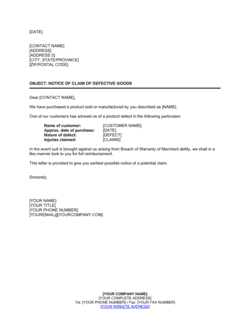
A notice of claim is a preliminary notification alerting the carrier that a claim will be filed — typically used within days of delivery to preserve rights when documentation is not yet complete. A full freight damage claim is the formal submission with complete valuation, supporting documents, and a specific dollar demand. Both serve different stages of the same process; the notice preserves the deadline while the full claim substantiates the recovery.

vs Cargo Insurance Claim Form

A cargo insurance claim is filed against your own insurance policy to recover loss beyond the carrier's liability. A freight damage claim is filed directly against the responsible carrier under federal or contractual law. Both claims often arise from the same loss event, and filing both simultaneously — within their respective deadlines — is common practice. Your insurer's subrogation clause typically requires you to file the carrier claim first.

vs Product Return and Refund Request

A product return or refund request is a commercial communication between a buyer and seller seeking a replacement or credit for a defective or unwanted product. A freight damage claim is a legal instrument directed at the carrier — a separate party from the seller — to recover for damage that occurred after the goods left the seller's control. The two documents serve entirely different parties and legal relationships.

Industry-specific considerations

Manufacturing

High-value equipment and components shipped via LTL or truckload; carrier liability limitations and declared-value elections are critical given per-pound tariff caps.

Retail and E-commerce

High volume of parcel and LTL shipments with frequent concealed damage claims; standardized claim processes reduce per-claim administrative cost significantly.

Food and Beverage

Temperature excursions and contamination during transit can render entire loads unsaleable; claims must document the condition of goods at delivery and reference temperature logs or inspection reports.

Professional Services

Law firms, insurance adjusters, and freight consultants file subrogation and third-party claims on behalf of clients; a standardized template reduces drafting time and ensures no required element is omitted.

Importing and Wholesale Distribution

International shipments governed by the Hague-Visby Rules or Warsaw Convention require claims filed within strict one-year deadlines, with survey reports and marine inspection certificates as standard supporting documents.

Construction

Structural materials, fixtures, and equipment damaged in transit can delay project timelines; claims must tie the loss to documented project costs and procurement records.

Jurisdictional notes

United States

The Carmack Amendment (49 U.S.C. § 14706) governs carrier liability for domestic surface freight. Claimants have 9 months from delivery to file a written claim and 2 years from the date of carrier denial to file suit. Carrier tariffs may impose shorter claim windows — as little as 60 days — and courts generally enforce them. Carriers may limit liability to their published per-pound rate unless the shipper declares a higher value and pays the applicable charge at the time of shipment.

Canada

Domestic freight claims in Canada are governed by the applicable provincial carriers act and the uniform bill of lading conditions, which typically require notice of visible damage at delivery and a written claim within 60 days. For interprovincial or international trucking, the Motor Carrier Act conditions may apply. Quebec has distinct civil law rules under the Civil Code governing carrier liability and claim procedures. Cargo insurer subrogation rights are similar to US practice.

United Kingdom

Road freight claims in the UK are governed by the Carriage of Goods by Road Act 1965, which incorporates the CMR Convention for international road transport. International ocean freight claims are subject to the Hague-Visby Rules as enacted by the Carriage of Goods by Sea Act 1971, with a one-year limitation period for suit. Domestic parcels and courier claims are governed by the carrier's standard conditions of carriage, which often impose tight notification windows of 3 to 7 days for visible damage.

European Union

International road freight within the EU is governed by the CMR Convention, which limits carrier liability to 8.33 Special Drawing Rights per kilogram of gross weight lost or damaged. Written notice of damage must be given at delivery for apparent damage, or within 7 days for non-apparent damage, or the presumption of sound delivery applies. Ocean freight claims follow the Hague-Visby Rules with a one-year suit limitation. GDPR considerations apply when claim correspondence contains personal data about delivery personnel or recipients.

Template vs lawyer — what fits your deal?

PathBest forCostTime
Use the templateDomestic LTL or parcel claims under $10,000 with clear documentation and a valid exception notationFree30–60 minutes
Template + legal reviewClaims between $10,000 and $50,000, concealed damage situations, or first-time international cargo claims$300–$600 for a transportation attorney review1–3 days
Custom draftedClaims exceeding $50,000, denied claims, multi-carrier or subrogation claims, or international shipments under the Hague-Visby Rules or Warsaw Convention$1,500–$5,000+1–3 weeks

Glossary

Bill of Lading (BOL)
A transport document issued by the carrier that serves as a receipt for the shipment, a contract of carriage, and — for negotiable BOLs — a document of title.
Consignee
The party named on the bill of lading as the recipient of the shipment — typically the buyer or the buyer's freight forwarder.
Carrier Liability
The legal obligation of a freight carrier to compensate for loss or damage to cargo in its care, typically capped by tariff or statute.
Tariff
A carrier's published schedule of rates, rules, and liability limitations that govern all shipments unless a higher-value declaration is made.
Declared Value
The shipper's stated value of the goods at the time of shipment, used to determine the carrier's maximum liability if a claim is filed.
Subrogation
The legal right of a cargo insurer that has paid a claim to step into the shoes of the insured and pursue recovery from the carrier responsible for the loss.
Freight Claim Filing Deadline
The contractual or statutory time limit within which a shipper or consignee must file a written damage or loss claim — typically 9 months under the Carmack Amendment for US domestic shipments.
Exception Notation
A notation written on the delivery receipt at the time of delivery that records visible damage or shortage — essential evidence to support a freight damage claim.
Pro Number
The carrier-assigned tracking number for a freight shipment, used to identify the shipment in all claim correspondence and documents.
Concealed Damage
Damage to cargo that is not apparent at delivery and is discovered only after the packaging is removed — subject to shorter filing deadlines than visible damage in most carrier tariffs.
Carmack Amendment
A US federal law (49 U.S.C. § 14706) governing carrier liability for loss or damage to household goods and freight shipped by surface carriers in interstate commerce.

Part of your Business Operating System

This document is one of 3,000+ business & legal templates included in Business in a Box.

  • Fill-in-the-blanks — ready in minutes
  • 100% customizable Word document
  • Compatible with all office suites
  • Export to PDF and share electronically

Create your document in 3 simple steps.

From template to signed document — all inside one Business Operating System.
1
Download or open template

Access over 3,000+ business and legal templates for any business task, project or initiative.

2
Edit and fill in the blanks with AI

Customize your ready-made business document template and save it in the cloud.

3
Save, Share, Send, Sign

Share your files and folders with your team. Create a space of seamless collaboration.

Save time, save money, and create top-quality documents.

★★★★★

"Fantastic value! I'm not sure how I'd do without it. It's worth its weight in gold and paid back for itself many times."

Managing Director · Mall Farm
Robert Whalley
Managing Director, Mall Farm Proprietary Limited
★★★★★

"I have been using Business in a Box for years. It has been the most useful source of templates I have encountered. I recommend it to anyone."

Business Owner · 4+ years
Dr Michael John Freestone
Business Owner
★★★★★

"It has been a life saver so many times I have lost count. Business in a Box has saved me so much time and as you know, time is money."

Owner · Upstate Web
David G. Moore Jr.
Owner, Upstate Web

Run your business with a system — not scattered tools

Stop downloading documents. Start operating with clarity. Business in a Box gives you the Business Operating System used by over 250,000 companies worldwide to structure, run, and grow their business.

Free Forever Plan · No credit card required