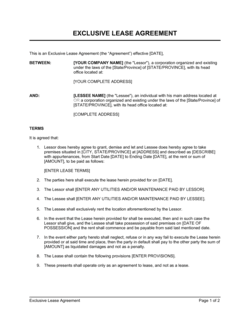
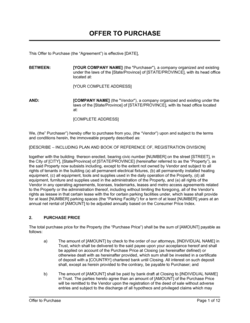
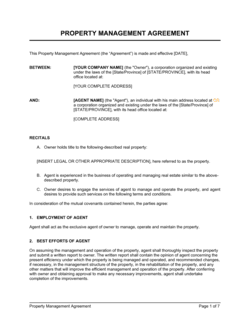
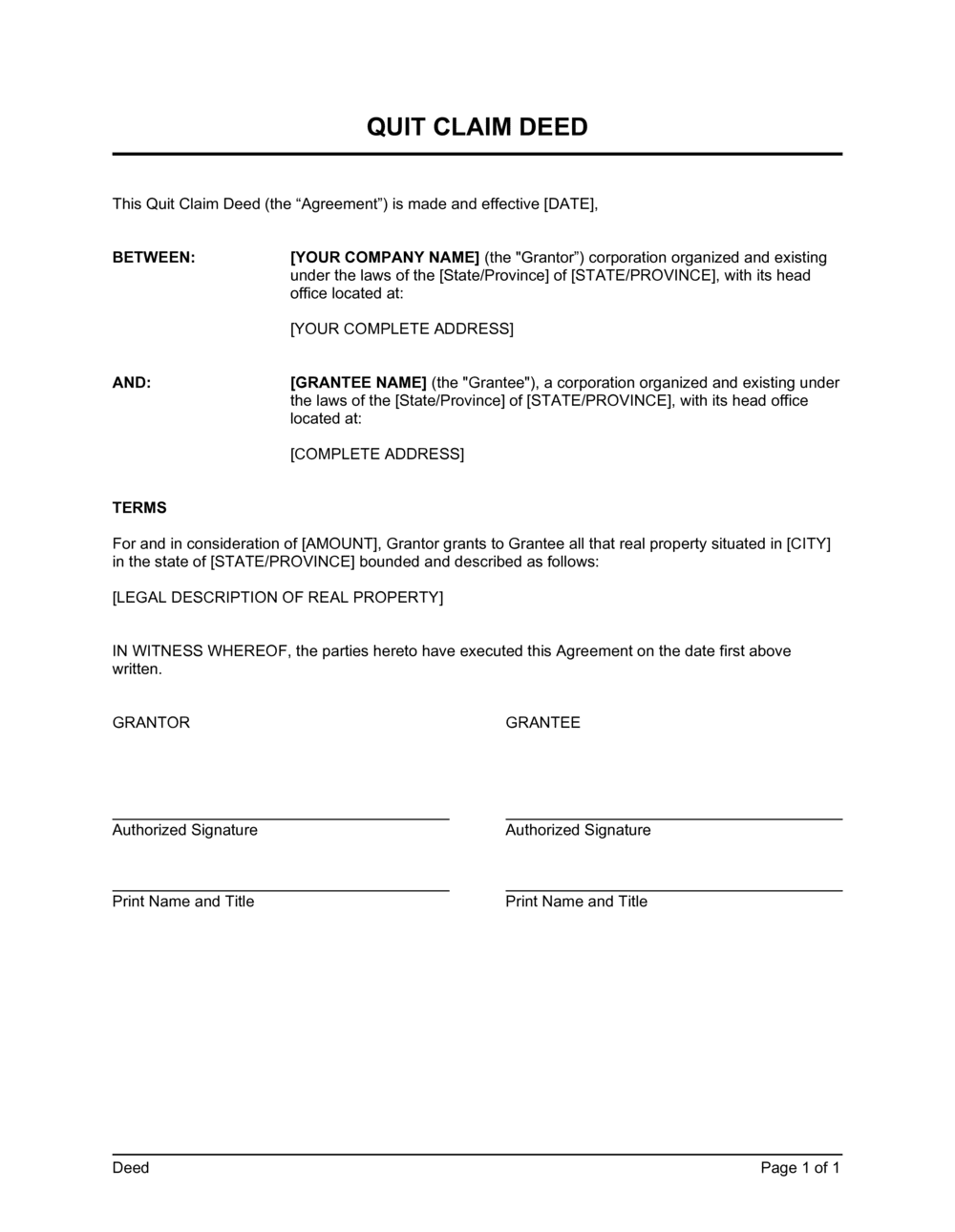
Quit Claim Deed Template

Free Word download • Edit online • Save & share with Drive • Export to PDF

1 page20–30 min to fillDifficulty: StandardSignature requiredLegal review recommended
Learn more ↓
FreeQuit Claim Deed Template

At a glance

What it is
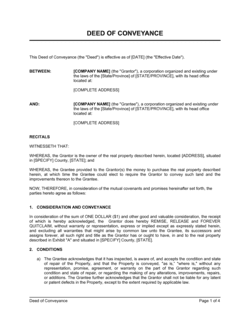
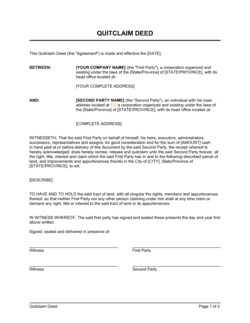
A Quit Claim Deed is a legal document used to transfer whatever interest a grantor holds in a piece of real property to a grantee — without making any warranties or guarantees about the quality or extent of that title. This free Word download gives you a professionally structured template you can edit online and export as PDF, ready for notarization and recording at your county or municipal registry.
When you need it
Use it when transferring property between family members, adding or removing a spouse or partner from a title, conveying property into or out of a trust or LLC, or resolving a cloud on title after an estate settlement. It is not appropriate when a buyer expects a clean, warranted title in an arm's-length sale.
What's inside
Grantor and grantee identification, legal property description, consideration amount, conveyance language, warranty disclaimer, grantor signature and notarization block, and recording information for the applicable county or municipality.

What is a Quit Claim Deed?

A Quit Claim Deed is a legal instrument used to transfer whatever ownership interest a grantor currently holds in a piece of real property to a grantee — without providing any warranty or guarantee about the quality, extent, or freedom from encumbrances of that title. Unlike a general warranty deed, the grantor makes no promise that the title is clear, that no liens exist, or even that they own what they are transferring. The grantee accepts whatever interest the grantor happens to hold, which may be full fee-simple ownership, a fractional share, a life estate, or nothing at all. Because of this, quit claim deeds are typically used between parties who already have a relationship of trust — family members, divorcing spouses, business partners, or an individual and their own LLC or trust — rather than in arm's-length sales to unrelated buyers.

Why You Need This Document

Without a properly executed and recorded quit claim deed, a property interest transfer has no standing in the public record — leaving both parties exposed. The grantor may continue to be liable for property taxes, HOA assessments, and mortgage obligations on property they believed they had transferred. The grantee holds no documented title and cannot sell, refinance, or insure the property. In estate and divorce contexts specifically, the absence of a recorded deed forces expensive court proceedings to establish ownership that a simple, correctly prepared deed would have resolved in days. This template gives you the professionally structured framework — with every required clause, the proper conveyance language, and the notarization and recording blocks recorders expect — so you can complete the transfer correctly the first time and protect both parties' interests in the public record.

Which variant fits your situation?

If your situation is…Use this template
Transferring property with a full guarantee of clean title to a buyerGeneral Warranty Deed
Transferring property with limited warranty covering only the grantor's period of ownershipSpecial Warranty Deed
Transferring property upon the grantor's death without going through probateTransfer on Death Deed
Conveying property into a revocable living trustDeed of Trust
Transferring property between divorcing spouses per a court settlement agreementInterspousal Transfer Deed
Correcting a minor error on a previously recorded deedCorrection Deed
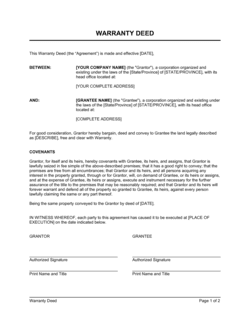
Transferring property as part of a formal real estate purchase with title insuranceWarranty Deed

Common mistakes to avoid

❌ Using a street address instead of a legal description

Why it matters: County recorders require the formal legal description from the public record — a street address does not legally identify a parcel, and the deed will be rejected or, if recorded, may be legally defective.

Fix: Obtain the current recorded deed from the county recorder or land registry and copy the legal description verbatim into the template.

❌ Only one spouse signs when both are on title

Why it matters: A grantor can only convey the interest they personally hold. If both spouses are vested on the existing deed and only one signs, the unsigned spouse retains their undivided interest — the grantee receives an incomplete title.

Fix: Pull the existing deed, confirm every vested titleholder, and ensure all of them sign the quit claim deed before notarization.

❌ Skipping lender notification on a mortgaged property

Why it matters: Most mortgage agreements include a due-on-sale clause that entitles the lender to demand full repayment if the property is transferred without consent — even into an LLC or family trust.

Fix: Contact the lender in writing before recording the deed and obtain written confirmation that the transfer will not trigger the due-on-sale clause.

❌ Relying on a quit claim deed where a warranty deed is required

Why it matters: A quit claim deed conveys no warranty of title. In an arm's-length purchase, the buyer receives no protection against undiscovered liens, competing claims, or prior transfers — and no title insurer will issue a standard owner's policy based solely on a quit claim.

Fix: Use a general warranty deed or special warranty deed for any property sale where the buyer is paying fair market value and expects insurable title.

❌ Failing to record the deed promptly after signing

Why it matters: An unrecorded deed is valid between the parties but does not protect the grantee against subsequent bona fide purchasers or judgment creditors who record first — in most jurisdictions, priority goes to whoever records first.

Fix: Record the notarized deed at the county recorder's office within a few days of signing, and retain the recorded copy with the document number stamped by the recorder.

❌ Nominating a nominal consideration without checking transfer tax rules

Why it matters: Using $1 or $10 as consideration does not exempt the transfer from documentary transfer tax in many states and counties — some jurisdictions assess tax on fair market value regardless of stated consideration, and underpayment triggers penalties and interest.

Fix: Research your state and county's transfer tax rules — or ask a local title company — before completing the consideration field, and file any required transfer tax affidavit at recording.

The 10 key clauses, explained

Grantor identification

In plain language: Names the current titleholder — individual, couple, or entity — and their legal address, establishing who is transferring the interest.

Sample language
[GRANTOR FULL LEGAL NAME], a [single person / married person / LLC], residing at [GRANTOR ADDRESS], City of [CITY], State of [STATE] ('Grantor'),

Common mistake: Using an informal name or nickname instead of the grantor's exact legal name as it appears on the existing recorded deed — a mismatch causes the recorder to reject the document.

Grantee identification

In plain language: Names the recipient of the property interest and their address, establishing who takes title and in what capacity.

Sample language
does hereby quit claim to [GRANTEE FULL LEGAL NAME], [a single person / husband and wife / [LLC NAME], a [STATE] limited liability company], whose address is [GRANTEE ADDRESS] ('Grantee'),

Common mistake: Failing to specify the vesting — how the grantee holds title (sole owner, joint tenants, tenants in common, community property) — which creates ambiguity about survivorship rights and share allocations.

Consideration

In plain language: States the value paid for the transfer. In family or intra-entity transfers, this is typically nominal; in arm's-length transactions it reflects fair market value.

Sample language
for and in consideration of the sum of [TEN DOLLARS ($10.00)] and other good and valuable consideration, the receipt and sufficiency of which are hereby acknowledged,

Common mistake: Using $0 as consideration in a jurisdiction that calculates transfer tax on consideration — some states impose a minimum tax or treat a $0 consideration deed as a gift subject to IRS gift-tax reporting requirements.

Conveyance language

In plain language: The operative words that legally effect the transfer — typically 'remise, release, and forever quit claim' — conveying whatever interest the grantor holds without any representation of its quality.

Sample language
the Grantor does hereby remise, release, and forever quit claim unto the Grantee, all right, title, interest, claim, and demand which the Grantor has in and to the following described real property:

Common mistake: Substituting warranty deed language ('grant and convey with warranty') for quit claim language. Using warranty phrasing in a document intended as a quit claim can inadvertently create a warranty obligation the grantor did not intend.

Legal description of the property

In plain language: The precise legal description of the property being transferred — drawn from the existing recorded deed, survey, or county assessor records — not a street address alone.

Sample language
Lot [LOT NUMBER], Block [BLOCK NUMBER], [SUBDIVISION NAME], according to the plat thereof recorded in Plat Book [X], Page [X], of the Public Records of [COUNTY] County, [STATE]. Also known as: [STREET ADDRESS] (for reference only).

Common mistake: Copying the street address from a tax bill instead of pulling the formal legal description from the existing recorded deed. An address is not a legal description and will cause the recorder to reject the instrument.

Parcel identification number (APN / PIN)

In plain language: The assessor's parcel number or property identification number assigned by the county or municipality, used to cross-reference the property in tax and recording databases.

Sample language
Assessor's Parcel Number (APN): [APN / PIN NUMBER]

Common mistake: Omitting the APN entirely. Most county recorders require it, and missing it is one of the most common causes of deed rejection at the recording counter.

Warranty disclaimer

In plain language: Explicitly states that the grantor makes no warranties about the condition of title — no promise that it is clear, unencumbered, or that the grantor actually owns what they are transferring.

Sample language
This conveyance is made without any covenant or warranty of title, express or implied. The Grantor conveys only such interest, if any, as the Grantor currently holds.

Common mistake: Leaving the warranty disclaimer out of the document entirely — creating an ambiguity that could allow the grantee to argue implied warranty of title in some jurisdictions.

Grantor signature block

In plain language: The line on which the grantor signs, with printed name below and the date of signing — must match the grantor's name exactly as stated in the body of the deed.

Sample language
IN WITNESS WHEREOF, the Grantor has executed this Quit Claim Deed as of [DATE]. ___________________________ [GRANTOR FULL LEGAL NAME] Date: [DATE]

Common mistake: Having only one spouse sign when both are vested on the existing title. Both titleholders must sign to convey the complete interest — an unsigned titleholder retains their share.

Notarization block

In plain language: The notary public's certification that the grantor appeared before them, presented valid identification, and signed voluntarily — required for recording in virtually every jurisdiction.

Sample language
State of [STATE], County of [COUNTY]. On [DATE], before me, [NOTARY NAME], a Notary Public, personally appeared [GRANTOR NAME], known to me (or proved to me on the basis of satisfactory evidence) to be the person whose name is subscribed to the within instrument... [NOTARY SEAL & SIGNATURE]

Common mistake: Having the deed notarized by a notary who was not physically present when the grantor signed. Remote online notarization (RON) is now permitted in many US states, but the specific RON requirements vary and must be followed precisely.

Recording information block

In plain language: Space for the county recorder's stamp, document number, and date of recording — completed by the recorder's office upon filing, but the return-to address must be filled in by the preparer.

Sample language
After recording, return to: [GRANTEE NAME OR ATTORNEY NAME] [RETURN ADDRESS] [CITY, STATE, ZIP]

Common mistake: Leaving the return-to address blank. The recorder's office will not know where to mail the original recorded deed after processing, and the grantee may never receive confirmation of recording.

How to fill it out

  1. 1

    Pull the existing recorded deed

    Obtain a certified copy of the current recorded deed from the county recorder's office or land registry. Copy the grantor's legal name, existing legal description, and APN exactly as they appear.

    💡 Do not rely on a tax bill or mortgage statement for the legal description — these often use abbreviated or informal descriptions that recorders reject.

  2. 2

    Identify and enter grantor and grantee information

    Enter the grantor's full legal name as it appears on the existing deed. Enter the grantee's full legal name exactly as they want to appear on title, along with their mailing address.

    💡 For LLCs or trusts receiving title, include the full entity name, state of formation, and entity type — e.g., '[NAME], a California limited liability company.'

  3. 3

    Choose vesting for the grantee

    Decide how the grantee will hold title: sole and separate property, joint tenancy with right of survivorship, tenants in common with specified shares, or community property. State this explicitly after the grantee's name.

    💡 Joint tenancy and tenants in common have very different inheritance consequences — confirm the intended outcome with an estate planning attorney before completing this field.

  4. 4

    Enter the consideration amount

    State the consideration — typically $10 or $1 for family transfers, or fair market value for commercial transfers. Check your state's transfer tax rules to avoid underpayment penalties.

    💡 Some states, including California and New York, calculate documentary transfer tax on the full fair market value even when consideration is nominal — confirm the applicable rate with a local title professional.

  5. 5

    Paste the full legal description

    Copy the complete legal description verbatim from the existing recorded deed into the property description field. Add the street address labeled 'for reference only' beneath it.

    💡 Even a single missing word in a metes-and-bounds description can render the deed legally defective — copy it character by character.

  6. 6

    Have the grantor sign before a notary

    All parties vested on the current title must sign in the presence of a licensed notary public. The notary verifies identity, witnesses the signature, and completes the notarial certificate with their seal.

    💡 Check whether your state permits remote online notarization — if so, confirm the platform you use meets your state's specific RON requirements for real property deeds.

  7. 7

    Record the deed with the county recorder

    Submit the original notarized deed to the county recorder's or registrar's office in the county where the property is located, along with the required recording fee and any transfer tax forms.

    💡 Call the recorder's office before submitting to confirm current fees, page-count requirements, and whether they accept e-recording — many counties now do.

  8. 8

    Update title insurance and notify your lender

    If the property carries a mortgage, notify the lender before recording — some loan agreements contain due-on-sale clauses triggered by a title transfer. Contact your title insurer to discuss whether an endorsement or new policy is needed.

    💡 Transferring mortgaged property into an LLC without lender consent can accelerate the loan — confirm in writing that the lender approves the transfer before recording.

Frequently asked questions

What is a quit claim deed?

A quit claim deed is a legal instrument that transfers whatever ownership interest the grantor currently holds in a piece of real property to a grantee, without making any warranty or guarantee about the title's quality, completeness, or freedom from liens. It conveys exactly what the grantor has — which may be full ownership, a partial interest, or nothing at all. Because it offers no title protection, it is most commonly used between parties who already trust each other: family members, divorcing spouses, or business partners restructuring entity ownership.

What is the difference between a quit claim deed and a warranty deed?

A warranty deed includes the grantor's formal promise that the title is clear, that no undisclosed liens or encumbrances exist, and that the grantor will defend the grantee against any future claims. A quit claim deed makes none of those promises — it simply passes whatever interest the grantor holds. For arm's-length real estate purchases where the buyer is paying fair market value, a warranty deed is required. A quit claim deed is appropriate only for transfers where the grantee accepts the title as-is and is not relying on any warranty.

When should I use a quit claim deed?

Common situations include adding or removing a spouse or partner from a title after marriage, separation, or divorce; transferring property into a revocable living trust or LLC for estate planning or asset protection; conveying real property from a deceased person's estate to heirs after probate; clearing a technical cloud on title caused by a prior recording error; and gifting property to a family member. It is not appropriate for sales to unrelated buyers who expect clean, insurable title.

Does a quit claim deed need to be notarized?

Yes, in virtually every US state and Canadian province, a deed must be signed in the presence of a licensed notary public and bear the notary's seal and certificate before it can be recorded. Some states also require one or two witnesses in addition to the notary. Recording is what makes the transfer part of the public record and protects the grantee against competing claims — an unnotarized deed typically cannot be recorded.

Does a quit claim deed transfer a mortgage?

No. A quit claim deed transfers title interest only — it does not affect the underlying mortgage obligation. The original borrower remains legally responsible for the loan unless the lender formally agrees to a loan assumption or refinance. Additionally, most mortgage agreements include a due-on-sale clause that allows the lender to demand full repayment if the property is transferred. Always notify and obtain written consent from the lender before recording a quit claim deed on a mortgaged property.

Can a quit claim deed be reversed or challenged?

A properly executed and recorded quit claim deed is generally difficult to reverse. It can be challenged if the grantor lacked legal capacity (e.g., was a minor or legally incapacitated), signed under duress or fraud, or if the document contained a material legal defect such as a missing or incorrect legal description. To correct errors, a new deed — often called a correction deed or deed of correction — is recorded. Reversing a valid transfer typically requires a court order or a new quit claim deed from the grantee back to the grantor.

Are there tax consequences to recording a quit claim deed?

Yes, potentially several. First, most states and counties impose a documentary transfer tax, which may be calculated on the stated consideration or on fair market value regardless of what was paid. Second, transferring property as a gift triggers IRS gift-tax reporting if the fair market value exceeds the annual exclusion ($18,000 per recipient in 2024). Third, if the property has appreciated, the grantee inherits the grantor's cost basis in a gift transfer — potentially creating a larger capital gains tax liability on a future sale. Consult a tax professional before completing the deed in any situation involving significant property value.

How long does it take to record a quit claim deed?

Recording time varies by county. Many recorder's offices process walk-in or mail submissions within 1–5 business days and return the original stamped deed within 2–4 weeks by mail. Counties offering e-recording typically process submissions within 24–48 hours. The legal transfer is effective on the date the deed is accepted for recording, not the date the grantor signed — so submitting promptly protects the grantee's priority in the public record.

Do I need a lawyer to prepare a quit claim deed?

For straightforward family transfers in a jurisdiction with clear requirements, a professionally drafted template is often sufficient. Legal counsel is strongly recommended when the property carries a mortgage, the transfer has tax implications above the annual gift exclusion, the parties are involved in a divorce proceeding where the deed is part of a settlement, or the property is in a state with complex deed-recording requirements such as New York or Florida. A real estate attorney typically charges $200–$600 to prepare and review a quit claim deed.

What happens if a quit claim deed is never recorded?

An unrecorded quit claim deed is still valid between the grantor and grantee — the transfer technically occurs at the moment of signing and delivery. However, under the recording acts of most US states, an unrecorded deed does not protect the grantee against a subsequent purchaser or creditor who records first without notice of the prior transfer. Failing to record promptly creates real risk that a third party could obtain superior title simply by recording before you do.

How this compares to alternatives

vs General Warranty Deed

A general warranty deed includes the grantor's binding guarantee that title is clear and unencumbered, and that the grantor will defend the grantee against any future claims — even those arising before the grantor's ownership. It is the standard instrument for arm's-length property sales. A quit claim deed makes no such warranty and is unsuitable where the buyer requires insurable title.

vs Special Warranty Deed

A special warranty deed provides a limited warranty covering only defects that arose during the grantor's period of ownership — not prior in the chain of title. It is commonly used in commercial transactions and foreclosure sales. A quit claim deed provides no warranty at all, making it appropriate only for transfers between parties who trust each other or where the grantee explicitly waives any title guarantee.

vs Transfer on Death Deed

A transfer on death deed (TODD) conveys property to a named beneficiary automatically upon the grantor's death, bypassing probate, while the grantor retains full ownership and control during their lifetime. A quit claim deed transfers the interest immediately upon execution and recording. Use a TODD for estate planning; use a quit claim deed for a present, immediate transfer.

vs Deed of Trust

A deed of trust is a lending instrument used as security for a mortgage loan, conveying title to a neutral trustee until the loan is repaid — not a voluntary property transfer between owners. A quit claim deed transfers the grantor's ownership interest to the grantee outright. The two documents serve entirely different functions and should never be substituted for each other.

Industry-specific considerations

Real estate investment

Investors regularly use quit claim deeds to transfer rental properties and fix-and-flip assets from personal ownership into LLCs, reducing personal liability exposure without triggering a formal sale.

Estate planning and probate

Estate attorneys use quit claim deeds to convey real property from a decedent's estate or probate proceeding directly to named heirs, or to fund assets into revocable living trusts before or after death.

Family law and divorce

Divorce proceedings frequently require a quit claim deed to transfer one spouse's interest to the other pursuant to a marital settlement agreement — the deed implements the court's property division order.

Small business and LLC formation

Business owners transferring commercially held real property between entities — from a sole proprietorship or partnership into an LLC — use quit claim deeds to update title without a formal sale transaction.

Jurisdictional notes

United States

Quit claim deed requirements vary significantly by state. Most states require notarization and recording with the county recorder; some (including Florida and Georgia) also require one or two witnesses. California imposes a documentary transfer tax calculated on fair market value, not stated consideration, and requires a Preliminary Change of Ownership Report (PCOR) at recording. New York requires a TP-584 transfer tax form and, in New York City, an RPTT filing. Always check your specific state and county requirements before submitting.

Canada

Canada does not use the term 'quit claim deed' — the equivalent instrument is a Transfer of Land (or Deed of Land in some provinces), filed with the provincial land registry. In Ontario, transfers are registered electronically through the Teraview system by a licensed solicitor. British Columbia uses a Property Transfer Form submitted to the Land Title Office. Land transfer tax applies in most provinces, and the transfer must comply with each province's Land Titles Act or Registry Act.

United Kingdom

England and Wales do not use quit claim deeds. Property is transferred using a Transfer of Whole (TR1) or Transfer of Part (TP1) form registered with HM Land Registry. Stamp Duty Land Tax (SDLT) may apply in England and Northern Ireland; Land Transaction Tax applies in Wales; Land and Buildings Transaction Tax applies in Scotland. Scotland uses a Disposition rather than a TR1. Legal conveyancing in the UK is typically handled by a solicitor or licensed conveyancer.

European Union

EU member states have highly varied real property transfer systems, and the concept of a quit claim deed has no direct equivalent. Most countries require notarial authentication by a public notary (notaire in France, Notar in Germany) and registration with the relevant land register (cadastre, Grundbuch). Transfer taxes, notary fees, and registration fees vary widely — for example, French notary fees and taxes can total 7–8% of property value. Cross-border EU property transfers should always involve local legal counsel in the property's jurisdiction.

Template vs lawyer — what fits your deal?

PathBest forCostTime
Use the templateStraightforward intra-family transfers or LLC conveyances on unencumbered property in a state with standard recording requirementsFree30–60 minutes to prepare; 1–5 days to record
Template + legal reviewTransfers involving gift-tax exposure, mortgaged property, or states with complex deed requirements such as New York, Florida, or Texas$200–$600 for a real estate attorney review2–5 business days
Custom draftedDivorce settlements, contested estate transfers, commercial property with multiple vested parties, or cross-border real property holdings$600–$2,000+1–2 weeks

Glossary

Grantor
The current titleholder who is transferring their interest in the property to another party.
Grantee
The person or entity receiving the property interest conveyed by the grantor.
Conveyance
The legal transfer of an ownership interest in real property from one party to another by deed or other written instrument.
Legal Description
A precise, formally recorded description of a property's boundaries using lot and block numbers, metes and bounds, or a government survey — not a street address.
Consideration
The value exchanged for the property transfer — often a nominal amount such as $1 or $10 in intra-family transfers, or fair market value in commercial transactions.
Cloud on Title
Any claim, lien, or encumbrance appearing in the public record that questions the clarity of ownership and can prevent a clean sale or refinancing.
Notarization
The process by which a licensed notary public verifies the identity of the signer and witnesses their signature, required for deed recording in virtually all US states and Canadian provinces.
Recording
The act of filing a signed and notarized deed with the appropriate county recorder, land registry, or municipal office to make the transfer part of the public record.
Title Insurance
A policy that protects a property owner or lender against losses arising from undiscovered defects or competing claims in the chain of title — not issued based solely on a quit claim deed.
Warranty of Title
A guarantee by the grantor that they hold valid, unencumbered title and will defend the grantee against any future claims — deliberately absent in a quit claim deed.
Chain of Title
The chronological sequence of documented ownership transfers for a property, traceable through recorded deeds in the public record.
Tenancy in Common
A form of co-ownership where two or more parties hold distinct, transferable shares of a property without the right of survivorship.

Part of your Business Operating System

This document is one of 3,000+ business & legal templates included in Business in a Box.

  • Fill-in-the-blanks — ready in minutes
  • 100% customizable Word document
  • Compatible with all office suites
  • Export to PDF and share electronically

Create your document in 3 simple steps.

From template to signed document — all inside one Business Operating System.
1
Download or open template

Access over 3,000+ business and legal templates for any business task, project or initiative.

2
Edit and fill in the blanks with AI

Customize your ready-made business document template and save it in the cloud.

3
Save, Share, Send, Sign

Share your files and folders with your team. Create a space of seamless collaboration.

Save time, save money, and create top-quality documents.

★★★★★

"Fantastic value! I'm not sure how I'd do without it. It's worth its weight in gold and paid back for itself many times."

Managing Director · Mall Farm
Robert Whalley
Managing Director, Mall Farm Proprietary Limited
★★★★★

"I have been using Business in a Box for years. It has been the most useful source of templates I have encountered. I recommend it to anyone."

Business Owner · 4+ years
Dr Michael John Freestone
Business Owner
★★★★★

"It has been a life saver so many times I have lost count. Business in a Box has saved me so much time and as you know, time is money."

Owner · Upstate Web
David G. Moore Jr.
Owner, Upstate Web

Run your business with a system — not scattered tools

Stop downloading documents. Start operating with clarity. Business in a Box gives you the Business Operating System used by over 250,000 companies worldwide to structure, run, and grow their business.

Start free · No credit card required