Notice of Claim of Mechanics Lien Template

Free Word download β€’ Edit online β€’ Save & share with Drive β€’ Export to PDF

1 pageβ€’15–20 min to fillβ€’Difficulty: Standard
Learn more ↓
FreeNotice of Claim of Mechanics Lien Template

At a glance

What it is
A Notice of Claim of Mechanics Lien is a formal written notice that a contractor, subcontractor, or supplier files β€” and typically serves on the property owner β€” to assert a legal claim against a property for unpaid labor, materials, or services delivered to a construction project. This free Word download gives you a ready-to-edit template you can complete in minutes and export as PDF for filing or delivery.
When you need it
Use it when a property owner, general contractor, or developer has failed to pay for work or materials you provided on a construction project and you need to formally protect your right to payment before the statutory filing deadline expires.
What's inside
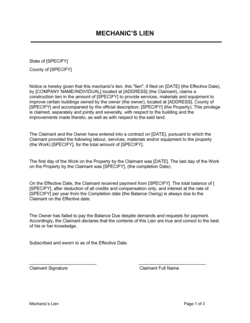
Claimant and property owner identification, property legal description, itemized statement of the amount owed, description of labor and materials furnished, dates of work, and a formal demand for payment β€” all structured to meet the information requirements common across most jurisdictions.

What is a Notice of Claim of Mechanics Lien?

A Notice of Claim of Mechanics Lien is a formal written notice that a contractor, subcontractor, or material supplier serves on a property owner β€” and in many jurisdictions files with the county recorder's office β€” to assert a legal claim against real property for unpaid labor, materials, or services furnished to improve that property. Unlike a standard collection letter, this notice creates or preserves a statutory security interest that encumbers the property's title, making it impossible for the owner to sell or refinance without first resolving the outstanding payment dispute. The notice identifies the claimant, describes the work performed, states the exact amount owed, and formally demands payment within a defined period.

Why You Need This Document

When a property owner or general contractor withholds payment, an unpaid contractor or supplier has two assets at risk: the money owed and the window of time to collect it. Mechanics lien laws impose hard filing deadlines β€” typically 60 to 90 days from the last date of work β€” and a missed deadline extinguishes lien rights permanently, regardless of how legitimate the underlying claim is. Without a formally served and filed notice, an unpaid party has no security interest in the property and must pursue payment through ordinary civil litigation, which is slower, more expensive, and offers no guarantee of recovery if the owner has other creditors. Serving a Notice of Claim of Mechanics Lien puts the owner and any lender or prospective buyer on immediate notice that the title is encumbered, creating powerful incentive to resolve the dispute quickly. This template gives contractors, subcontractors, and suppliers the correctly structured document they need to assert those rights before the clock runs out.

Which variant fits your situation?

If your situation is…Use this template
Notifying a property owner before filing the formal lienPreliminary Notice / Pre-Lien Notice
Filing the official lien with the county recorder after notice is servedMechanics Lien (Filed Document)
Demanding payment as a final step before filing a lienDemand Letter for Payment
Releasing a lien after payment has been receivedMechanics Lien Release
Notifying a surety bond company of a payment claimNotice of Bond Claim
Documenting unpaid invoices leading up to a lien filingPast Due Invoice Notice
Escalating a lien claim to a formal legal disputeConstruction Dispute Notice

Common mistakes to avoid

❌ Missing the statutory filing deadline

Why it matters: Every jurisdiction imposes a hard deadline β€” typically 60 to 90 days from the last date of work. A lien filed even one day late is unenforceable and cannot be revived.

Fix: Calculate the deadline the moment a payment dispute arises, not when it escalates. Calendar the date and serve the notice with at least two weeks to spare.
❌ Using a trade name instead of the registered legal entity

Why it matters: A lien filed under a DBA or informal name instead of the registered corporate or LLC name can be challenged and dismissed, voiding the claimant's security interest.

Fix: Use the exact legal name as it appears on your corporate registration or state filing. If you operate under a DBA, list both: '[DBA] d/b/a [LEGAL NAME]'.

❌ Omitting or incorrectly stating the legal property description

Why it matters: A lien must attach to a specific, identifiable parcel. An address alone is insufficient in most jurisdictions, and a wrong legal description means the lien encumbers the wrong property.

Fix: Pull the legal description verbatim from the county recorder's database or the property deed before completing the notice.

❌ Overclaiming the amount owed

Why it matters: Including disputed, unapproved, or inflated amounts in the lien claim exposes the claimant to willful exaggeration penalties in states that impose them, and undermines credibility in any subsequent litigation.

Fix: Claim only the net unpaid balance for work and materials actually furnished and agreed upon. File a separate claim or change order dispute for contested amounts.

The 8 key clauses, explained

Header and date

In plain language: Identifies the document as a formal legal notice, states the date of service, and establishes the record of when the notice was delivered.

Sample language
NOTICE OF CLAIM OF MECHANICS LIEN Date: [DATE] Sent Via: [CERTIFIED MAIL / PERSONAL DELIVERY]

Common mistake: Using the wrong date β€” entering the date work was completed rather than the date the notice is being served, which creates confusion about lien period compliance.

Claimant identification

In plain language: States the full legal name, address, and role of the party asserting the lien β€” whether a contractor, subcontractor, or supplier.

Sample language
Claimant: [CLAIMANT FULL LEGAL NAME], a [STATE] [ENTITY TYPE], located at [ADDRESS] ('Claimant').

Common mistake: Using a trade name or DBA instead of the registered legal entity name, which can invalidate the lien if the filing name does not match public records.

Property owner and recipient identification

In plain language: Names the property owner and any other required recipients β€” such as the general contractor or lender β€” to whom the notice is directed.

Sample language
To: [PROPERTY OWNER FULL NAME], [ADDRESS]. cc: [GENERAL CONTRACTOR NAME], [ADDRESS].

Common mistake: Omitting the general contractor as a recipient when required by the applicable jurisdiction, which can void the claimant's lien rights entirely.

Property description

In plain language: Identifies the property subject to the lien using the legal description from the county recorder's records β€” not just the street address.

Sample language
The property subject to this lien claim is legally described as: [LEGAL DESCRIPTION], commonly known as [PROPERTY STREET ADDRESS], [CITY], [STATE] [ZIP].

Common mistake: Providing only the street address without the legal description. In most jurisdictions, a lien without a valid legal description is unenforceable.

Description of labor and materials furnished

In plain language: Summarizes the type of work performed or materials supplied, the dates services were rendered, and the contractor or owner the claimant contracted with.

Sample language
Claimant furnished [DESCRIPTION OF LABOR / MATERIALS] to the above-described property between [START DATE] and [END DATE] under contract with [CONTRACTING PARTY NAME].

Common mistake: Using a vague description like 'construction services' without specifying the type of work or materials β€” courts have dismissed liens for failure to adequately identify the improvement.

Amount claimed

In plain language: States the exact dollar amount owed for unpaid labor, materials, or services β€” the figure that the lien secures against the property.

Sample language
The amount claimed as unpaid and due is $[AMOUNT], which represents the balance owed for the above-described labor and materials after all credits and offsets.

Common mistake: Inflating the claimed amount to include disputed or unearned items. Overclaiming can expose the claimant to penalties for willful exaggeration in states that impose them.

Formal demand for payment

In plain language: Notifies the property owner that unless payment is received within a defined period, the claimant intends to enforce the lien through foreclosure or other legal remedies.

Sample language
Demand is hereby made for payment of the sum of $[AMOUNT] within [NUMBER] days of this notice. Failure to remit payment may result in enforcement of this lien through foreclosure proceedings.

Common mistake: Setting an unrealistically short payment deadline β€” fewer than 10 days β€” which can undermine good-faith negotiations and reduce the likelihood of voluntary payment.

Signature and claimant attestation

In plain language: Closes the notice with the claimant's or authorized representative's signature, title, and contact information, affirming the accuracy of the claim.

Sample language
I, [SIGNATORY NAME], [TITLE] of [CLAIMANT ENTITY], declare under penalty of perjury that the foregoing is true and correct to the best of my knowledge. Signature: ________________________ Date: [DATE]

Common mistake: Having an unauthorized employee sign the notice. The signatory should be a principal, officer, or expressly authorized agent β€” an unauthorized signature can be challenged during enforcement.

How to fill it out

  1. 1

    Confirm you are within the statutory filing deadline

    Mechanics lien deadlines are strict and vary by state β€” typically 60 to 90 days from the last date labor or materials were furnished. Verify your jurisdiction's deadline before completing the form, as a late filing is unenforceable regardless of how well the notice is drafted.

    πŸ’‘ Check your state's lien law using the property's location β€” not the claimant's home state β€” since lien rights are governed by where the property sits.

  2. 2

    Enter claimant and property owner details

    Fill in the claimant's full registered legal name and address, and the property owner's full name and address as it appears in county property records. Include the general contractor's information if your jurisdiction requires them as a recipient.

    πŸ’‘ Pull the property owner's name and address directly from the county assessor's or recorder's website to avoid discrepancies with recorded documents.

  3. 3

    Insert the legal property description

    Locate the legal description of the property from the county recorder's records β€” typically a lot and block number or metes-and-bounds description. Copy it verbatim into the property description field.

    πŸ’‘ The legal description appears on the deed or title report. If you don't have these, most county recorder websites offer a free parcel search by street address.

  4. 4

    Describe the labor and materials furnished

    Write a specific, plain-English summary of the work performed or materials supplied, the start and end dates, and the name of the party you contracted with directly (owner or GC).

    πŸ’‘ Be specific enough to identify the improvement β€” 'framing labor for second-floor addition' rather than 'construction work' β€” without turning this section into a line-item invoice.

  5. 5

    State the exact amount owed

    Enter the net unpaid balance β€” total contracted amount minus any payments already received. Do not include disputed extras or change orders that have not been agreed in writing unless you are prepared to support them.

    πŸ’‘ Attach a copy of your unpaid invoice or payment ledger as an exhibit to support the claimed amount if challenged.

  6. 6

    Set a reasonable payment deadline and sign

    State a payment demand period of 10 to 30 days, then have the authorized signatory β€” a principal or officer β€” sign and date the notice.

    πŸ’‘ Sign in blue ink if delivering a paper original β€” it visually distinguishes the original from copies during any court proceeding.

  7. 7

    Serve and file the notice correctly

    Send the notice via certified mail with return receipt requested to all required recipients, and file a copy with the county recorder's office if your jurisdiction requires it. Retain proof of service and file receipt in your project records.

    πŸ’‘ Some states require service by certified mail AND personal delivery for the notice to be valid β€” check your state's mechanics lien statute before choosing a delivery method.

Frequently asked questions

What is a Notice of Claim of Mechanics Lien?

A Notice of Claim of Mechanics Lien is a formal written notice served on a property owner β€” and in many jurisdictions filed with the county recorder β€” asserting a legal claim against real property for unpaid labor, materials, or services furnished to improve that property. It is a prerequisite to enforcing a mechanics lien in most states and puts the owner and any prospective buyer or lender on notice that a payment dispute exists.

Who can file a mechanics lien notice?

Any party who furnishes labor, materials, equipment, or professional services that improve real property typically has lien rights β€” including general contractors, subcontractors at every tier, material suppliers, equipment lessors, architects, engineers, and surveyors. Eligibility rules and preliminary notice requirements vary by jurisdiction, so confirm your state's specific lien statutes before filing.

How long do I have to file a mechanics lien after completing work?

Deadlines vary by state β€” typically 60 to 90 days from the last date labor or materials were furnished, though some states allow up to 180 days. The clock generally runs from the last date of work, not the invoice date or the date payment became overdue. Missing this deadline extinguishes lien rights entirely, with no exception or extension available in most states.

Does filing a mechanics lien notice guarantee I will get paid?

A mechanics lien notice secures your claim against the property and creates significant pressure on the owner, since the lien clouds the title and can prevent refinancing or sale until resolved. It does not automatically result in payment β€” if the owner still refuses to pay, you must enforce the lien through a foreclosure action within a second statutory deadline, which varies by state and is typically 90 days to one year from filing.

What is the difference between a preliminary notice and a mechanics lien notice?

A preliminary notice β€” sometimes called a pre-lien notice or Notice to Owner β€” is served early in the project, often within the first 20 days of furnishing labor or materials, to preserve the right to file a lien later. A Notice of Claim of Mechanics Lien is the actual lien claim served and filed after payment becomes overdue. Many states require the preliminary notice as a prerequisite to a valid lien; skipping it voids lien rights even if the work is undeniably unpaid.

Can a property owner dispute a mechanics lien claim?

Yes. A property owner can challenge a mechanics lien by filing a bond to release the lien, disputing the validity or amount of the claim in court, or demonstrating that statutory requirements β€” such as preliminary notice or filing deadline β€” were not met. In states with willful exaggeration statutes, owners can also seek penalties if the claimed amount is materially inflated without basis.

Do I need a lawyer to file a mechanics lien notice?

For straightforward claims involving clearly documented unpaid invoices on residential or small commercial projects, a well-prepared template is typically sufficient to serve the notice. Engaging a construction attorney is advisable when the claim exceeds $50,000, when the owner has disputed the work itself rather than just the payment, when preliminary notice requirements are complex, or when you anticipate a foreclosure action to enforce the lien.

What happens to the lien if I get paid after filing?

Once payment is received in full, you are obligated in most jurisdictions to file a lien release or satisfaction with the county recorder within a defined period β€” typically 10 to 30 days of receiving payment. Failing to release a lien after payment exposes the claimant to damages and penalties in most states. Use a Mechanics Lien Release template to formally discharge the claim from the public record.

How this compares to alternatives

vs Demand Letter for Payment

A demand letter requests payment as a pre-litigation step and carries no automatic security interest against the property. A Notice of Claim of Mechanics Lien formally encumbers the property title, making it a far stronger enforcement tool. Use a demand letter first; escalate to a mechanics lien notice if payment is not received within the stated deadline.

vs Preliminary Notice (Pre-Lien Notice)

A preliminary notice is served early in a project β€” often within the first 20 days of furnishing work β€” to preserve future lien rights. A Notice of Claim of Mechanics Lien is filed after payment becomes overdue to assert those rights. The preliminary notice is a prerequisite in many states; without it, the lien notice has no legal effect.

vs Construction Contract

A construction contract establishes the parties' obligations before work begins, including payment terms and dispute resolution procedures. A mechanics lien notice is a remedy used after those payment obligations are breached. A strong contract with clear milestones and payment schedules reduces the likelihood of ever needing a lien notice.

vs Mechanics Lien Release

A mechanics lien release is the document filed after payment is received to formally remove the lien from the property's title. A Notice of Claim of Mechanics Lien creates the encumbrance; the release extinguishes it. Failing to file a release promptly after payment is received exposes the claimant to penalties in most jurisdictions.

Industry-specific considerations

Residential Construction

Subcontractors and suppliers on single-family and multi-family builds frequently use mechanics lien notices when homeowners withhold final payment or GCs fail to distribute retainage.

Commercial Real Estate Development

On large commercial projects with multiple subcontractor tiers, lien notices are a standard cash-flow protection tool, with many states requiring preliminary notice to preserve rights on privately funded projects.

Specialty Trades

Electrical, plumbing, HVAC, and roofing contractors rely on mechanics lien notices as a primary collection tool given high material costs and long billing cycles common in trade work.

Building Material Supply

Lumber yards, concrete suppliers, and equipment rental companies use lien notices to secure payment for materials delivered to job sites where they have no direct contract with the property owner.

Template vs pro β€” what fits your needs?

PathBest forCostTime
Use the templateContractors and suppliers with clear, documented unpaid invoices on straightforward residential or small commercial projectsFree15–30 minutes to complete and serve
Template + professional reviewClaims above $25,000, projects with complex preliminary notice requirements, or multi-tier subcontractor disputes$150–$400 for a construction attorney review1–2 days
Custom draftedLarge commercial lien claims, anticipated foreclosure actions, or jurisdictions with highly technical filing requirements$500–$2,000+3–7 days

Glossary

Mechanics Lien
A statutory security interest placed on a property by a contractor, subcontractor, or supplier who has provided unpaid labor or materials to improve that property.
Claimant
The party asserting the lien β€” typically the contractor, subcontractor, or material supplier who performed work or delivered goods for which payment is outstanding.
Property Owner
The individual or entity holding title to the property on which the lien is being claimed.
Legal Description
The formal identification of a parcel of real property as recorded in public land records β€” distinct from a street address and required for a valid lien filing.
Lien Period
The statutory window β€” varying by jurisdiction, typically 60 to 180 days from last date of work β€” within which a mechanics lien must be filed to remain valid.
Preliminary Notice
A pre-lien document served on the property owner, GC, and lender early in a project to preserve the right to file a mechanics lien if payment is not received.
Lien Waiver
A document signed by a claimant releasing all or part of their lien rights in exchange for payment β€” either conditional (upon clearing funds) or unconditional.
Lien Foreclosure
The legal process by which a lien claimant enforces their lien by seeking a court order to sell the property to satisfy the unpaid debt.
Notice to Owner (NTO)
A jurisdiction-specific preliminary notice required in some states before a subcontractor or supplier can validly file a mechanics lien.
Retainage
A percentage of each progress payment β€” typically 5–10% β€” withheld by the owner until project completion, commonly the subject of final lien claims.

Part of your Business Operating System

This document is one of 3,000+ business & legal templates included in Business in a Box.

  • Fill-in-the-blanks β€” ready in minutes
  • 100% customizable Word document
  • Compatible with all office suites
  • Export to PDF and share electronically

Create your document in 3 simple steps.

From template to signed document β€” all inside one Business Operating System.
1
Download or open template

Access over 3,000+ business and legal templates for any business task, project or initiative.

2
Edit and fill in the blanks with AI

Customize your ready-made business document template and save it in the cloud.

3
Save, Share, Send, Sign

Share your files and folders with your team. Create a space of seamless collaboration.

Save time, save money, and create top-quality documents.

β˜…β˜…β˜…β˜…β˜…

"Fantastic value! I'm not sure how I'd do without it. It's worth its weight in gold and paid back for itself many times."

Managing Director Β· Mall Farm
Robert Whalley
Managing Director, Mall Farm Proprietary Limited
β˜…β˜…β˜…β˜…β˜…

"I have been using Business in a Box for years. It has been the most useful source of templates I have encountered. I recommend it to anyone."

Business Owner Β· 4+ years
Dr Michael John Freestone
Business Owner
β˜…β˜…β˜…β˜…β˜…

"It has been a life saver so many times I have lost count. Business in a Box has saved me so much time and as you know, time is money."

Owner Β· Upstate Web
David G. Moore Jr.
Owner, Upstate Web

Run your business with a system β€” not scattered tools

Stop downloading documents. Start operating with clarity. Business in a Box gives you the Business Operating System used by over 250,000 companies worldwide to structure, run, and grow their business.

Start freeΒ Β·Β No credit card required