Announcement of Catalog Price Reductions Template

Free Word download β€’ Edit online β€’ Save & share with Drive β€’ Export to PDF

1 pageβ€’15–25 min to fillβ€’Difficulty: Standard
Learn more ↓
FreeAnnouncement of Catalog Price Reductions Template

At a glance

What it is
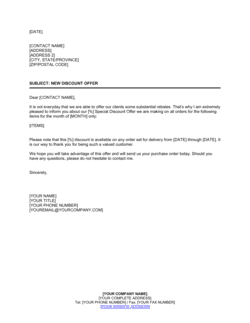
An Announcement of Catalog Price Reductions is a formal business letter a company sends to customers, dealers, or distributors to communicate new lower prices on products listed in its catalog. This free Word download gives you a ready-to-edit structure you can customize with your product lines, percentage reductions, effective date, and contact details, then send by email or post in minutes.
When you need it
Use it whenever you reduce catalog pricing β€” whether driven by lower production costs, a promotional campaign, competitive repositioning, or a seasonal clearance β€” and need to notify your buyer network in a clear, consistent, and professional format.
What's inside
Sender and recipient identification, a clear statement of the price reduction and the products or categories affected, the effective date of the new pricing, any ordering or transitional instructions, and a professional closing with contact information for follow-up questions.

What is an Announcement of Catalog Price Reductions?

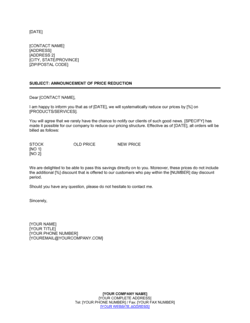
An Announcement of Catalog Price Reductions is a formal business letter a company issues to notify customers, dealers, or distributors that the published prices on one or more catalog products are being reduced. It identifies the affected items, states the new prices alongside the old ones, specifies the exact date the new pricing takes effect, and explains how orders placed around the transition date will be handled. Unlike a promotional discount, a catalog price reduction typically represents a permanent change to the published list price β€” and a written announcement creates the documented record both parties need to update their purchasing systems, contracts, and accounts.

Why You Need This Document

Communicating a price reduction verbally or through a revised catalog alone creates gaps: buyers miss the change, invoices arrive at unexpected prices, and accounts-payable teams raise disputes that slow payment and strain relationships. A formal written announcement eliminates that ambiguity by putting the new price, the effective date, and the order-handling policy in one place, distributed to the right contacts before the change takes effect. It also protects your business from billing disputes β€” if a buyer claims they were invoiced at the wrong price, a dated announcement letter with a clear effective date resolves the question immediately. This template gives you a professional, complete letter structure you can fill in and send in under 15 minutes, ensuring every customer in your network receives the same accurate information at the same time.

Which variant fits your situation?

If your situation is…Use this template
Reducing prices on the full product catalog simultaneouslyAnnouncement Of Catalog Price Reductions
Notifying customers of a temporary promotional discountSales Promotion Announcement Letter
Communicating a price increase rather than a reductionPrice Increase Announcement Letter
Alerting dealers to changes in a distributor price listDealer Price Schedule Update Letter
Announcing a clearance sale with end-of-line pricingClearance Sale Announcement Letter
Notifying a single key account of negotiated pricing changesPrice Adjustment Confirmation Letter

Common mistakes to avoid

❌ Vague scope β€” 'selected items' with no list attached

Why it matters: Buyers cannot update purchase orders, ERP records, or budgets without knowing exactly which SKUs changed. Ambiguity leads to billing disputes and frustrated purchasing teams.

Fix: Attach a formatted price schedule listing every affected item with the old price, new price, and percentage change. Reference it explicitly in the letter body.
❌ Omitting the effective date or making it ambiguous

Why it matters: Without a clear date, buyers and your own order-entry team will apply new prices inconsistently, producing invoices that don't match purchase orders and triggering chargebacks.

Fix: State the effective date in both the subject line and the first paragraph. Specify whether orders received on the effective date are billed at old or new pricing.

❌ No explanation for how existing or in-transit orders are handled

Why it matters: Buyers with open purchase orders at the old price will expect to be invoiced at that price. Invoicing at the new price without clarification creates payment holds and relationship friction.

Fix: Add one sentence explicitly stating: 'Orders received before [DATE] will be invoiced at current prices; orders received on or after [DATE] will be invoiced at the new reduced prices.'

❌ Sending the announcement after the effective date has already passed

Why it matters: Retroactive price-change notices confuse accounts payable teams who have already processed invoices at the old price, requiring credit notes and reconciliation work.

Fix: Build a 10–14 day advance notice window into your pricing change process. Set an internal approval deadline at least three weeks before the effective date.

The 9 key clauses, explained

Sender and recipient identification

In plain language: States who is sending the letter (company name, address, date) and who is receiving it (customer or dealer name and address).

Sample language
[COMPANY NAME] | [STREET ADDRESS] | [CITY, STATE, ZIP] | [DATE] | To: [RECIPIENT NAME / COMPANY] | [RECIPIENT ADDRESS]

Common mistake: Sending to a generic 'Dear Customer' list without personalizing the salutation β€” impersonal letters are filed, not acted upon.

Subject line

In plain language: A brief, descriptive header that tells the reader immediately what the letter is about before they read the body.

Sample language
Re: Price Reductions on [PRODUCT LINE / CATALOG EDITION] β€” Effective [DATE]

Common mistake: Omitting the subject line entirely, forcing the reader to scan the opening paragraph to understand the letter's purpose.

Opening statement of the price reduction

In plain language: The first paragraph that announces the price reduction clearly and positively, referencing which products or categories are affected.

Sample language
We are pleased to inform you that effective [DATE], [COMPANY NAME] will be reducing catalog prices on [PRODUCT LINE / ALL ITEMS IN CATEGORY] by [X]%.

Common mistake: Burying the announcement in background context. State the reduction and effective date in the first two sentences so the reader immediately grasps the action required.

Reason for the reduction

In plain language: A brief, honest explanation of why prices are being reduced β€” lower production costs, improved supply chain, competitive alignment, or a promotional decision.

Sample language
These reductions reflect improvements in our manufacturing process and reduced material costs that we are passing on directly to our customers.

Common mistake: Over-explaining internal cost structures. One to two sentences is sufficient; lengthy justification raises more questions than it answers.

Scope of affected products

In plain language: Specifies exactly which products, SKUs, or catalog categories are covered by the reduction, so buyers can identify the items relevant to them.

Sample language
The price reductions apply to all items listed in [CATALOG NAME / EDITION], specifically pages [X–Y] covering [PRODUCT CATEGORY]. A revised price schedule is enclosed for your reference.

Common mistake: Referencing 'selected items' without listing them or attaching a price schedule, leaving buyers uncertain about what changed.

New pricing details and comparison

In plain language: Presents the new prices β€” either as a table, percentage reduction, or reference to an attached updated price list β€” alongside the previous prices where helpful.

Sample language
Previous catalog price: $[OLD PRICE] per unit. New catalog price effective [DATE]: $[NEW PRICE] per unit β€” a reduction of [X]%.

Common mistake: Stating only the new price without referencing the old one. Buyers need the comparison to understand the value and update their own records accurately.

Effective date and transitional ordering instructions

In plain language: States when the new prices take effect and explains how orders placed before, on, or after that date will be handled.

Sample language
New pricing will apply to all orders received on or after [DATE]. Orders submitted prior to [DATE] will be processed at current catalog prices.

Common mistake: Not clarifying how in-transit or already-placed orders are handled, which leads to billing disputes when invoices arrive at the new price.

Action requested of the recipient

In plain language: Tells the reader what, if anything, they need to do β€” update their records, place an order before a deadline, or contact a sales rep.

Sample language
We encourage you to review the enclosed revised price schedule and contact your [COMPANY NAME] account representative at [PHONE / EMAIL] with any questions.

Common mistake: Ending the letter without a clear next step, leaving buyers passive when you may want them to place an order or confirm receipt.

Professional closing and signature

In plain language: A courteous close that thanks the recipient for their business, reinforces the relationship, and provides the sender's name, title, and contact details.

Sample language
We value your continued partnership and look forward to supporting your needs at these new lower prices. Sincerely, [NAME] | [TITLE] | [COMPANY NAME] | [PHONE] | [EMAIL]

Common mistake: Closing with only a name and no contact details, making it difficult for recipients to follow up with questions about specific line items or order processing.

How to fill it out

  1. 1

    Add your company and recipient details

    Enter your company's legal name, address, and the letter date at the top. Fill in the recipient's name, company, and mailing or email address. For bulk distribution, use a mail-merge field.

    πŸ’‘ Address the letter to the specific accounts-payable or purchasing contact, not just the company name β€” it reaches the right desk faster.

  2. 2

    Write a clear subject line

    Include the product line or catalog edition affected and the effective date of the new pricing in the subject line. Keep it under 12 words.

    πŸ’‘ A subject line with a specific date β€” 'Price Reductions Effective July 1, 2026' β€” performs better than a vague one when recipients file or search for it later.

  3. 3

    State the reduction in the opening paragraph

    Name the product line, the percentage or dollar reduction, and the effective date in the first two sentences. Do not lead with background context or pleasantries.

    πŸ’‘ Positive framing works: 'We are pleased to reduce prices' outperforms 'Please be advised of the following changes' in customer response.

  4. 4

    Define the scope and attach updated pricing

    List the specific SKUs, product categories, or catalog pages affected. Attach a revised price schedule or reference the updated catalog edition so buyers can update their systems.

    πŸ’‘ If more than ten SKUs are affected, always attach a formatted price table rather than listing items in the letter body β€” it reduces errors when buyers update their purchasing systems.

  5. 5

    Clarify the effective date and order handling

    State the precise date new pricing applies and specify how orders placed before that date will be billed. This prevents invoice disputes at the cutover.

    πŸ’‘ Give at least 10–14 days of advance notice before the effective date so buyers can adjust purchase orders and budget approvals.

  6. 6

    Include a clear call to action

    Tell the recipient what to do next β€” contact their sales rep, place a pre-effective-date order, or update their catalog records. Include a direct phone number or email.

    πŸ’‘ A call-to-action tied to a deadline ('Order by [DATE] to lock in current pricing on any pending requisitions') can accelerate order placement.

  7. 7

    Review and send before the effective date

    Proofread the new prices against your internal pricing system before sending. Distribute the letter at least two weeks before the effective date so buyers have time to act.

    πŸ’‘ Send a brief follow-up email one week before the effective date referencing the original letter β€” it catches recipients who missed or forgot the first notice.

Frequently asked questions

What is a catalog price reduction announcement letter?

A catalog price reduction announcement letter is a formal business communication a company sends to its customers, dealers, or distributors to notify them of lower prices on products in its catalog. It states which products are affected, the new prices, the effective date, and any instructions for how orders around the transition date will be handled. It creates a documented record of the pricing change for both parties.

When should I send a price reduction announcement?

Send it at least 10–14 days before the new pricing takes effect so buyers can adjust purchase orders, update ERP records, and plan orders accordingly. If the reduction is part of a product launch or seasonal promotion, coordinate the letter with your sales team so they are briefed before customers receive it.

Do I need to explain why I am reducing prices?

A brief explanation builds credibility and prevents speculation, but it should be one to two sentences. Common reasons to mention include reduced production costs, supply-chain improvements, or a strategic decision to pass savings to customers. Avoid disclosing sensitive internal cost data or framing the reduction as a sign of financial distress.

Should the letter attach a revised price schedule?

Yes, whenever more than a handful of SKUs are affected. A formatted price schedule listing each item with old price, new price, and percentage change lets buyers update their systems accurately and reduces follow-up calls to your customer service team. Reference the attachment explicitly in the letter body.
How do I handle orders that were placed before the effective date?

State your policy clearly in the letter. The standard approach is to honor orders received before the effective date at the old price and apply new pricing to all orders received on or after the effective date. Communicate this in the body of the letter and confirm it on invoices issued around the cutover date to prevent disputes.

Can I use this letter for a temporary promotional price reduction?

Yes, with one important modification: add an expiry date alongside the effective date so recipients know the reduced pricing is time-limited. State clearly that catalog prices will revert to standard levels after the promotional period ends. This prevents buyers from expecting the lower price permanently after the promotion closes.

Is a signature required on a price reduction announcement letter?

A formal signature is not legally required for a price announcement, but including the sender's name, title, and contact details adds credibility and gives recipients a direct point of contact for questions. For high-volume digital distribution, a printed name and title with a company logo is standard practice.

What format should I use to distribute the letter?

Email with a PDF attachment is the most common format for B2B price announcements β€” it is trackable, easy to forward to accounts payable, and creates a time-stamped record. For dealers or distributors without reliable email, a printed letter with the price schedule enclosed remains appropriate. Some businesses send both to ensure receipt.

How this compares to alternatives

vs Announcement of Price Increases

A price increase announcement notifies buyers of higher prices and typically requires more lead time, a stronger justification, and careful tone management to preserve relationships. A price reduction announcement is generally well-received and more straightforward to write. Both documents follow the same structure but differ in framing and the urgency they create for buyers.

vs Sales Promotion Announcement Letter

A sales promotion announcement describes a temporary discount, bundle deal, or limited-time offer with an expiry date. A catalog price reduction letter communicates a permanent change to the published list price. The key difference is duration: promotions revert; catalog reductions replace the prior price indefinitely.

vs New Product Announcement Letter

A new product announcement introduces a previously unavailable item, focusing on features, benefits, and availability. A catalog price reduction letter addresses existing products whose prices are changing. They serve different buyer decisions β€” one is an adoption message, the other is a procurement update.

vs Credit Note

A credit note is a financial document that reduces the amount owed on a specific past invoice, typically issued after a billing dispute or return. A catalog price reduction letter is a forward-looking communication about future pricing. If an invoice was issued at a price that has since been reduced, a credit note handles the correction; the announcement letter handles the policy change.

Industry-specific considerations

Manufacturing

Manufacturers announcing input-cost savings commonly issue catalog price reductions across entire product lines, requiring a detailed attached price schedule for dealer and distributor networks.

Wholesale and Distribution

Distributors use this letter to push updated pricing to retail accounts, often tying the announcement to a new catalog edition or seasonal price book effective date.

Retail

Retailers notify B2B purchasing contacts or franchise operators of catalog price changes, especially ahead of a new season or product refresh cycle.

Professional Services

Service firms with published rate cards or service catalogs use a price reduction letter to notify clients of lower fees, often tied to efficiency gains or a client-retention initiative.

Template vs pro β€” what fits your needs?

PathBest forCostTime
Use the templateAny business announcing standard catalog price reductions to customers or dealer networksFree10–15 minutes per letter
Template + professional reviewBusinesses with complex tiered pricing, contractual pricing obligations, or distribution agreements that govern how price changes must be communicated$50–$200 for a brief review by a sales operations or legal contact1–2 hours
Custom draftedEnterprise distributors with contractual minimum-notice obligations or regulated industries where pricing communications require compliance review$200–$6001–3 days

Glossary

Catalog Price
The standard published price for a product as listed in a company's official catalog, before any individual discounts or negotiated terms are applied.
Effective Date
The specific calendar date on which new pricing takes effect and replaces all previously published prices.
Price Reduction
A permanent or temporary decrease in the listed selling price of one or more products, expressed as a dollar amount or percentage.
List Price
The manufacturer's or distributor's official published price, which may differ from the net price after trade or volume discounts.
Trade Discount
A reduction off the list price offered to a specific class of buyer β€” such as a wholesaler or authorized dealer β€” rather than the general public.
Net Price
The actual price a buyer pays after all discounts, rebates, and deductions have been applied to the list or catalog price.
Superseding Notice
A communication that formally replaces and invalidates a prior document β€” in this context, earlier catalog pages or price sheets.
Order Lead Time
The number of days between placing an order and expected delivery, which may change alongside a price update during catalog transitions.

Part of your Business Operating System

This document is one of 3,000+ business & legal templates included in Business in a Box.

  • Fill-in-the-blanks β€” ready in minutes
  • 100% customizable Word document
  • Compatible with all office suites
  • Export to PDF and share electronically

Create your document in 3 simple steps.

From template to signed document β€” all inside one Business Operating System.
1
Download or open template

Access over 3,000+ business and legal templates for any business task, project or initiative.

2
Edit and fill in the blanks with AI

Customize your ready-made business document template and save it in the cloud.

3
Save, Share, Send, Sign

Share your files and folders with your team. Create a space of seamless collaboration.

Save time, save money, and create top-quality documents.

β˜…β˜…β˜…β˜…β˜…

"Fantastic value! I'm not sure how I'd do without it. It's worth its weight in gold and paid back for itself many times."

Managing Director Β· Mall Farm
Robert Whalley
Managing Director, Mall Farm Proprietary Limited
β˜…β˜…β˜…β˜…β˜…

"I have been using Business in a Box for years. It has been the most useful source of templates I have encountered. I recommend it to anyone."

Business Owner Β· 4+ years
Dr Michael John Freestone
Business Owner
β˜…β˜…β˜…β˜…β˜…

"It has been a life saver so many times I have lost count. Business in a Box has saved me so much time and as you know, time is money."

Owner Β· Upstate Web
David G. Moore Jr.
Owner, Upstate Web

Run your business with a system β€” not scattered tools

Stop downloading documents. Start operating with clarity. Business in a Box gives you the Business Operating System used by over 250,000 companies worldwide to structure, run, and grow their business.

Free Forever PlanΒ Β·Β No credit card required