- Effective Date
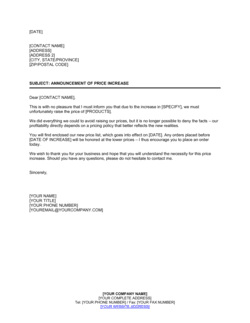
- The specific calendar date on which the new pricing takes effect — any charges after this date are billed at the revised rate.
- Notice Period
- The minimum number of days a party must provide before a contract change — such as a price increase — becomes binding on the other party.
- Price Adjustment Clause
- A provision in an existing contract that grants one or both parties the right to revise pricing under defined conditions, such as cost-of-living increases or material cost changes.
- Grandfathering
- A transition provision allowing existing customers to remain on their current pricing for a defined period after a general rate increase takes effect.
- CPI Escalation
- A price adjustment mechanism that ties rate increases to the Consumer Price Index, making the change formulaic and defensible rather than arbitrary.
- Material Adverse Change
- A significant negative shift in costs, regulations, or market conditions that a party may cite as justification for renegotiating or adjusting contractual pricing.
- Acknowledgment Clause
- A section requiring the recipient to confirm they have received and understood the notice, often by signing and returning the letter or clicking an acceptance link.
- Opt-Out Provision
- A term allowing the customer to terminate the contract or subscription without penalty if they do not accept the new pricing within a specified window.
- Force Majeure
- A clause excusing a party from contractual obligations — including pricing commitments — when extraordinary events outside their control make performance impractical.
- Contract Renewal Period
- The window before an automatic contract renewal during which either party may modify terms, including pricing, for the upcoming term.
- Pass-Through Cost
- An increase in the supplier's own input costs — materials, shipping, labor — that is contractually permitted to be transferred directly to the buyer.