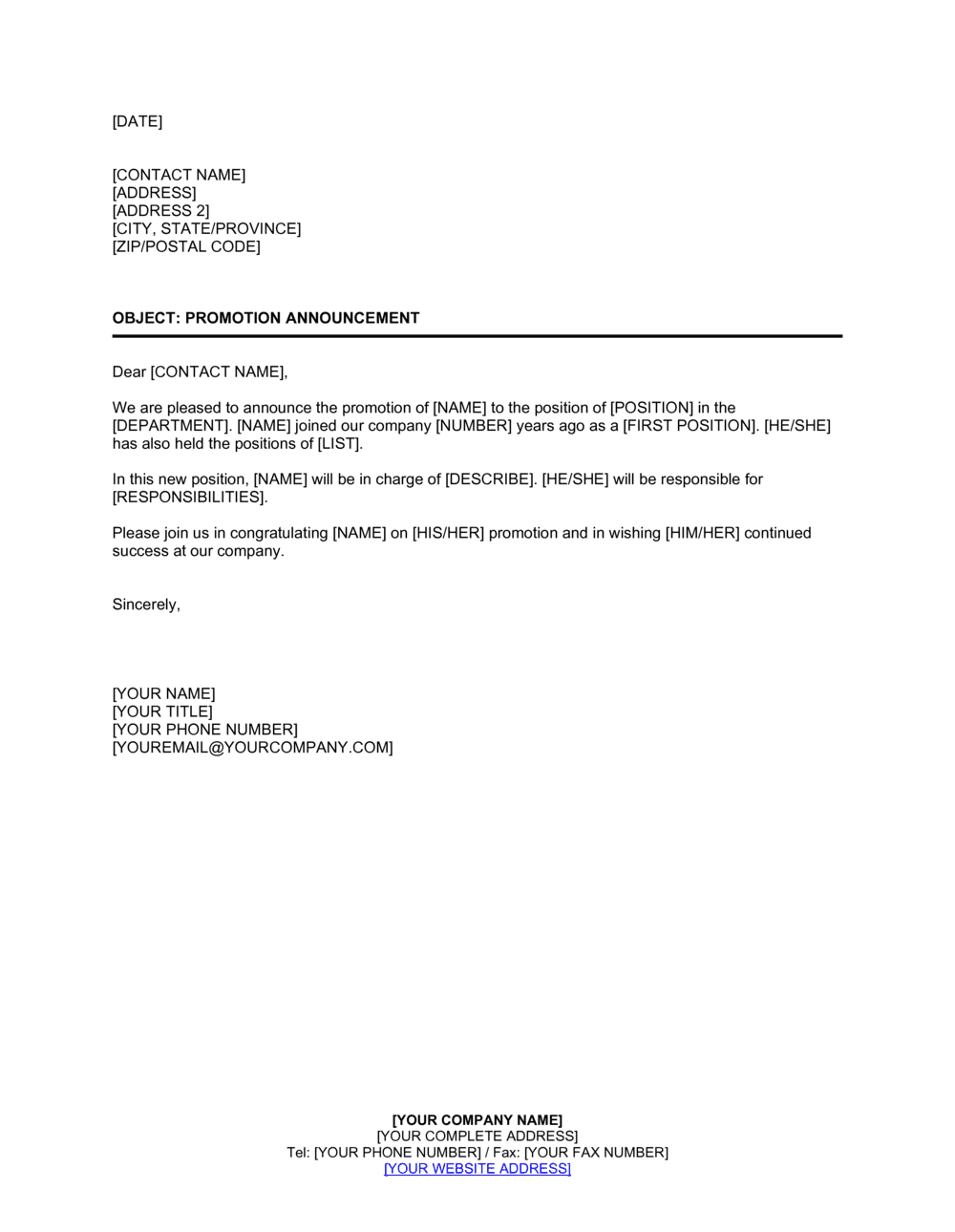
Promotion Announcement Template

Free Word download β€’ Edit online β€’ Save & share with Drive β€’ Export to PDF

1 pageβ€’20–30 min to fillβ€’Difficulty: Standardβ€’Signature requiredβ€’Legal review recommended
Learn more ↓
FreePromotion Announcement Template

At a glance

What it is
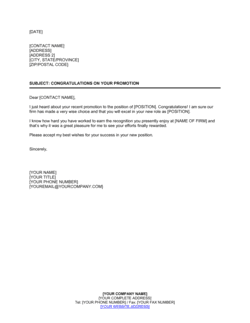
A Promotion Announcement is a formal written document that officially communicates an employee's promotion to a new role, confirming the updated job title, revised compensation, adjusted reporting structure, and effective date. This free Word download gives employers a structured, legally sound template they can edit online and export as PDF for distribution to HR records, the promoted employee, and β€” where appropriate β€” the broader team.
When you need it
Use it when an employee is moving from one position to a higher-level role, whether due to performance, tenure, or a restructuring. It is especially important when the promotion changes compensation, benefits eligibility, or managerial authority in ways that need to be documented in writing.
What's inside
Parties and effective date, new job title and grade, updated compensation and benefits, revised duties and reporting structure, acknowledgment of prior employment terms that remain in force, and signature blocks for both employer and employee. Some versions also include an updated confidentiality or non-compete reminder tied to the new role's expanded access.

What is a Promotion Announcement?

A Promotion Announcement is a formal written document issued by an employer to officially confirm an employee's advancement to a higher-level role within the organization. It records the new job title and grade, revised compensation, updated duties and reporting structure, and the exact effective date β€” and when signed by both parties, it functions as a legally binding amendment to the employee's original employment contract. Unlike an informal email or verbal notification, a properly executed promotion announcement creates a clear documented record for HR files, payroll systems, and any future dispute about employment terms, including the scope of restrictive covenants that apply in the new role.

Why You Need This Document

Without a signed promotion announcement, the legal terms of an employee's role remain exactly as they were written in the original employment contract, regardless of what has changed in practice. This creates four concrete risks. First, payroll and benefits adjustments made without a signed effective-date record are difficult to defend in a dispute or audit. Second, updated non-compete or non-solicitation terms added verbally at promotion are almost certainly unenforceable β€” courts require written evidence of both the new terms and the consideration provided. Third, in the UK, Canada, and EU member states, failing to document changes to principal employment terms within the statutory window exposes the employer to regulatory penalties. Fourth, an employee promoted to a managerial or director role without documented authority may find their decisions challenged by third parties who had no notice of the updated organizational structure. This template gives HR teams and business owners a structured, legally sound document they can complete in under 20 minutes β€” with the right clauses in place to protect the employer, the employee, and the integrity of the employment relationship going forward.

Which variant fits your situation?

If your situation is…Use this template
Promoting a team member to a people-manager role for the first timePromotion Announcement (Manager)
Giving a title change without a compensation increasePromotion Announcement (Title Change Only)
Promoting an executive to C-suite with equity and enhanced severanceExecutive Employment Agreement
Notifying the full company of an internal promotion via email or memoInternal Promotion Announcement Memo
Confirming a lateral transfer with updated duties but same gradeEmployee Transfer Letter
Issuing a temporary acting-role assignment pending a formal promotionActing Role Appointment Letter
Promoting a remote employee in a different jurisdiction with new termsRemote Work Employment Agreement

Common mistakes to avoid

❌ No signed acceptance required

Why it matters: Without the employee's signature, updated terms β€” especially revised non-competes or expanded IP assignment β€” may be unenforceable because there is no evidence the employee agreed to them.

Fix: Always include a signature block and set a clear deadline for return. Treat an unsigned promotion letter as an incomplete document, not a valid amendment.

❌ Effective date misaligned with payroll cycle

Why it matters: A promotion effective mid-pay-period triggers manual proration calculations, increases the risk of overpayment or underpayment, and creates a paper trail inconsistency between the letter and payroll records.

Fix: Align the effective date with the first day of a new pay period and confirm this with payroll before the letter is issued.

❌ Omitting a reference to the original employment agreement

Why it matters: Without a continuity clause, it is ambiguous whether the promotion letter supersedes or supplements the original contract. Courts may find that prior restrictive covenants were inadvertently voided.

Fix: Include an explicit clause stating which terms of the original agreement remain in force and which are amended by the promotion letter.

❌ Updating restrictive covenants without fresh consideration

Why it matters: In most jurisdictions, extending or tightening a non-compete at promotion requires the employee to receive something new of value. A letter that expands restrictions without a salary increase or other benefit may be unenforceable.

Fix: Tie any expansion of non-compete or non-solicitation terms explicitly to the compensation increase or other benefit that accompanies the promotion, and state this linkage in the letter.

❌ Embedding detailed duty lists in the letter body

Why it matters: Granular duty specifications in the contract body mean any role adjustment requires a formal amendment β€” creating administrative friction and potential 'constructive dismissal' claims if duties are later modified without one.

Fix: Keep the letter body to three to four high-level responsibilities and attach a Schedule A for detail. State that the Company may reasonably adjust duties over time.

❌ Issuing the letter after the promotion is already in effect

Why it matters: A backdated or post-hoc promotion letter creates a fresh-consideration problem for any new terms β€” the employee has already accepted the role without signing anything β€” and undermines the document's enforceability.

Fix: Issue and obtain a signed copy before or on the effective date. If the promotion has already commenced, provide documented additional consideration β€” a bonus or extra PTO β€” alongside the late signature.

The 9 key clauses, explained

Parties and effective date

In plain language: Identifies the employer and employee by full legal name and states the exact date the promotion takes effect.

Sample language
This Promotion Announcement is issued by [EMPLOYER LEGAL NAME] ('Company') to [EMPLOYEE FULL NAME] ('Employee') and is effective as of [EFFECTIVE DATE].

Common mistake: Using the date the letter was drafted rather than the actual promotion effective date β€” payroll and benefits adjustments then start at the wrong time, creating retroactive correction headaches.

New job title and grade

In plain language: States the employee's new title, job band or grade level, and department, replacing the prior role definition for all HR and payroll purposes.

Sample language
Effective [DATE], Employee's title is changed from [PRIOR TITLE] to [NEW TITLE], classified at Grade [X] within the [DEPARTMENT] department.

Common mistake: Omitting the job grade when the company uses a graded pay structure β€” downstream payroll and benefits calculations use the grade, not just the title.

Updated compensation

In plain language: Specifies the new base salary or hourly rate, payment frequency, and any change to bonus target or commission plan that accompanies the promotion.

Sample language
Effective [DATE], Employee's base salary is increased to $[AMOUNT] per year, payable [bi-weekly / semi-monthly]. Employee's annual bonus target is revised to [X]% of base salary, subject to Company and individual performance.

Common mistake: Leaving the prior salary in the original employment contract without explicitly superseding it in the promotion letter β€” conflicting figures create payroll disputes and potential litigation.

Revised duties and responsibilities

In plain language: Describes the key responsibilities of the new role at a high level, with a reference to a detailed job description in Schedule A rather than embedding full specifics in the body.

Sample language
In the new role, Employee will be responsible for [KEY RESPONSIBILITY 1], [KEY RESPONSIBILITY 2], and such other duties as may be reasonably assigned by the Company. A detailed role description is attached as Schedule A.

Common mistake: Over-specifying duties in the letter body so that any future adjustment requires a formal amendment β€” reference a Schedule A that can be updated separately.

Updated reporting structure

In plain language: States who the employee now reports to and, if the employee has gained direct reports, acknowledges managerial authority over named or described positions.

Sample language
In the new role, Employee will report directly to [MANAGER TITLE / NAME]. Employee will manage the following direct reports: [TITLES / NAMES].

Common mistake: Failing to update the reporting line in writing when a promotion adds managerial authority β€” verbal instructions are insufficient if authority is later disputed.

Continuation of existing employment terms

In plain language: Confirms which terms of the original employment agreement β€” confidentiality, IP assignment, dispute resolution β€” remain in full force and are unaffected by the promotion.

Sample language
Except as expressly modified herein, all other terms of Employee's Employment Agreement dated [ORIGINAL DATE] remain in full force and effect, including without limitation the confidentiality, IP assignment, and non-solicitation provisions.

Common mistake: Not referencing the original agreement at all, leaving ambiguity about whether the promotion letter replaces or supplements prior terms β€” this can unintentionally void IP assignment or non-compete clauses.

Updated restrictive covenants (if applicable)

In plain language: If the new role gives the employee access to more sensitive information, customers, or markets, this clause refreshes or extends the non-compete and non-solicitation terms to reflect the expanded scope.

Sample language
In connection with Employee's promotion to [NEW TITLE], the non-compete period set forth in Section [X] of the Employment Agreement is extended to [DURATION] and the geographic scope is revised to [GEOGRAPHY], to reflect Employee's expanded access to [CONFIDENTIAL INFORMATION / CUSTOMER RELATIONSHIPS].

Common mistake: Failing to provide fresh consideration for expanded restrictive covenants β€” the salary increase accompanying the promotion typically serves as adequate consideration, but this should be stated explicitly.

Benefits and perquisites

In plain language: Notes any changes to benefits eligibility β€” additional PTO, enhanced health coverage, car allowance, travel budget β€” that accompany the new role.

Sample language
Effective [DATE], Employee is eligible for [BENEFIT CHANGE β€” e.g., an additional 5 days of PTO per year / a monthly car allowance of $[AMOUNT] / enrollment in the Company's enhanced benefits tier].

Common mistake: Detailing specific plan terms in the letter body β€” benefits plans change annually. Reference the category and current plan summary only, so future plan changes do not create a breach.

Acknowledgment and acceptance

In plain language: Requires the employee to sign and return the letter by a stated deadline, confirming they accept the promotion on the terms set out.

Sample language
By signing below, Employee acknowledges receipt of this Promotion Announcement, accepts the promotion on the terms described, and confirms that no verbal representations beyond those contained herein have been made. Please return a signed copy to HR by [DEADLINE DATE].

Common mistake: Not requiring a signature at all, treating the announcement as a unilateral notice β€” without signed acceptance, disputes about whether the employee agreed to any updated terms (especially revised restrictive covenants) are difficult to resolve.

How to fill it out

  1. 1

    Enter the employer's legal entity name and the employee's details

    Use the employer's full registered corporate name β€” not a trade name or department name β€” and the employee's legal name as it appears in their employment file and on their government ID.

    πŸ’‘ Cross-check the entity name against your corporate registry filing to ensure it matches payroll and HR system records exactly.

  2. 2

    Set the effective date carefully

    The effective date drives payroll, benefits enrollment, and organizational chart updates. Confirm with payroll that the date aligns with a pay period start to avoid mid-period proration errors.

    πŸ’‘ For promotions that require system access changes or new managerial permissions, align the effective date with an IT provisioning window β€” usually the first working day of a new pay period.

  3. 3

    State the new title, grade, and department

    Enter the new job title exactly as it will appear in the HRIS, on business cards, and in organizational charts. Include the job grade or band if your company uses a graded pay structure.

    πŸ’‘ Confirm the title with your HRIS administrator before issuing the letter β€” mismatches between the letter and the system create data integrity problems that surface during audits.

  4. 4

    Update the compensation block

    Enter the new base salary, payment frequency, and revised bonus target. Explicitly state that the new salary supersedes the salary stated in the original employment agreement.

    πŸ’‘ If the promotion includes a one-time promotion bonus, document it as a separate line item and specify whether it is subject to a repayment obligation if the employee leaves within a defined period.

  5. 5

    Describe revised duties and attach a Schedule A

    Write two to four high-level responsibilities in the body and move detailed role specifics to a Schedule A. This keeps the letter concise and allows duty updates without amending the main document.

    πŸ’‘ Have the employee initial Schedule A separately at signing to confirm they reviewed and accepted the full scope of the new role.

  6. 6

    Reference the original employment agreement

    Cite the original agreement by date and confirm which terms remain in force. If you are updating restrictive covenants, specify the original clause number and the revised terms precisely.

    πŸ’‘ If you cannot locate the original signed agreement, resolve that gap before issuing the promotion letter β€” you cannot reference terms you cannot produce in a dispute.

  7. 7

    Set a deadline for signed acceptance and distribute

    Give the employee three to five business days to sign and return the letter. Send it to the employee directly, with a copy to HR and payroll. Retain the signed original in the personnel file.

    πŸ’‘ Use a timestamped electronic signature tool so the exact date and time of acceptance is recorded β€” this is critical if a restrictive covenant is later challenged.

Frequently asked questions

What is a promotion announcement?

A promotion announcement is a formal written document issued by an employer to confirm an employee's move to a higher-level role. It records the new job title, updated compensation, revised duties, reporting structure, and effective date. When signed by both parties, it functions as a legal amendment to the original employment agreement and creates a documented record for HR files, payroll, and any future disputes about employment terms.

Is a promotion announcement legally binding?

Yes, when properly executed with signatures from both parties, a promotion announcement is generally considered a binding amendment to the underlying employment contract. It modifies specific terms β€” title, salary, duties β€” while leaving the rest of the original agreement intact. An unsigned promotion notice, by contrast, is typically treated as a unilateral communication rather than a contractual amendment, which can leave updated restrictive covenants unenforceable.

Do I need a lawyer to issue a promotion announcement?

For standard internal promotions involving a title change and salary increase, a high-quality template is usually sufficient. Engage a lawyer when the promotion is to a director or officer role with fiduciary duties, when the new role significantly expands non-compete or IP assignment obligations, when the employee works in a heavily regulated jurisdiction, or when the promotion involves equity grants or enhanced severance terms. A brief legal review typically costs $150–$400 and is worthwhile for senior promotions.

What is the difference between a promotion announcement and an offer letter?

An offer letter is issued to a new external hire to confirm terms of initial employment. A promotion announcement is issued to an existing employee to amend specific terms of an established employment relationship. The promotion announcement must reference and interact with the original employment agreement, whereas an offer letter typically stands alone as the primary governing document for the incoming employee.

Can a promotion announcement update a non-compete clause?

Yes, but it must do so carefully. Updating or expanding a non-compete at the time of promotion requires fresh consideration β€” typically the salary increase or a promotion bonus. The letter should explicitly state which clause in the original agreement is being amended, what the new terms are, and that the accompanying compensation change constitutes adequate consideration. In jurisdictions that ban or heavily restrict non-competes (California, Minnesota, the UK post-2024 guidance), any expansion may still be unenforceable regardless of consideration.

What happens if the employee refuses to sign the promotion announcement?

If an employee declines to sign, the promotion has not been formally accepted on the documented terms, and any updated restrictive covenants or duties described in the letter are likely unenforceable. In practice, most employees accept promotions willingly β€” refusal often signals disagreement with specific terms, such as an expanded non-compete. Employers should treat an unsigned letter as an open negotiation rather than a finalised amendment and consult an employment lawyer before proceeding.

Should a promotion announcement be distributed company-wide?

The signed legal version β€” containing compensation details and amended terms β€” should go only to the employee, HR, and payroll. A separate internal announcement memo or email can be shared more broadly to inform the team of the new reporting structure and role. Combining confidential compensation information with a general team communication is a common privacy error that can violate data protection obligations in the UK and EU.

How does a promotion announcement interact with the original employment contract?

The promotion announcement functions as a partial amendment: it expressly modifies the terms it addresses (title, salary, duties, reporting) and leaves all other terms of the original contract β€” IP assignment, confidentiality, dispute resolution, governing law β€” in full force. Including an explicit integration clause in the promotion letter is essential to confirm this interaction clearly and prevent arguments that the new document replaced the original entirely.

What jurisdictions require written documentation of a promotion?

Most jurisdictions do not legally mandate a written promotion document, but written records are strongly advisable everywhere. In the UK, any change to a principal statement of employment particulars must be notified in writing within one month. In Canada, changes to compensation or duties that amount to a fundamental alteration of the employment relationship must be documented to avoid constructive dismissal liability. In EU member states, the Transparent and Predictable Working Conditions Directive requires updated written information when key employment terms change.

How this compares to alternatives

vs Employment contract

An employment contract governs the entire working relationship from day one and stands as the primary binding document. A promotion announcement is a targeted amendment that modifies specific terms of that contract β€” title, compensation, duties β€” while leaving the rest intact. Issuing a promotion announcement without an underlying employment contract creates ambiguity about which terms apply to the updated relationship.

vs Offer letter

An offer letter is addressed to a new external hire and establishes the initial employment relationship. A promotion announcement is addressed to an existing employee and amends a relationship already in effect. Unlike an offer letter, the promotion announcement must explicitly interact with prior contract terms to avoid unintentionally voiding confidentiality, IP, or non-compete clauses from the original agreement.

vs Employee transfer letter

An employee transfer letter documents a lateral move β€” same grade, comparable pay, different department or location. A promotion announcement documents an upward move with a higher title, increased compensation, and typically expanded responsibilities. The legal implications differ: a lateral transfer rarely requires fresh consideration or updated restrictive covenants, whereas a promotion typically does.

vs Executive employment agreement

An executive employment agreement is a comprehensive standalone contract used when hiring or promoting someone to a C-suite or VP-level role, covering equity, change-of-control provisions, enhanced severance, and board reporting. A promotion announcement is a lighter amendment document suitable for non-executive promotions. For senior leadership moves, a full executive agreement should replace or supplement the promotion letter.

Industry-specific considerations

Technology / SaaS

Promotions often trigger equity refresh grants and expanded IP assignment β€” both require explicit documentation in the promotion letter or a parallel equity agreement.

Financial services

Promotions to regulated roles (e.g., registered representative, senior manager) must align with FINRA, FCA, or equivalent registration requirements, and the letter should reference any new regulatory obligations.

Healthcare

Promotions to clinical leadership or administrative officer roles may trigger HIPAA privacy obligations, credentialing prerequisites, and updated malpractice coverage β€” all of which should be referenced in the letter.

Professional services

Promotions to partner or principal involve changes to compensation structure (from salary to profit share), client ownership, and non-solicitation terms that require tailored legal review rather than a standard template.

Manufacturing

Promotions to supervisory or safety-officer roles create new OSHA-related legal duties β€” the announcement should confirm that the employee has completed required safety certifications before the effective date.

Retail / hospitality

Promotions from hourly to salaried status change overtime eligibility under the FLSA β€” the letter must document the FLSA exemption classification and confirm the new salary meets the current weekly threshold.

Jurisdictional notes

United States

At-will employment means a promotion does not guarantee continued employment, but any new terms added at promotion β€” expanded non-compete, revised bonus β€” must be supported by fresh consideration. Promotions from hourly to salaried status must comply with FLSA exemption thresholds (currently $684 per week as of 2024; check current DOL threshold). Non-compete enforceability at promotion varies sharply by state β€” California, Minnesota, and Oklahoma generally ban post-employment restrictions regardless of when they are added.

Canada

Unilaterally changing material employment terms β€” even upward β€” without proper documentation can trigger a constructive dismissal claim if the employee later argues the promotion altered their fundamental role without consent. Employment Standards Acts in each province set the floor for notice and severance, which a promotion letter cannot waive. Quebec employers must provide the promotion announcement in French for provincially regulated workplaces. Non-competes added at promotion require reasonable scope and explicit consideration to be enforceable.

United Kingdom

Under the Employment Rights Act 1996, any change to a principal statement of employment particulars β€” including title, pay, and duties β€” must be communicated in writing within one month of the change. Promotions to roles classified as 'senior manager' under the Senior Managers and Certification Regime (SM&CR) in financial services trigger FCA registration requirements that must be completed before the effective date. Post-employment non-competes updated at promotion are subject to reasonableness review and recent government guidance has signaled further restrictions.

European Union

The EU Transparent and Predictable Working Conditions Directive (2019/1152) requires employers to provide updated written information when key terms change, typically within one week of the change taking effect. GDPR considerations apply when the promotion announcement references personal data β€” compensation details should be kept out of any broadly distributed version. In France and Germany, works councils may have information or consultation rights before a promotion that changes team structure is finalised. Post-employment non-competes added at promotion generally require financial compensation to the employee β€” ranging from 25% to 100% of salary depending on the member state.

Template vs lawyer β€” what fits your deal?

PathBest forCostTime
Use the templateStandard non-executive promotions with a title change and salary increase in a single domestic jurisdictionFree15–20 minutes
Template + legal reviewPromotions that update non-compete terms, add managerial authority over sensitive functions, or involve employees in heavily regulated roles$150–$4001–3 days
Custom draftedC-suite or director promotions with equity, fiduciary duties, enhanced severance, or cross-border employment considerations$800–$3,000+1–2 weeks

Glossary

Effective Date
The specific calendar date on which the promotion and its associated changes β€” title, compensation, duties β€” take legal effect.
Job Grade / Band
A classification level within a company's compensation structure that determines salary range, bonus eligibility, and benefits tier.
Reporting Structure
The formal hierarchy defining who the promoted employee reports to and, if applicable, who now reports to them.
Constructive Dismissal
A legal concept where unilateral changes to employment terms β€” including a demotion disguised as a promotion β€” may entitle the employee to resign and claim wrongful termination.
Fresh Consideration
New value exchanged between employer and employee to make a modified contract enforceable β€” such as a salary increase accompanying a promotion.
Integration Clause
A clause stating the promotion letter and any referenced original contract together constitute the complete agreement, superseding prior verbal or written understandings about the role.
Retention Agreement
An obligation sometimes attached to a promotion requiring the employee to remain in the new role for a minimum period or repay part of any promotion bonus.
Fiduciary Duty
A heightened legal obligation of loyalty and care that arises when an employee is promoted to a director, officer, or trustee role.
Non-Solicitation Clause
A restriction, sometimes updated at promotion, preventing the employee from poaching customers or colleagues if they later leave the company.
At-Will Employment
Employment in most US states that either party may end at any time for any lawful reason β€” a promotion does not alter this baseline unless the letter expressly changes the terms.

Part of your Business Operating System

This document is one of 3,000+ business & legal templates included in Business in a Box.

  • Fill-in-the-blanks β€” ready in minutes
  • 100% customizable Word document
  • Compatible with all office suites
  • Export to PDF and share electronically

Create your document in 3 simple steps.

From template to signed document β€” all inside one Business Operating System.
1
Download or open template

Access over 3,000+ business and legal templates for any business task, project or initiative.

2
Edit and fill in the blanks with AI

Customize your ready-made business document template and save it in the cloud.

3
Save, Share, Send, Sign

Share your files and folders with your team. Create a space of seamless collaboration.

Save time, save money, and create top-quality documents.

β˜…β˜…β˜…β˜…β˜…

"Fantastic value! I'm not sure how I'd do without it. It's worth its weight in gold and paid back for itself many times."

Managing Director Β· Mall Farm
Robert Whalley
Managing Director, Mall Farm Proprietary Limited
β˜…β˜…β˜…β˜…β˜…

"I have been using Business in a Box for years. It has been the most useful source of templates I have encountered. I recommend it to anyone."

Business Owner Β· 4+ years
Dr Michael John Freestone
Business Owner
β˜…β˜…β˜…β˜…β˜…

"It has been a life saver so many times I have lost count. Business in a Box has saved me so much time and as you know, time is money."

Owner Β· Upstate Web
David G. Moore Jr.
Owner, Upstate Web

Run your business with a system β€” not scattered tools

Stop downloading documents. Start operating with clarity. Business in a Box gives you the Business Operating System used by over 250,000 companies worldwide to structure, run, and grow their business.

Start freeΒ Β·Β No credit card required