Announcement of Partnership Buyout Template

Free Word download β€’ Edit online β€’ Save & share with Drive β€’ Export to PDF

1 pageβ€’15–25 min to fillβ€’Difficulty: Standard
Learn more ↓
FreeAnnouncement of Partnership Buyout Template

At a glance

What it is
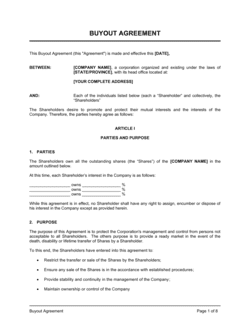
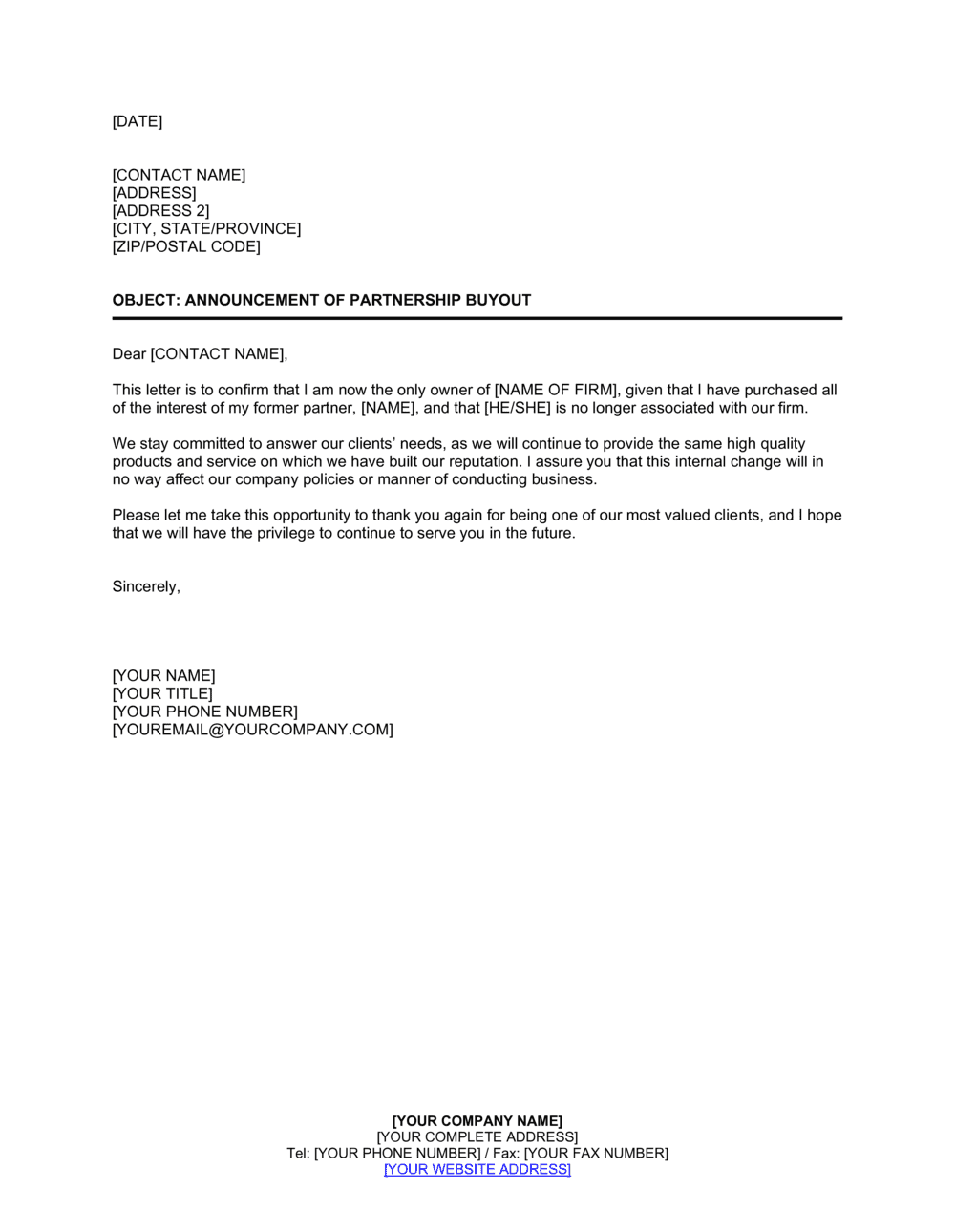
An Announcement of Partnership Buyout is a formal business letter that notifies clients, employees, suppliers, and other stakeholders that one partner has purchased another partner's interest in the business. This free Word download gives you a professionally worded letter you can edit online, personalize with your details, and export as PDF or print in minutes.
When you need it
Send it promptly after a buyout transaction closes β€” before rumors spread or stakeholders discover the change through unofficial channels. It is especially important when the departing partner had direct relationships with clients, vendors, or staff.
What's inside
A subject line and opening statement identifying the change, the names of the buying and departing partners, the effective date of the transaction, a brief explanation of business continuity, and a closing that invites questions and reinforces confidence in the organization.

What is an Announcement of Partnership Buyout?

An Announcement of Partnership Buyout is a formal business letter issued by the remaining partner or partners to notify clients, employees, vendors, lenders, and other stakeholders that one partner has purchased another's ownership interest in the business. It identifies both parties by name, records the effective date of the transaction, and provides clear assurance that the business will continue operating without interruption. Unlike the underlying Buyout Agreement β€” which is a legally binding contract β€” this letter is a professional communication designed to preserve stakeholder confidence and prevent uncertainty following an ownership change.

Why You Need This Document

When a partner leaves a business through a buyout, the people who depend on that business β€” clients, suppliers, and staff β€” notice. Without a timely, well-worded announcement, they draw their own conclusions: that the business is in financial trouble, that contracts may not be honored, or that they should start talking to competitors. The cost of that uncertainty is real. Clients preemptively look for alternatives. Vendors tighten payment terms. Employees begin updating their resumes. A prompt, professional announcement letter closes that window of uncertainty before it opens. It directs the narrative, names the point of contact going forward, and confirms that existing agreements remain valid β€” three assurances that no rumor or informal update can reliably deliver. This template gives you a complete, correctly structured letter you can personalize and send within minutes of a buyout closing.

Which variant fits your situation?

If your situation is…Use this template
Buying out one partner in a multi-partner firmAnnouncement of Partnership Buyout
Dissolving the partnership entirely with no continuing entityNotice of Partnership Dissolution
Notifying clients that a new partner has joined the businessAnnouncement of New Business Partner
Transferring full ownership to a new buyer outside the partnershipBusiness Transfer Announcement Letter
Announcing a merger where two partnerships combineAnnouncement of Business Merger
Internally notifying employees of a change in management structureInternal Change of Management Memo

Common mistakes to avoid

❌ Delaying the announcement after the buyout closes

Why it matters: Stakeholders who hear about the change through unofficial channels β€” from the departing partner, industry contacts, or social media β€” feel blindsided and lose trust in the business.

Fix: Send the announcement within five business days of the effective date. Draft the letter in advance of closing so it is ready to deploy immediately.
❌ Using the departing partner's personal name in the business name field

Why it matters: If the partnership traded partly under the departing partner's name, clients may assume the business is closing rather than continuing, prompting them to seek alternatives.

Fix: Clarify the business's registered or trading name explicitly, and address any name change or continuity of branding in the business continuity clause.

❌ Omitting the business continuity assurance

Why it matters: Clients and vendors reading about an ownership change will immediately wonder whether their contracts, pricing, and service terms are still in effect β€” silence invites them to renegotiate.

Fix: Include a clear, explicit statement that all existing agreements remain valid and that day-to-day operations continue without interruption.

❌ Sending a single generic letter to all stakeholder groups without customization

Why it matters: Employees need different information than clients; lenders need different assurances than suppliers. A one-size-fits-all letter either over-discloses to some groups or under-communicates to others.

Fix: Create at least two versions β€” one for external stakeholders (clients, vendors) and one for internal audiences (employees, management) β€” adjusting tone and detail accordingly.

The 9 key clauses, explained

Subject line and date

In plain language: The letter's heading that identifies its purpose at a glance and records the date it was sent.

Sample language
Date: [DATE] | Subject: Announcement of Partnership Buyout β€” [BUSINESS NAME]

Common mistake: Omitting a clear subject line. Without one, recipients may not understand the letter's significance until the second paragraph, delaying their response.

Recipient address block

In plain language: The name and address of the person or organization receiving the letter, used for formal correspondence and record-keeping.

Sample language
[RECIPIENT NAME] | [TITLE] | [COMPANY NAME] | [ADDRESS LINE 1] | [CITY, STATE, ZIP]

Common mistake: Sending a generic undated copy to all stakeholders rather than personalizing each letter. A client who sees another client's name in the header loses confidence immediately.

Opening statement

In plain language: A direct declaration that a partnership buyout has occurred, naming the parties and the effective date.

Sample language
We are writing to inform you that, effective [DATE], [REMAINING PARTNER NAME] has completed the purchase of [DEPARTING PARTNER NAME]'s ownership interest in [BUSINESS NAME].

Common mistake: Burying the ownership change in the second or third paragraph. State the core fact in the first sentence so the reader understands the letter's purpose immediately.

Background and context

In plain language: A brief, neutral explanation of why the buyout occurred β€” framed positively or neutrally to maintain stakeholder confidence.

Sample language
After [X] years of successful partnership, [DEPARTING PARTNER NAME] has decided to pursue other interests. This transition was completed on mutually agreed terms, and we wish [DEPARTING PARTNER NAME] well in future endeavors.

Common mistake: Oversharing the reasons for the departure β€” especially any conflict or dispute. Even factual negative details damage trust with clients and are unnecessary in a public-facing letter.

Business continuity assurance

In plain language: A clear statement that operations, services, and existing commitments will continue unchanged under the new ownership structure.

Sample language
We want to assure you that [BUSINESS NAME] will continue to operate without interruption. All existing contracts, service agreements, and terms of business remain fully in effect.

Common mistake: Omitting this clause entirely. Without an explicit continuity statement, clients and vendors will wonder whether their contracts are still valid β€” and some will contact competitors preemptively.

Introduction of continuing leadership

In plain language: Identifies who will now lead the business and provides updated contact information so stakeholders know who to reach.

Sample language
[REMAINING PARTNER NAME] will continue to serve as [TITLE] and will be your primary point of contact going forward. You can reach [HIM/HER/THEM] at [EMAIL] or [PHONE NUMBER].

Common mistake: Not updating contact details when the departing partner was the main client contact. Failing to redirect communication causes missed inquiries and lost business.

Transition support statement

In plain language: Notes that the departing partner will assist with the handover for a defined period, where applicable, to reassure stakeholders of a smooth transition.

Sample language
[DEPARTING PARTNER NAME] will be available to assist with the transition through [DATE] to ensure continuity for all ongoing matters.

Common mistake: Including this clause when no transition period has actually been agreed. Promising availability the departing partner has not committed to sets expectations that won't be met.

Invitation to contact with questions

In plain language: Encourages recipients to reach out with any questions or concerns, reinforcing openness and accessibility.

Sample language
Should you have any questions regarding this change or wish to discuss how it affects your relationship with [BUSINESS NAME], please do not hesitate to contact us at [CONTACT DETAILS].

Common mistake: Providing no contact details in this clause. Inviting questions without giving a direct email or phone number creates frustration and reflects poorly on the business.

Closing and signature block

In plain language: A professional closing that thanks the recipient for their continued relationship, followed by the sender's name and title.

Sample language
We value your continued trust and look forward to serving you. Sincerely, [REMAINING PARTNER NAME] | [TITLE] | [BUSINESS NAME] | [DATE]

Common mistake: Signing only with the business name and omitting the individual's name. Stakeholders want to know who is accountable β€” a personal signature adds credibility and accountability.

How to fill it out

  1. 1

    Confirm the effective date with your legal team

    Identify the exact date the buyout transaction closed β€” this is the date the ownership transfer became legally effective, not the date negotiations concluded.

    πŸ’‘ The effective date on this letter must match the date on your Buyout Agreement. Inconsistencies between the two documents create confusion during audits or disputes.

  2. 2

    List all stakeholder groups who need to receive the letter

    Compile separate recipient lists for clients, vendors, employees, lenders, and any government or regulatory bodies that registered the original partnership. Each group may need a slightly tailored version.

    πŸ’‘ Check your original partnership registration filings β€” some jurisdictions require formal written notice to a government registry within 30 days of a partner change.

  3. 3

    Enter the names of both partners and the business

    Use the full legal names of the remaining partner, the departing partner, and the registered business name exactly as they appear in your partnership agreement.

    πŸ’‘ If the business is rebranding or renaming as part of the buyout, note the new name here and in the continuity clause β€” do not assume stakeholders will infer the connection.

  4. 4

    Draft the background and context clause

    Write a brief, neutral statement explaining the transition. Keep it positive or factual β€” avoid language that implies disagreement, legal action, or financial difficulty.

    πŸ’‘ Have the departing partner review and approve this clause before sending. Their agreement on the wording reduces the risk of a follow-up dispute about how the departure was characterized.

  5. 5

    Update contact details throughout the letter

    Replace all contact information placeholders with current details for the remaining partner β€” email, phone, and physical address. Verify that any email addresses referenced are active and monitored.

    πŸ’‘ If the departing partner's email will be forwarded or deactivated, state that explicitly so recipients know not to use the old address.

  6. 6

    Personalize and send each letter

    Insert each recipient's name and address into the address block. Send by email with a PDF attachment, or by post for formal legal or financial relationships.

    πŸ’‘ For key clients representing significant revenue, follow up the letter with a personal phone call from the remaining partner within 48 hours of sending.

Frequently asked questions

What is an announcement of partnership buyout?

An announcement of partnership buyout is a formal business letter that notifies clients, employees, vendors, and other stakeholders that one partner has purchased another's ownership interest in the business. It records the effective date of the change, identifies the parties involved, and provides assurance that the business will continue operating normally under the remaining partner's leadership.

When should I send a partnership buyout announcement?

Send the announcement within five business days of the buyout's effective date β€” the date the transaction legally closed. Sending it earlier, before the deal is final, risks having to retract or correct it. Sending it later allows informal word to spread first, which damages stakeholder confidence more than a late formal notice would.

Who should receive a partnership buyout announcement?

All direct stakeholders: active clients, key vendors and suppliers, lending institutions, employees, and any government registries that hold the original partnership filing. For regulated industries, check whether professional licensing bodies or industry regulators also require formal written notice of an ownership change.

Does a partnership buyout announcement need to be signed?

No formal signature is legally required for the announcement letter itself to be effective as a communication. However, including the remaining partner's name and title in the signature block adds personal accountability and makes the letter more credible than one signed only with the business name.

Is this letter legally binding?

The announcement letter itself is not a legally binding document β€” it is a communication notice. The binding elements of the buyout are contained in the underlying Buyout Agreement or Partnership Dissolution Agreement. This letter simply informs stakeholders that the transaction has occurred.

What should I avoid saying in a partnership buyout announcement?

Avoid any reference to disputes, disagreements, or financial difficulty that contributed to the buyout. Do not speculate about the departing partner's future plans unless confirmed in writing. Keep the tone neutral to positive β€” the goal is to retain stakeholder confidence, not to explain the internal dynamics of the transition.

Do I need a lawyer to write a partnership buyout announcement?

Generally, no. This letter is a business communication, not a legal document. A well-structured template covers the required elements for most standard buyouts. However, if the buyout involved litigation, complex restructuring, or regulatory filings, have legal counsel review the letter before distribution to ensure it does not inadvertently make admissions that could be used in a dispute.

Should the departing partner sign the buyout announcement?

There is no requirement for both parties to sign the announcement letter. However, having the departing partner review and approve the wording β€” especially the background and transition clauses β€” reduces the risk of a later dispute about how their departure was characterized publicly.

How this compares to alternatives

vs Announcement of New Business Partner

An announcement of new business partner introduces an incoming partner joining the firm, whereas a buyout announcement explains that one partner has purchased another's share and the departing partner is leaving. Use the new-partner announcement when the ownership group is expanding; use the buyout announcement when it is contracting or restructuring.

vs Notice of Partnership Dissolution

A notice of partnership dissolution announces that the entire partnership is ending and the business is winding down. A buyout announcement communicates the opposite β€” that the business continues under sole or remaining ownership. If any partners remain and the company keeps operating, use the buyout announcement, not a dissolution notice.

vs Announcement of Business Merger

A merger announcement notifies stakeholders that two separate businesses are combining into one entity. A buyout announcement addresses an internal ownership change within an existing partnership. Mergers involve two or more previously independent organizations; buyouts involve one partner acquiring another's share in the same firm.

vs Change of Business Ownership Letter

A change of business ownership letter covers the transfer of a business from one unrelated owner to another β€” for example, a sale to a third-party buyer. A partnership buyout announcement is specific to the internal transfer of one partner's interest to another existing partner. The tone and context differ significantly because stakeholder relationships in a buyout scenario are already established.

Industry-specific considerations

Professional Services

Law firms, accounting practices, and consulting partnerships rely on personal client relationships, making a prompt and personalized buyout announcement critical to preventing client attrition.

Healthcare

Medical and dental partnerships must notify patients and often relevant licensing boards of an ownership change, with some jurisdictions requiring formal regulatory filings alongside the announcement.

Retail and Hospitality

Customer-facing businesses use the announcement to reassure regular customers that service standards, loyalty programs, and pricing will continue unchanged under the new ownership structure.

Construction and Trades

Contractor partnerships with active project clients need to confirm that project timelines, warranties, and subcontractor relationships remain intact after the partner change.

Template vs pro β€” what fits your needs?

PathBest forCostTime
Use the templateMost standard partnership buyouts where the business continues operating under an existing partnerFree15–30 minutes
Template + professional reviewBuyouts involving regulatory notifications, professional licensing bodies, or clients under long-term contracts$150–$400 for a brief attorney or communications advisor review1–2 days
Custom draftedHigh-stakes buyouts with litigation history, public-facing brands, or complex multi-jurisdiction stakeholder obligations$500–$1,500 for legal or PR-assisted drafting3–5 days

Glossary

Partnership Buyout
A transaction in which one or more partners purchase the ownership interest of a departing partner, typically at an agreed valuation.
Buyout Agreement
The underlying legal contract governing the terms, price, and conditions of the buyout β€” separate from this announcement letter.
Effective Date
The specific calendar date on which the ownership transfer is legally complete and the new structure takes effect.
Remaining Partner
The partner or partners who continue operating the business after the departing partner's interest has been purchased.
Departing Partner
The partner whose ownership interest is being sold or transferred as part of the buyout transaction.
Business Continuity
The assurance that operations, client relationships, contracts, and services will continue without interruption following the ownership change.
Stakeholder
Any person or organization with a direct interest in the business β€” including clients, employees, suppliers, lenders, and regulators.
Partnership Interest
An owner's proportional share in a partnership, including their rights to profits, losses, and a say in business decisions.
Successor Entity
The continuing business entity β€” under the same or a revised name β€” that operates after the buyout is complete.

Part of your Business Operating System

This document is one of 3,000+ business & legal templates included in Business in a Box.

  • Fill-in-the-blanks β€” ready in minutes
  • 100% customizable Word document
  • Compatible with all office suites
  • Export to PDF and share electronically

Create your document in 3 simple steps.

From template to signed document β€” all inside one Business Operating System.
1
Download or open template

Access over 3,000+ business and legal templates for any business task, project or initiative.

2
Edit and fill in the blanks with AI

Customize your ready-made business document template and save it in the cloud.

3
Save, Share, Send, Sign

Share your files and folders with your team. Create a space of seamless collaboration.

Save time, save money, and create top-quality documents.

β˜…β˜…β˜…β˜…β˜…

"Fantastic value! I'm not sure how I'd do without it. It's worth its weight in gold and paid back for itself many times."

Managing Director Β· Mall Farm
Robert Whalley
Managing Director, Mall Farm Proprietary Limited
β˜…β˜…β˜…β˜…β˜…

"I have been using Business in a Box for years. It has been the most useful source of templates I have encountered. I recommend it to anyone."

Business Owner Β· 4+ years
Dr Michael John Freestone
Business Owner
β˜…β˜…β˜…β˜…β˜…

"It has been a life saver so many times I have lost count. Business in a Box has saved me so much time and as you know, time is money."

Owner Β· Upstate Web
David G. Moore Jr.
Owner, Upstate Web

Run your business with a system β€” not scattered tools

Stop downloading documents. Start operating with clarity. Business in a Box gives you the Business Operating System used by over 250,000 companies worldwide to structure, run, and grow their business.

Start freeΒ Β·Β No credit card required