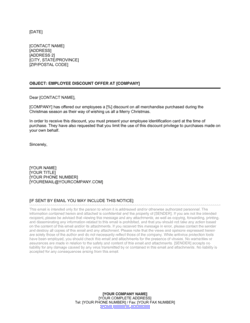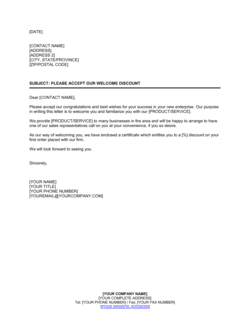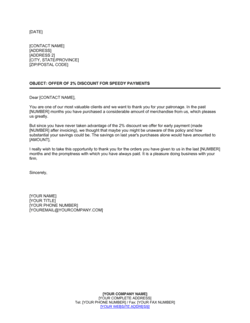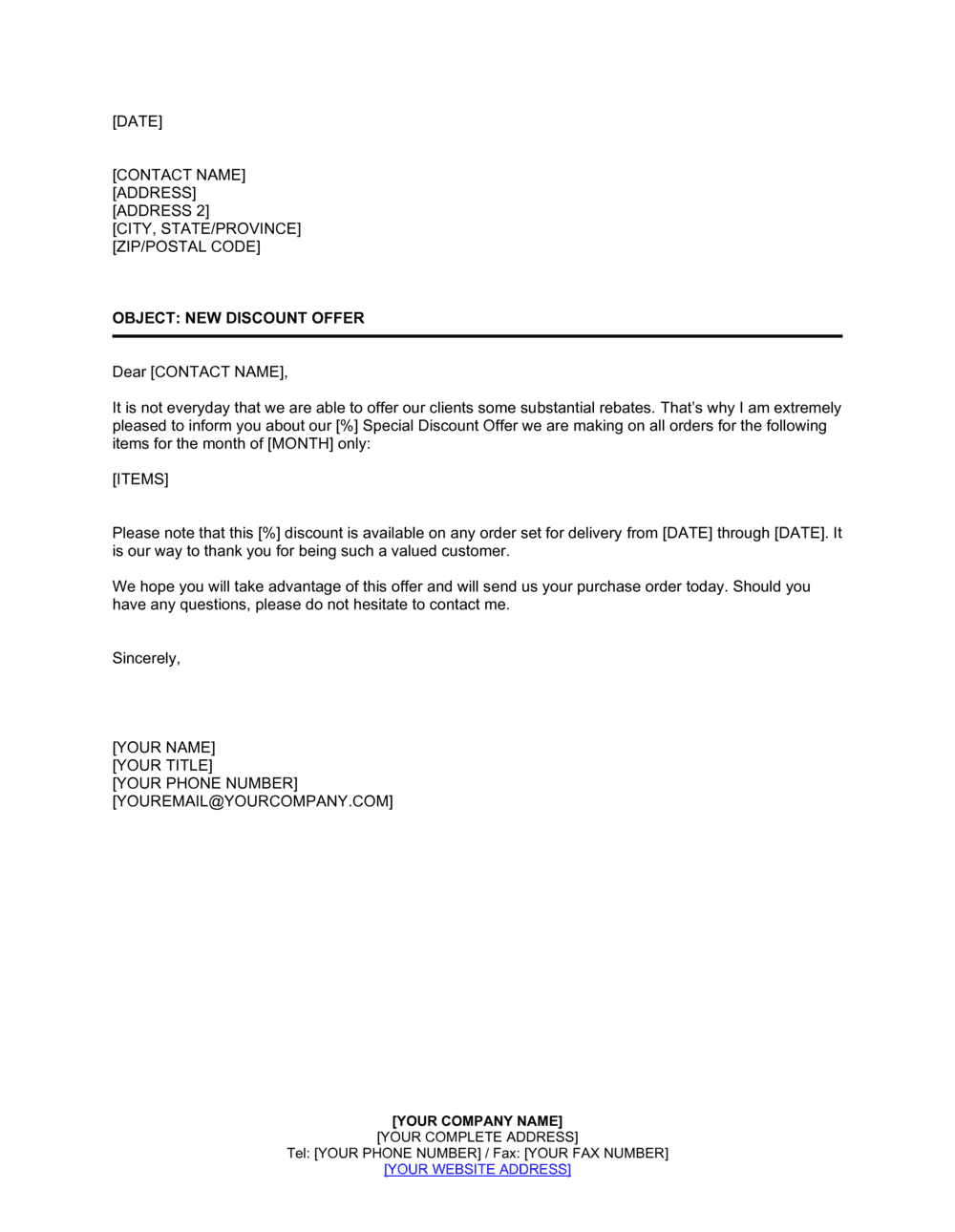
Announcement of New Discount Offer Template

Free Word download β€’ Edit online β€’ Save & share with Drive β€’ Export to PDF

1 pageβ€’15–25 min to fillβ€’Difficulty: Standard
Learn more ↓
FreeAnnouncement of New Discount Offer Template

At a glance

What it is
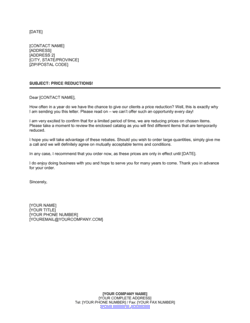
An Announcement of New Discount Offer is a formal business letter a company sends to customers, clients, or partners to communicate a new pricing reduction, promotional deal, or limited-time offer. This free Word download gives you a ready-to-edit template you can personalize with your discount details, eligibility conditions, and validity period, then send by email or post within minutes.
When you need it
Use it whenever you are launching a new discount for existing customers, rewarding loyal buyers, clearing seasonal inventory, or promoting a product or service to a targeted list. It is also appropriate when responding to competitive pressure with a price adjustment.
What's inside
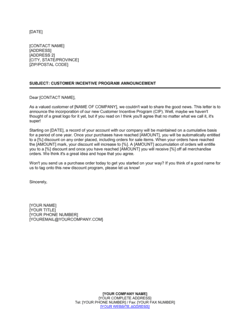
Sender and recipient details, a clear subject line, an opening that states the discount, the specific terms and eligibility conditions, validity dates, redemption instructions, and a professional closing with contact information.

What is an Announcement of New Discount Offer?

An Announcement of New Discount Offer is a formal business letter sent by a company to its customers, clients, or trade partners to communicate a new pricing reduction, promotional deal, or limited-time offer. It sets out the exact discount amount, the products or services it applies to, the eligibility conditions, the validity period, and how the recipient can redeem the offer. Unlike a generic promotional flyer, this letter is addressed to a specific individual or segment, giving the offer credibility and making the recipient feel the discount was extended intentionally rather than broadcast to everyone.

Why You Need This Document

Announcing a discount verbally or through a vague email leaves the terms open to interpretation β€” customers claim discounts on excluded products, redemption windows stay open indefinitely, and your sales team has no written reference to point to. A properly structured discount announcement letter eliminates all of that: it fixes the terms in writing, creates a clear deadline that drives action, and gives both sides a reference if a billing dispute arises. For B2B relationships, a formal letter also signals that the offer is authorized at a management level, which can accelerate a purchase decision that might otherwise wait for the next budget cycle. This template gives you the professional structure you need in under 15 minutes.

Which variant fits your situation?

If your situation is…Use this template
Announcing a discount to all customers at onceAnnouncement Of New Discount Offer
Offering a discount to a single client as part of a negotiationPrice Reduction Letter
Communicating a temporary sale with expiry date to your mailing listPromotional Announcement Letter
Notifying customers of a permanent price decrease on a productPrice Adjustment Notice
Sending a loyalty reward or referral discount to select customersCustomer Loyalty Discount Letter
Announcing a bulk or volume pricing tier to wholesale buyersVolume Discount Announcement

Common mistakes to avoid

❌ Burying the discount in the third paragraph

Why it matters: Readers scan business letters in under 10 seconds. If the offer is not in the first two sentences, most recipients never reach it.

Fix: State the discount percentage and product scope in the opening sentence. Every supporting detail follows.
❌ Omitting the offer end date

Why it matters: A discount letter without a deadline creates an open-ended liability β€” customers may try to redeem months later and claim the offer is still valid.

Fix: Always include a specific end date and time with timezone. State it in both the subject line and the body.

❌ Leaving out exclusions

Why it matters: Customers who apply the discount to excluded products feel misled when the billing doesn't match expectations, damaging the relationship the letter was meant to strengthen.

Fix: List exclusions explicitly in the eligibility section, or attach a schedule with the full terms and reference it in the letter.

❌ Using a generic greeting with no personalization

Why it matters: Letters addressed to 'Valued Customer' read as mass mail and are treated accordingly β€” lower engagement and lower conversion than named letters.

Fix: Address each letter to the individual's name and, for B2B, reference the specific account or relationship. Use mail-merge for large lists.

The 9 key clauses, explained

Sender and Recipient Header

In plain language: Identifies the sending company and the recipient by name, title, and address β€” following standard business letter format.

Sample language
[COMPANY NAME] | [ADDRESS] | [CITY, STATE, ZIP] | [DATE] To: [RECIPIENT NAME] [TITLE], [COMPANY] [ADDRESS]

Common mistake: Addressing the letter to a generic 'Valued Customer' instead of a named individual. Personalized letters achieve significantly higher response rates and signal that the offer is intentional, not mass spam.

Subject Line

In plain language: A single line that identifies the purpose of the letter before the body β€” ensures the reader knows immediately what the communication is about.

Sample language
Subject: Exclusive [X]% Discount Offer for [RECIPIENT NAME / CUSTOMER SEGMENT] β€” Valid Until [DATE]

Common mistake: Writing a vague subject like 'Special Offer' without stating the discount percentage or deadline. A specific subject line doubles the chance the letter is read before other mail.

Opening Statement

In plain language: Introduces the offer directly and establishes why the recipient is receiving it β€” loyalty, relationship, or a new promotional campaign.

Sample language
We are pleased to extend to you an exclusive [X]% discount on all [PRODUCT/SERVICE CATEGORY] purchases, effective [START DATE]. This offer is our way of thanking you for your continued partnership with [COMPANY NAME].

Common mistake: Opening with lengthy company background before stating the offer. Recipients decide in the first two sentences whether to keep reading β€” lead with the discount.

Discount Details

In plain language: States the exact discount β€” percentage off, flat dollar reduction, or free unit β€” and what it applies to, leaving no ambiguity.

Sample language
You will receive [X]% off the standard list price on all orders of [PRODUCT/SERVICE NAME] placed between [START DATE] and [END DATE]. The discount applies to a minimum order value of $[AMOUNT].

Common mistake: Stating the discount without defining what it applies to. 'X% off everything' causes billing disputes when customers apply it to excluded items or services.

Eligibility Conditions

In plain language: Specifies who qualifies β€” account type, purchase threshold, geography β€” and any exclusions that limit the offer's scope.

Sample language
This offer is available exclusively to customers with an active account in good standing as of [DATE]. It does not apply to [EXCLUDED PRODUCTS/SERVICES] or orders already placed before [START DATE].

Common mistake: Omitting exclusions from the letter and stating them only in a separate terms document the customer never reads. Undisclosed exclusions generate complaints and erode trust.

Validity Period and Deadline

In plain language: States the exact start and end dates β€” and any hard deadline for placing an order β€” to create urgency and prevent open-ended redemption claims.

Sample language
This offer is valid from [START DATE] through [END DATE] at 11:59 PM [TIMEZONE]. Orders must be received and confirmed by [COMPANY NAME] before the deadline to qualify.

Common mistake: Stating an end date without a timezone. Customers in different regions interpret 'midnight on the 30th' differently, leading to redemption disputes.

Redemption Instructions

In plain language: Tells the recipient exactly how to claim the discount β€” promo code, reference number, or contacting a sales representative.

Sample language
To redeem your discount, quote code [PROMO CODE] at checkout on [WEBSITE URL], or contact your account representative at [PHONE / EMAIL] and reference offer [OFFER ID].

Common mistake: Providing the discount without any redemption mechanism. If customers cannot figure out how to apply the offer in under 30 seconds, most will abandon it rather than call to ask.

Contact Information and Next Steps

In plain language: Provides the direct contact β€” name, phone, email β€” the recipient should use to place an order or ask questions about the offer.

Sample language
For questions or to place your order, please contact [REPRESENTATIVE NAME] at [PHONE NUMBER] or [EMAIL ADDRESS]. We are available [BUSINESS HOURS, TIMEZONE].

Common mistake: Listing a generic info@ email with no named contact. For B2B discount letters, a named representative increases reply rate and makes follow-up calls easier.

Professional Closing

In plain language: Closes the letter with a courteous sign-off, the sender's name and title, and the company's contact details β€” mirroring standard business letter format.

Sample language
We look forward to serving you and hope you take advantage of this limited-time offer. Sincerely, [SENDER FULL NAME] [TITLE], [COMPANY NAME] [PHONE] | [EMAIL]

Common mistake: Ending without a clear next-step reminder or sense of urgency. The closing paragraph should briefly restate the deadline so it is the last thing the reader sees.

How to fill it out

  1. 1

    Fill in your company and recipient details

    Enter your company name and address in the sender block and the recipient's full name, title, and address. If sending to multiple customers, use mail-merge fields rather than editing each copy manually.

    πŸ’‘ Always use the recipient's legal or registered business name for B2B letters β€” trade names and entity names differ and using the wrong one can cause confusion on purchase orders.

  2. 2

    Write a specific subject line with the discount and deadline

    Replace the placeholder subject line with the actual percentage or dollar discount and the exact offer end date. Keep it under 12 words.

    πŸ’‘ Discount percentage plus deadline in the subject line β€” e.g., '20% off all orders through June 30' β€” outperforms vague teasers in open rates consistently.

  3. 3

    State the discount clearly in the opening paragraph

    Lead the body of the letter with the offer itself β€” the percentage, what it covers, and the timeframe. Do not bury the headline in the third paragraph.

    πŸ’‘ If you are writing to existing customers, add one sentence explaining the relationship context: 'As a customer since [YEAR], you have been selected for this exclusive pricing.'

  4. 4

    Define eligibility conditions and exclusions

    List any minimum order value, eligible product categories, account status requirements, and explicitly excluded items or services. Be specific β€” 'select products' is not specific enough.

    πŸ’‘ If the list of exclusions is long, attach a separate schedule and reference it in the letter: 'see Schedule A for full terms.'

  5. 5

    Set the validity period with timezone

    Enter the exact start date, end date, and cutoff time including timezone. Confirm the order receipt cutoff with your operations team before sending.

    πŸ’‘ Short windows (7–14 days) drive faster response than open-ended offers. If the goal is urgency, keep validity under two weeks.

  6. 6

    Add a promo code or redemption reference

    Assign a unique promo code or offer ID that the customer quotes when ordering. This lets you track redemptions and attribute sales to the campaign.

    πŸ’‘ Use a code that encodes the campaign β€” e.g., SUMMER25 or Q2LOYAL β€” so your sales team instantly recognizes the offer without looking it up.

  7. 7

    Include a named contact and review before sending

    Add a specific representative's name, direct phone number, and email. Proofread the discount math β€” confirm the percentage matches your pricing system before the letter goes out.

    πŸ’‘ Send a test copy to an internal email first to check formatting, especially if using mail-merge β€” a letter addressed to 'Dear [FIRST_NAME]' is worse than no personalization at all.

Frequently asked questions

What is an announcement of new discount offer?

An announcement of new discount offer is a formal business letter sent to customers, clients, or trade partners to communicate a price reduction, promotional deal, or limited-time offer. It states the discount amount, what it applies to, who is eligible, the validity period, and how to redeem it β€” creating a written record of the offer and its terms.

When should I send a discount announcement letter?

Send one when launching a seasonal sale, rewarding loyal customers, clearing excess inventory, responding to competitive pricing pressure, or promoting a specific product or service to a targeted segment. It is also useful when offering a negotiated rate to a key account as part of a renewal or upsell conversation.

Does a discount announcement letter need to be signed?

A standard discount announcement letter does not require a signature to be effective β€” it is a commercial communication, not a binding contract. However, including the sender's name and title adds credibility and gives the recipient a direct point of contact. For large B2B accounts, a signed letter from a senior representative signals that the offer is formally authorized.

How long should a discount announcement letter be?

One page is the target for most audiences β€” typically three to five short paragraphs. Longer letters dilute the offer and reduce the chance the reader reaches the redemption instructions. If the terms are complex, summarize them in the letter and attach a separate terms schedule.

Can I send this letter by email instead of post?

Yes β€” this template works equally well as an email body or a PDF attachment. Email delivery is faster and allows you to track opens and clicks. For high-value B2B accounts, a printed letter on company letterhead sent by post alongside an email follow-up signals a higher level of attention and often generates a better response.

What discount percentage is typical in a business announcement letter?

There is no universal standard β€” discount depth depends on margin, objective, and audience. Retail promotional discounts commonly run 10–30%. B2B volume or loyalty discounts typically range from 5–20%. The letter itself should focus on the specific terms rather than benchmarking against industry norms; what matters is that the offer is clearly stated and the business can sustain the margin impact.

What is the difference between a discount announcement letter and a promotional flyer?

A discount announcement letter is a formal, addressed communication sent to a specific recipient or list β€” it uses business letter format, names the recipient, and states specific terms. A promotional flyer is a general-audience marketing piece designed for broad distribution with no personalization. The letter format is more appropriate for existing customers, key accounts, and B2B audiences where the relationship context matters.

Should I include a promo code in the letter?

Yes, whenever possible. A unique promo code or offer reference number lets your sales or checkout system apply the discount automatically, tracks redemptions for ROI measurement, and removes ambiguity for the customer. Without a code, customers must rely on a sales representative to manually apply the discount β€” which introduces delay and error.

How this compares to alternatives

vs Promotional Flyer

A promotional flyer is a general-audience visual piece designed for broad, impersonal distribution β€” posted in-store, attached to packaging, or broadcast on social media. A discount announcement letter is addressed to a specific recipient or segment, uses formal business letter format, and is appropriate for existing customer relationships or B2B accounts. The letter carries more authority and generates higher per-recipient response than a flyer.

vs Price Reduction Letter

A price reduction letter communicates a permanent decrease to the standard list price and is typically sent to all customers as a policy update. A discount announcement letter communicates a temporary promotional offer with a defined validity period and specific eligibility conditions. Use a price reduction letter for structural pricing changes and a discount announcement for time-limited campaigns.

vs Customer Loyalty Letter

A customer loyalty letter focuses on recognizing and thanking long-standing customers β€” the discount, if any, is secondary to the relationship message. A discount announcement letter leads with the offer details and uses the relationship as context for why the recipient was selected. When the primary goal is retention, use the loyalty letter; when the primary goal is driving a purchase within a specific window, use the discount announcement.

vs Sales Proposal

A sales proposal presents a tailored solution to a specific prospect's needs, including scope, pricing, and timeline β€” it is a complex, multi-page document used to close new business. A discount announcement letter is a short, single-purpose communication that notifies an existing customer of a pricing opportunity. Use the proposal for new or complex deals; use the announcement letter for quick-turn promotional offers to known buyers.

Industry-specific considerations

Retail and E-commerce

Seasonal clearance letters, loyalty discount notices, and flash-sale announcements sent to segmented customer lists with promo codes and cart-minimum conditions.

Professional Services

Discounted retainer rates or introductory pricing letters sent to prospects or lapsed clients, with eligibility tied to contract length or service bundle.

Manufacturing and Wholesale

Volume discount announcements to distributors and trade buyers, with tiered pricing schedules and minimum order quantities referenced in the letter.

Hospitality and Food Service

Off-peak pricing offers, group booking discounts, and loyalty member rate announcements sent to frequent guests or corporate account holders.

Template vs pro β€” what fits your needs?

PathBest forCostTime
Use the templateAny business announcing a discount to customers, clients, or trade partnersFree10–15 minutes per letter
Template + professional reviewHigh-value B2B accounts or offers with complex eligibility terms requiring marketing or legal input$50–$200 (copywriter or marketing advisor review)1–2 hours
Custom draftedEnterprise campaigns with legal terms, multi-jurisdiction compliance, or co-branded partner offers$300–$1,000+1–3 days

Glossary

Discount Offer
A temporary or permanent reduction in the standard price of a product or service communicated to a customer or group of customers.
Promotional Period
The specific date range during which a discounted price or special offer is valid and can be redeemed.
Eligibility Conditions
The criteria a customer must meet to qualify for the discount β€” such as minimum purchase amount, account status, or product category.
Promo Code
An alphanumeric code a customer enters at checkout to activate a discount, allowing the business to track redemptions.
Call to Action (CTA)
A direct instruction in the letter telling the recipient what to do next β€” such as 'call us by Friday' or 'visit our website to redeem your offer.'
Validity Period
The window of time, expressed as specific start and end dates, within which the offer must be used.
Exclusions
Products, services, or customer categories that are explicitly not covered by the discount offer.
Volume Discount
A price reduction applied when a customer purchases above a minimum quantity or dollar threshold in a single transaction or period.
Loyalty Pricing
A preferential discount offered to long-standing customers as a reward for repeat business and continued relationship.

Part of your Business Operating System

This document is one of 3,000+ business & legal templates included in Business in a Box.

  • Fill-in-the-blanks β€” ready in minutes
  • 100% customizable Word document
  • Compatible with all office suites
  • Export to PDF and share electronically

Create your document in 3 simple steps.

From template to signed document β€” all inside one Business Operating System.
1
Download or open template

Access over 3,000+ business and legal templates for any business task, project or initiative.

2
Edit and fill in the blanks with AI

Customize your ready-made business document template and save it in the cloud.

3
Save, Share, Send, Sign

Share your files and folders with your team. Create a space of seamless collaboration.

Save time, save money, and create top-quality documents.

β˜…β˜…β˜…β˜…β˜…

"Fantastic value! I'm not sure how I'd do without it. It's worth its weight in gold and paid back for itself many times."

Managing Director Β· Mall Farm
Robert Whalley
Managing Director, Mall Farm Proprietary Limited
β˜…β˜…β˜…β˜…β˜…

"I have been using Business in a Box for years. It has been the most useful source of templates I have encountered. I recommend it to anyone."

Business Owner Β· 4+ years
Dr Michael John Freestone
Business Owner
β˜…β˜…β˜…β˜…β˜…

"It has been a life saver so many times I have lost count. Business in a Box has saved me so much time and as you know, time is money."

Owner Β· Upstate Web
David G. Moore Jr.
Owner, Upstate Web

Run your business with a system β€” not scattered tools

Stop downloading documents. Start operating with clarity. Business in a Box gives you the Business Operating System used by over 250,000 companies worldwide to structure, run, and grow their business.

Start freeΒ Β·Β No credit card required