Announcement of Price Increase Template

Free Word download β€’ Edit online β€’ Save & share with Drive β€’ Export to PDF

1 pageβ€’15–20 min to fillβ€’Difficulty: Standard
Learn more ↓
FreeAnnouncement of Price Increase Template

At a glance

What it is
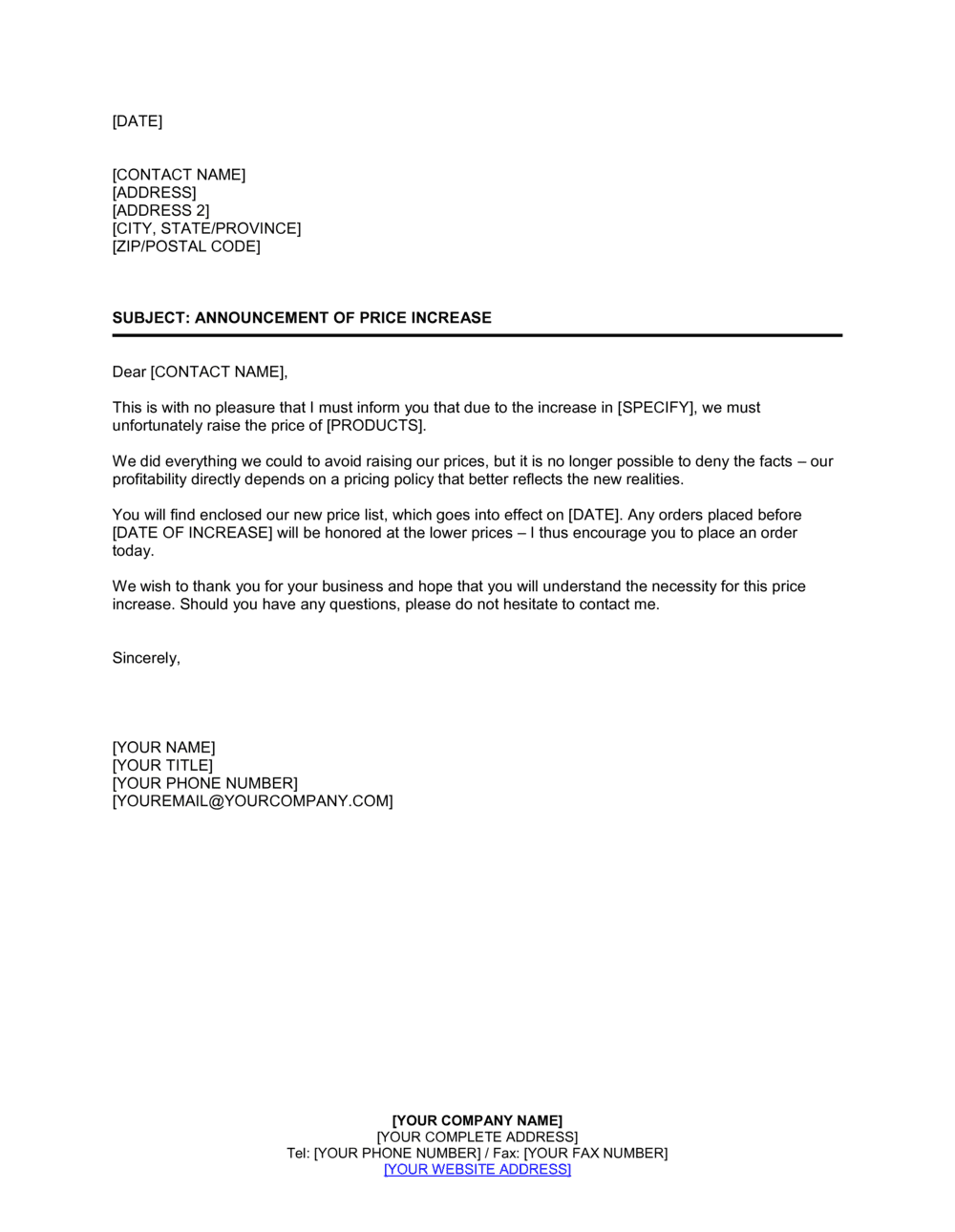
An Announcement of Price Increase is a formal business letter sent to existing customers to communicate an upcoming change in pricing β€” explaining the rationale, the new rates, and the effective date. This free Word download gives you a professionally structured template you can edit online and send by email or post in minutes.
When you need it
Use it whenever you need to raise prices due to rising costs, expanded service scope, or market repositioning β€” and want to notify customers professionally with enough lead time to maintain the relationship.
What's inside
Opening context and relationship acknowledgment, clear statement of the new pricing and effective date, explanation of the rationale, any grandfathering or transition terms, and a courteous closing with contact details for questions.

What is an Announcement of Price Increase?

An Announcement of Price Increase is a formal business letter sent to existing customers to notify them of an upcoming change in rates, fees, or subscription pricing. It states the new price and effective date clearly, explains the reason for the adjustment, and outlines any transition terms β€” such as a grandfather window or early-renewal incentive β€” designed to preserve the customer relationship through the change. Unlike a generic email blast, a well-structured price increase letter treats the notification as a relationship communication rather than a billing update.

Why You Need This Document

Raising prices without a formal, professionally written letter is one of the fastest ways to damage customer trust and accelerate churn. Customers who receive a surprise rate increase on their next invoice β€” with no prior notice and no explanation β€” have no context for the change and no time to adjust their budgets. A price increase letter gives them both. It also protects you contractually: many service agreements require written notice of rate changes within a defined period, and failing to provide it can make the new pricing unenforceable. This template gives you a proven structure that delivers the news clearly, justifies the change with a credible rationale, reinforces the value the customer receives, and gives them a specific action to take β€” reducing inbound complaints, accelerating renewals, and keeping the relationship intact through a change that is never easy to communicate.

Which variant fits your situation?

If your situation is…Use this template
Raising prices due to increased supplier or materials costsAnnouncement of Price Increase (Cost-Based)
Repositioning a premium service at a higher market rateAnnouncement of Price Increase (Market Repositioning)
Notifying customers of a subscription plan price changeSubscription Price Change Notice
Communicating a rate increase with a grandfathering periodPrice Increase Letter with Grandfathering Terms
Announcing a fee change to a regulated or government clientFormal Rate Adjustment Notice
Updating wholesale customers on revised trade pricingWholesale Price Revision Letter
Informing clients of a fuel or delivery surcharge additionSurcharge Announcement Letter

Common mistakes to avoid

❌ Giving less than 30 days' notice

Why it matters: Short notice leaves customers unable to update budgets, renegotiate contracts, or evaluate alternatives β€” increasing the likelihood of an angry response or immediate churn.

Fix: Send the letter at least 30 days before the effective date for consumer accounts and 60–90 days for B2B clients with annual contracts.
❌ Providing no rationale for the increase

Why it matters: Customers who receive a price increase with no explanation assume it is arbitrary, which damages trust and accelerates cancellations.

Fix: State one or two specific, honest reasons β€” a named cost increase, an added service capability, or a clear market factor β€” in two sentences or fewer.

❌ Burying the new price in explanatory text

Why it matters: Customers scan for the number first. If they cannot find it immediately, the letter feels evasive and generates more support contacts.

Fix: State the current price, the new price, and the effective date in a single clear sentence near the top of the letter body.

❌ No named contact for questions

Why it matters: Routing customer questions to a generic inbox signals that the price increase is a mass announcement rather than a relationship communication β€” increasing churn risk.

Fix: Include the name, direct email, and phone number of a specific account manager or customer success contact in the closing paragraph.

The 8 key clauses, explained

Salutation and relationship opener

In plain language: Addresses the customer by name and acknowledges the existing relationship before delivering the news.

Sample language
Dear [CUSTOMER NAME], We value your continued partnership with [COMPANY NAME] and appreciate the trust you have placed in us over the past [X] years.

Common mistake: Opening with the price change in the first sentence. Customers who feel ambushed are more likely to churn than those given a moment of relationship context first.

Statement of the price change

In plain language: Clearly states the new price or percentage increase and the product or service it applies to β€” no ambiguity.

Sample language
Effective [DATE], the price for [PRODUCT / SERVICE NAME] will increase from $[CURRENT PRICE] to $[NEW PRICE] per [UNIT / MONTH / YEAR], representing a [X]% adjustment.

Common mistake: Burying the new price in a paragraph of explanation. State the number clearly and early so the customer can assess the impact without hunting for it.

Effective date

In plain language: Specifies the exact calendar date the new pricing applies, giving the customer a clear planning horizon.

Sample language
This pricing adjustment will take effect on [DATE]. Orders or invoices issued before this date will be billed at the current rate of $[CURRENT PRICE].

Common mistake: Providing only a month or quarter without a specific date. Customers and their finance teams need a precise date to update purchase orders and budgets.

Rationale for the increase

In plain language: Explains the business reason β€” cost inflation, scope expansion, or market repositioning β€” in concrete terms without oversharing internal financials.

Sample language
This adjustment reflects a [X]% increase in [MATERIALS / LABOR / OPERATING COSTS] over the past [TIMEFRAME], as well as investments we have made in [SPECIFIC IMPROVEMENT β€” e.g., faster delivery, expanded support hours, upgraded platform].

Common mistake: Offering no rationale at all, or citing vague 'market conditions.' Customers accept price increases more readily when given a specific, credible reason.

Value reinforcement

In plain language: Reminds the customer of the concrete benefits they receive and any recent improvements to the product or service.

Sample language
Since [YEAR / LAST INCREASE], we have [LIST 2–3 SPECIFIC IMPROVEMENTS β€” e.g., reduced average response time from 48 hours to 4 hours, added [FEATURE], and expanded coverage to [REGION]].

Common mistake: Skipping this clause and moving directly from rationale to transition terms. Without value reinforcement, the letter reads as purely a cost notification rather than a relationship communication.

Grandfathering or transition terms

In plain language: Describes any special terms for existing customers β€” a locked-in rate window, a phased increase, or an early-renewal discount.

Sample language
As a valued existing customer, you are eligible to lock in your current rate of $[CURRENT PRICE] through [LOCK-IN DATE] by renewing your agreement before [RENEWAL DEADLINE]. After this date, the new rate of $[NEW PRICE] will apply.

Common mistake: Offering grandfathering without a clear deadline. An open-ended grandfather offer creates administrative complexity and reduces the incentive to act.

Action step or next steps

In plain language: Tells the customer exactly what to do next β€” nothing, renew early, sign an amendment, or contact their account manager.

Sample language
No action is required on your part if you wish to continue at the new rate. To lock in your current pricing before [DATE], please contact your account manager at [EMAIL / PHONE] or reply directly to this letter.

Common mistake: Leaving the customer without a clear next step. Ambiguity at this point in the letter increases inbound support calls and delays contract renewals.

Closing and contact details

In plain language: Thanks the customer for their continued business, expresses confidence in the ongoing relationship, and provides a direct contact for questions.

Sample language
We are grateful for your continued trust in [COMPANY NAME] and remain committed to delivering [VALUE PROPOSITION]. If you have any questions, please contact [NAME] at [EMAIL] or [PHONE NUMBER].

Common mistake: Closing with a generic sign-off and no named contact. Customers with concerns need a specific person to reach β€” routing them to a general inbox signals low priority.

How to fill it out

  1. 1

    Identify the affected products or services and new pricing

    List every product, service tier, or contract type affected by the change. Confirm the exact new price or percentage for each before drafting the letter.

    πŸ’‘ If you have multiple customer segments at different price points, create a separate version of the letter for each β€” do not send one letter with a range of possible prices.

  2. 2

    Set the effective date with adequate lead time

    Choose a specific calendar date that gives customers at least 30 days' notice for consumer accounts and 60–90 days for B2B contracts. Enter this date in every date placeholder.

    πŸ’‘ Align the effective date with the start of your billing cycle or the customer's contract renewal date to reduce administrative friction on both sides.

  3. 3

    Write the rationale in one to two specific sentences

    State the actual driver β€” e.g., a specific percentage rise in materials costs, a new service capability added, or a significant wage increase. Avoid vague language like 'rising costs across the board.'

    πŸ’‘ One concrete data point ('our logistics costs increased 18% over the past 12 months') is more persuasive than three paragraphs of general explanation.

  4. 4

    Add value reinforcement with two or three specific improvements

    List service or product improvements made since the last price review. These should be concrete: faster delivery, a new feature, extended support hours, or expanded coverage.

    πŸ’‘ If you genuinely have no improvements to cite, focus the rationale on external cost factors and keep this section brief β€” do not fabricate value.

  5. 5

    Define any grandfathering or transition terms with clear deadlines

    Decide whether you will offer a lock-in window, phased increase, or early-renewal discount. Enter the specific lock-in deadline and the action required to claim it.

    πŸ’‘ A 14–21 day window to lock in current pricing creates urgency without feeling coercive. Longer windows reduce conversion; shorter ones increase complaints.

  6. 6

    Personalize the salutation and insert the account manager's contact

    Replace all [PLACEHOLDERS] with the customer's name, your company name, and the direct contact details of the person handling the account.

    πŸ’‘ Mail merge the customer name and account details from your CRM rather than sending a visibly generic letter β€” a named contact improves response rates significantly.

Frequently asked questions

What should a price increase letter to customers include?

A price increase letter should include a clear statement of the new price and the effective date, a brief and honest rationale, a reminder of the value the customer receives, any transition or grandfathering terms available to existing customers, and a direct contact for questions. Missing any of these elements increases customer confusion and churn risk.

How much notice should I give customers before raising prices?

For consumer accounts, 30 days is generally the minimum. For B2B clients on annual contracts, 60–90 days is standard and often required by the contract itself. Check your existing service agreements for any notice provisions before setting the effective date β€” some contracts require written notice and a specific notice period to make a price change enforceable.

How do I explain a price increase without losing customers?

Be specific about the reason, quantify it where possible, and pair it with concrete evidence of the value the customer continues to receive. Customers accept price increases more readily when the rationale is credible and the communication is personal. Offering a grandfather window or early-renewal incentive reduces the immediate friction of the announcement.

Can I raise prices on customers who are mid-contract?

In most cases, you cannot raise prices on a customer mid-contract unless the contract includes a price adjustment clause β€” for example, a CPI escalation provision or a clause permitting increases with a defined notice period. Review the contract terms before sending the letter and consult a lawyer if the contract language is ambiguous. Price increases typically take effect at renewal for fixed-term agreements.

What is a grandfathering clause in a price increase letter?

A grandfathering clause offers existing customers the option to remain on their current pricing for a defined window β€” typically by renewing their agreement before a stated deadline. It rewards loyalty, reduces immediate churn, and creates a clear incentive for customers to act before the new rate takes effect. The window should have a specific end date to be effective.

How do I write a price increase letter for a service business?

Start by acknowledging the relationship, then state the new rate and effective date clearly. Explain the increase in one or two sentences β€” rising labor costs, expanded service scope, or market rate alignment are all credible reasons. Reinforce the value delivered, offer any transition terms, and close with a direct contact. Keep the letter under one page.

Should I apologize for raising prices in my letter?

No. Apologizing implies the price increase is unjustified, which undermines your rationale and invites pushback. Instead, use confident, matter-of-fact language that frames the change as a natural business adjustment. Acknowledge the impact briefly β€” 'We understand this represents a change to your budget' β€” but do not apologize for a decision that reflects real costs or genuine value.

Is a price increase letter legally required?

In most standard commercial relationships, there is no statutory requirement to send a formal price increase letter β€” but your service contract may require written notice of rate changes. In consumer contexts, some regulated industries (telecommunications, utilities, financial services) have statutory notice obligations. Review your contracts and any applicable regulations before setting the notice period and delivery method.

How this compares to alternatives

vs Proposal / Quote

A proposal or quote presents pricing to a prospective customer before a relationship is established. A price increase letter addresses existing customers to notify them of a change to already-agreed rates. The tone, purpose, and timing are entirely different β€” one opens a conversation, the other manages an ongoing one.

vs Service Agreement Amendment

A service agreement amendment is a formal contract document that modifies the binding terms of an existing agreement, including price. A price increase letter is a communication tool β€” it informs the customer and may trigger an amendment, but is not itself a contract modification. For contractually bound rates, an amendment or addendum is required to make the change legally effective.

vs Contract Renewal Letter

A contract renewal letter invites the customer to continue the relationship at renewal, and may introduce revised terms. A price increase letter focuses specifically on a rate change and can be sent independently of a renewal cycle. The two are often combined when the increase coincides with the renewal date.

vs Customer Apology Letter

A customer apology letter addresses a service failure or mistake. A price increase letter communicates a planned business decision. Conflating the two tones β€” apologetic language in a price increase letter β€” undermines the rationale and signals that the increase is unjustified. Keep the price increase letter confident and factual.

Industry-specific considerations

Professional Services

Annual rate reviews for retainer clients, with grandfathering tied to early contract renewal and specific productivity or scope improvements cited as justification.

SaaS and Technology

Subscription plan price changes require grandfather windows for current subscribers and clear communication of new feature value to justify the increase.

Construction and Trades

Materials and labor cost pass-throughs, often referencing published commodity price indices to substantiate the increase to trade and commercial clients.

Wholesale and Distribution

Trade price revisions tied to supplier cost increases, freight surcharges, or currency movements β€” typically communicated 60–90 days before the effective date.

Template vs pro β€” what fits your needs?

PathBest forCostTime
Use the templateSmall businesses, freelancers, and service providers sending standard rate increase notices to existing customersFree15–30 minutes
Template + professional reviewBusinesses with complex contract terms, regulated industries, or large enterprise accounts where the letter triggers a formal amendment$100–$300 (lawyer or contract specialist review)1–2 days
Custom draftedCompanies with statutory notice obligations, multi-jurisdiction customer bases, or pricing changes tied to regulatory filings$300–$8002–5 days

Glossary

Effective Date
The specific calendar date on which the new pricing takes effect for new or existing transactions.
Grandfathering
A transition provision that allows existing customers to remain on their current pricing for a defined period after the new rates take effect.
Rate Adjustment
A formal change to the price charged for a product or service, typically expressed as a percentage increase or a new absolute figure.
Lead Time
The amount of advance notice given to customers before a price change becomes effective β€” typically 30 to 90 days for B2B relationships.
Cost Pass-Through
A pricing mechanism where increases in input costs β€” materials, labor, logistics β€” are transferred directly to the customer.
Transition Period
A defined window during which both old and new pricing may apply, giving customers time to adjust contracts or purchasing plans.
Price Anchoring
The practice of referencing the current (lower) price alongside the new price to frame the increase as modest relative to the value delivered.
Contract Renewal
The point at which an existing service agreement is extended, often the natural moment to introduce revised pricing terms.
Value Justification
The explanation of service improvements, added features, or market factors that support the rationale for a price increase.
Opt-Out Window
A defined period in which a customer may cancel or renegotiate their agreement without penalty before the new pricing applies.

Part of your Business Operating System

This document is one of 3,000+ business & legal templates included in Business in a Box.

  • Fill-in-the-blanks β€” ready in minutes
  • 100% customizable Word document
  • Compatible with all office suites
  • Export to PDF and share electronically

Create your document in 3 simple steps.

From template to signed document β€” all inside one Business Operating System.
1
Download or open template

Access over 3,000+ business and legal templates for any business task, project or initiative.

2
Edit and fill in the blanks with AI

Customize your ready-made business document template and save it in the cloud.

3
Save, Share, Send, Sign

Share your files and folders with your team. Create a space of seamless collaboration.

Save time, save money, and create top-quality documents.

β˜…β˜…β˜…β˜…β˜…

"Fantastic value! I'm not sure how I'd do without it. It's worth its weight in gold and paid back for itself many times."

Managing Director Β· Mall Farm
Robert Whalley
Managing Director, Mall Farm Proprietary Limited
β˜…β˜…β˜…β˜…β˜…

"I have been using Business in a Box for years. It has been the most useful source of templates I have encountered. I recommend it to anyone."

Business Owner Β· 4+ years
Dr Michael John Freestone
Business Owner
β˜…β˜…β˜…β˜…β˜…

"It has been a life saver so many times I have lost count. Business in a Box has saved me so much time and as you know, time is money."

Owner Β· Upstate Web
David G. Moore Jr.
Owner, Upstate Web

Run your business with a system β€” not scattered tools

Stop downloading documents. Start operating with clarity. Business in a Box gives you the Business Operating System used by over 250,000 companies worldwide to structure, run, and grow their business.

Start freeΒ Β·Β No credit card required