Announcement of Price Reduction Template

Free Word download β€’ Edit online β€’ Save & share with Drive β€’ Export to PDF

1 pageβ€’15–20 min to fillβ€’Difficulty: Standard
Learn more ↓
FreeAnnouncement of Price Reduction Template

At a glance

What it is
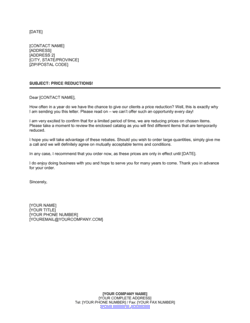
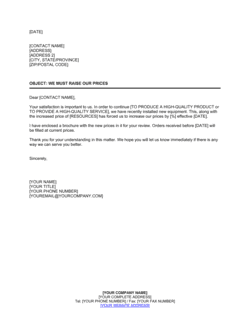
An Announcement of Price Reduction is a formal business letter sent to customers, clients, or distribution partners to notify them that a product or service price has been lowered. This free Word download gives you a ready-to-edit template you can personalize with your new pricing, effective date, and rationale, then send by email or post in minutes.
When you need it
Use it whenever you permanently or temporarily reduce a price β€” after a cost improvement, a competitive repositioning, a promotional campaign, or a volume-discount rollout β€” and want to communicate the change professionally and in writing.
What's inside
Sender and recipient details, a clear statement of the old and new price, the effective date of the change, a brief explanation of the reason for the reduction, any conditions or limitations that apply, and a call to action inviting the recipient to place an order or reach out with questions.

What is an Announcement of Price Reduction?

An Announcement of Price Reduction is a formal business letter a company sends to its customers, clients, or trade partners to inform them that the price of a specific product or service has been permanently or temporarily lowered. It states the previous price, the new price, the date the change takes effect, and a brief rationale β€” giving recipients everything they need to update their records, revise budgets, and take advantage of the lower rate. Unlike a casual email or a website update, a formal written announcement creates a documented record of the pricing change and signals that the sender is communicating a deliberate business decision.

Why You Need This Document

Failing to communicate a price reduction in writing creates the same friction as failing to communicate a price increase β€” customers who discover the change on an invoice rather than through a direct notice feel uninformed and are slower to act on the opportunity. Without a formal letter, your sales team fields inconsistent questions about when the new price applies, whether open orders are covered, and which products are included. A clear, dated announcement eliminates those calls, protects your billing team from disputes, and turns a cost improvement into a sales opportunity: customers who feel rewarded by a proactive price reduction are measurably more likely to increase order volume. This template gives you the structure to communicate the change in under 15 minutes with nothing important left out.

Which variant fits your situation?

If your situation is…Use this template
Notifying customers of a permanent list-price reductionAnnouncement of Price Reduction
Communicating a time-limited promotional discountPromotional Offer Letter
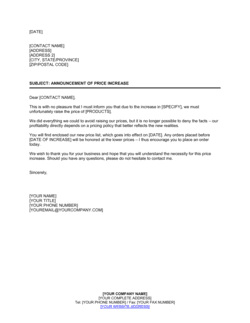
Advising clients of a price increase insteadAnnouncement of Price Increase
Sending a volume-discount schedule to trade accountsVolume Discount Pricing Letter
Revising full product catalog pricing for distributorsNew Price List Announcement
Notifying a supplier of reduced purchasing pricesSupplier Price Negotiation Letter
Offering a loyalty discount to long-standing customersCustomer Loyalty Discount Letter

Common mistakes to avoid

❌ Burying the new price mid-letter

Why it matters: Readers who scan the opening paragraph and don't see the key information assume the letter is routine correspondence and delay reading it, missing the call to action entirely.

Fix: State the old price, new price, and effective date in the first two sentences β€” the announcement should be unmissable at first glance.

❌ Omitting the effective date

Why it matters: Without a clear effective date, recipients don't know when to start placing orders at the new price, and your billing team cannot apply the correct rate consistently.

Fix: Include a specific calendar date β€” 'effective June 1, 2026' β€” in both the subject line and the opening paragraph.

❌ Not specifying whether open orders are covered

Why it matters: Customers with orders already in the pipeline will expect the lower price; if you haven't addressed it, disputes arise at invoicing.

Fix: Add one sentence explicitly stating whether the new price applies retroactively to pending orders or only to new orders placed on or after the effective date.

❌ No call to action or named contact

Why it matters: A price reduction announcement with no invitation to act is a missed sales opportunity β€” the reader has no clear next step and the momentum is lost.

Fix: Close with a specific instruction: the name, direct phone number, and email of the account representative the recipient should contact, or a direct URL to place an order.

The 8 key clauses, explained

Sender and recipient header

In plain language: Identifies who is sending the letter and who is receiving it, including company names, addresses, and the date.

Sample language
[SENDER COMPANY NAME] | [STREET ADDRESS] | [CITY, STATE, ZIP] | [DATE] | Attention: [RECIPIENT NAME] | [RECIPIENT COMPANY NAME] | [RECIPIENT ADDRESS]

Common mistake: Addressing the letter to a generic title ('The Purchasing Department') when you have a named contact β€” impersonal openers reduce engagement and can delay the letter reaching the right decision-maker.

Subject line

In plain language: A brief, bolded reference line that tells the recipient exactly what the letter is about before they read the body.

Sample language
RE: Price Reduction on [PRODUCT / SERVICE NAME] β€” Effective [DATE]

Common mistake: Omitting the subject line entirely. Without it, the recipient must read the full letter before understanding the purpose, increasing the chance it gets filed without action.

Opening statement

In plain language: The first paragraph announces the price reduction directly and states the effective date with no preamble.

Sample language
We are pleased to inform you that effective [DATE], the price of [PRODUCT / SERVICE NAME] will be reduced from $[OLD PRICE] to $[NEW PRICE] per [UNIT / MONTH / LICENSE].

Common mistake: Burying the price reduction in the second or third paragraph after a lengthy introduction. Recipients scan letters first β€” state the key fact in the opening sentence.

Reason for the reduction

In plain language: A concise explanation of why the price is being lowered β€” cost efficiencies, supplier improvements, competitive repositioning, or a policy decision β€” to build credibility and trust.

Sample language
This reduction reflects cost efficiencies achieved through [IMPROVED MANUFACTURING PROCESS / RENEGOTIATED SUPPLIER AGREEMENTS / ECONOMIES OF SCALE], and we are passing these savings directly to our customers.

Common mistake: Skipping the rationale entirely. Customers who receive an unexplained price drop may question product quality or assume a clearance event β€” a one-sentence reason prevents misinterpretation.

Scope and conditions

In plain language: Specifies which products, services, SKUs, or plans the new price applies to, and any conditions such as minimum order quantity, regional limits, or expiry.

Sample language
This reduced price applies to all orders of [PRODUCT NAME] (SKU: [XXXXXX]) placed on or after [DATE]. Orders must meet a minimum quantity of [X UNITS]. The new price is available to all accounts in [REGION / TERRITORY].

Common mistake: Failing to state whether the reduction applies to existing open orders or only to new orders placed after the effective date β€” ambiguity leads to billing disputes.

Price comparison table or summary

In plain language: A simple side-by-side display of the old price and the new price for easy reference, particularly useful when multiple products or tiers are affected.

Sample language
Product: [PRODUCT NAME] | Previous Price: $[OLD PRICE] | New Price: $[NEW PRICE] | Savings: $[DIFFERENCE] ([PERCENTAGE]%)

Common mistake: Stating only the new price without referencing the old price. Recipients who don't remember the previous rate cannot appreciate the reduction or its value.

Call to action

In plain language: Invites the recipient to take a specific next step β€” place an order, contact their account representative, or visit a portal β€” while the benefit is fresh.

Sample language
To take advantage of this new pricing, please contact your account representative at [PHONE / EMAIL] or place your order at [URL] by [DATE, if applicable].

Common mistake: Closing with a vague invitation like 'feel free to reach out.' A specific action with a named contact and channel converts announcements into orders.

Closing and signature block

In plain language: The complimentary close, sender's name, title, company, and contact details β€” completing the formal letter and establishing accountability.

Sample language
Sincerely, [SENDER FULL NAME] | [TITLE] | [COMPANY NAME] | [PHONE] | [EMAIL]

Common mistake: Signing with only a first name or department name. The full name and title confirm the sender's authority and give the recipient a specific person to follow up with.

How to fill it out

  1. 1

    Fill in the sender and recipient header

    Enter your company's full name, mailing address, and the letter date. Then add the recipient's full name, title, company, and address. Use the legal entity name for corporate recipients.

    πŸ’‘ Confirm the recipient's current title and address before sending β€” outdated details signal a mass mailout and reduce response rates.

  2. 2

    Write the subject line with the product name and effective date

    Complete the RE: line with the exact product or service name and the date the new price takes effect. This is the first thing a busy reader sees.

    πŸ’‘ Keep the subject line under 12 words β€” longer reference lines get truncated in email previews and printed headers.

  3. 3

    State the old price, new price, and effective date in the opening

    In the first paragraph, write the current price, the reduced price, and the date the change applies. Do not save this information for later in the letter.

    πŸ’‘ Express the savings as both a dollar amount and a percentage β€” '$20 less per unit (15% savings)' β€” to make the benefit concrete.

  4. 4

    Add a one-sentence reason for the reduction

    Explain in plain language why the price is going down β€” cost savings passed on, supplier renegotiation, increased production volume, or a competitive decision. Keep it to one or two sentences.

    πŸ’‘ Avoid language that implies the previous price was unfair. Frame the reason as a positive business development, not a correction.

  5. 5

    Define the scope and any conditions

    List which products or SKUs are affected, any minimum order requirements, geographic limits, and whether the price applies to existing open orders or only new ones placed after the effective date.

    πŸ’‘ If multiple products are affected, attach a revised price list rather than listing every item in the letter body β€” it keeps the letter concise and the data easy to reference.

  6. 6

    Add a price comparison table for clarity

    Insert a simple two-column table or formatted row showing the old price, new price, and the savings per unit or subscription period.

    πŸ’‘ Including the percentage reduction alongside the dollar figure helps recipients quickly calculate their annual savings β€” a natural motivator to increase order volume.

  7. 7

    Close with a specific call to action and your signature

    Direct the recipient to a named contact, phone number, email, or ordering portal. Complete the complimentary close with your full name, title, and direct contact details.

    πŸ’‘ If the reduced price is time-limited or subject to stock availability, state the deadline clearly in the call to action β€” urgency increases response rates.
Frequently asked questions

What is an announcement of price reduction?

An announcement of price reduction is a formal business letter sent by a seller to its customers or trade partners to notify them that the price of a specific product or service has been permanently or temporarily lowered. It states the old price, the new price, the effective date, and the reason for the change, giving recipients the information they need to update their budgets and place orders at the new rate.

When should I send a price reduction announcement?

Send it as soon as the new pricing is confirmed and before the effective date β€” ideally 7 to 14 days in advance so recipients can plan purchases or update their own systems. Common triggers include a supplier cost reduction passed on to buyers, a production efficiency gain, a competitive repositioning, or the end of a cost-recovery period.

Does a price reduction announcement need to be signed?

A signature is not legally required for a price notification letter to be effective, but including the sender's full name, title, and direct contact details adds credibility and gives the recipient a specific person to follow up with. For high-value accounts or significant price changes, a personally signed letter carries more weight than an unsigned circular.

Should I explain why I am lowering the price?

Yes, briefly. A one or two sentence rationale β€” such as improved manufacturing efficiency, renegotiated supplier terms, or increased production volume β€” prevents recipients from assuming a clearance event, a product phase-out, or a quality concern. A clear reason builds confidence and reinforces the relationship.

Can I use this letter to announce a temporary promotional price reduction?

Yes, with one modification: include a clear expiry date in the scope and conditions clause so recipients understand the reduced price is time-limited. State the promotional period (e.g., 'valid on orders placed between June 1 and June 30, 2026') and note that the standard list price will resume after that date.

What is the difference between a price reduction announcement and a discount offer?

A price reduction announcement communicates a permanent or policy-level change to the standard list price, applicable to all qualifying orders going forward. A discount offer is typically a one-time or limited promotional incentive β€” a coupon, a sale, or a deal β€” that does not change the underlying list price. The announcement is more appropriate when you are resetting pricing as a business decision rather than running a short-term promotion.

How do I handle customers who paid the higher price recently?

If you intend to offer price protection β€” crediting or refunding the difference on recent purchases β€” state that explicitly in the conditions clause of the letter. Define the lookback window (e.g., orders placed within the 30 days before the effective date) and the mechanism for claiming the credit. If no price protection is offered, do not leave the question unanswered β€” customers will ask, and a proactive statement prevents frustration.

Should the letter go to all customers or only selected accounts?

Send it to all customers and trade partners who purchase the affected product or service. Selectively notifying some accounts but not others creates pricing confusion, breeds distrust when buyers compare notes, and can create perceived discrimination in business-to-business relationships. If different customer tiers receive different new prices, send a tailored version to each tier rather than omitting any group.

Can I include the updated price list as an attachment?

Yes, and it is recommended when more than three products are affected. Reference the attachment in the scope clause β€” 'Please refer to the attached revised price list effective [DATE]' β€” so the letter body stays concise and the detailed pricing data is easy to file and reference separately.

How this compares to alternatives

vs Announcement of Price Increase

A price increase announcement notifies customers that they will pay more, which requires more careful framing around cost justification and advance notice to soften the impact. A price reduction announcement is a positive communication but still needs a clear effective date and scope. Use the price increase letter when costs have risen; use this template when you are passing savings on to buyers.

vs Promotional Offer Letter

A promotional offer letter communicates a time-limited discount or deal without changing the underlying list price. An announcement of price reduction sets a new permanent (or policy-level) price as the standard going forward. If the lower price will eventually revert, use a promotional offer letter and state the expiry date explicitly.

vs New Price List Announcement

A new price list announcement distributes a revised schedule covering many products at once, often attached as a separate document. An announcement of price reduction focuses on one product or a small set of items and reads as a personal communication rather than a catalog update. Use the price list format when more than five items change; use this letter for targeted, high-impact reductions.

vs Sales Proposal

A sales proposal introduces pricing as part of a competitive bid for new business β€” it is forward-looking and tailored to a specific opportunity. A price reduction announcement communicates a change to existing pricing for current customers. The proposal wins new clients; this letter retains and rewards existing ones.

Industry-specific considerations

Manufacturing and Distribution

Price reductions are driven by raw-material cost decreases or production scale; the letter is sent to distributors and resellers with an updated wholesale price list attached.

Retail and E-commerce

Retailers use price reduction letters to notify trade buyers or loyalty program members of permanent markdowns on specific SKUs, often timed to a category review or inventory cycle.

SaaS and Technology

Subscription price reductions β€” new lower tiers, plan consolidations, or legacy-plan discounts β€” require a formal notice to existing subscribers specifying the date the new billing rate takes effect.

Professional Services

Consulting or agency firms use price reduction letters to revise retainer or project rates for long-standing clients, often framing the reduction as a loyalty or volume commitment benefit.

Template vs pro β€” what fits your needs?

PathBest forCostTime
Use the templateAny business communicating a price reduction to customers, clients, or trade partnersFree10–15 minutes per letter
Template + professional reviewBusinesses reducing prices on high-value contracts where conditions, retroactive coverage, or legal commitments are involved$100–$300 (brief review by a business advisor or attorney)1–2 hours
Custom draftedEnterprise or regulated-industry price changes that interact with long-term supply agreements, government contracts, or pricing covenants$300–$1,000+1–3 days

Glossary

Effective Date
The specific calendar date from which the new lower price applies to purchases or orders.
List Price
The standard published price for a product or service before any discounts or negotiated terms are applied.
Price Reduction
A permanent or temporary decrease in the selling price of a product or service, distinct from a one-time discount or coupon.
SKU (Stock Keeping Unit)
A unique identifier assigned to a specific product variant, used to reference the exact item whose price is being changed.
Call to Action
A direct instruction to the recipient at the close of the letter β€” such as placing an order or contacting a sales representative β€” designed to convert the announcement into a transaction.
Retroactive Pricing
Applying a new lower price to orders already placed but not yet invoiced or shipped β€” must be explicitly stated if intended.
Price Protection
A commitment to honor the new lower price for orders already in the pipeline before the effective date, reducing friction for buyers who recently purchased.
Conditions or Limitations
Specific restrictions on the reduced price, such as minimum order quantity, product line scope, geographic applicability, or expiry date.
Salutation
The opening greeting of a formal business letter β€” typically 'Dear [NAME]' or 'Dear Valued Customer' β€” that sets the tone and addresses the recipient directly.
Complimentary Close
The sign-off phrase before the sender's signature, such as 'Sincerely' or 'Best regards,' signaling the end of the formal letter body.

Part of your Business Operating System

This document is one of 3,000+ business & legal templates included in Business in a Box.

  • Fill-in-the-blanks β€” ready in minutes
  • 100% customizable Word document
  • Compatible with all office suites
  • Export to PDF and share electronically

Create your document in 3 simple steps.

From template to signed document β€” all inside one Business Operating System.
1
Download or open template

Access over 3,000+ business and legal templates for any business task, project or initiative.

2
Edit and fill in the blanks with AI

Customize your ready-made business document template and save it in the cloud.

3
Save, Share, Send, Sign

Share your files and folders with your team. Create a space of seamless collaboration.

Save time, save money, and create top-quality documents.

β˜…β˜…β˜…β˜…β˜…

"Fantastic value! I'm not sure how I'd do without it. It's worth its weight in gold and paid back for itself many times."

Managing Director Β· Mall Farm
Robert Whalley
Managing Director, Mall Farm Proprietary Limited
β˜…β˜…β˜…β˜…β˜…

"I have been using Business in a Box for years. It has been the most useful source of templates I have encountered. I recommend it to anyone."

Business Owner Β· 4+ years
Dr Michael John Freestone
Business Owner
β˜…β˜…β˜…β˜…β˜…

"It has been a life saver so many times I have lost count. Business in a Box has saved me so much time and as you know, time is money."

Owner Β· Upstate Web
David G. Moore Jr.
Owner, Upstate Web

Run your business with a system β€” not scattered tools

Stop downloading documents. Start operating with clarity. Business in a Box gives you the Business Operating System used by over 250,000 companies worldwide to structure, run, and grow their business.

Start freeΒ Β·Β No credit card required