Announcement of New Area Representative Template

Free Word download β€’ Edit online β€’ Save & share with Drive β€’ Export to PDF

1 pageβ€’20–25 min to fillβ€’Difficulty: Standard
Learn more ↓
FreeAnnouncement of New Area Representative Template

At a glance

What it is
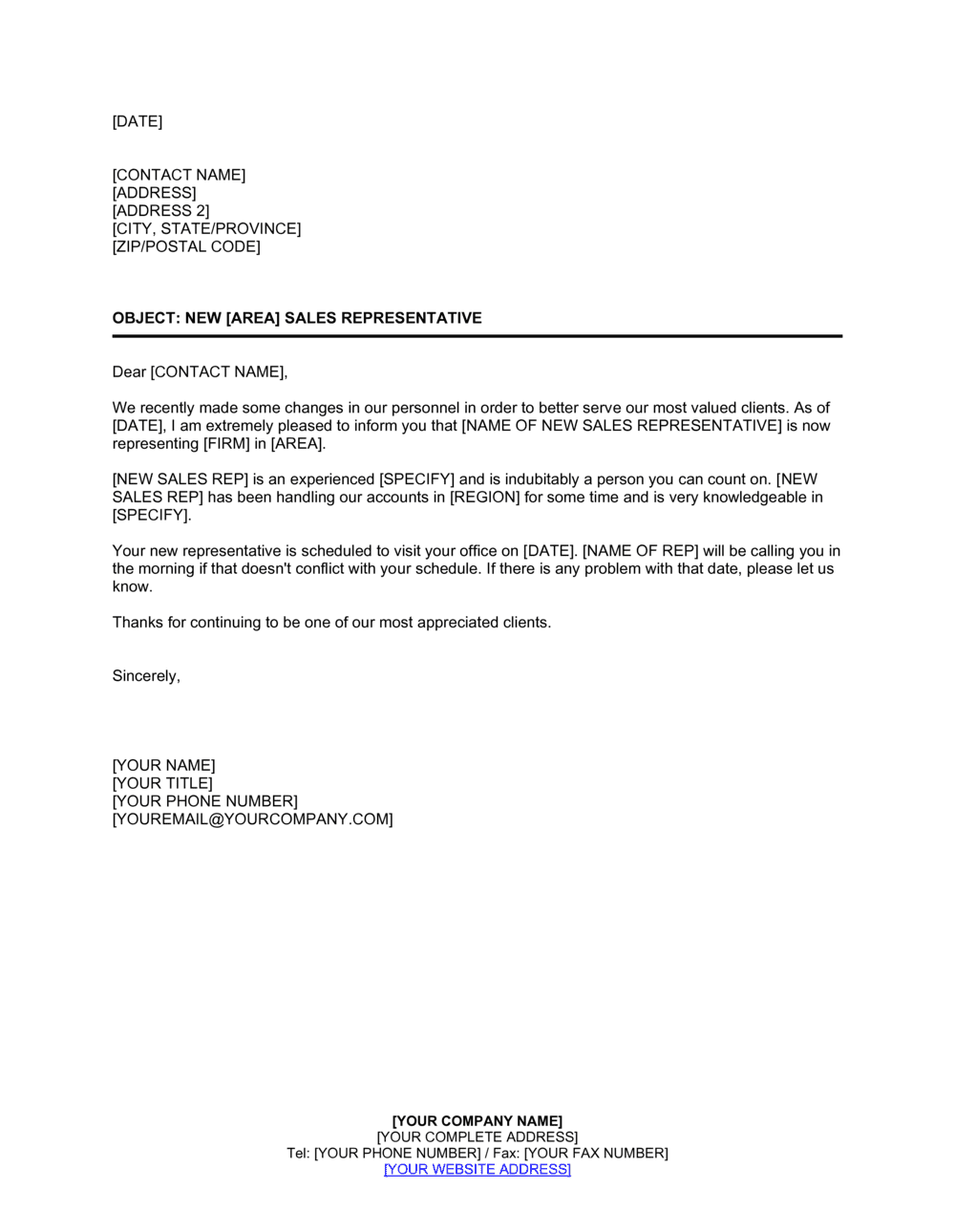
An Announcement of New Area Representative is a formal business letter sent by a company to notify clients, partners, or stakeholders that a new representative has been assigned to their account or geographic territory. This free Word download gives you a ready-to-edit template you can personalize and send in minutes, either as a printed letter or by email attachment.
When you need it
Use it when a new regional or account representative takes over an existing territory, when a territory is restructured and reassigned, or when a company is expanding into a new area and appointing its first local contact. Sending the letter promptly prevents relationship gaps and ensures clients know exactly who to call.
What's inside
The letter covers a formal salutation, a concise announcement of the appointment, a brief professional background of the new representative, clear contact details, and a closing that invites the recipient to reach out. An optional transition paragraph is included to acknowledge the outgoing representative where applicable.

What is an Announcement of New Area Representative?

An Announcement of New Area Representative is a formal business letter sent by a company to notify existing clients, partners, distributors, or other stakeholders that a new representative has been assigned to manage their geographic territory or account. The letter introduces the new contact by name, provides a concise professional background to establish credibility, and supplies direct contact details so recipients know immediately how to reach them. It may also acknowledge the outgoing representative and confirm that account history has been transferred to ensure continuity.

Why You Need This Document

Failing to formally announce a territory or account representative change leaves clients in the dark β€” they may receive calls from an unfamiliar name with no context, or worse, continue attempting to reach a representative who has moved on. Either scenario creates friction, signals organizational disorganization, and puts client relationships at risk during a vulnerable transition period. A timely, well-written announcement letter closes that gap by giving clients the name, background, and direct contact they need before the transition affects them. It also demonstrates that your company manages change proactively, which reinforces client confidence and reduces the risk of attrition. This template gives you a professionally structured letter you can personalize and send in under 15 minutes, ensuring every recipient receives a consistent, credible introduction to their new point of contact.

Which variant fits your situation?

If your situation is…Use this template
Introducing a new rep while also acknowledging a departing oneAnnouncement Of New Area Representative (With Transition)
Announcing a new internal department contact to staffMemo β€” Internal Staff Announcement
Formally welcoming a newly hired employee to clientsNew Employee Announcement Letter
Notifying partners of a change in account managerChange Of Account Manager Announcement
Announcing a new distributor or channel partner to a regionNew Distributor Announcement Letter
Introducing new executive leadership to a client baseExecutive Appointment Announcement Letter

Common mistakes to avoid

❌ Sending the letter after the representative has already started calling clients

Why it matters: Clients who receive a call from an unfamiliar name before receiving any introduction are more likely to treat it as a cold call and disengage, damaging the relationship from day one.

Fix: Send the announcement letter at least five business days before the new representative's first client outreach so recipients are already expecting contact.

❌ Using a generic salutation such as 'Dear Valued Customer'

Why it matters: Generic salutations signal a mass mailing rather than a personal communication, reducing the likelihood that the recipient reads past the first line.

Fix: Personalize each letter with the recipient's name. If the volume is too high for individual letters, use mail-merge to populate the name field from your CRM.

❌ Omitting direct contact details for the new representative

Why it matters: Without a direct phone number and email address, the letter gives recipients no clear path to act, and they are likely to do nothing β€” or call the main line and feel frustrated.

Fix: Always include the new representative's direct phone and email in the body of the letter, not just in the signature block.

❌ Including the transition acknowledgment paragraph for new territory expansions

Why it matters: Referencing a handover when there is no predecessor confuses recipients and implies discontinuity where none exists, raising unnecessary questions.

Fix: Delete the transition paragraph entirely when the letter announces the first representative for a territory. Only include it when a named predecessor is being acknowledged.

❌ Signing the letter from a junior staff member or the representative themselves

Why it matters: When the new representative signs their own introduction letter, it lacks the organizational endorsement that reassures clients the appointment is official and supported.

Fix: Have a senior manager β€” regional director, VP of Sales, or company owner β€” sign the letter to give the announcement proper authority.

❌ Sending one letter to all accounts regardless of account tier

Why it matters: High-value accounts notice when they receive the same generic letter as smaller customers, which can signal that their relationship is not prioritized.

Fix: Segment your account list and send a more personalized version to top-tier accounts, referencing specific shared history or upcoming priorities for that client.

The 9 key clauses, explained

Sender and Date Block

In plain language: The sender's company name, address, and the date the letter is issued, placed at the top of the document.

Sample language
[COMPANY NAME] | [STREET ADDRESS] | [CITY, STATE, ZIP] | [DATE]

Common mistake: Using an informal date format such as '5/2/26' instead of 'May 2, 2026' β€” abbreviated dates look careless on formal business correspondence.

Recipient Address Block

In plain language: The full name, title, company, and mailing address of the person or organization receiving the letter.

Sample language
[RECIPIENT NAME] | [TITLE] | [COMPANY NAME] | [STREET ADDRESS] | [CITY, STATE, ZIP]

Common mistake: Addressing the letter to a job title only (e.g., 'The Purchasing Manager') when the contact name is known β€” personalized letters have a significantly higher open and response rate.

Reference Line

In plain language: An optional one-line subject indicator placed above the salutation to identify the letter's purpose at a glance.

Sample language
Re: Appointment of New Area Representative β€” [TERRITORY / REGION NAME]

Common mistake: Omitting the reference line entirely. Recipients who receive high volumes of correspondence may file or discard the letter before reading it without a clear subject indicator.

Opening Announcement Paragraph

In plain language: States clearly and immediately that a new area representative has been appointed, who they are, and the effective date of their assignment.

Sample language
We are pleased to announce that [NEW REPRESENTATIVE FULL NAME] has been appointed as our new Area Representative for [TERRITORY / REGION], effective [DATE].

Common mistake: Burying the announcement in the second or third paragraph after introductory pleasantries β€” recipients should know the purpose of the letter within the first two sentences.

Representative Background Paragraph

In plain language: Provides a brief, relevant professional profile of the new representative to establish credibility and help the recipient feel confident in the new contact.

Sample language
[NEW REPRESENTATIVE NAME] brings [X] years of experience in [INDUSTRY / FUNCTION]. Prior to joining [COMPANY NAME], [he/she/they] served as [PREVIOUS ROLE] at [PREVIOUS COMPANY], where [RELEVANT ACHIEVEMENT].

Common mistake: Writing a full career history instead of one or two targeted sentences. Two relevant facts β€” years of experience and one quantified achievement β€” are more persuasive than a full resume summary.

Contact Information Paragraph

In plain language: Provides the new representative's direct phone number, email address, and any relevant office address so the recipient can immediately reach out.

Sample language
[NEW REPRESENTATIVE NAME] can be reached directly at [PHONE NUMBER] or [EMAIL ADDRESS]. [He/She/They] will be your primary contact for all inquiries related to [PRODUCT / SERVICE / ACCOUNT] in [TERRITORY].

Common mistake: Providing only a general company phone number or email alias instead of the representative's direct contact details β€” this defeats the purpose of the announcement and frustrates recipients trying to reach the right person.

Transition Acknowledgment Paragraph (optional)

In plain language: Acknowledges the outgoing representative by name, thanks them for their service, and reassures the recipient that continuity and account history will be maintained.

Sample language
We would like to take this opportunity to thank [OUTGOING REPRESENTATIVE NAME] for [his/her/their] dedicated service to your account over the past [X] years. [NEW REPRESENTATIVE NAME] has been fully briefed on your account history and is prepared to ensure a smooth transition.

Common mistake: Including this paragraph even when there is no outgoing representative to acknowledge β€” in new territory expansions, there is no predecessor and the paragraph creates confusion.

Closing and Call to Action

In plain language: Invites the recipient to contact the new representative directly, expresses confidence in the relationship, and signals the company's commitment to continued service.

Sample language
We encourage you to reach out to [NEW REPRESENTATIVE NAME] at your earliest convenience. We are confident that [he/she/they] will provide the same high standard of service you have come to expect from [COMPANY NAME]. Please do not hesitate to contact us if you have any questions.

Common mistake: Closing with a vague 'feel free to contact us' without specifying who to contact or how β€” always tie the call to action directly to the new representative's name and contact details already provided.

Complimentary Close and Signature Block

In plain language: The sign-off phrase followed by the sender's printed name, title, and optionally a handwritten or digital signature.

Sample language
Sincerely, | [SENDER NAME] | [TITLE] | [COMPANY NAME] | [PHONE] | [EMAIL]

Common mistake: Signing the letter with only a first name or initials. A formal business letter requires the sender's full printed name and title below the signature to establish authority and accountability.

How to fill it out

  1. 1

    Enter the sender and date information

    Fill in your company's full legal name, mailing address, and today's date at the top of the template. Use the written-out date format β€” 'May 2, 2026' not '05/02/26'.

    πŸ’‘ If you are sending the letter on company letterhead, delete the sender address block from the template β€” the letterhead already carries that information.

  2. 2

    Address each recipient by name

    Enter the recipient's full name, job title, company name, and mailing address. If sending to multiple recipients, create a separate letter for each rather than using a generic salutation.

    πŸ’‘ Pull recipient names from your CRM rather than typing from memory to avoid spelling errors β€” a misspelled client name undermines the letter's professionalism.

  3. 3

    Add a reference line identifying the territory

    Insert a reference line above the salutation that names the specific territory or region β€” for example, 'Re: New Area Representative β€” Pacific Northwest Region'.

    πŸ’‘ Recipients who receive many vendor communications will file this letter by the reference line. A clear territory name makes it easy to retrieve.

  4. 4

    Write the opening announcement with the effective date

    State the new representative's full name and the precise effective date of their appointment in the first paragraph. Do not delay this information.

    πŸ’‘ If the letter is going out after the effective date has already passed, adjust the language to 'has been appointed' rather than 'will be appointed' to avoid confusion.

  5. 5

    Complete the representative's background in two to three sentences

    Include years of relevant experience, one previous role, and one specific achievement or qualification. Keep it to three sentences maximum.

    πŸ’‘ Lead with the credential most relevant to the recipient's industry β€” a logistics client cares more about supply chain experience than a general sales background.

  6. 6

    Insert direct contact details

    Enter the new representative's direct phone number and email address. Confirm these details with the representative before sending.

    πŸ’‘ Send the letter only after the representative's company email and phone line are fully active β€” routing a client to a non-functional number on day one creates a poor first impression.

  7. 7

    Include or remove the transition paragraph

    Include the transition paragraph if there is an outgoing representative to acknowledge. Delete it entirely for new territory expansions where no predecessor exists.

    πŸ’‘ If the departure of the previous representative was contentious, keep the transition paragraph brief and forward-focused β€” avoid any language that could be interpreted as negative toward the departing individual.

  8. 8

    Sign and send from the appropriate authority

    The letter should be signed by a senior manager β€” typically the sales director, regional manager, or company owner β€” to signal that the appointment carries organizational weight.

    πŸ’‘ For high-value accounts, consider a follow-up phone call from the signing manager within 48 hours of the letter's delivery to reinforce the transition personally.

Frequently asked questions

What is an announcement of new area representative letter?

An announcement of new area representative letter is a formal business communication sent by a company to clients, partners, or stakeholders to introduce a newly appointed representative for a specific geographic territory or account group. It identifies the new contact by name, provides a brief professional background, and supplies direct contact details so recipients know exactly who to call going forward.

When should I send a new area representative announcement?

Send the letter at least five business days before the new representative begins making client contact. This gives recipients time to read the letter, update their records, and feel prepared when they receive a call or email from an unfamiliar name. For high-value accounts, a personal phone call from senior management before the letter arrives further reinforces the transition.

Who should sign the announcement letter?

A senior manager β€” typically the regional sales director, VP of Sales, or company owner β€” should sign the letter. Having the letter signed by someone with organizational authority signals that the appointment is official and endorsed at a leadership level. The new representative should not sign their own introduction letter.

Should the letter mention the outgoing representative?

Yes, if there is an outgoing representative whose departure the clients may notice. Acknowledging them by name, thanking them for their service, and confirming that the new representative has been briefed on account history reassures clients and demonstrates professionalism. If the letter announces a new territory with no predecessor, omit this paragraph entirely.

Can I send this announcement by email instead of a printed letter?

Yes. The same content works as the body of a formal email, or as a PDF attachment to an email. For most business contexts today, email delivery is faster and equally acceptable. For high-value accounts or industries where printed correspondence carries more weight β€” legal, financial services, government β€” a printed letter on company letterhead is preferable.

How long should the announcement letter be?

One page is the standard length. The letter should cover the announcement, the new representative's background in two to three sentences, direct contact details, an optional transition acknowledgment, and a brief closing call to action. A letter that runs longer than one page typically contains more information than the recipient needs at this stage.

What details about the new representative should I include?

Include the representative's full name, years of relevant experience, one or two specific credentials or accomplishments relevant to the recipient's industry, their direct phone number, and their direct email address. Avoid reproducing a full resume β€” two targeted sentences of background are more persuasive and easier to read than a detailed career history.

Do I need a separate letter for each client, or can I send one letter to all?

For best results, personalize each letter with the recipient's name and company. If the volume makes individual drafting impractical, use mail-merge to populate names from your CRM. At minimum, segment your account list and write a more tailored version for top-tier accounts that references shared history or specific upcoming priorities.

How this compares to alternatives

vs New Employee Announcement Letter

A new employee announcement letter is typically sent internally to staff to introduce a new hire. An announcement of new area representative is sent externally to clients, partners, or distributors to introduce their new point of contact. Both introduce a person, but the audience, tone, and focus differ β€” the area representative letter emphasizes continuity of service and provides direct contact details for the recipient's immediate use.

vs Introduction Letter

A general introduction letter introduces a company or individual to a new prospect with no prior relationship. An announcement of new area representative addresses an existing client or partner who already has a relationship with the company and needs to know their contact has changed. The existing-relationship context makes the announcement letter warmer in tone and focused on continuity rather than acquisition.

vs Change of Contact Information Letter

A change of contact information letter updates recipients on new phone numbers, addresses, or email addresses for an existing contact. An announcement of new area representative introduces an entirely different person. When the contact change involves a personnel change rather than just updated details, the area representative announcement is the appropriate format.

vs Business Announcement Letter

A general business announcement letter covers a broad range of organizational news β€” new services, office openings, or policy changes. An announcement of new area representative is a focused, person-specific communication designed to introduce a named individual and supply direct contact details. Use the specific template when the announcement centers on a single representative appointment rather than a broader organizational update.

Industry-specific considerations

Wholesale and Distribution

Territory rep changes are frequent in distribution networks, making a standardized announcement letter essential for maintaining uninterrupted supplier-distributor relationships.

Pharmaceutical and Medical Devices

Regulatory compliance and clinical purchasing decisions are relationship-driven, so introducing a new rep with verified credentials and direct contact details is critical for maintaining procurement trust.

Financial Services

Account continuity is closely monitored by clients; a formal written announcement with a named transition from the outgoing advisor reduces client attrition risk.

Manufacturing

Long-standing supplier relationships mean clients expect personal notification of any representative change, particularly when the rep manages ongoing service or warranty accounts.

Template vs pro β€” what fits your needs?

PathBest forCostTime
Use the templateSales managers, business owners, and operations teams announcing rep changes to existing client listsFree10–15 minutes per letter
Template + professional reviewCompanies sending announcements to high-value accounts or regulated industries where tone and accuracy are critical$50–$150 (communications or marketing professional review)1–2 hours
Custom draftedEnterprise-scale territory restructures requiring multiple tailored letters, multilingual versions, or brand-voice alignment across a large account base$200–$600 (copywriter or communications agency)1–3 days

Glossary

Area Representative
An individual assigned by a company to manage client relationships, sales activity, or service delivery within a defined geographic territory.
Territory
A defined geographic area or set of accounts for which a representative holds primary responsibility.
Account Transition
The formal handover of client relationship management from one representative to another, ideally documented and communicated in writing.
Salutation
The opening greeting of a formal letter, addressing the recipient by name or title β€” for example, 'Dear Ms. [NAME]'.
Call to Action
A specific instruction in the letter inviting the recipient to take a next step, such as contacting the new representative directly.
Cc (Carbon Copy)
A line at the bottom of a formal letter listing additional recipients who receive a copy β€” typically the new representative and relevant internal managers.
Complimentary Close
The sign-off phrase before the sender's signature β€” typically 'Sincerely,' 'Best regards,' or 'Yours faithfully' in formal business correspondence.
Block Format
The standard layout for formal business letters in which all text is left-aligned and paragraphs are separated by a blank line rather than an indent.
Reference Line
An optional line placed above the salutation (e.g., 'Re: New Area Representative β€” [TERRITORY]') that helps recipients file and track the correspondence.

Part of your Business Operating System

This document is one of 3,000+ business & legal templates included in Business in a Box.

  • Fill-in-the-blanks β€” ready in minutes
  • 100% customizable Word document
  • Compatible with all office suites
  • Export to PDF and share electronically

Create your document in 3 simple steps.

From template to signed document β€” all inside one Business Operating System.
1
Download or open template

Access over 3,000+ business and legal templates for any business task, project or initiative.

2
Edit and fill in the blanks with AI

Customize your ready-made business document template and save it in the cloud.

3
Save, Share, Send, Sign

Share your files and folders with your team. Create a space of seamless collaboration.

Save time, save money, and create top-quality documents.

β˜…β˜…β˜…β˜…β˜…

"Fantastic value! I'm not sure how I'd do without it. It's worth its weight in gold and paid back for itself many times."

Managing Director Β· Mall Farm
Robert Whalley
Managing Director, Mall Farm Proprietary Limited
β˜…β˜…β˜…β˜…β˜…

"I have been using Business in a Box for years. It has been the most useful source of templates I have encountered. I recommend it to anyone."

Business Owner Β· 4+ years
Dr Michael John Freestone
Business Owner
β˜…β˜…β˜…β˜…β˜…

"It has been a life saver so many times I have lost count. Business in a Box has saved me so much time and as you know, time is money."

Owner Β· Upstate Web
David G. Moore Jr.
Owner, Upstate Web

Run your business with a system β€” not scattered tools

Stop downloading documents. Start operating with clarity. Business in a Box gives you the Business Operating System used by over 250,000 companies worldwide to structure, run, and grow their business.

Free Forever PlanΒ Β·Β No credit card required