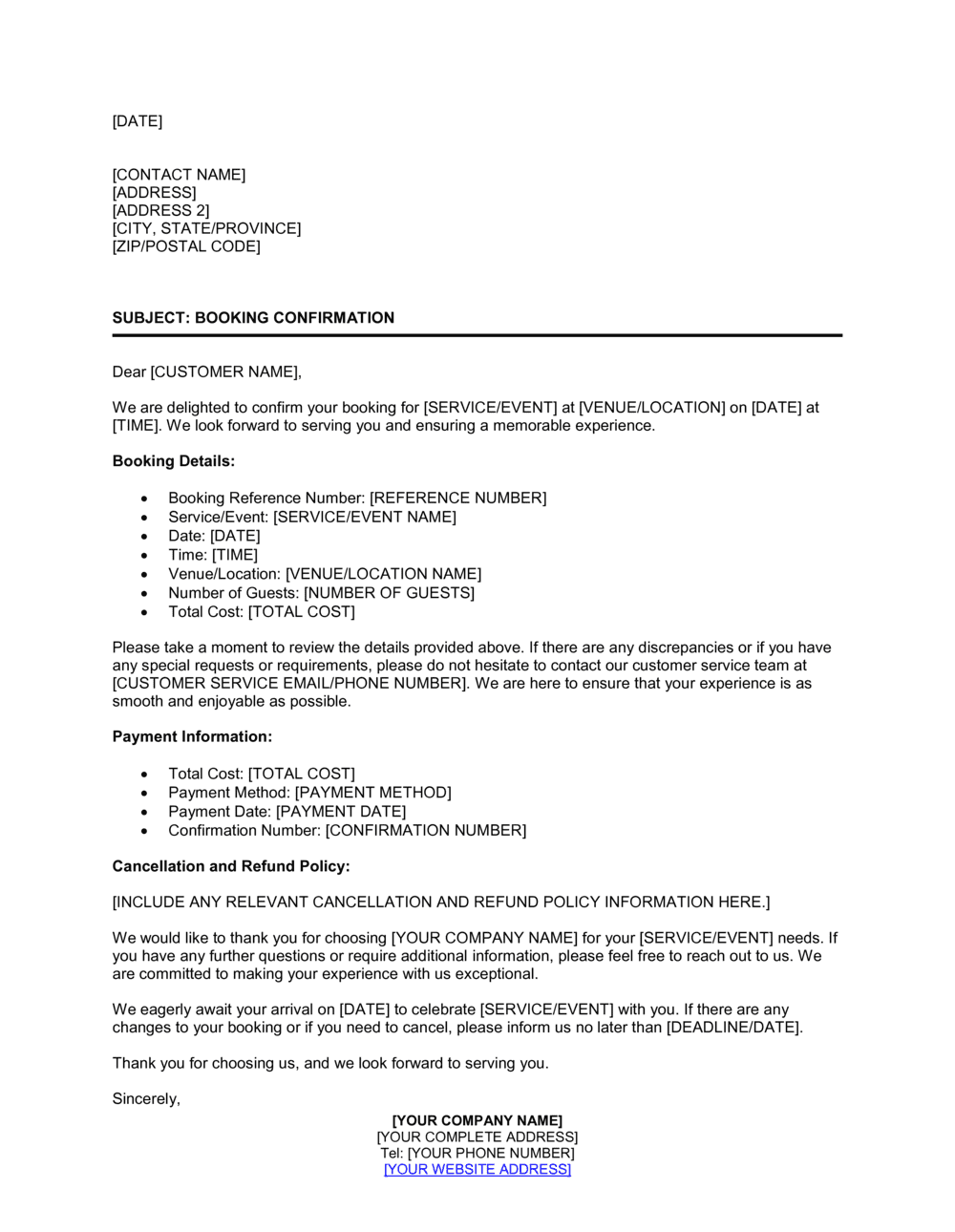
Booking Confirmation Letter Template

Free Word download • Edit online • Save & share with Drive • Export to PDF

2 pages15–20 min to fillDifficulty: Standard
Learn more ↓
FreeBooking Confirmation Letter Template

At a glance

What it is
A Booking Confirmation Letter is a formal written notice sent by a service provider to a customer confirming that a reservation has been accepted and recorded. This free Word download lets you fill in the booking details — date, time, location, services, total cost, and cancellation policy — and send a professional confirmation in minutes.
When you need it
Send it immediately after a customer pays a deposit or finalises a reservation — for hotel stays, venue hire, transport, event coordination, or professional service appointments. It establishes a shared written record before the service date arrives.
What's inside
The letter covers the customer and provider details, a precise description of the booked service, confirmed date and time, pricing and payment schedule, cancellation and refund terms, and any special instructions or conditions the customer must acknowledge.

What is a Booking Confirmation Letter?

A Booking Confirmation Letter is a formal written notice sent by a service provider to a customer confirming that a reservation has been accepted, recorded, and held for the agreed date and time. It documents the specific service booked, the total cost, the deposit paid and balance due, and the cancellation policy — creating a single written record that both parties can refer to if any detail is questioned before or on the service date. Hotels, venues, transport operators, event coordinators, and professional services firms all use this letter to eliminate the ambiguity that verbal or email-thread confirmations routinely leave behind.

Why You Need This Document

Without a formal confirmation letter, booking disputes are almost impossible to resolve cleanly. Customers remember what they were told, not what was agreed in writing — and when service dates, inclusions, or refund entitlements are disputed, a clear written record is the only evidence that holds. Missing confirmation details — a vague inclusions list, no stated balance due date, a cancellation policy buried in a separate document the customer never read — are the direct cause of chargebacks, refund demands, and negative reviews that damage reputation and revenue. A well-structured booking confirmation letter sent within 24 hours of deposit closes all of those gaps in under ten minutes, and this free Word template gives you the exact structure to do it consistently every time.

Which variant fits your situation?

If your situation is…Use this template
Confirming a hotel room or accommodation reservationHotel Booking Confirmation Letter
Confirming a venue hire for a wedding, conference, or private eventVenue Booking Confirmation Letter
Confirming a transport or charter vehicle bookingTransport Booking Confirmation Letter
Confirming a scheduled professional services appointmentAppointment Confirmation Letter
Following up after a customer misses or cancels a bookingCancellation Confirmation Letter
Notifying a customer of a change to an existing confirmed bookingBooking Amendment Letter
Confirming a group or corporate block bookingGroup Booking Confirmation Letter

Common mistakes to avoid

❌ Omitting the cancellation policy from the letter

Why it matters: If the policy is not stated in the confirmation, customers can legitimately argue they were never informed — making it very difficult to withhold a deposit or charge a cancellation fee.

Fix: Include the full cancellation tiers — with specific notice periods and dollar amounts — in every confirmation letter, not as a separate attachment or website link.
❌ Confirming the date but not the time

Why it matters: Customers who arrive an hour early or late create real operational problems — rooms aren't ready, staff aren't scheduled, and subsequent bookings get disrupted.

Fix: Always state both a start time and, where relevant, an end time or checkout time in the booking details block.

❌ Using vague descriptions of inclusions

Why it matters: Terms like 'full event setup' or 'standard package' mean different things to different customers and routinely lead to on-the-day disputes about what was promised.

Fix: List every included item individually — tables, chairs, AV equipment, linen, parking — and add a short exclusions note for anything commonly assumed but not covered.

❌ Sending the confirmation days after the booking was made

Why it matters: A delayed confirmation creates anxiety for the customer and suggests the booking may not be firmly held — they may double-book elsewhere or call repeatedly to verify.

Fix: Send the confirmation letter within 24 hours of receiving the deposit or finalising the reservation, ideally on the same business day.

The 8 key clauses, explained

Header and reference details

In plain language: Opens the letter with the provider's letterhead, the date issued, the customer's name and address, and a unique booking reference number.

Sample language
[COMPANY NAME] | [ADDRESS] | [DATE] | Booking Reference: [REF-XXXXXX] | Dear [CUSTOMER NAME],

Common mistake: Omitting the booking reference number — without it, both parties have to search through correspondence to identify the correct reservation when a question or dispute arises.

Confirmation statement

In plain language: A direct, single-sentence opening paragraph confirming that the booking has been accepted and recorded.

Sample language
We are pleased to confirm your booking with [COMPANY NAME] as detailed below.

Common mistake: Starting with lengthy pleasantries instead of a clear confirmation statement — the customer opens this letter looking for a simple 'yes, you are booked' and should find it in the first line.

Booking details

In plain language: Specifies the service booked, the confirmed date and time, duration, and the location or delivery address.

Sample language
Service: [SERVICE DESCRIPTION] | Date: [DATE] | Time: [START TIME] – [END TIME] | Location: [VENUE / ADDRESS]

Common mistake: Listing only the date without confirming the start time — customers arrive at the wrong time, creating operational disruption and disputes over responsibility.

Services and inclusions

In plain language: Lists exactly what is included in the booking — facilities, equipment, staff, catering, or other items covered by the agreed fee.

Sample language
Your booking includes: [ITEM 1], [ITEM 2], [ITEM 3]. Items not included: [EXCLUSION 1], [EXCLUSION 2].

Common mistake: Describing inclusions vaguely — writing 'standard setup' instead of specifying whether tables, chairs, AV, or catering staff are actually included causes disputes on the day.

Pricing and payment schedule

In plain language: States the total cost, the deposit already paid, the remaining balance, and the date by which it must be settled.

Sample language
Total Fee: $[AMOUNT] | Deposit Received: $[AMOUNT] on [DATE] | Balance Due: $[AMOUNT] by [DATE]

Common mistake: Confirming the total price but not the balance due date — customers assume they can pay on the day, which creates cash-flow problems and delays on arrival.

Cancellation and refund policy

In plain language: Sets out the deadlines and financial consequences for cancellation by either the customer or the provider.

Sample language
Cancellations received more than [X] days before the booking date will receive a full refund. Cancellations within [X] days will forfeit the deposit. Cancellations within [X] hours of the booking will be charged in full.

Common mistake: Referencing 'our standard cancellation policy' without stating it in the letter — customers cannot be held to a policy they were not clearly given at the time of confirmation.

Special instructions and conditions

In plain language: Notes any customer-specific requirements the provider has agreed to, as well as conditions the customer must meet — arrival time, ID requirements, dress code, or access restrictions.

Sample language
Please note: [SPECIAL ARRANGEMENT / REQUIREMENT]. [CUSTOMER NAME] must [CONDITION — e.g., present photo ID / arrive by TIME / confirm final numbers by DATE].

Common mistake: Leaving agreed special arrangements out of the confirmation letter — if a dietary requirement or accessibility need is not written down, it is easily overlooked by the operational team.

Contact and next-steps

In plain language: Provides the customer with a named contact and direct communication channel for questions, amendments, or pre-arrival logistics.

Sample language
For any questions or amendments, please contact [CONTACT NAME] at [EMAIL] or [PHONE NUMBER]. We look forward to welcoming you on [DATE].

Common mistake: Listing only a generic info@ email address — customers with time-sensitive questions cannot reach anyone directly, and amendment requests go unacknowledged until it is too late to act.

How to fill it out

  1. 1

    Add your company letterhead and booking reference

    Enter your business name, address, phone, and email at the top. Assign a unique booking reference number using a consistent format — e.g., BK-2026-0047.

    💡 Store booking references in a simple spreadsheet or booking system so you can retrieve any confirmation in under 30 seconds when a customer calls.

  2. 2

    Address the letter to the correct contact

    Use the customer's full name and the billing address they provided at the time of booking. For corporate bookings, include the company name and the specific individual who made the reservation.

    💡 For group bookings, address the letter to the lead booker even if the service is for a larger party — it keeps accountability clear.

  3. 3

    Fill in the booking details block

    Enter the service description, confirmed date, start and end time, and the precise location or delivery address. Double-check the date and time against your internal booking calendar before sending.

    💡 If the booking spans multiple days, list each date separately rather than writing a date range — 'March 4–6' is ambiguous about whether the 6th is included.

  4. 4

    List inclusions and exclusions explicitly

    Write out every item or service covered by the fee in bullet form. Then add a brief exclusions note for anything a customer might reasonably expect but that is not included.

    💡 Review your last three booking disputes — the items customers argued about most should be in your exclusions list going forward.

  5. 5

    State the total cost, deposit paid, and balance due date

    Enter the full fee, acknowledge the deposit amount and the date it was received, calculate the remaining balance, and set a specific calendar date for payment.

    💡 Set the balance due date at least 48 hours before the service date — same-day payment chasing is stressful for both parties.

  6. 6

    Insert your cancellation policy in full

    Copy your cancellation tiers into the letter — do not reference a separate document. State the exact notice periods and the financial consequence of each tier.

    💡 Use days, not vague terms like 'short notice' or 'late cancellation' — a customer 10 days out may believe they qualify for a refund if the policy is unclear.

  7. 7

    Add special instructions and a named contact

    Record any special arrangements agreed with the customer and any conditions they must fulfill before or on the day. Close with a named contact person and direct email or phone number.

    💡 Read the letter aloud before sending — anything that sounds ambiguous to you will definitely sound ambiguous to the customer.

Frequently asked questions

What is a booking confirmation letter?

A booking confirmation letter is a formal written notice from a service provider to a customer confirming that a reservation has been accepted, recorded, and is held for the agreed date. It states the service details, pricing, payment schedule, and cancellation terms so both parties have a clear written record to refer to before the service date.

When should a booking confirmation letter be sent?

Send it within 24 hours of receiving the customer's deposit or finalising the reservation — same-day is best practice. Waiting longer creates uncertainty for the customer, who may not be confident the booking is secured. For bookings made well in advance, a brief reminder confirmation sent 7–14 days before the service date is also good practice.

Does a booking confirmation letter need to be signed?

A signature is not required for a booking confirmation letter to function as an effective written record. However, some providers request a signed copy back from the customer to confirm they have read and accepted the cancellation policy. For high-value or complex bookings, a countersigned confirmation reduces the risk of disputed terms.

What should a booking confirmation letter include?

At minimum: a unique booking reference number, the customer's name, the confirmed service description, date and time, location, itemised inclusions, total cost, deposit paid and balance due date, full cancellation and refund policy, any special instructions, and a named contact for queries. Missing any of these commonly leads to disputes or operational problems on the service date.

Can a booking confirmation letter serve as a contract?

A booking confirmation letter is not a formal contract, but it does create a clear evidentiary record of the agreed terms and can be used in a dispute to demonstrate what both parties understood at the time of booking. For high-value services or complex events, a separate service agreement signed by both parties provides stronger legal protection alongside the confirmation letter.

How do I handle cancellations after sending a confirmation letter?

When a customer cancels, apply the cancellation tiers stated in the original confirmation letter and send a written cancellation confirmation that references the booking reference number, the cancellation date, and the refund amount (if any) and timeline. Keeping both letters on file creates a clean paper trail if a payment dispute arises.

What is the difference between a booking confirmation letter and an appointment confirmation letter?

The terms are often used interchangeably, but a booking confirmation typically applies to reserved services with a deposit and cancellation policy — venues, transport, accommodation — where a financial commitment has been made. An appointment confirmation is more commonly used for scheduled meetings or professional consultations that may not involve a deposit. Both documents follow the same structure and serve the same purpose of creating a written record.

Should the confirmation letter reference a separate terms and conditions document?

You can reference full terms and conditions for additional detail, but the key terms — particularly the cancellation policy and payment schedule — must appear in the letter itself. Customers who never read the linked document can argue they were not adequately informed of those terms. Write the letter so it stands alone as a complete record of what was agreed.

How this compares to alternatives

vs Appointment Confirmation Letter

An appointment confirmation letter is used for scheduled meetings or professional consultations — typically without a deposit or formal cancellation fee. A booking confirmation letter covers reservations where a financial commitment has been made, deposit terms apply, and a cancellation policy must be stated. Use the appointment version for advisory sessions; use this template when money has changed hands.

vs Service Agreement

A service agreement is a formal bilateral contract signed by both parties that governs the entire scope of work, liability, intellectual property, and dispute resolution. A booking confirmation letter is a one-way written notice confirming a specific reservation. For simple, single-session bookings, a confirmation letter is sufficient; for ongoing or high-value engagements, a signed service agreement provides stronger protection.

vs Invoice

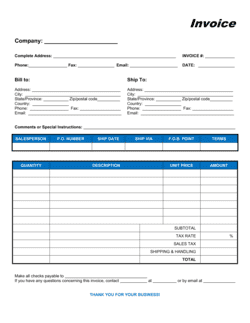
An invoice is a payment request issued after services are delivered — or alongside a deposit request. A booking confirmation letter confirms the reservation and sets out the payment schedule, but it is not a demand for payment. Both documents are typically part of the same transaction flow: confirmation first, invoice to trigger each payment milestone.

vs Event Planning Proposal

An event planning proposal is sent before a booking is agreed — it outlines options, pricing, and scope to help a client decide. A booking confirmation letter is sent after the decision has been made, to record the agreed terms. The proposal gets you the booking; the confirmation letter protects both parties once the booking is confirmed.

Industry-specific considerations

Hospitality and accommodation

Confirmation letters state room type, check-in and check-out times, included breakfast or facilities, and the deposit and balance payment schedule against the rate.

Events and venues

Venue confirmations must list setup and breakdown access times, AV and catering inclusions, maximum guest capacity, and noise or curfew restrictions.

Transport and logistics

Transport confirmations specify the vehicle type, driver name and contact number, exact pickup time and address, drop-off point, and luggage or passenger restrictions.

Professional services

Service firms confirm the appointment date and duration, the specific adviser or practitioner assigned, the session fee, and any preparation the client must complete beforehand.

Template vs pro — what fits your needs?

PathBest forCostTime
Use the templateHotels, venues, transport operators, and service providers sending standard booking confirmationsFree5–10 minutes per letter
Template + professional reviewHigh-value bookings where cancellation policy and payment terms need to align with an existing service agreement$50–$150 (brief legal or business advisor review)1–2 hours
Custom draftedLarge-scale event or hospitality operators standardising confirmation workflows across multiple venues or booking types$300–$800 (custom template set)2–5 days

Glossary

Booking Reference Number
A unique identifier assigned to a reservation so both parties can locate and discuss it quickly without ambiguity.
Deposit
An upfront partial payment made by the customer to secure a reservation, typically non-refundable if the booking is cancelled within a specified window.
Cancellation Policy
The set of conditions and deadlines that determine whether a customer is entitled to a full refund, partial refund, or no refund when they cancel a booking.
Balance Due
The remaining amount owed after the deposit has been paid, typically due on arrival, on the service date, or by a specified deadline before the booking.
Force Majeure
A clause excusing either party from fulfilling the booking if an extraordinary event outside their control — such as a natural disaster or government order — makes performance impossible.
Confirmation Date
The date the service provider issues the confirmation letter, marking the point at which the booking is officially accepted and recorded.
Amendment
A formal change to a confirmed booking — such as a date shift, service upgrade, or guest-count adjustment — that both parties must agree to in writing.
No-Show
When a customer fails to appear for a confirmed booking without cancelling in advance, typically resulting in forfeiture of the deposit or full charge.
Inclusions
The specific services, facilities, or items covered by the booking fee — such as breakfast, AV equipment, or parking — listed explicitly to avoid disputes.

Part of your Business Operating System

This document is one of 3,000+ business & legal templates included in Business in a Box.

  • Fill-in-the-blanks — ready in minutes
  • 100% customizable Word document
  • Compatible with all office suites
  • Export to PDF and share electronically

Create your document in 3 simple steps.

From template to signed document — all inside one Business Operating System.
1
Download or open template

Access over 3,000+ business and legal templates for any business task, project or initiative.

2
Edit and fill in the blanks with AI

Customize your ready-made business document template and save it in the cloud.

3
Save, Share, Send, Sign

Share your files and folders with your team. Create a space of seamless collaboration.

Save time, save money, and create top-quality documents.

★★★★★

"Fantastic value! I'm not sure how I'd do without it. It's worth its weight in gold and paid back for itself many times."

Managing Director · Mall Farm
Robert Whalley
Managing Director, Mall Farm Proprietary Limited
★★★★★

"I have been using Business in a Box for years. It has been the most useful source of templates I have encountered. I recommend it to anyone."

Business Owner · 4+ years
Dr Michael John Freestone
Business Owner
★★★★★

"It has been a life saver so many times I have lost count. Business in a Box has saved me so much time and as you know, time is money."

Owner · Upstate Web
David G. Moore Jr.
Owner, Upstate Web

Run your business with a system — not scattered tools

Stop downloading documents. Start operating with clarity. Business in a Box gives you the Business Operating System used by over 250,000 companies worldwide to structure, run, and grow their business.

Free Forever Plan · No credit card required