Minimum Advertised Price Policy Template

Free Word download β€’ Edit online β€’ Save & share with Drive β€’ Export to PDF

2 pagesβ€’20–25 min to fillβ€’Difficulty: Standard
Learn more ↓
FreeMinimum Advertised Price Policy Template

At a glance

What it is
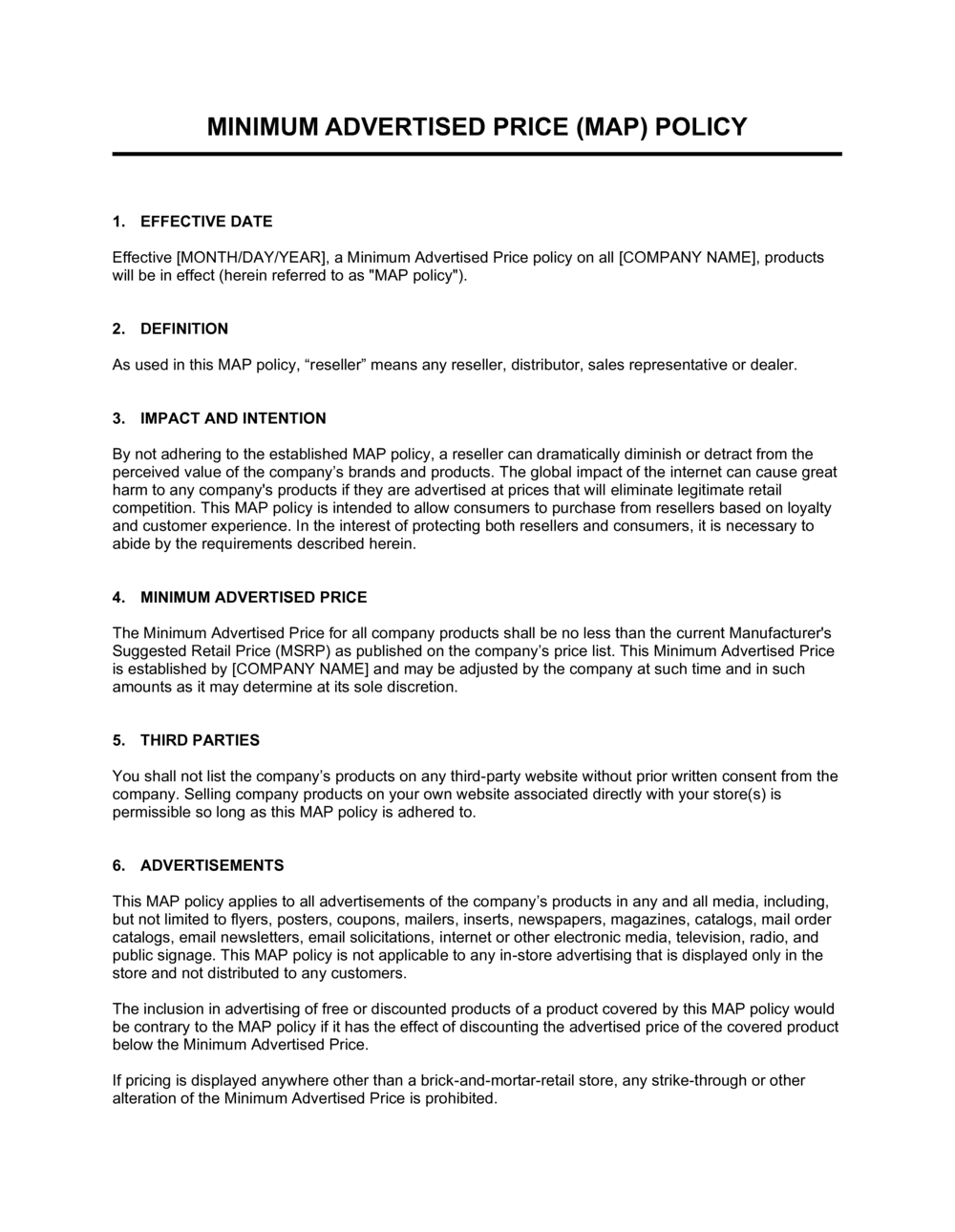
A Minimum Advertised Price (MAP) Policy is a written brand policy that establishes the lowest price at which authorized resellers and retailers may publicly advertise a manufacturer's products. This free Word download gives brands and manufacturers a structured, ready-to-customize document they can edit online and distribute to their entire reseller network.
When you need it
Use it when you sell through multiple retailers, distributors, or online marketplaces and need to prevent price erosion that undermines brand perception and margin across the channel. It is especially critical before onboarding new resellers or launching on platforms like Amazon or Walmart Marketplace.
What's inside
Policy purpose and scope, product coverage, MAP price schedule, advertising definitions, retailer compliance requirements, promotional exceptions, enforcement procedures, and the consequences for violations β€” all in a single document you can distribute to your entire reseller network.

What is a Minimum Advertised Price Policy?

A Minimum Advertised Price (MAP) Policy is a written brand policy that establishes the lowest price at which authorized resellers and retailers may publicly advertise a manufacturer's products. It governs what resellers display in online listings, print ads, email campaigns, and any other consumer-facing media β€” not the actual transaction price, which resellers remain free to set independently. MAP policies are issued unilaterally by the brand rather than negotiated with individual resellers, a structure that keeps them on the right side of US antitrust law while still giving manufacturers meaningful control over how their products are presented to consumers across every sales channel.

Why You Need This Document

Without a MAP policy, a single reseller willing to accept thin margins can trigger a race to the bottom that damages every other retailer in your channel β€” and ultimately your brand's perceived value. Once consumers associate your product with a discounted price, recovering that positioning is expensive and slow. Retailers who invest in trained staff, physical display space, and post-sale support quickly exit a channel where a no-frills online competitor undercuts them by 20%. A clearly written MAP policy, distributed to all authorized resellers before disputes arise, gives you the documented foundation to issue violation notices, suspend orders, and terminate non-compliant accounts consistently. This template provides the complete structure β€” scope, price schedule, enforcement procedures, and consequence tiers β€” so you can deploy a professional, legally defensible MAP policy in a matter of hours rather than starting from scratch.

Which variant fits your situation?

If your situation is…Use this template
Selling exclusively through online marketplaces like Amazon or eBayOnline MAP Policy
Managing a mix of brick-and-mortar and online retail accountsMinimum Advertised Price Policy
Setting both an advertised floor and a minimum transaction priceMinimum Resale Price Policy
Establishing authorized reseller criteria alongside pricing termsAuthorized Reseller Agreement
Protecting distributor margins with volume-tiered pricing floorsDistributor Pricing Policy
Communicating promotional pricing windows during peak retail seasonsPromotional Pricing Agreement
Setting pricing expectations for a single brand-owned retail partnerRetail Partner Agreement

Common mistakes to avoid

❌ Framing MAP as a negotiated agreement

Why it matters: A MAP policy structured as a bilateral contract between a manufacturer and resellers resembles price-fixing under US antitrust law, which is a per se violation regardless of intent.

Fix: Issue MAP as a unilateral brand policy β€” state explicitly that it is not an agreement, requires no reseller signature, and that continued purchases constitute acknowledgment.

❌ No written MAP price schedule

Why it matters: Without a specific, dated price schedule, resellers cannot reliably comply, and enforcement actions become impossible to defend when a reseller claims they did not know the MAP price.

Fix: Attach a versioned Exhibit A listing every covered SKU and MAP price, and update it with at least 30 days' notice whenever prices change.

❌ Inconsistent enforcement across resellers

Why it matters: Enforcing MAP aggressively against small online sellers while ignoring the same behavior from a preferred large retailer exposes the brand to discriminatory enforcement claims and signals to all resellers that the policy is not serious.

Fix: Apply violation notices and consequences uniformly across all reseller accounts, regardless of account size or revenue contribution.

❌ Skipping the cure period before consequences

Why it matters: Immediately suspending orders without giving the reseller a chance to correct the price damages goodwill unnecessarily and invites disputes from resellers who made genuine listing errors.

Fix: Define a 24–48 hour cure window for online violations and communicate violation notices to a designated compliance contact rather than the sales contact.

The 9 key sections, explained

Policy purpose and brand rationale

Scope and product coverage

Definition of 'advertised price'

MAP price schedule

Promotional and sale exceptions

Compliance monitoring

Violation notification and cure period

Consequences for violations

Policy updates and communication

How to fill it out

  1. 1

    Insert brand and company details

    Replace all [BRAND NAME] and [COMPANY NAME] placeholders with your registered brand and legal entity name. Confirm these match the names used in your reseller agreements.

    πŸ’‘ Use your registered trademark name in the policy header β€” not a product line name β€” so the policy covers your full catalog consistently.

  2. 2

    Build and attach the MAP price schedule

    Create Exhibit A listing every covered SKU, its product name, and the MAP price. Organize by product category for readability. Include the effective date on the schedule itself.

    πŸ’‘ Version-control the price schedule with a date stamp (e.g., 'MAP Schedule v2 β€” effective 2026-06-01') so you can prove which schedule was in effect when a dispute arises.

  3. 3

    Define your advertised price scope

    Review the 'advertised price' definition and add any platform-specific examples relevant to your channel β€” Amazon Buy Box, Google Shopping listings, or social media ad copy.

    πŸ’‘ If you sell on Amazon, explicitly address whether the Buy Box price and marketplace strike-through pricing constitute an advertised price β€” this is the most common MAP ambiguity on that platform.

  4. 4

    Set cure period and violation escalation timeline

    Enter specific timeframes for the cure period (recommend 24–48 hours for online violations) and the look-back window for escalating repeat violations (recommend 12 months).

    πŸ’‘ Shorter cure windows (24 hours) are appropriate for marketplace listings that update in real time; allow 5–7 business days for print or catalog violations.

  5. 5

    Document promotional exception procedures

    Specify how resellers may request a promotional exception, what lead time is required, and confirm that all exceptions must be granted in writing before the promotion runs.

    πŸ’‘ Create a simple email template for approving promotional exceptions β€” a consistent approval format makes your authorization records audit-ready.

  6. 6

    Identify your compliance monitoring approach

    Decide whether you will monitor manually, use a price-monitoring service, or a combination. Enter the monitoring frequency that matches your actual capacity.

    πŸ’‘ Free tools like Google Shopping search and marketplace seller lookup can cover smaller catalogs; paid tools (e.g., Wiser, Skuuudle) automate monitoring across thousands of SKUs and multiple platforms.

  7. 7

    Distribute to all authorized resellers and document receipt

    Send the completed policy to every authorized reseller via email and request written acknowledgment. Retain acknowledgment records with timestamps.

    πŸ’‘ If a reseller refuses to acknowledge the policy, treat continued purchases as acceptance per the policy's acceptance clause β€” and note the refusal in your records.

  8. 8

    Schedule an annual review

    Set a calendar reminder to review MAP prices and policy terms once per year, or whenever you adjust your wholesale price list by more than 10%.

    πŸ’‘ Align MAP price updates with your annual catalog or product line review so the schedule and the catalog stay in sync without separate update cycles.

Frequently asked questions

What is a Minimum Advertised Price (MAP) policy?

A Minimum Advertised Price policy is a written brand policy that sets the lowest price at which authorized resellers may publicly advertise a manufacturer's products. It does not dictate the actual transaction price β€” only the price that can be displayed in ads, online listings, and other public-facing media. MAP policies are used by brands to prevent price erosion, protect retailer margins, and maintain consistent brand perception across the distribution channel.

Is a MAP policy legally enforceable?

A MAP policy is generally enforceable in the US when structured as a unilateral brand policy β€” not a negotiated agreement with resellers. Under the Supreme Court's Leegin decision (2007), vertical pricing policies are evaluated under a rule-of-reason standard rather than treated as per se antitrust violations. However, MAP policies that read as bilateral price-fixing agreements, or that involve enforcement coordination among competing retailers, carry antitrust risk. Some state laws impose stricter standards than federal law β€” consider a legal review for high-volume distribution arrangements.

What is the difference between MAP and MSRP?

MAP (Minimum Advertised Price) is the floor on what a reseller can publicly advertise β€” it is a brand policy restricting advertising, not the actual transaction price. MSRP (Manufacturer's Suggested Retail Price) is a non-binding recommendation for the retail selling price. A reseller can sell below MSRP without restriction; advertising below MAP violates the brand's policy. In practice, MSRP is set above MAP to give resellers a visible price anchor while MAP protects the channel floor.

Does a MAP policy control the actual selling price?

No. A MAP policy only governs the publicly advertised price, not the price at which the transaction is completed. A reseller may complete a sale below MAP β€” for example, through a coupon applied at checkout or a negotiated price for a bulk order β€” as long as the pre-checkout advertised price does not fall below MAP. This distinction is what keeps MAP policies on the right side of US antitrust law.

How do I enforce a MAP policy on Amazon?

Enforcing MAP on Amazon requires monitoring the Buy Box price and third-party seller listings using a price-monitoring tool or manual searches. When a violation is found, send a written notice to the seller through Amazon Seller Central messaging or directly if they are an authorized reseller. For unauthorized third-party sellers, Amazon Brand Registry and test purchases followed by IP infringement reports are the primary tools β€” MAP policy alone does not bind unauthorized sellers.

Do resellers need to sign the MAP policy?

No β€” and requesting a signature can work against you. A MAP policy structured as a bilateral signed agreement begins to look like a price-fixing contract. The legally preferred approach is to issue MAP as a unilateral policy, distribute it to all authorized resellers, and include a clause stating that continued purchases constitute acceptance. Document distribution with timestamped emails and retain acknowledgment records where resellers voluntarily provide them.

What should the consequences be for a MAP violation?

A graduated consequence structure is most effective: written warning for a first violation, order suspension for a defined period (typically 30 days) for a second violation within 12 months, and termination of authorized reseller status for a third violation. Apply consequences uniformly across all resellers regardless of account size. Inconsistent enforcement is the most common reason MAP policies lose effectiveness and credibility across the channel.

Can MAP policies cover promotional events like Black Friday?

Yes β€” brands typically include a promotional exception clause that allows them to authorize resellers to advertise below MAP during specific, brand-approved windows such as Black Friday, Cyber Monday, or seasonal clearance events. The key is requiring all promotional exceptions to be granted in writing before the promotion runs, with the approved price, covered products, and dates clearly specified.

How often should a MAP policy be updated?

Review your MAP policy and price schedule at least once per year, aligned with your annual catalog or wholesale price review. Update the schedule whenever you change wholesale pricing by more than 10% or add new SKUs to the covered product line. Notify resellers at least 30 days before any price schedule change takes effect and document the notification.

How this compares to alternatives

vs Reseller Agreement

A reseller agreement is a bilateral contract governing the full commercial relationship β€” territory, payment terms, exclusivity, and product liability. A MAP policy is a unilateral brand policy focused solely on advertised pricing. The two documents complement each other: the reseller agreement governs the relationship, and the MAP policy governs pricing behavior within it.

vs Distributor Agreement

A distributor agreement sets the terms under which a distributor may purchase and resell products β€” including pricing tiers, minimums, and territory rights. A MAP policy operates at the retail advertising level, governing what the distributor's downstream resellers may display publicly. For multi-tier channels, both documents are typically needed.

vs Pricing Strategy Document

A pricing strategy document is an internal planning tool that defines how a brand sets prices across channels, segments, and lifecycle stages. A MAP policy is an external-facing operational document that communicates and enforces one element of that strategy β€” the advertised price floor β€” to the reseller network.

vs Authorized Reseller Agreement

An authorized reseller agreement establishes who is permitted to sell the brand's products and under what conditions. A MAP policy governs what all authorized resellers may advertise. Using both together ensures that pricing discipline is enforceable only against resellers who have been formally admitted to the authorized channel.

Industry-specific considerations

Consumer Electronics

Rapid price erosion on high-velocity SKUs makes MAP enforcement critical; monitoring must cover major marketplaces and price-comparison engines daily.

Sporting Goods and Outdoor

Seasonal demand cycles require promotional exception windows aligned with peak seasons; MAP schedules typically include clearance pricing tiers for end-of-season inventory.

Beauty and Personal Care

Premium positioning depends heavily on price consistency; unauthorized third-party marketplace sellers are the primary enforcement challenge for prestige brands.

Home Goods and Furniture

High average order values mean even a 5% MAP violation significantly impacts retailer margin; policies often include bundle and floor-model pricing carve-outs.

Template vs pro β€” what fits your needs?

PathBest forCostTime
Use the templateBrands with fewer than 50 SKUs selling through a manageable number of authorized online and retail resellersFree2–4 hours
Template + professional reviewBrands with wide distribution, high-volume marketplaces, or multi-state retail footprints where antitrust exposure is a real concern$300–$800 for a one-hour legal review1–3 days
Custom draftedEnterprise brands with hundreds of SKUs, international distribution, or prior MAP enforcement disputes requiring legal documentation$1,500–$4,0001–2 weeks

Glossary

Minimum Advertised Price (MAP)
The lowest price at which a reseller is permitted to publicly advertise a manufacturer's product, regardless of the actual transaction price.
Advertised Price
Any publicly visible price displayed in online listings, print ads, email promotions, or any other medium accessible to consumers before purchase.
Reseller
Any retailer, distributor, dealer, or third-party seller authorized to purchase and resell the manufacturer's products.
Price Erosion
A gradual decline in the retail price of a product across the market, typically triggered by competitive undercutting among resellers.
Authorized Reseller
A reseller that has been formally approved by the brand or manufacturer to carry and advertise its products under defined terms.
Unilateral Policy
A pricing policy issued by a manufacturer as a standalone business decision β€” not a negotiated agreement with resellers β€” which is the legally preferred structure for MAP policies in the US.
MAP Violation
Any instance where an authorized reseller advertises a product below the MAP price set by the manufacturer.
Point-of-Sale Exception
A carve-out that permits a reseller to complete a transaction below MAP after a consumer has added the item to a cart or reached the checkout screen, since the price is no longer publicly advertised.
Price Monitoring
The systematic process of tracking reseller advertised prices β€” typically through automated crawling tools β€” to identify MAP violations.
Channel Conflict
Tension between different resellers in a brand's distribution network caused by inconsistent pricing, terms, or market coverage.

Part of your Business Operating System

This document is one of 3,000+ business & legal templates included in Business in a Box.

  • Fill-in-the-blanks β€” ready in minutes
  • 100% customizable Word document
  • Compatible with all office suites
  • Export to PDF and share electronically

Create your document in 3 simple steps.

From template to signed document β€” all inside one Business Operating System.
1
Download or open template

Access over 3,000+ business and legal templates for any business task, project or initiative.

2
Edit and fill in the blanks with AI

Customize your ready-made business document template and save it in the cloud.

3
Save, Share, Send, Sign

Share your files and folders with your team. Create a space of seamless collaboration.

Save time, save money, and create top-quality documents.

β˜…β˜…β˜…β˜…β˜…

"Fantastic value! I'm not sure how I'd do without it. It's worth its weight in gold and paid back for itself many times."

Managing Director Β· Mall Farm
Robert Whalley
Managing Director, Mall Farm Proprietary Limited
β˜…β˜…β˜…β˜…β˜…

"I have been using Business in a Box for years. It has been the most useful source of templates I have encountered. I recommend it to anyone."

Business Owner Β· 4+ years
Dr Michael John Freestone
Business Owner
β˜…β˜…β˜…β˜…β˜…

"It has been a life saver so many times I have lost count. Business in a Box has saved me so much time and as you know, time is money."

Owner Β· Upstate Web
David G. Moore Jr.
Owner, Upstate Web

Run your business with a system β€” not scattered tools

Stop downloading documents. Start operating with clarity. Business in a Box gives you the Business Operating System used by over 250,000 companies worldwide to structure, run, and grow their business.

Free Forever PlanΒ Β·Β No credit card required