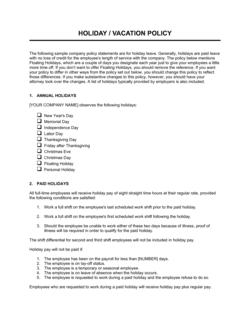
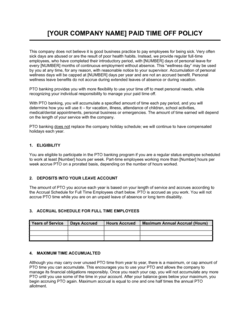
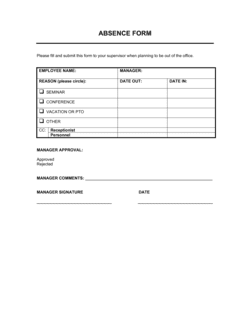
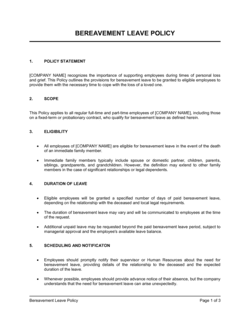
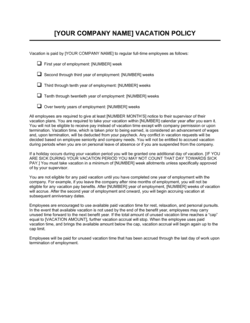
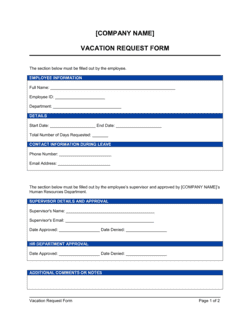
Leaves and Time off Templates
★★★★★4.7from 280+ reviews· Trusted by 20M+ businesses
Set clear, consistent leave rules and track employee time with ready-to-use HR templates.
WordEditable onlinePDF22+ leaves and time off templates
Other Human Resources categories
Most popular leave and time off templates
Time tracking and records
Time management guides and plans
Productivity and goal-setting resources
Extension of time and related correspondence
250K+Clients
20M+Free users
20+Years
190+Countries
10,000+Law firms
50M+Downloads
Trusted across review platforms
- Capterra★★★★☆4.649 reviews
- G2★★★★☆4.713 reviews
- GetApp★★★★☆4.649 reviews
- Google Play★★★★☆4.6179 ratings
- Google Reviews★★★★☆4.567 reviews
Frequently asked questions
Is a written time off policy legally required?
In most jurisdictions, employers are not required to offer vacation or PTO, but once they do, many employment laws require the policy to be documented and communicated to employees. Some states and provinces also mandate written sick-leave policies. A written policy is the simplest way to prove consistent, non-discriminatory treatment if an employee dispute arises.
Can an employer deny a time off request?
Yes, in most cases. Employers can deny requests for operational reasons — peak business periods, insufficient coverage, or inadequate notice — as long as the denial is applied consistently and does not conflict with legally protected leave (such as FMLA, state sick-leave laws, or human rights legislation). Documenting the reason for denial in writing protects both parties.
Do accrued vacation days have to be paid out when an employee leaves?
It depends on the jurisdiction. In California and several other US states, accrued vacation is treated as earned wages and must be paid out on termination. Other states allow employers to adopt a use-it-or-lose-it policy. In Canada, most provinces require vacation pay on termination. Always check local law and reflect the correct rule in your written policy.
What is the difference between PTO and vacation time?
Vacation time is a separate leave category restricted to personal time away from work. PTO (paid time off) is a broader bank that typically combines vacation, sick days, and personal days into a single balance the employee uses for any purpose. PTO banks are simpler to administer but may be less effective at ensuring employees take true vacation rest.
How much PTO should a small business offer?
There is no universal standard, but 10–15 days per year is typical for US small businesses at the lower range; 15–20 days is common among companies competing for talent. Adding sick days separately or including them in the PTO bank is a strategic choice. Benchmark against competitors in your industry and location to avoid being below market.
What records does an employer need to keep for time off?
At minimum, employers should retain records of hours worked, leave requests submitted and approved, leave taken, and remaining balances for each employee. US federal law (FLSA) requires payroll records for at least three years; state laws may require longer. A consistent time-record template is the most practical way to meet these obligations.
Can an employer change its time off policy?
Generally yes, with reasonable advance notice to employees. Changes that reduce already-accrued balances may be restricted by state wage laws or employment contracts. Best practice is to give 30–60 days' notice before any policy change takes effect and to confirm the change in writing.
Are part-time employees entitled to the same leave as full-time employees?
Not necessarily. Many leave entitlements are proportional to hours worked. Statutory sick leave laws in some jurisdictions apply from the first hour of work, making part-time employees eligible; other entitlements like parental leave may have minimum hours-worked thresholds. Your policy should explicitly state which benefits apply to which employment categories.
Leaves and Time Off vs. related documents
A PTO bank combines vacation, sick, and personal days into a single balance the employee draws from freely. Separate policies keep each category distinct, which can limit abuse of sick leave but adds administrative complexity. Small businesses often prefer the PTO bank for simplicity; larger or regulated employers may need separate buckets to satisfy statutory sick-leave requirements.
A time sheet captures hours worked in a single pay period — typically a week or two weeks — for payroll processing. An employee time record is a cumulative ledger tracking leave balances, days taken, and remaining entitlements over the full employment relationship. Use both: the time sheet feeds payroll each period; the time record is the long-running HR file.
A leave policy is a standing company rule that applies to all employees and explains entitlements, accrual, and approval procedures. A leave of absence agreement is a one-off document between employer and a specific employee for an extended or unusual leave event — for example, a sabbatical or a long medical leave. The policy sets the framework; the agreement documents the individual arrangement.
An overtime policy governs when extra hours are approved and at what pay rate. A compensatory time (comp time) policy governs the alternative arrangement where extra hours are repaid with future time off rather than extra pay. In the United States, comp time for non-exempt employees in the private sector is generally prohibited under the FLSA; consult counsel before offering it to hourly staff.
Key clauses every Leaves and Time Off contains
Whether you are writing a PTO policy or a standalone time-off procedure, every leave and time off document shares the same core elements.
- Scope and eligibility. Defines which employees (full-time, part-time, contractors) are covered and from what date entitlements begin.
- Accrual rate and method. Specifies how leave accumulates — by pay period, annually upfront, or based on hours worked.
- Maximum accrual and carryover cap. Sets the ceiling on banked leave to limit employer liability and encourage employees to actually take time off.
- Request and approval procedure. Outlines how employees submit leave requests, how much advance notice is required, and who approves them.
- Pay during leave. States whether the leave is paid, unpaid, or partially paid and how pay is calculated during the absence.
- Interaction with statutory entitlements. Clarifies how company leave runs concurrently with or separately from legally mandated leave such as FMLA or state sick-leave laws.
- Payout on termination. States whether accrued, unused leave is paid out when employment ends and under what conditions.
- Record-keeping requirements. Specifies how leave taken and balances are tracked, who maintains the records, and for how long.
How to write a leave and time off policy
A clear leave policy protects both the employer and the employee by removing ambiguity before a dispute arises. Here is how to build one from scratch.
1
Identify which leave types you need to cover
List every category — vacation, sick, personal, bereavement, jury duty, voting, parental, and any statutory types required in your jurisdiction.
2
Confirm your legal minimums
Check federal, state or provincial, and local laws for mandatory entitlements before setting company amounts — your policy cannot provide less than the legal floor.
3
Choose a PTO bank or separate-category structure
Decide whether employees draw from a single pool or from distinct vacation, sick, and personal buckets, then document accrual rates and any waiting period for new hires.
4
Set accrual caps and carryover rules
Define the maximum hours that can accumulate in a year and how much, if any, rolls over to the next year to manage financial liability.
5
Write the request and approval procedure
State how far in advance employees must request leave, which form or system to use, and who has authority to approve or deny requests.
6
Address pay, benefits continuation, and return-to-work
Clarify whether the employee is paid during leave, whether benefits continue, and what happens if the employee does not return on the agreed date.
7
Document record-keeping and payout on termination
Specify how balances are tracked and whether unused accrued leave is paid out when employment ends, consistent with applicable law.
8
Have legal counsel review before distributing
A one-hour employment-law review catches jurisdiction-specific compliance issues before the policy reaches employees.
At a glance
- What it is
- Leaves and time off templates are standardized HR documents that define how employees request, accrue, and use paid or unpaid leave — and how employers track the time worked. They cover everything from general PTO policies and time sheets to specialized leave types such as voting leave and compensatory time.
- When you need one
- Any time you hire staff, update your employee handbook, or face a complaint about inconsistent leave treatment, you need a written policy in place.
Which Leaves and Time Off do I need?
The right template depends on whether you are setting a company-wide policy, tracking time actually worked, or addressing a specific leave scenario. Match your situation to the template below.
Your situation
Recommended template
Creating a general leave policy for your employee handbook
Covers all leave categories in one document, suitable for most small and mid-size employers.Formalizing a PTO bank that combines vacation, sick, and personal days
Designed specifically for PTO-bank structures with accrual rates and carryover rules.Complying with laws that require paid or unpaid time to vote
Documents your voting-leave entitlement and procedure to satisfy legal requirements.Managing overtime hours and compensatory time arrangements
Sets rules for when overtime is approved and how comp time is earned and used.Recording hours worked each week for payroll or billing purposes
Standard weekly timesheet with daily hour columns, totals, and supervisor sign-off.Keeping a running log of each employee's attendance and leave balances
Tracks cumulative leave taken and remaining balances at the individual employee level.Documenting a specific block of time worked for a client or project
Short-form record of time spent on a discrete task or project, useful for client billing.Planning how employees will manage their working hours more effectively
Helps employees structure their workday to meet goals within scheduled hours.Glossary
- Accrual
- The process by which leave balance builds up over time, typically linked to hours worked or pay periods completed.
- PTO bank
- A single leave balance that combines vacation, sick, and personal days so employees can use them for any purpose.
- Carryover cap
- The maximum number of unused leave hours an employee may carry from one year to the next.
- Use-it-or-lose-it policy
- A rule that forfeits any leave balance not used by the end of the accrual year, prohibited in some jurisdictions.
- Compensatory time (comp time)
- Paid time off granted in lieu of overtime pay for extra hours worked; its legality for private-sector hourly employees varies by jurisdiction.
- FMLA
- The US Family and Medical Leave Act, which entitles eligible employees of covered employers to up to 12 weeks of unpaid, job-protected leave per year for qualifying family or medical reasons.
- Leave of absence
- An approved period of extended time away from work, either paid or unpaid, beyond standard leave entitlements.
- Time record
- A cumulative HR document tracking an individual employee's hours worked, leave taken, and remaining leave balances over time.
- Statutory leave
- Leave entitlements mandated by law — such as parental leave, sick leave, or jury-duty leave — that a company policy cannot reduce below the legal minimum.
- Waiting period
- A defined period after hire — commonly 30–90 days — before a new employee is eligible to begin accruing or using leave.
What is a leave and time off policy?
A leave and time off policy is a written HR document that defines the types of leave a company offers, how employees earn and use that time, and the procedures for requesting and approving absences. It covers everything from standard paid vacation and sick days to specialized leave categories such as voting leave, bereavement, jury duty, and compensatory time. The policy creates a single, consistent reference point for managers and employees so that every leave request is handled by the same rules.
Leave and time off documents exist on two levels. Policy documents — such as a Time Off Policy or Paid-Time-Off Policy — set the company-wide rules that apply to all eligible employees. Time-tracking documents — such as time sheets and employee time records — capture the day-to-day reality of hours worked and leave taken, feeding both payroll processing and the running leave-balance ledger that managers need to approve future requests.
Together, these documents form the operational backbone of workforce scheduling and attendance management. Without them, employers face inconsistent treatment claims, payroll errors, and difficulty demonstrating compliance with statutory leave laws.
When you need a leave and time off template
Leave and time off templates become essential the moment you have more than a handful of employees, because informal "figure it out as we go" arrangements break down quickly under scrutiny. Specific triggers include:
- Hiring your first employees and drafting an employee handbook
- Expanding a workforce where different managers are making inconsistent leave decisions
- Receiving an employee complaint or legal inquiry about leave entitlement or denial
- Moving from separate vacation and sick-day buckets to a unified PTO bank
- Operating in a state or province that has enacted new statutory sick-leave or paid-family-leave requirements
- Onboarding hourly or shift workers who require weekly time sheets for payroll
- Tracking comp time arrangements with salaried employees who regularly work beyond standard hours
- Updating policies to stay competitive when recruiting in a tight labor market
Skipping written leave documentation does not reduce administrative work — it shifts that work to dispute resolution after something goes wrong. A clear, compliant leave policy written before a request is made is far less expensive than reconstructing an undocumented arrangement under legal pressure. The templates in this folder give you a legally aware starting point for every common leave scenario, ready to tailor to your specific workforce and jurisdiction.
Award-winning platform
- Great Place to Work 2025
- BIG Award — Product of the Year 2025
- Smartest Companies 2025
- Global 100 Excellence 2026
- Best of the Best 2025