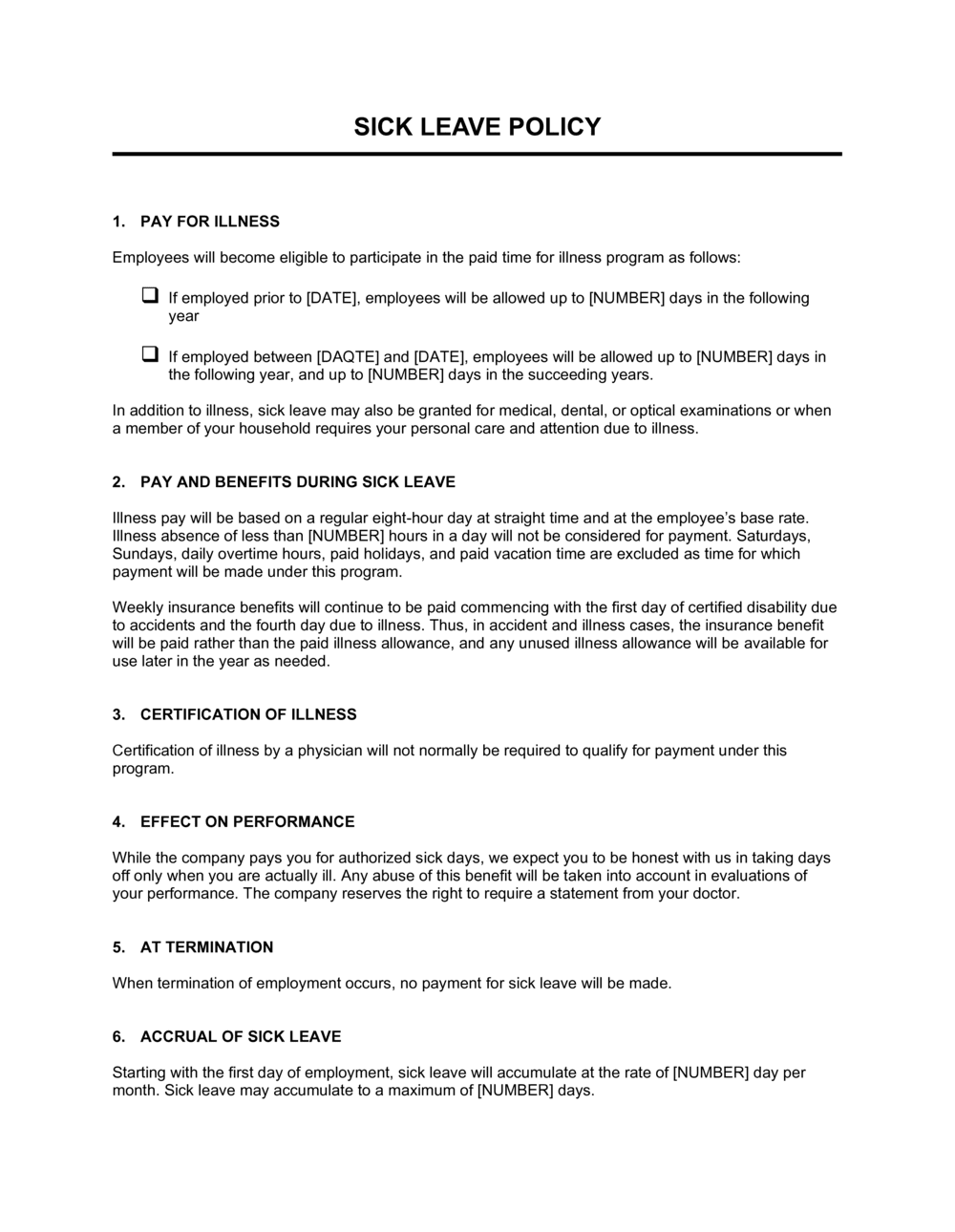
Sick Leave Policy Template

Free Word download β€’ Edit online β€’ Save & share with Drive β€’ Export to PDF

2 pagesβ€’20–25 min to fillβ€’Difficulty: Standard
Learn more ↓
FreeSick Leave Policy Template

At a glance

What it is
A Sick Leave Policy is an internal HR document that defines how employees request, accrue, and use paid or unpaid time off for illness, injury, or medical appointments. This free Word download gives you a structured, editable template you can tailor to your company's size, jurisdiction, and benefits structure, then distribute to staff or embed in your employee handbook.
When you need it
Use it when onboarding your first employees, updating an outdated or informal leave practice, or aligning your policy with new state or local paid sick leave mandates. Any time a manager asks "what do I do when someone calls in sick?" and no written answer exists, this document is overdue.
What's inside
Purpose and scope, eligibility and accrual rules, permitted uses of sick leave, request and notification procedures, documentation requirements, pay during leave, carry-over and payout rules, return-to-work procedures, and the interaction with other leave types such as FMLA and disability.

What is a Sick Leave Policy?

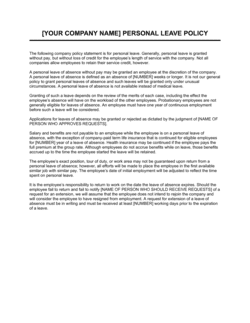
A Sick Leave Policy is an internal HR document that defines how employees earn, request, and use paid or unpaid time off for personal illness, injury, mental health needs, medical appointments, or care of a sick family member. It establishes the accrual rate, eligibility rules, permitted uses, notification procedures, documentation thresholds, carry-over limits, and the interaction with longer-term leave protections such as FMLA or short-term disability. A written policy replaces informal, manager-by-manager decisions with a single documented standard that applies consistently across the organization.

Why You Need This Document

Without a written sick leave policy, managers make inconsistent decisions β€” one approves five days without a note, another demands documentation after one β€” creating discrimination exposure and eroding employee trust. In the United States, more than 15 states and dozens of cities now mandate paid sick leave with specific accrual minimums, eligible uses, and anti-retaliation protections; an undocumented or outdated policy that falls short of statutory requirements creates retroactive liability for every day it was in effect. When an employee challenges a sick leave denial or files a wage claim, the first thing a labor authority asks for is the written policy. A clear, jurisdiction-reviewed sick leave policy closes that gap, gives managers a defensible framework for absence decisions, and signals to employees that their wellbeing is taken seriously β€” which measurably reduces unplanned absenteeism over time.

Which variant fits your situation?

If your situation is…Use this template
Company offers a single combined PTO bank instead of separate sick leavePTO Policy
Need to comply with a specific state paid sick leave law (CA, NY, WA)State-Compliant Paid Sick Leave Policy
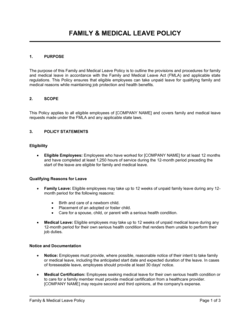
Managing extended illness that may trigger FMLA or disability leaveFamily and Medical Leave Policy
Setting rules for remote employees who work across multiple jurisdictionsRemote Work Policy
Documenting a broader package of all employee leave entitlementsEmployee Leave of Absence Policy
Creating a full employee handbook that includes sick leave as one sectionEmployee Handbook

Common mistakes to avoid

❌ Restricting sick leave to the employee's own physical illness

Why it matters: Paid sick leave laws in more than 15 US states and several Canadian provinces require employers to permit use of sick leave for care of a sick family member. A policy that prohibits this creates direct statutory liability.

Fix: Expand permitted uses to include care for a spouse, child, parent, or domestic partner, and add a catch-all clause referencing applicable local law.

❌ Implementing a use-it-or-lose-it rule on accrued sick leave

Why it matters: Several jurisdictions, including California, prohibit forfeiture of accrued sick leave at year-end. Enforcing a use-it-or-lose-it rule in these locations exposes the company to back-pay claims and penalties.

Fix: Replace forfeiture language with a carry-over cap β€” allow unused hours to roll over up to a defined maximum balance rather than voiding them entirely.

❌ Requiring a doctor's note for every single-day absence

Why it matters: This practice is prohibited or restricted in multiple US states (including California and New York) and most Canadian provinces. It also creates a chilling effect on legitimate sick leave use and erodes employee trust.

Fix: Set a documentation threshold of 3 consecutive days or more, and reserve the right to request documentation only when a clear absence pattern is documented in writing.

❌ Failing to pro-rate sick leave for part-time or mid-year hires

Why it matters: Offering a flat annual grant without adjusting for part-time hours or hire date results in over- or under-entitlement and exposes the company to discrimination claims if applied inconsistently.

Fix: Add a pro-ration formula to the accrual section: full-time annual grant Γ— (FTE percentage) Γ— (months remaining in the year Γ· 12).

The 10 key sections, explained

Purpose and scope

Eligibility and waiting period

Accrual and leave entitlement

Permitted uses of sick leave

Notification and request procedure

Documentation requirements

Pay during sick leave

Carry-over and year-end treatment

Return-to-work and fitness-for-duty

Interaction with other leave types

How to fill it out

  1. 1

    Identify all locations where the policy applies

    List every state, province, or country where your employees work. Paid sick leave laws differ sharply by jurisdiction β€” what is legally compliant in Texas may violate California or New York law.

    πŸ’‘ If you have employees in California, New York, Washington, Massachusetts, or any major US city with its own ordinance, treat those jurisdictions as the floor and build your policy up from the strictest requirement.

  2. 2

    Choose an accrual method

    Decide whether sick leave will accrue per hours worked (e.g., 1 hour per 30), per pay period, or as a lump-sum annual grant. Document the method clearly and confirm it meets the accrual minimum in every applicable jurisdiction.

    πŸ’‘ A lump-sum grant at the start of each year is simpler to administer than hourly accrual β€” but only if you also pro-rate it for mid-year hires and part-time workers.

  3. 3

    Define permitted uses explicitly

    List every qualifying reason an employee may use sick leave, including their own illness, family member care, and any mental health or public-health-emergency provisions required by law.

    πŸ’‘ Err on the side of a broader list of permitted uses β€” restricting leave to 'physical illness only' creates legal exposure in most states with paid sick leave laws.

  4. 4

    Set the notification procedure

    Specify the method (call, HRIS, email), timing (at least 30 minutes before shift start), and who to notify (direct manager and HR). Write this as a clear, step-by-step instruction employees can follow at 6 a.m. when feeling unwell.

    πŸ’‘ Require notification through a system that creates a written record β€” even a simple email to HR eliminates 'I told my manager' disputes.

  5. 5

    Establish documentation thresholds

    Set the number of consecutive days after which a medical note is required β€” typically 3 to 5 days. Also document whether repeat-pattern absences can trigger a documentation request and how that process works.

    πŸ’‘ Check your jurisdiction before requiring notes for absences of fewer than 3 days β€” many US states and Canadian provinces prohibit this practice.

  6. 6

    Specify carry-over and payout rules

    State the carry-over cap (e.g., 40 or 80 hours maximum) and confirm sick leave has no cash value at termination β€” unless you are in a jurisdiction where payout is required.

    πŸ’‘ Run a quick audit of your current employee balances before setting a carry-over cap β€” if tenured employees are sitting on 200 hours, a sudden cap could create compliance and morale issues.

  7. 7

    Address FMLA and disability leave interaction

    Add a section stating that qualifying sick leave runs concurrently with FMLA and that employees must exhaust accrued sick leave before transitioning to unpaid leave. Reference your FMLA policy or handbook section.

    πŸ’‘ This single section prevents one of the most common and costly HR disputes β€” employees who claim extended protected leave well beyond what the law intends.

  8. 8

    Distribute, acknowledge, and store

    Share the final policy with all employees, collect signed acknowledgments (or digital confirmations via your HRIS), and store acknowledgment records for at least 3 years.

    πŸ’‘ Embed the policy in your employee handbook and re-issue it whenever you make a material change β€” verbal updates do not satisfy most jurisdictional posting and notice requirements.

Frequently asked questions

What is a sick leave policy?

A sick leave policy is a written HR document that defines how employees earn, request, and use time off for illness, injury, or medical care. It sets out accrual rates, eligible uses, notification requirements, documentation thresholds, and carry-over rules. A clear written policy protects both employees β€” who know their entitlements β€” and employers, who have a defensible standard to apply consistently.

How much sick leave should a company provide?

There is no federal minimum in the United States, but more than 15 states and dozens of cities mandate paid sick leave ranging from 24 to 72 hours per year. A common benchmark for small businesses is 5 paid sick days (40 hours) per year. Companies competing for talent in professional services or tech typically offer 7–10 days. The minimum should always be the highest applicable statutory requirement across all locations where employees work.

Is paid sick leave required by law?

At the federal level in the United States, there is no universal paid sick leave requirement for private employers. However, California, New York, Washington, Massachusetts, Connecticut, Oregon, and many other states β€” plus dozens of local jurisdictions β€” mandate paid sick leave. In Canada, the federal government and most provinces require a minimum of 3 to 10 paid sick days. Employers should verify requirements in every jurisdiction where they have employees.

Can unused sick leave be paid out when an employee leaves?

In most US jurisdictions, sick leave has no cash value and is not paid out at separation β€” unlike accrued vacation in states such as California. However, if your company uses a combined PTO bank rather than separate sick and vacation buckets, the full balance may be subject to payout laws. Check local law and document your policy's payout treatment explicitly to avoid disputes at termination.

Can an employer require a doctor's note for sick leave?

Generally yes, after a defined number of consecutive days β€” typically 3 to 5. However, requiring a note for every single-day absence is restricted or prohibited in several US states and Canadian provinces. Some jurisdictions also prohibit requiring a diagnosis β€” the note need only confirm the employee was seen and is unfit to work. Check applicable law before setting your documentation threshold.

How does sick leave interact with FMLA?

Under US federal law, if an employee's illness qualifies as a serious health condition under the FMLA, the employer may β€” and generally should β€” require sick leave and FMLA leave to run concurrently. This prevents employees from using FMLA first and then claiming separate sick leave for the same condition. Employers with 50 or more employees should document this concurrent-leave rule explicitly in their sick leave policy.

Should sick leave and vacation be combined into a single PTO bank?

A combined PTO bank simplifies administration and gives employees flexibility, but it has trade-offs. In states where vacation pay is treated as earned wages (California, Colorado, Nebraska), combining sick and vacation means the entire balance may be payable at termination. A separate sick leave bucket limits that liability. If you operate in multiple states, separate buckets are generally safer from a compliance standpoint.

What should the sick leave policy say about remote employees?

Remote employees are covered by the sick leave laws of the state or country where they physically work β€” not where the employer is headquartered. Your policy should explicitly state that employees working remotely are subject to the sick leave laws of their work location and that the company will apply the more generous of the two where applicable. This is especially important for companies that shifted to remote work across multiple states post-2020.

How often should a sick leave policy be reviewed?

Review the policy at least once per year, and immediately following any change to federal, state, or local paid sick leave law in a jurisdiction where you have employees. Paid sick leave legislation has expanded significantly since 2014, and rules change frequently at the city and county level. A dated policy that no longer meets statutory minimums creates retroactive liability for every day it was in effect.

How this compares to alternatives

vs PTO Policy

A PTO policy combines sick leave, vacation, and personal days into a single bank that employees use for any purpose. A sick leave policy keeps these entitlements separate, which limits termination payout liability in states that treat accrued vacation as earned wages. Use a separate sick leave policy when you operate in California, Colorado, or any state where unused vacation must be paid out at separation.

vs Family and Medical Leave Policy

An FMLA policy governs extended leave for serious health conditions, childbirth, or caregiving β€” typically up to 12 weeks of unpaid, job-protected leave for employers with 50 or more employees. A sick leave policy covers shorter, routine illness absences. The two should cross-reference each other, and qualifying sick leave should run concurrently with FMLA to prevent double-dipping.

vs Employee Leave of Absence Policy

A leave of absence policy is a broader document covering all types of extended absence β€” medical, personal, military, jury duty, and bereavement. A sick leave policy focuses specifically on illness-related short-term absences and accrual mechanics. Growing companies typically need both: the sick leave policy for day-to-day absences and the leave of absence policy for extended situations.

vs Employee Handbook

An employee handbook is a comprehensive reference covering all workplace policies, including sick leave, in a single document. A standalone sick leave policy goes into greater operational detail β€” accrual tables, notification procedures, documentation thresholds β€” than handbook summaries typically include. Most companies maintain both: the handbook summarizes the policy and the standalone policy document governs.

Industry-specific considerations

Professional Services

Client-facing roles require clear absence notification chains to prevent service disruption; intermittent leave provisions are common for high-stress environments.

Retail and Hospitality

High hourly-worker turnover and shift-based scheduling make same-day notification requirements and coverage procedures especially critical to operations.

Healthcare

Infection-control obligations may require stricter absence rules and fitness-for-duty clearances; state licensing boards may impose additional return-to-work requirements.

Technology and SaaS

Distributed remote teams working across multiple states require jurisdiction-specific accrual rules and a clear statement that local law governs each employee's entitlement.

Template vs pro β€” what fits your needs?

PathBest forCostTime
Use the templateSmall businesses with employees in one or two states using standard accrual structuresFree1–2 hours
Template + professional reviewCompanies operating in California, New York, or any jurisdiction with complex paid sick leave laws$200–$500 (HR consultant or employment attorney review)2–5 business days
Custom draftedMulti-state or multinational employers, unionized workforces, or companies undergoing rapid headcount growth$750–$2,500+1–3 weeks

Glossary

Accrual Rate
The pace at which an employee earns sick leave hours β€” commonly expressed as 1 hour per 30 hours worked or a fixed number of days per calendar year.
Carry-Over
Unused sick leave hours that roll from one calendar or fiscal year into the next, up to any cap the policy specifies.
Waiting Period
The initial period of employment β€” often 30 to 90 days β€” before a new hire is eligible to use accrued sick leave.
Intermittent Leave
Sick leave taken in separate, non-consecutive blocks rather than one continuous absence β€” for example, a few hours each week for ongoing medical treatment.
FMLA
The US Family and Medical Leave Act, which requires employers with 50 or more employees to provide up to 12 weeks of unpaid, job-protected leave for serious health conditions.
Documentation Requirement
A condition that an employee provide a medical certificate or physician's note after a defined number of consecutive sick days.
Return-to-Work Clearance
A written statement from a healthcare provider confirming that an employee is medically fit to resume their duties after an extended illness.
Pay During Leave
Whether the employee receives their normal salary, a percentage of salary, or no pay while absent β€” determined by the policy and any applicable statutory minimums.
Absence Management
A systematic approach to tracking, reporting, and addressing employee absenteeism to reduce operational disruption and identify patterns.
Concurrent Leave
When two leave types β€” for example, sick leave and FMLA β€” run at the same time, counting the same absence days against both entitlements simultaneously.

Part of your Business Operating System

This document is one of 3,000+ business & legal templates included in Business in a Box.

  • Fill-in-the-blanks β€” ready in minutes
  • 100% customizable Word document
  • Compatible with all office suites
  • Export to PDF and share electronically

Create your document in 3 simple steps.

From template to signed document β€” all inside one Business Operating System.
1
Download or open template

Access over 3,000+ business and legal templates for any business task, project or initiative.

2
Edit and fill in the blanks with AI

Customize your ready-made business document template and save it in the cloud.

3
Save, Share, Send, Sign

Share your files and folders with your team. Create a space of seamless collaboration.

Save time, save money, and create top-quality documents.

β˜…β˜…β˜…β˜…β˜…

"Fantastic value! I'm not sure how I'd do without it. It's worth its weight in gold and paid back for itself many times."

Managing Director Β· Mall Farm
Robert Whalley
Managing Director, Mall Farm Proprietary Limited
β˜…β˜…β˜…β˜…β˜…

"I have been using Business in a Box for years. It has been the most useful source of templates I have encountered. I recommend it to anyone."

Business Owner Β· 4+ years
Dr Michael John Freestone
Business Owner
β˜…β˜…β˜…β˜…β˜…

"It has been a life saver so many times I have lost count. Business in a Box has saved me so much time and as you know, time is money."

Owner Β· Upstate Web
David G. Moore Jr.
Owner, Upstate Web

Run your business with a system β€” not scattered tools

Stop downloading documents. Start operating with clarity. Business in a Box gives you the Business Operating System used by over 250,000 companies worldwide to structure, run, and grow their business.

Free Forever PlanΒ Β·Β No credit card required