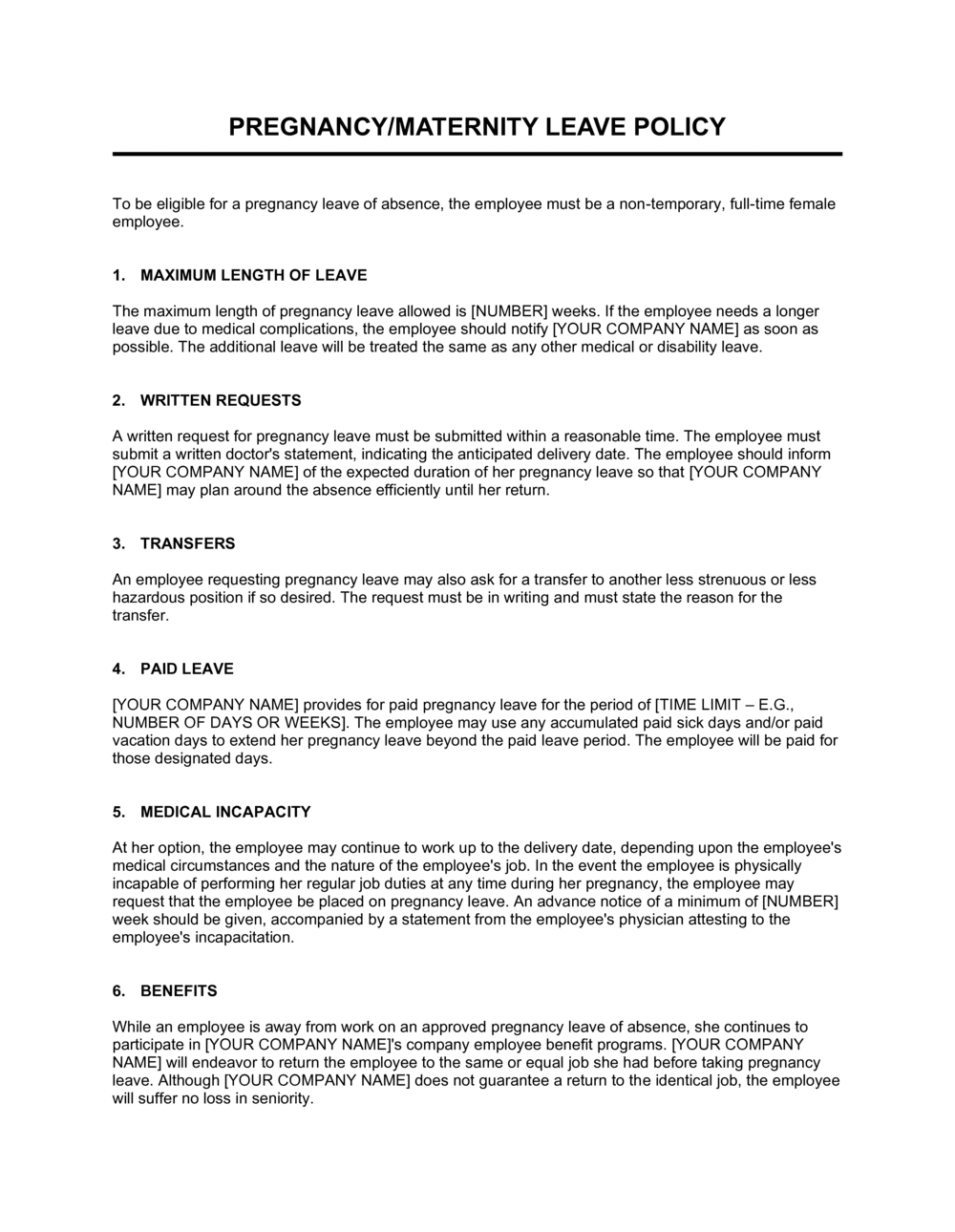
Pregnancy Leave Policy Template

Free Word download β€’ Edit online β€’ Save & share with Drive β€’ Export to PDF

1 pageβ€’20–25 min to fillβ€’Difficulty: Standard
Learn more ↓
FreePregnancy Leave Policy Template

At a glance

What it is
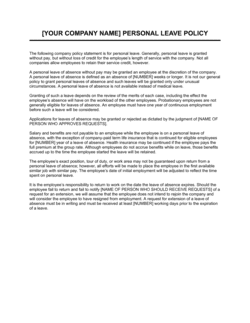
A Pregnancy Leave Policy is a formal HR document that defines the rules governing employee leave before, during, and after pregnancy. This free Word download gives you a structured, editable template covering eligibility, leave duration, pay continuation, job protection, and return-to-work procedures β€” ready to paste into your employee handbook or distribute as a standalone policy.
When you need it
Use it when onboarding your first pregnant employee, building out your HR policy library, or updating an existing maternity policy to reflect current legal minimums and company practice. It is also required before applying for government parental-leave top-up programs in several jurisdictions.
What's inside
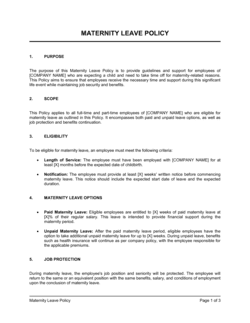
Eligibility criteria and notice requirements, leave duration and scheduling options, pay and benefits continuation rules, job protection and return-to-work procedures, accommodation obligations, and anti-discrimination provisions.

What is a Pregnancy Leave Policy?

A Pregnancy Leave Policy is a formal HR document that establishes an employer's rules and procedures for employee absences related to pregnancy, childbirth, and postnatal recovery. It defines who is eligible, how much leave they can take, what they will be paid, which benefits continue during the absence, and how the return to work is managed. Unlike a general leave of absence policy, a pregnancy leave policy addresses the specific legal obligations β€” job protection, accommodation duties, anti-discrimination provisions β€” that apply to pregnant employees under federal, state, and provincial employment law.

Why You Need This Document

Without a written pregnancy leave policy, managers make inconsistent decisions that expose the business to discrimination claims, equal pay disputes, and regulatory penalties β€” all from a situation that should be straightforward to handle. Employees who cannot find clear answers about their entitlements take longer to give notice, plan their leave poorly, and are significantly more likely to resign rather than return. A documented policy eliminates that ambiguity: every employee sees the same rules, every manager follows the same process, and every HR record reflects consistent treatment. For businesses operating across multiple US states or Canadian provinces, a written policy is also the first thing a labor authority requests when investigating a complaint. This template gives you a compliant, editable starting point in under two hours β€” far less than the cost of a single HR dispute.

Which variant fits your situation?

If your situation is…Use this template
Policy for a company that also offers paternity or partner leaveParental Leave Policy
Documenting all employee leave types in one placeEmployee Leave of Absence Policy
Formal request form for an employee to apply for pregnancy leaveMaternity Leave Request Form
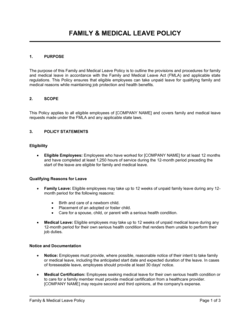
Policy covering broader disability and medical leave alongside pregnancyMedical Leave Policy
Return-to-work agreement after leave endsReturn to Work Agreement
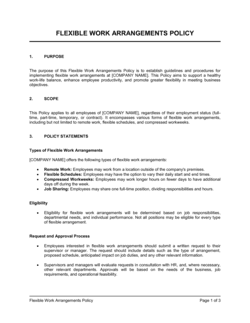
Flexible or phased return arrangements after maternity leaveFlexible Working Policy
Full HR policy manual incorporating pregnancy leave and all other HR policiesEmployee Handbook

Common mistakes to avoid

❌ Setting eligibility terms stricter than the law requires

Why it matters: Employees who meet the statutory threshold but not your policy threshold still have legal entitlements β€” and they may not realize it, leading to under-use and potential discrimination claims when they do.

Fix: Align policy eligibility exactly with the statutory minimum in each jurisdiction, or simply remove the qualifying period entirely.
❌ Omitting pay detail and relying on 'standard benefits apply'

Why it matters: Vague pay language creates inconsistent treatment across managers β€” one employee gets full salary, another gets statutory minimum β€” and opens the door to equal pay and discrimination claims.

Fix: State the exact pay percentage, duration of each pay phase, and every benefit category that continues during leave.

❌ No process for pregnancy loss or premature birth

Why it matters: Employees who experience pregnancy loss or a premature birth still have leave entitlements in many jurisdictions. Silence on this leaves managers without guidance and employees without support at a critical moment.

Fix: Add a short section acknowledging that leave entitlements apply in the event of pregnancy loss or premature birth, and direct employees to HR for individual support.

❌ Failing to communicate the policy until an employee announces a pregnancy

Why it matters: Reactive communication means employees often do not give the required notice, do not know what documentation is needed, and do not plan their leave correctly β€” creating operational gaps.

Fix: Publish the policy in the employee handbook on day one of employment and reference it in the annual HR policy acknowledgment cycle.

The 9 key sections, explained

Purpose and scope

Eligibility criteria

Leave duration and structure

Notice and documentation requirements

Pay and benefits during leave

Job protection and anti-discrimination

Workplace accommodations

Return-to-work procedures

Interaction with other leave policies

How to fill it out

  1. 1

    Insert your company name and applicable locations

    Replace all [COMPANY NAME] and [LOCATION(S)] placeholders in the purpose and scope section. If the policy applies to employees in multiple states or countries, list each separately and note any jurisdiction-specific variations.

    πŸ’‘ If your employees work across multiple US states, verify the most generous state entitlement and use it as the floor β€” do not create separate policies for each state unless requirements differ substantially.

  2. 2

    Set eligibility criteria at or above the statutory minimum

    Enter the qualifying service length. Check the statutory minimum for each jurisdiction your employees work in and ensure your threshold does not exceed it. Most US states and Canadian provinces require no minimum service for basic pregnancy leave.

    πŸ’‘ A zero-service-length eligibility threshold eliminates ambiguity and is already the law in many jurisdictions β€” consider adopting it company-wide for simplicity.

  3. 3

    Define leave duration and pre/post-birth split

    Enter the total leave weeks and how they are divided before and after the due date. Reference your jurisdiction's statutory minimum as the floor, then decide whether to offer additional company-funded weeks.

    πŸ’‘ Offering 2–4 weeks above the statutory minimum at full pay is a low-cost retention tool β€” annual cost is typically under 0.5% of affected salaries.

  4. 4

    Specify pay continuation and benefits

    Enter the pay percentage and duration for each phase of leave. List every benefit that continues β€” health, dental, pension, life insurance, PTO accrual β€” rather than using a general phrase like 'standard benefits.'

    πŸ’‘ Confirm with your benefits providers that coverage continues during unpaid leave β€” some group plans require active payroll status and may need a direct-pay arrangement.

  5. 5

    Complete the notice and documentation requirements

    Set the required notice period and specify exactly what documentation the employee must provide and by when. Keep documentation requirements to the legal minimum β€” an expected due date confirmation from a licensed provider is sufficient in most cases.

    πŸ’‘ Build a simple leave request form to accompany the policy so managers receive consistent, complete information every time.

  6. 6

    Review and finalize the return-to-work section

    Set the return-date confirmation window and the return-to-work meeting timeline. Decide whether to offer a standard phased-return option (e.g., 60% hours for the first two weeks) and document it explicitly.

    πŸ’‘ A written return-to-work checklist for managers reduces the chance of inadvertent discrimination during the reintegration period.

  7. 7

    Add the policy to your employee handbook and communicate it

    Insert the finalized policy into the HR or employee handbook with an effective date. Notify all employees β€” not just those currently pregnant β€” by email and confirm acknowledgment in writing.

    πŸ’‘ Employees who know the policy exists before they need it are less likely to feel blindsided and more likely to follow the notice requirements correctly.

Frequently asked questions

What is a pregnancy leave policy?

A pregnancy leave policy is a formal HR document that defines an employer's rules for employee absences related to pregnancy, birth, and recovery. It covers eligibility, leave duration, pay and benefit continuation, job protection, accommodation obligations, and return-to-work procedures. A written policy ensures consistent, legally compliant treatment of all pregnant employees and reduces managerial discretion that can lead to unequal outcomes.

Is a written pregnancy leave policy legally required?

In most jurisdictions, a written policy is not explicitly mandated by law, but the underlying employee entitlements β€” leave duration, pay minimums, and job protection β€” are. Without a written policy, managers apply the law inconsistently, which creates discrimination exposure. In the UK, large employers must publish their parental leave policies, and in several Canadian provinces a posted policy is best practice for compliance audits.

How much maternity leave are employees entitled to in the US?

Under the federal FMLA, eligible employees at covered employers (50+ employees) are entitled to 12 weeks of unpaid, job-protected leave per year. FMLA does not require paid leave. Several states have extended entitlements β€” California, New York, New Jersey, Washington, and Massachusetts, among others, provide paid family leave programs. Employers are free to offer more generous terms than the statutory minimum.

Does a pregnancy leave policy need to address pay?

Yes. Pay continuation rules are among the most frequently disputed aspects of pregnancy leave. A policy should state clearly what percentage of base salary continues, for how long, whether statutory pay is included within or on top of company pay, and what happens during any unpaid extension. Leaving pay unaddressed forces managers to make ad hoc decisions that are difficult to apply consistently.

Can an employer require an employee to start leave on a specific date?

In most jurisdictions, employers cannot compel an employee to begin pregnancy leave before a specific date unless the employee is unable to perform her duties safely. In the US, employers generally cannot force leave until the employee's healthcare provider certifies incapacity. The policy should reflect this by requiring notice of the intended leave start date rather than dictating it.

What is the difference between pregnancy leave and parental leave?

Pregnancy leave β€” sometimes called maternity leave β€” is specifically for the birth parent and typically covers the period immediately before and after birth, including physical recovery. Parental leave is broader and covers all parents β€” birth, non-birth, and adoptive β€” for the purpose of bonding with a new child. Many companies maintain separate policies for each; others combine them under a unified parental leave framework.

Should the policy cover employees who experience pregnancy loss?

Yes. Several jurisdictions β€” including the UK, New Zealand, and some US states β€” provide specific leave entitlements following pregnancy loss or stillbirth. Even where not legally required, addressing pregnancy loss in the policy signals organizational support and prevents managers from treating it inconsistently. A brief acknowledgment directing employees to HR for individual support is sufficient for most policies.

How often should a pregnancy leave policy be reviewed?

Review the policy annually as part of your HR policy calendar, and immediately following any change to applicable legislation. Paid family leave laws are evolving rapidly across US states and internationally β€” a policy that was compliant 18 months ago may now fall below new statutory minimums. Assign a named owner (typically the HR manager) responsible for monitoring legislative updates.

Can a small business with fewer than 50 employees use this template?

Yes. While federal FMLA applies only to employers with 50 or more employees, many state pregnancy leave laws cover smaller employers β€” California's CFRA covers employers with 5 or more employees, and several other states have similar thresholds. A written policy is valuable at any size because it creates consistency, sets employee expectations, and demonstrates good faith in the event of a complaint.

How this compares to alternatives

vs Parental Leave Policy

A parental leave policy covers all parents β€” birth, non-birth, and adoptive β€” for the purpose of bonding with a new child. A pregnancy leave policy is specific to the birth parent and focuses on the physical aspects of pregnancy and recovery. Most employers need both: pregnancy leave for the birth parent's recovery period and a broader parental leave policy for all caregivers.

vs Leave of Absence Policy

A leave of absence policy covers all types of extended employee absence β€” medical, personal, military, and family. A pregnancy leave policy is a dedicated document with specific legal obligations that are distinct from general leave. Using only a general leave policy risks missing pregnancy-specific requirements such as accommodation obligations, job protection language, and pay continuation rules.

vs Employee Handbook

An employee handbook is a comprehensive HR document covering all company policies and procedures in one place. A standalone pregnancy leave policy provides the depth of detail β€” eligibility, pay tables, notice forms, accommodation procedures β€” that a handbook summary cannot. Best practice is to include a summary in the handbook and reference the full policy as a separate appendix.

vs Flexible Working Policy

A flexible working policy governs ongoing schedule and location arrangements for any employee. A pregnancy leave policy addresses the leave period itself. The two documents interact at the return-to-work stage β€” a phased or flexible return arrangement is governed by the flexible working policy, while the transition back from leave is governed by the pregnancy leave policy.

Industry-specific considerations

Technology / SaaS

Competitive talent markets mean tech employers commonly offer above-statutory pay continuation β€” 12–16 weeks at full salary β€” as a retention and recruitment differentiator.

Healthcare

Shift-based scheduling requires specific guidance on how leave interacts with on-call obligations, shift swaps, and clinical licensing requirements during extended absence.

Retail / Hospitality

High part-time and casual workforce means eligibility criteria and statutory minimums for non-standard employment arrangements must be addressed explicitly.

Professional Services

Client-facing roles require clear coverage and handover procedures during leave; billable hour tracking must pause correctly to avoid pay calculation errors.

Manufacturing

Physical job demands make workplace accommodation provisions β€” modified duties, reduced lifting, schedule adjustments β€” particularly important to define in detail.

Education

Academic calendars and tenure-track considerations create timing complexity; policies should address how mid-semester leave is handled and how research timelines are protected.

Template vs pro β€” what fits your needs?

PathBest forCostTime
Use the templateSmall to mid-size businesses creating or updating a pregnancy leave policy for a single jurisdictionFree1–2 hours
Template + professional reviewEmployers operating in multiple states or countries, or those updating a policy after a legislative change$300–$800 for an HR consultant or employment lawyer review3–5 business days
Custom draftedLarge employers, highly regulated industries, or businesses with complex multi-jurisdiction workforces requiring bespoke pay structures$1,000–$3,000+1–3 weeks

Glossary

Pregnancy Leave
A period of employer-approved absence taken by an employee before or after the birth of a child, distinct from general parental leave available to all parents.
FMLA (Family and Medical Leave Act)
A US federal law providing eligible employees at covered employers up to 12 weeks of unpaid, job-protected leave per year for qualifying family and medical reasons, including the birth of a child.
Job Protection
The guarantee that an employee returning from approved leave will be reinstated to the same or a substantially equivalent position with the same pay and benefits.
Pay Continuation
The portion of base salary an employer continues to pay during leave β€” either fully, partially, or via top-up of statutory benefits β€” as defined in the policy.
Statutory Maternity Pay (SMP)
A government-mandated minimum payment to eligible employees on maternity leave, the rate and duration of which varies by jurisdiction.
Qualifying Period
The minimum length of continuous employment an employee must have completed before becoming eligible for leave entitlements under the policy.
Notice Period
The advance notice β€” typically 30 days where practicable β€” an employee is required to give before taking pregnancy leave.
Reasonable Accommodation
An adjustment to job duties, schedule, or working conditions made to allow a pregnant employee to continue working without undue hardship to the employer.
Intermittent Leave
Leave taken in separate blocks of time or by reducing the normal weekly or daily work schedule, rather than as a single continuous absence.
Top-Up Pay
An employer supplement that bridges the gap between a government statutory benefit and an employee's regular salary during leave.

Part of your Business Operating System

This document is one of 3,000+ business & legal templates included in Business in a Box.

  • Fill-in-the-blanks β€” ready in minutes
  • 100% customizable Word document
  • Compatible with all office suites
  • Export to PDF and share electronically

Create your document in 3 simple steps.

From template to signed document β€” all inside one Business Operating System.
1
Download or open template

Access over 3,000+ business and legal templates for any business task, project or initiative.

2
Edit and fill in the blanks with AI

Customize your ready-made business document template and save it in the cloud.

3
Save, Share, Send, Sign

Share your files and folders with your team. Create a space of seamless collaboration.

Save time, save money, and create top-quality documents.

β˜…β˜…β˜…β˜…β˜…

"Fantastic value! I'm not sure how I'd do without it. It's worth its weight in gold and paid back for itself many times."

Managing Director Β· Mall Farm
Robert Whalley
Managing Director, Mall Farm Proprietary Limited
β˜…β˜…β˜…β˜…β˜…

"I have been using Business in a Box for years. It has been the most useful source of templates I have encountered. I recommend it to anyone."

Business Owner Β· 4+ years
Dr Michael John Freestone
Business Owner
β˜…β˜…β˜…β˜…β˜…

"It has been a life saver so many times I have lost count. Business in a Box has saved me so much time and as you know, time is money."

Owner Β· Upstate Web
David G. Moore Jr.
Owner, Upstate Web

Run your business with a system β€” not scattered tools

Stop downloading documents. Start operating with clarity. Business in a Box gives you the Business Operating System used by over 250,000 companies worldwide to structure, run, and grow their business.

Start freeΒ Β·Β No credit card required