Medical Leave Policy Template

Free Word download β€’ Edit online β€’ Save & share with Drive β€’ Export to PDF

3 pagesβ€’20–30 min to fillβ€’Difficulty: Standard
Learn more ↓
FreeMedical Leave Policy Template

At a glance

What it is
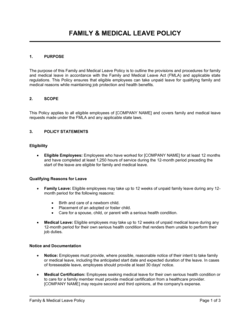
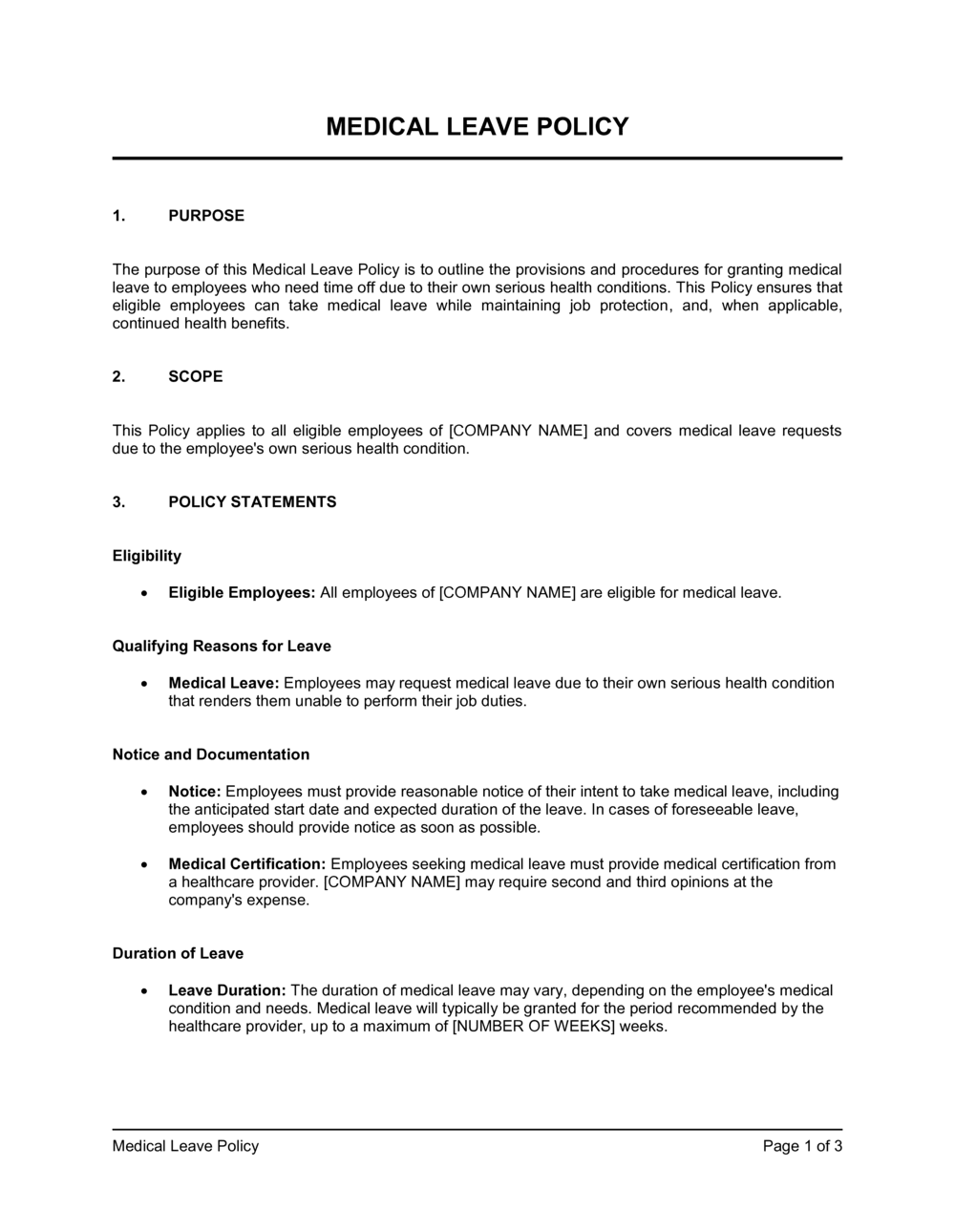
A Medical Leave Policy is a written HR document that defines how employees request, qualify for, and return from medically necessary time off. This free Word download covers eligibility thresholds, leave types, documentation requirements, pay continuation, and the return-to-work process β€” giving managers and employees a single authoritative reference they can follow consistently.
When you need it
Use it when onboarding your first employees, updating an employee handbook, or responding to a medical leave request where no written procedure exists. A documented policy also helps demonstrate compliance with federal and state leave laws during audits or employee disputes.
What's inside
The policy covers purpose and scope, leave eligibility, qualifying medical conditions, leave request and documentation procedures, pay and benefits continuation, manager responsibilities, confidentiality of medical records, and the return-to-work process including accommodation requests.

What is a Medical Leave Policy?

A Medical Leave Policy is an HR policy document that defines the rules, procedures, and entitlements governing employee absences due to serious health conditions. It specifies who qualifies for leave, what medical documentation is required, how pay and benefits continue during the absence, what responsibilities fall on managers and HR, and how an employee returns to work when they are medically cleared. Unlike a general sick leave policy β€” which handles brief, routine absences β€” a medical leave policy addresses extended, certified absences that require job protection, coordination with disability benefits, and formal return-to-work planning.

Why You Need This Document

Without a written medical leave policy, every leave request becomes an ad hoc decision β€” managers grant or deny time off inconsistently, HR has no documented basis to defend those decisions, and employees who feel unfairly treated escalate to complaints or litigation. The absence of a policy does not eliminate your legal obligations: FMLA, state mini-FMLA laws, and ADA accommodation requirements apply whether or not you have documented them. Failing to designate leave properly, storing medical records in the wrong file, or contacting employees during leave can each independently trigger regulatory exposure. A clear, distributed medical leave policy closes those gaps before an absence occurs, gives employees a predictable process they can trust, and gives HR and managers a consistent procedure they can follow without legal guesswork. This template gives you a professionally structured starting point you can customize in under two hours and distribute with confidence.

Which variant fits your situation?

If your situation is…Use this template
Company has 50 or more employees and must comply with FMLAFMLA Leave Policy
Covering leave for mental health conditions specificallyMental Health Leave Policy
Handling pregnancy and parental leave alongside medical leaveParental Leave Policy
Managing short-term disability pay coordinationShort-Term Disability Policy
Covering all employee leave types in a single documentEmployee Leave of Absence Policy
Documenting a return-to-work program after long-term illnessReturn to Work Policy
Setting out daily sick day entitlements for hourly workersSick Leave Policy

Common mistakes to avoid

❌ Requesting a medical diagnosis on the certification form

Why it matters: Asking for a diagnosis rather than functional limitations violates HIPAA privacy rules and creates ADA liability. Employees may refuse to provide it, and HR should not require it.

Fix: Use a healthcare provider certification form that asks only for the nature of the limitation, the expected duration, and the frequency of intermittent leave β€” not the underlying diagnosis.

❌ Applying the policy only to continuous leave

Why it matters: Employees with chronic conditions β€” diabetes, cancer treatment, migraines β€” may need intermittent leave. Excluding intermittent leave from the policy exposes the company to discrimination claims.

Fix: Add an explicit intermittent leave provision with its own notification and tracking procedures separate from continuous absence rules.

❌ Failing to designate leave in writing within the required window

Why it matters: If HR never formally designates the absence as medical leave, the absence may not count against the employee's leave entitlement β€” effectively extending the protected period indefinitely.

Fix: Build a written designation step into your HR workflow with a 5-business-day target from the date sufficient information is received.

❌ Contacting employees on leave for work tasks

Why it matters: Routine work-related contact during approved leave constitutes interference under FMLA and similar state laws and can expose the company to damages and reinstatement orders.

Fix: State explicitly in the manager responsibilities section that work contact during leave is prohibited except in mutually agreed emergencies, and train managers on this restriction.

❌ Storing medical certifications in the general personnel file

Why it matters: Medical records must be kept separate from standard employment records under HIPAA and ADA. A combined file creates privacy violations and audit risk.

Fix: Create a dedicated confidential medical file for each employee and restrict access to HR and those with a legitimate operational need.

❌ Omitting a job-protection and reinstatement clause

Why it matters: Without explicit reinstatement language, employees may fear taking leave or challenge their return status, increasing the likelihood of retaliation claims.

Fix: Include a clear reinstatement provision β€” same role or equivalent, same pay and benefits β€” along with the narrow exception for positions legitimately eliminated during the leave period.

The 10 key sections, explained

Purpose and scope

Eligibility requirements

Types of qualifying medical leave

Leave request procedure

Medical documentation requirements

Pay and benefits continuation

Manager and HR responsibilities

Confidentiality of medical information

Return-to-work process

Job protection and reinstatement rights

How to fill it out

  1. 1

    Enter your company name and effective date

    Replace all [COMPANY NAME] and [EFFECTIVE DATE] placeholders in the header and purpose section. The effective date triggers the policy's enforceability and should align with your next payroll cycle or handbook update.

    πŸ’‘ Include a version number (e.g., v1.0) so future updates are distinguishable from the original.

  2. 2

    Set eligibility thresholds

    Enter the minimum service period and hours-worked threshold in the eligibility section. Confirm these thresholds meet or exceed applicable federal minimums β€” FMLA requires 12 months of service and 1,250 hours worked for covered employers.

    πŸ’‘ If your company has fewer than 50 employees, note that FMLA does not apply federally, but state laws may impose equivalent obligations β€” check your state before lowering thresholds.

  3. 3

    Define qualifying leave types for your workforce

    Review the list of qualifying medical reasons and add or remove items based on your workforce composition. Include intermittent leave if your employees have recurring conditions.

    πŸ’‘ Explicitly listing mental health conditions as qualifying avoids ambiguity and reduces the likelihood of discriminatory treatment of psychiatric leave.

  4. 4

    Set notification and documentation deadlines

    Enter the advance notice period (typically 30 days for foreseeable leave), the certification submission deadline (typically 15 days), and the recertification interval (typically 30 days for ongoing leave).

    πŸ’‘ Mirror FMLA deadline language even if you are not a covered employer β€” it signals good-faith process and reduces disputes.

  5. 5

    Complete the pay continuation rules

    Specify the order in which paid leave balances are exhausted, identify whether short-term disability benefits coordinate with paid leave, and state the maximum duration of employer-paid or benefit-maintained leave.

    πŸ’‘ Consult your STD carrier to confirm how their plan coordinates with PTO exhaustion before finalizing this section.

  6. 6

    Define manager and HR action timelines

    Enter the number of business days HR has to designate leave in writing after receiving the request and the intervals for manager check-ins on extended leaves.

    πŸ’‘ A 5-business-day designation window matches FMLA's regulatory standard and is defensible in any dispute.

  7. 7

    Review confidentiality and records-handling procedures

    Confirm your document management system physically or digitally separates medical records from personnel files. Update the confidentiality section to reference your actual file-storage system.

    πŸ’‘ Name the specific HR role (e.g., HR Manager, not just 'HR') responsible for maintaining medical files β€” ambiguity leads to accidental disclosures.

  8. 8

    Distribute and acknowledge

    Add the policy to your employee handbook and obtain signed acknowledgments from all current employees. For new hires, include it in the onboarding packet.

    πŸ’‘ A digital acknowledgment with a timestamp is easier to produce in a dispute than a paper signature collected months earlier.

Frequently asked questions

What is a medical leave policy?

A medical leave policy is a written HR document that defines how employees request, qualify for, and return from medically necessary time away from work. It sets out eligibility criteria, the documentation employees must provide, how pay and benefits continue during leave, and what happens when they are ready to return. A clear policy protects both the employee and the employer by ensuring consistent, documented treatment of every leave request.

Do all companies need a medical leave policy?

Any employer with at least one employee benefits from a written medical leave policy, even if federal FMLA does not apply. Without one, managers make inconsistent decisions that can be perceived as discriminatory, and the company has no documented basis for its actions if a dispute arises. Companies with 50 or more employees in the US are required by FMLA to have documented leave procedures; state laws may impose similar requirements at lower employee thresholds.

How does a medical leave policy relate to FMLA?

FMLA is a federal law that sets minimum leave entitlements for covered employers β€” 50 or more employees within 75 miles. A medical leave policy is the internal document that implements those entitlements and fills in the procedural details FMLA does not specify, such as notification timelines, pay continuation order, and manager responsibilities. Companies with fewer than 50 employees should still maintain a policy because state mini-FMLA laws or ADA accommodation obligations may apply.

What medical documentation can an employer request?

An employer can require a healthcare provider certification confirming that the employee has a serious health condition, the estimated duration of leave, and any functional limitations that prevent the employee from performing their duties. Employers cannot require disclosure of the specific diagnosis. Recertification can be requested every 30 days for ongoing leave, or sooner if the employee's condition or expected return date changes.

Does an employee get paid during medical leave?

FMLA leave is unpaid at the federal level, but most employers require employees to exhaust accrued paid sick leave and PTO concurrently. Short-term disability insurance, where available, typically replaces 60–70% of salary for the duration of the disability period. Your medical leave policy should specify the exact order in which paid leave balances are applied and how STD benefits coordinate with those balances.

Can an employer deny a medical leave request?

An employer can deny leave that does not meet the policy's eligibility or documentation criteria, but cannot deny leave that qualifies under FMLA or state law equivalents. For employees not covered by FMLA, denial is legally permissible but should be documented carefully, particularly if the employee has a disability covered by the ADA β€” extended leave may be a required reasonable accommodation in that case.

What happens if an employee cannot return at the end of medical leave?

If an employee is unable to return at the end of their approved leave period, the employer should engage in an interactive process to explore whether an extension, modified duties, or a phased return constitutes a reasonable accommodation under the ADA. For FMLA-covered leave, the employer is not required to hold the position indefinitely beyond the 12-week entitlement, but must consider ADA obligations before making an employment decision.

How should intermittent medical leave be tracked?

Track intermittent leave by recording the date, duration, and reason for each absence against the employee's annual leave entitlement. Require employees to notify HR or their manager on each day of absence covered by the intermittent leave certification. Maintain a running log in the confidential medical file β€” not the general HR file β€” so you can accurately calculate remaining leave balance and identify potential misuse patterns.

How often should a medical leave policy be updated?

Review the policy annually as part of your standard HR policy cycle and whenever federal or state leave laws change. Notable trigger events include crossing the 50-employee threshold (triggering FMLA coverage), entering a new state with its own leave law, or an internal leave dispute that exposes a gap in the current policy language.

How this compares to alternatives

vs Sick Leave Policy

A sick leave policy governs short, routine absences β€” typically 1 to 5 days β€” for minor illness and covers daily accrual, carryover, and payout rules. A medical leave policy handles extended absences requiring healthcare certification, job protection, and return-to-work planning. Most companies need both: the sick leave policy manages day-to-day absence; the medical leave policy kicks in when a condition becomes serious or prolonged.

vs Leave of Absence Policy

A leave of absence policy is a broader document covering all categories of extended leave β€” personal, educational, military, and medical. A medical leave policy focuses exclusively on health-related absences and typically goes deeper on certification requirements, pay coordination, ADA accommodation, and fitness-for-duty procedures. Companies often embed the medical section inside a leave of absence policy but benefit from a standalone document for clarity.

vs Return to Work Policy

A return-to-work policy is a standalone document governing the re-entry process β€” modified duties, phased schedules, accommodation requests, and fitness-for-duty review. A medical leave policy includes a return-to-work section but focuses primarily on the leave itself. Organizations with high-volume leave activity often use both documents together, with the return-to-work policy providing the operational detail the leave policy outlines.

vs Parental Leave Policy

A parental leave policy governs pregnancy, adoption, and bonding leave β€” which may overlap with medical leave during the period of physical recovery from childbirth. A medical leave policy applies broadly to any serious health condition and is the governing document for the medical recovery component; parental leave then picks up the bonding period. Both policies should cross-reference each other to prevent gaps or double-counting.

Industry-specific considerations

Healthcare

Healthcare employers face higher-than-average leave frequency due to physical demands and infectious disease exposure, making a clearly documented intermittent leave process and fit-for-duty certification step especially important.

Manufacturing

Physical roles mean medical leave often follows workplace injuries, requiring the policy to coordinate with workers' compensation claims, modified-duty assignments, and OSHA recordkeeping.

Professional Services

Knowledge-worker roles create pressure on employees to stay connected during leave; the policy's manager responsibility section must explicitly prohibit work-task contact to protect both the employee and the firm.

Retail and Hospitality

High turnover and shift-based scheduling make intermittent leave tracking complex; clear notification timelines and a standardized absence-reporting procedure reduce scheduling disruption.

Template vs pro β€” what fits your needs?

PathBest forCostTime
Use the templateCompanies under 50 employees setting up a first written medical leave procedureFree1–2 hours to customize and distribute
Template + professional reviewCompanies crossing the 50-employee FMLA threshold or operating in states with additional leave mandates$300–$700 for an HR consultant or employment attorney review3–5 business days
Custom draftedMulti-state employers, heavily regulated industries, or companies integrating leave with a self-insured disability plan$1,000–$3,500 for employment counsel1–3 weeks

Glossary

FMLA
The Family and Medical Leave Act β€” a US federal law requiring employers with 50 or more employees to provide up to 12 weeks of unpaid, job-protected leave per year for qualifying medical reasons.
Qualifying Medical Condition
A serious health condition that requires inpatient care or continuing treatment by a healthcare provider, such as surgery, chronic illness, or incapacity lasting more than three consecutive days.
Intermittent Leave
Medical leave taken in separate blocks of time or by reducing daily or weekly hours rather than as a single continuous absence.
Leave of Absence
An approved period during which an employee is excused from work responsibilities while retaining their employment relationship with the company.
Short-Term Disability (STD)
An employer or insurer-provided benefit that replaces a portion of an employee's income β€” typically 60–70% β€” during a medically certified absence of up to 12–26 weeks.
Return-to-Work Plan
A structured arrangement that outlines modified duties, reduced hours, or workplace accommodations enabling an employee to safely resume work after a medical absence.
Medical Certification
A completed form from a licensed healthcare provider confirming the nature of the condition, the estimated duration of leave, and any functional limitations.
ADA (Americans with Disabilities Act)
A US federal law requiring employers with 15 or more employees to provide reasonable accommodations for employees with qualifying disabilities, which may include extended or modified leave.
Fitness-for-Duty Certification
A healthcare provider's written confirmation that the employee is medically cleared to return to their specific role and duties.
Pay Continuation
The period during which an employee on medical leave continues to receive full or partial salary, typically through accrued paid time off, short-term disability benefits, or employer policy.

Part of your Business Operating System

This document is one of 3,000+ business & legal templates included in Business in a Box.

  • Fill-in-the-blanks β€” ready in minutes
  • 100% customizable Word document
  • Compatible with all office suites
  • Export to PDF and share electronically

Create your document in 3 simple steps.

From template to signed document β€” all inside one Business Operating System.
1
Download or open template

Access over 3,000+ business and legal templates for any business task, project or initiative.

2
Edit and fill in the blanks with AI

Customize your ready-made business document template and save it in the cloud.

3
Save, Share, Send, Sign

Share your files and folders with your team. Create a space of seamless collaboration.

Save time, save money, and create top-quality documents.

β˜…β˜…β˜…β˜…β˜…

"Fantastic value! I'm not sure how I'd do without it. It's worth its weight in gold and paid back for itself many times."

Managing Director Β· Mall Farm
Robert Whalley
Managing Director, Mall Farm Proprietary Limited
β˜…β˜…β˜…β˜…β˜…

"I have been using Business in a Box for years. It has been the most useful source of templates I have encountered. I recommend it to anyone."

Business Owner Β· 4+ years
Dr Michael John Freestone
Business Owner
β˜…β˜…β˜…β˜…β˜…

"It has been a life saver so many times I have lost count. Business in a Box has saved me so much time and as you know, time is money."

Owner Β· Upstate Web
David G. Moore Jr.
Owner, Upstate Web

Run your business with a system β€” not scattered tools

Stop downloading documents. Start operating with clarity. Business in a Box gives you the Business Operating System used by over 250,000 companies worldwide to structure, run, and grow their business.

Start freeΒ Β·Β No credit card required