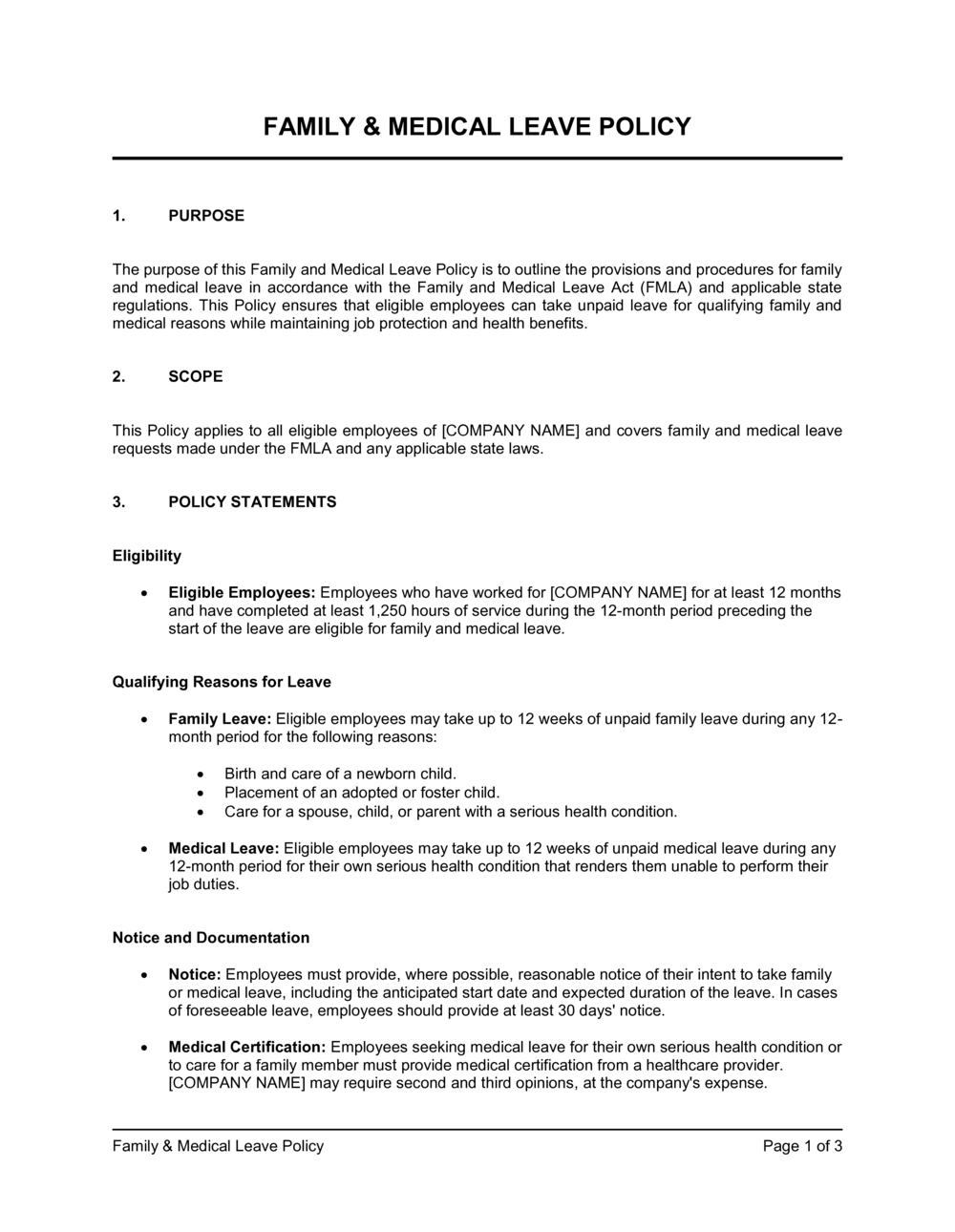
Family and Medical Leave Policy Template

Free Word download β€’ Edit online β€’ Save & share with Drive β€’ Export to PDF

3 pagesβ€’20–25 min to fillβ€’Difficulty: Standard
Learn more ↓
FreeFamily and Medical Leave Policy Template

At a glance

What it is
A Family and Medical Leave Policy is a written HR policy document that defines which employees are eligible for unpaid, job-protected leave, what qualifying reasons trigger that leave, how much leave is available, and what procedures employees and managers must follow. This free Word download gives you a ready-to-edit policy you can tailor to your workforce size, state requirements, and any leave benefits you offer beyond the federal FMLA minimum.
When you need it
Use it when hiring a first employee who may qualify for federal or state family and medical leave, when updating an employee handbook for a new fiscal year, or when an HR audit reveals your current leave procedures are undocumented or inconsistent. Any employer with 50 or more employees is required by federal law to have FMLA procedures in place.
What's inside
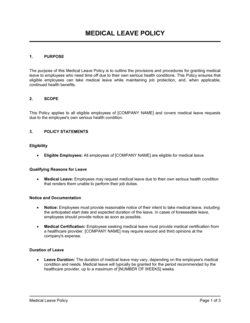
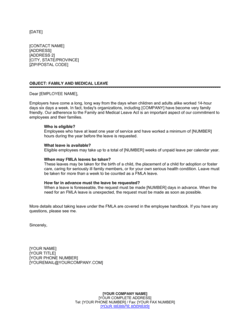
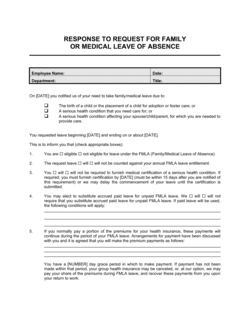
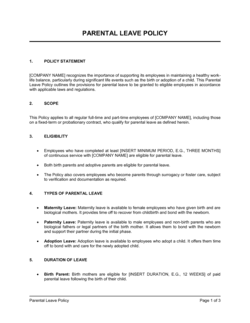
The policy covers eligibility criteria, qualifying leave reasons, leave duration and calculation method, employee notice and documentation requirements, benefit continuation during leave, and return-to-work procedures. It also includes manager responsibilities, anti-retaliation language, and a coordination clause for other paid leave programs.

What is a Family and Medical Leave Policy?

A Family and Medical Leave Policy is a written HR policy document that translates the federal Family and Medical Leave Act (FMLA) β€” and any applicable state leave laws β€” into a set of clear, actionable procedures for employees and managers. It defines who qualifies for job-protected leave, which life events and medical conditions trigger that protection, how much leave is available and how the leave year is calculated, and what steps both the employee and the employer must follow from the moment a leave request is made through the employee's return to work. The policy typically also addresses benefit continuation during leave, substitution of paid leave, and anti-retaliation protections.

Why You Need This Document

Operating without a documented family and medical leave policy exposes your organization to interference and retaliation claims under the FMLA β€” each carrying potential liability for back pay, liquidated damages, and attorney's fees. Without written procedures, managers make inconsistent decisions: one supervisor approves intermittent leave for a chronic condition while another denies an equivalent request, creating discrimination exposure. Employees who cannot find clear guidance on how to request leave or what documentation is required escalate directly to the Department of Labor rather than giving HR a chance to resolve the situation internally. A well-drafted policy eliminates that gap, ensures every leave request is evaluated against the same standard, and gives employees the clarity they need to exercise their rights without confusion. This template gives you a complete, FMLA-aligned starting point you can customize for your workforce size, state requirements, and any leave benefits you offer above the statutory floor.

Which variant fits your situation?

If your situation is…Use this template
Employer covered by federal FMLA (50+ employees within 75 miles)Family and Medical Leave Policy (FMLA)
Employer in a state with leave entitlements beyond federal FMLAState Family and Medical Leave Policy Addendum
Employer offering paid parental leave as a separate benefitParental Leave Policy
Policy covering short-term and long-term disability coordinationDisability Leave Policy
Documenting flexible return-to-work after extended medical leaveReturn-to-Work Plan
Comprehensive HR policy manual incorporating leave alongside other policiesEmployee Handbook

Common mistakes to avoid

❌ Using a single policy for all state locations without state addenda

Why it matters: States like California, New York, and Massachusetts have paid family leave programs and lower employer-size thresholds than federal FMLA. A federal-only policy leaves employees in those states underinformed about their actual entitlements.

Fix: Add a one-page state addendum for each state where you have employees, describing the state benefit, how it coordinates with FMLA, and any additional qualifying reasons the state law covers.

❌ Requiring employees to specifically invoke FMLA by name

Why it matters: FMLA regulations only require employees to provide enough information to alert the employer that a potentially qualifying condition may exist. Denying leave because an employee did not say 'FMLA' is an interference violation.

Fix: Train managers to escalate any leave request involving a health condition, a new child, or a family caregiving need to HR immediately, regardless of how the employee phrases the request.

❌ Failing to send the eligibility and designation notices within 5 business days

Why it matters: The DOL requires employers to notify employees of their FMLA eligibility and formally designate leave within 5 business days of receiving a qualifying leave request. Missing this window can prevent the employer from counting the leave against the employee's 12-week entitlement.

Fix: Create a checklist in your HR system that auto-triggers when a leave request is received, with due dates for the WH-381 eligibility notice and WH-382 designation notice.

❌ Applying the fitness-for-duty certification requirement to all leave types

Why it matters: Fitness-for-duty certifications may only be required when the leave was for the employee's own serious health condition. Requiring them for parental leave or military exigency leave is an unlawful condition of reinstatement.

Fix: Add a table to the return-to-work section mapping each qualifying leave reason to whether a fitness-for-duty certification is required, so managers apply the requirement correctly.

The 10 key sections, explained

Purpose and Scope

Eligibility Criteria

Qualifying Reasons for Leave

Amount and Calculation of Leave

Employee Notice Requirements

Medical Certification

Benefit Continuation and Pay During Leave

Manager and HR Responsibilities

Return to Work

Anti-Retaliation and Complaint Procedure

How to fill it out

  1. 1

    Confirm your coverage status and applicable laws

    Determine whether your organization qualifies as a covered employer under federal FMLA (50+ employees within 75 miles of any work site). Then check your state for additional leave laws that may apply at lower headcounts or provide longer entitlements.

    πŸ’‘ If you operate in California, New York, New Jersey, Massachusetts, or Washington, review those state-specific paid family leave programs before filling in the federal minimums β€” your policy must reflect whichever standard is more generous.

  2. 2

    Choose your leave-year calculation method

    Select one of the four FMLA-approved methods: calendar year, any fixed 12-month period, the 12-month period beginning on the employee's first FMLA leave date, or the rolling backward 12-month period. Enter your choice in the Amount of Leave section.

    πŸ’‘ The rolling backward 12-month period prevents employees from stacking 24 consecutive weeks of leave across two calendar years and is the most commonly used method among mid-size employers.

  3. 3

    Define your paid leave substitution rule

    Decide whether the company will require employees to substitute accrued PTO, sick leave, or vacation concurrently with unpaid FMLA leave, or leave the election to the employee. Document the rule explicitly in the Benefit Continuation and Pay section.

    πŸ’‘ Mandatory substitution is permitted under FMLA and is standard practice β€” it reduces the total out-of-pocket cost for the employee while limiting the employer's overall leave exposure.

  4. 4

    Insert your HR contact information and notice procedures

    Replace all [HR CONTACT] and [SUPERVISOR] placeholders with the specific person, role, or shared inbox employees should notify. Confirm the 30-day foreseeable notice requirement and the 'as soon as practicable' standard for unforeseeable leave.

    πŸ’‘ Route all leave requests to a dedicated HR inbox rather than to direct managers β€” this creates a defensible paper trail and ensures consistent FMLA designation decisions.

  5. 5

    Specify the certification forms and deadlines

    Reference the current DOL certification forms by number (WH-380-E for the employee's own condition, WH-380-F for a family member). Confirm the 15-calendar-day return window and your recertification triggers.

    πŸ’‘ Attach blank copies of both DOL forms to the policy as an appendix so employees and managers can access them immediately without searching the DOL website.

  6. 6

    Add state-specific addenda if required

    If your employees work in states with paid family leave programs (CA, NY, NJ, MA, WA, CT, OR, CO, DE, MD), add a state addendum that describes the state benefit, the employee contribution rate, and how the state benefit coordinates with unpaid FMLA.

    πŸ’‘ State paid family leave benefits generally run concurrently with federal FMLA leave β€” document this coordination explicitly to prevent employees from treating them as separate, additive entitlements.

  7. 7

    Review, date, and distribute the policy

    Have HR or an employment attorney review the completed policy before publication. Add the effective date and version number to the header, then distribute to all employees via the employee handbook or HR portal.

    πŸ’‘ Collect a signed acknowledgment from each employee confirming they received and reviewed the policy β€” this acknowledgment is your first line of defense in any FMLA interference or retaliation claim.

Frequently asked questions

What is a family and medical leave policy?

A family and medical leave policy is a written HR document that explains which employees are eligible for job-protected leave, what events or conditions qualify, how much leave is available, and what procedures employees and managers must follow to request, approve, and track leave. It operationalizes the federal FMLA and any applicable state leave laws into a consistent workplace procedure.

Which employers are required to comply with FMLA?

Private employers with 50 or more employees within a 75-mile radius of any single work site are covered by federal FMLA. All public agencies and schools are covered regardless of size. Many states have parallel leave laws that apply to smaller employers β€” California's CFRA applies to employers with 5 or more employees, for example. Even employers not yet covered by FMLA benefit from having a written policy as they grow.

How much leave is an eligible employee entitled to?

Under federal FMLA, eligible employees are entitled to up to 12 workweeks of unpaid, job-protected leave per leave year for most qualifying reasons. For military caregiver leave β€” caring for a covered servicemember with a serious injury or illness β€” the entitlement is up to 26 workweeks in a single 12-month period. Many state paid family leave programs provide a separate, partially paid benefit that runs concurrently with FMLA.

Does the employer have to pay employees during FMLA leave?

Federal FMLA leave is unpaid. However, employers may require β€” and employees may elect β€” to substitute any accrued paid leave (PTO, sick leave, vacation) for the unpaid FMLA period. State paid family leave programs in California, New York, New Jersey, and other states provide a partial wage replacement benefit funded through employee payroll contributions. Group health insurance must continue on the same terms during FMLA leave regardless of whether the employee is receiving pay.

What happens if an employee does not return after FMLA leave?

If an employee fails to return after FMLA leave ends, the employer may recover the cost of health insurance premiums paid on the employee's behalf during the leave β€” unless the failure to return is due to a continuation or recurrence of the serious health condition or other circumstances beyond the employee's control. The employer is not required to hold the position open beyond the FMLA entitlement period.

Can an employer deny FMLA leave to a key employee?

In limited circumstances, an employer may deny reinstatement β€” but not the leave itself β€” to a "key employee," defined as a salaried employee among the top 10% of earners at the work site, if restoring them would cause substantial and grievous economic injury. The employer must notify the employee of their key-employee status and the potential denial of reinstatement at the time leave is requested.

What is intermittent FMLA leave and how is it tracked?

Intermittent leave is FMLA leave taken in separate, non-consecutive blocks of time or through a reduced work schedule β€” for example, two hours off per day for chemotherapy appointments or one day per week for a chronic condition. Employers may track intermittent leave in hourly increments and may temporarily transfer the employee to an alternative position with equivalent pay and benefits that better accommodates the recurring leave schedule.

Do small businesses need a family and medical leave policy even if not covered by federal FMLA?

Yes, for two reasons. First, many states require leave for employers with far fewer than 50 employees β€” operating without a written policy in those states creates legal exposure. Second, a written policy establishes consistent, fair procedures that prevent discrimination claims and help the company manage workforce planning as it grows toward the federal coverage threshold.

How this compares to alternatives

vs Employee Handbook

An employee handbook is a comprehensive reference covering all workplace policies β€” conduct, compensation, benefits, and leave. A family and medical leave policy is a standalone document that focuses exclusively on leave entitlements, procedures, and manager obligations. The standalone policy can be updated independently of the full handbook when laws change, and it is easier to distribute as a required notice to new hires.

vs Parental Leave Policy

A parental leave policy addresses only the birth, adoption, or foster placement of a child and typically describes any paid leave benefit the employer offers beyond the FMLA minimum. A family and medical leave policy is broader, covering the employee's own serious health condition, family caregiving, and military leave in addition to parental leave. Many employers maintain both documents β€” the standalone parental policy for recruitment purposes and the FMLA policy for compliance purposes.

vs Attendance and Absenteeism Policy

An attendance policy sets expectations for punctuality, absence notification, and the consequences of unplanned absences. A family and medical leave policy carves out protected leave from those attendance rules β€” FMLA leave cannot be counted as an absence under a no-fault attendance policy. Without a clear FMLA policy, applying an attendance policy to protected leave is one of the most common FMLA interference violations.

vs Return-to-Work Plan

A return-to-work plan is an individualized document created for a specific employee outlining a phased or transitional schedule after extended medical or disability leave. A family and medical leave policy is a company-wide framework that establishes the rules governing all leaves. The policy triggers and authorizes the process; the return-to-work plan implements it for each individual case.

Industry-specific considerations

Healthcare

High rates of physically demanding roles mean FMLA for the employee's own serious health condition is frequent; 24/7 staffing requirements make intermittent leave scheduling particularly complex.

Manufacturing

Shift-based environments require clear procedures for intermittent leave tracking and temporary position transfers to maintain production continuity during extended absences.

Professional Services

Parental leave and military exigency leave are common triggers; policies must address client continuity and matter-handoff procedures during extended attorney, accountant, or consultant absences.

Retail / Hospitality

High turnover and part-time workforces mean eligibility determination β€” especially the 1,250-hour threshold β€” must be calculated carefully for each leave request.

Template vs pro β€” what fits your needs?

PathBest forCostTime
Use the templateEmployers with straightforward domestic operations in a single state who need an FMLA-compliant policy fastFree1–2 hours to customize and distribute
Template + professional reviewMulti-state employers, companies in states with paid family leave programs, or any employer that has received an FMLA complaint$300–$800 for an employment attorney or HR consultant review3–5 business days
Custom draftedLarge employers with complex multi-state leave coordination, union workforces, or federal contractor obligations$1,000–$3,500 for a full employment law firm policy review and state addenda1–3 weeks

Glossary

FMLA
The federal Family and Medical Leave Act of 1993, which entitles eligible employees of covered employers to up to 12 weeks of unpaid, job-protected leave per year for qualifying reasons.
Covered Employer
A private employer with 50 or more employees within a 75-mile radius, or any public agency or school, making them subject to federal FMLA obligations.
Eligible Employee
An employee who has worked for the employer for at least 12 months, logged at least 1,250 hours in the past 12 months, and works at a location with 50 or more employees within 75 miles.
Qualifying Reason
A condition or event that triggers FMLA entitlement β€” including the birth or adoption of a child, a serious health condition of the employee or an immediate family member, or a qualifying military exigency.
Serious Health Condition
An illness, injury, impairment, or physical or mental condition requiring inpatient care or continuing treatment by a healthcare provider, as defined under FMLA regulations.
Intermittent Leave
FMLA leave taken in separate blocks of time or by reducing the employee's normal weekly or daily work schedule rather than in a single continuous period.
Leave Year
The 12-month period an employer uses to calculate an employee's FMLA entitlement β€” options include calendar year, fiscal year, rolling backward 12 months, or fixed 12-month period from first leave date.
Benefit Continuation
The employer's obligation to maintain the employee's group health insurance on the same terms during FMLA leave as if the employee had continued working.
Reinstatement Right
An eligible employee's right to return to the same or an equivalent position β€” same pay, benefits, and working conditions β€” upon returning from FMLA leave.
Substitution of Paid Leave
An employer's policy or an employee's election to use accrued paid leave (PTO, sick leave, vacation) concurrently with unpaid FMLA leave, reducing the total unpaid leave taken.

Part of your Business Operating System

This document is one of 3,000+ business & legal templates included in Business in a Box.

  • Fill-in-the-blanks β€” ready in minutes
  • 100% customizable Word document
  • Compatible with all office suites
  • Export to PDF and share electronically

Create your document in 3 simple steps.

From template to signed document β€” all inside one Business Operating System.
1
Download or open template

Access over 3,000+ business and legal templates for any business task, project or initiative.

2
Edit and fill in the blanks with AI

Customize your ready-made business document template and save it in the cloud.

3
Save, Share, Send, Sign

Share your files and folders with your team. Create a space of seamless collaboration.

Save time, save money, and create top-quality documents.

β˜…β˜…β˜…β˜…β˜…

"Fantastic value! I'm not sure how I'd do without it. It's worth its weight in gold and paid back for itself many times."

Managing Director Β· Mall Farm
Robert Whalley
Managing Director, Mall Farm Proprietary Limited
β˜…β˜…β˜…β˜…β˜…

"I have been using Business in a Box for years. It has been the most useful source of templates I have encountered. I recommend it to anyone."

Business Owner Β· 4+ years
Dr Michael John Freestone
Business Owner
β˜…β˜…β˜…β˜…β˜…

"It has been a life saver so many times I have lost count. Business in a Box has saved me so much time and as you know, time is money."

Owner Β· Upstate Web
David G. Moore Jr.
Owner, Upstate Web

Run your business with a system β€” not scattered tools

Stop downloading documents. Start operating with clarity. Business in a Box gives you the Business Operating System used by over 250,000 companies worldwide to structure, run, and grow their business.

Free Forever PlanΒ Β·Β No credit card required