Time Off Policy Template

Free Word download β€’ Edit online β€’ Save & share with Drive β€’ Export to PDF

5 pagesβ€’25–30 min to fillβ€’Difficulty: Standard
Learn more ↓
FreeTime Off Policy Template

At a glance

What it is
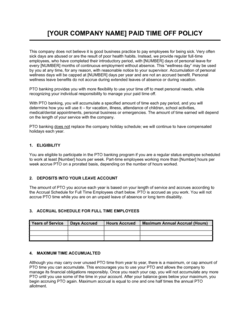
A Time Off Policy is an internal company document that defines how employees request, accrue, and use paid and unpaid leave β€” including vacation, sick days, personal days, and holidays. This free Word download gives you a structured, editable starting point you can customize for your organization and incorporate directly into your employee handbook, then export as PDF for distribution.
When you need it
Use it when onboarding your first employees, updating an outdated leave policy, or standardizing inconsistent time-off practices across departments. It is also essential whenever you expand into a new state or country with mandatory paid leave requirements.
What's inside
Leave categories and accrual rates, eligibility rules, request and approval procedures, carryover and payout rules, holiday schedule, special leave provisions, and manager responsibilities β€” organized into a single ready-to-distribute policy document.

What is a Time Off Policy?

A Time Off Policy is an internal company document that defines every dimension of employee leave β€” how vacation, sick days, personal days, and holidays are earned, requested, approved, and tracked. It establishes accrual rates and caps, carryover and forfeiture rules, request procedures and notice requirements, and what happens to unused balances when an employee leaves the company. A clearly written policy replaces the informal, manager-by-manager arrangements that create inconsistency, disputes, and legal exposure as a company grows.

Why You Need This Document

Without a written time off policy, leave decisions default to individual manager judgment β€” producing different outcomes for similarly situated employees and opening the door to discrimination claims. Accrued vacation balances with no stated cap accumulate silently as a growing balance-sheet liability that surfaces during audits or acquisition due diligence. In states like California, Illinois, and Massachusetts, undefined or improperly drafted forfeiture rules expose employers to wage claims and penalties regardless of what managers told employees verbally. A policy document also protects against the opposite problem: employees who take more leave than intended because nothing in writing limits them. This template gives you a compliant, consistent, and editable foundation that communicates leave entitlements clearly to every employee from day one.

Which variant fits your situation?

If your situation is…Use this template
Offering unlimited PTO with no accrual trackingUnlimited PTO Policy
Covering leave specifically for illness and medical appointmentsSick Leave Policy
Documenting leave for a new parent after birth or adoptionParental Leave Policy
Granting leave for military service obligationsMilitary Leave Policy
Managing extended absences for a serious health conditionFMLA Leave Policy
Formalizing bereavement time off for the loss of a family memberBereavement Leave Policy
Providing a summary of all leave types inside a broader HR documentEmployee Handbook

Common mistakes to avoid

❌ Implementing use-it-or-lose-it without a state law check

Why it matters: In California, Colorado, Illinois, and several other states, accrued vacation is legally earned wages β€” forfeiting it at year-end exposes the company to wage claims and penalties.

Fix: Before finalizing carryover and forfeiture language, audit the states where you have employees and confirm which forfeiture rules are legally permissible in each.

❌ Hard-coding specific holiday dates in the policy body

Why it matters: When observed dates shift (e.g., a holiday falling on a weekend), the policy is immediately out of date and requires a formal amendment to correct.

Fix: Reference a separately published annual holiday schedule rather than listing specific dates, and publish the updated schedule each November.

❌ Setting no accrual cap on vacation balances

Why it matters: An uncapped accrual liability appears on the company's balance sheet and becomes a significant cash obligation during audits, fundraising due diligence, or a business sale.

Fix: Set a carryover cap equal to 1.0–1.5 times the annual accrual (e.g., a cap of 15 days for a 10-day annual accrual) and communicate it clearly in the policy.

❌ Requiring advance notice for unplanned sick leave

Why it matters: State paid sick leave laws in California, New York, Washington, and others explicitly prohibit penalizing employees for not providing advance notice when illness is unexpected.

Fix: Create two separate notice procedures: one for planned vacation (e.g., 5 business days) and a separate, lenient procedure for unplanned sick leave that only requires notification before the start of the shift.

❌ Stating that accrued vacation is forfeited at separation

Why it matters: In states that treat accrued vacation as earned wages, a forfeiture-at-separation clause is unenforceable and exposes the company to individual and class wage claims.

Fix: Replace forfeiture language with a compliant payout obligation for vacation and use separate, explicit language to exclude non-accruing leave types (personal days, sick leave) from the payout.

❌ Leaving manager accountability out of the policy entirely

Why it matters: Without written manager obligations, inconsistent approval patterns create discrimination claims when employees in protected classes are denied leave that comparable employees routinely receive.

Fix: Add a dedicated manager responsibilities section specifying response timeframes, recordkeeping duties, and the obligation to flag potential protected-leave situations to HR.

The 10 key sections, explained

Purpose and scope

Leave categories and definitions

Accrual schedule and eligibility

Carryover and forfeiture rules

Request and approval procedure

Company holidays

Special and protected leave

Payout on separation

Manager responsibilities

Policy review and amendments

How to fill it out

  1. 1

    Define which employees the policy covers

    Specify whether the policy applies to full-time only, part-time, exempt, non-exempt, or all employees. Note any distinctions in accrual rates or eligibility between groups.

    πŸ’‘ If you have employees in multiple states, flag state-specific variations in a separate addendum rather than trying to write a single nationwide rule that works for every jurisdiction.

  2. 2

    Choose your leave structure: separate buckets or combined PTO

    Decide whether to maintain separate vacation and sick leave balances or merge them into a single PTO bank. Each approach has trade-offs for tracking, culture, and compliance with state sick leave mandates.

    πŸ’‘ A combined PTO bank simplifies administration but requires you to maintain a minimum sick-leave component in states with mandatory sick leave laws β€” confirm your PTO accrual rate meets those minimums.

  3. 3

    Set accrual rates and caps for each leave type

    Enter the accrual rate per pay period and the annual cap for each leave category. Calculate the corresponding days-per-year figure and confirm it is competitive for your industry.

    πŸ’‘ Check the median vacation offering for your sector before finalizing β€” 10 days per year is below market for knowledge workers and will show up in recruiting conversations.

  4. 4

    Draft the carryover and forfeiture rules

    Set the carryover cap and decide whether balances above it are forfeited or frozen. Verify that any use-it-or-lose-it or forfeiture rule is permitted in the states where you have employees.

    πŸ’‘ If you operate in California, Montana, or Nebraska, remove all forfeiture language β€” accrued vacation is legally treated as earned wages in those states.

  5. 5

    Define the request and approval procedure

    Name the system or method employees use to submit requests, set the required advance notice window for planned leave, and specify who approves. Add separate instructions for unplanned sick leave that do not require advance notice.

    πŸ’‘ Specify a response deadline for managers (e.g., within 3 business days) β€” unanswered requests create planning problems and employee frustration.

  6. 6

    List the company holiday schedule by reference

    Name the holidays the company observes but reference a separately published annual schedule rather than listing specific dates in the policy body.

    πŸ’‘ Publish the annual holiday schedule in your HR system or intranet in November each year so employees can plan in advance.

  7. 7

    Add the payout-on-separation clause

    State which leave types are paid out at separation and which are not, using language that reflects your state law obligations. Limit forfeiture language to leave types that your applicable states permit to be forfeited.

    πŸ’‘ Run the payout language by a local employment attorney or HR consultant if you have employees in more than three states β€” the variation is significant.

  8. 8

    Set the review schedule and publish the policy

    Assign a policy owner (typically the HR lead), set an annual review date, and specify where the current version is stored and how updates are communicated.

    πŸ’‘ Version-control the document with a 'last revised' date in the footer β€” employees and managers can then confirm they are referencing the current version.

Frequently asked questions

What is a time off policy?

A time off policy is a written company document that defines the types of leave available to employees, how leave is earned and tracked, how employees request and managers approve time off, and what happens to unused balances at year-end or separation. It applies to vacation, sick leave, personal days, holidays, and other leave types. A written policy replaces informal, manager-by-manager arrangements with a consistent set of rules that applies to everyone.

Is a time off policy legally required?

No federal law requires a private employer to offer vacation or paid time off. However, once a company offers leave, certain rules about accrual, payout, and forfeiture are governed by state law β€” making a written policy essential for compliance. Additionally, many states and cities now mandate paid sick leave, and a written policy is the standard mechanism for documenting how that obligation is met.

What is the difference between PTO and vacation?

Vacation is a specific leave category typically reserved for rest and personal travel, kept separate from sick leave. PTO (paid time off) is a combined bank that merges vacation, sick days, and personal days into a single balance an employee can use for any reason. PTO simplifies administration but requires the company to verify that the combined accrual rate satisfies state minimum sick leave requirements in every state where it operates.

Can employers implement a use-it-or-lose-it PTO policy?

In many US states, yes β€” an employer can require employees to use PTO by year-end or forfeit it. However, California, Colorado, Illinois, Montana, and Nebraska prohibit forfeiture of accrued vacation because those states treat it as earned wages. Employers operating across multiple states typically need state-specific addenda or a nationwide policy that defaults to the most employee-favorable rule.

Do employers have to pay out unused vacation when an employee leaves?

It depends on state law. California, Illinois, Massachusetts, Montana, and several other states require employers to pay out all accrued, unused vacation at the employee's regular rate upon separation, regardless of the reason for leaving. In most other states, the obligation is governed by the written policy β€” which is why the policy's payout clause must be drafted carefully for each state where you employ people.

How much PTO should a small business offer?

Median vacation for full-time employees in the US is 10 days after one year and 15 days after five years, according to Bureau of Labor Statistics data. Knowledge-work and technology roles typically see 15–20 days as the competitive minimum. Starting below 10 days is a visible recruiting disadvantage. Adding 5–10 sick days separately (or building a combined PTO bank of 15–18 days) is the most common structure for companies with fewer than 50 employees.

What is an unlimited PTO policy and what are the risks?

An unlimited PTO policy removes accrual tracking and caps, letting employees take as much time off as they need with manager approval. The practical risks: employees often take less time off under unlimited policies than under accrual systems because there is no balance to spend; it can create inequity if managers approve requests inconsistently; and it requires a strong trust-based culture to function. It also eliminates the accrued-vacation payout liability at separation, which is the primary financial reason many companies adopt it.

How should managers handle leave requests during busy periods?

The policy should explicitly permit managers to deny or defer requests during defined blackout periods β€” such as a retail holiday season or fiscal year-end close β€” as long as the restriction is applied consistently and employees are given advance notice of the blackout dates. Denying requests outside defined blackout periods without documented business justification creates fairness and legal exposure, particularly if the denial pattern correlates with a protected characteristic.

How often should a time off policy be reviewed?

At minimum, annually β€” state and local paid leave laws change every year, and a policy that was compliant in January can be out of step with new mandates by July. A practical cadence is a full review in Q4, timed to publish any changes before the new calendar year begins so employees know their balances and rules before January 1.

How this compares to alternatives

vs Employee Handbook

An employee handbook is a comprehensive document covering all HR policies β€” conduct, compensation, benefits, leave, and performance. A time off policy is a standalone document addressing leave exclusively, with the depth of detail (accrual tables, request procedures, state-specific rules) that handbooks typically summarize rather than spell out. Use the standalone policy as the authoritative leave reference and cross-link it from the handbook.

vs Parental Leave Policy

A parental leave policy governs leave specifically related to the birth, adoption, or foster placement of a child β€” including duration, pay continuation, and return-to-work rights. A time off policy covers the full range of everyday leave types (vacation, sick, personal days, holidays) but typically refers employees to a separate parental leave document for birth and adoption leave details.

vs Attendance Policy

An attendance policy governs expectations around punctuality, unplanned absences, and the disciplinary consequences of excessive absence. A time off policy governs how leave is earned and used, not how attendance is enforced. Both are needed: the time off policy sets the entitlements; the attendance policy sets the accountability framework when those entitlements are exhausted or misused.

vs Remote Work Agreement

A remote work agreement governs where and how an employee works, not whether they are working. A time off policy governs approved absences from work entirely. The two documents interact when remote employees request time off β€” the time off policy applies equally regardless of work location β€” but they address different operational questions.

Industry-specific considerations

Technology / SaaS

Unlimited or high-accrual PTO is a standard recruiting tool; clear blackout windows around product launches and quarterly closes help prevent coverage gaps.

Retail / Hospitality

Seasonal blackout periods during peak shopping seasons, shift-based coverage requirements, and high turnover rates make accrual caps and forfeiture rules especially consequential.

Healthcare

24/7 coverage requirements mean leave scheduling requires minimum staffing thresholds and often mandatory notice windows longer than other industries.

Professional Services

Client engagement timelines and billable-hour targets mean leave requests around deal closings or audit periods require careful coordination with project staffing.

Manufacturing

Shift schedules, production quotas, and union contract interactions mean time off policies must specify coverage minimums per shift and align with any applicable collective bargaining agreements.

Education

Academic calendar constraints limit when staff can take leave; summer and inter-session periods are typically the designated vacation windows, requiring clear rules for non-teaching staff.

Template vs pro β€” what fits your needs?

PathBest forCostTime
Use the templateSmall businesses and startups with employees in one or two states who need a written policy quicklyFree1–2 hours
Template + professional reviewCompanies with employees in three or more states, or any employer subject to state paid sick leave mandates$300–$800 for an HR consultant or employment attorney review3–5 business days
Custom draftedMulti-state or international employers, unionized workforces, or companies with complex leave structures requiring state-specific addenda$1,000–$3,000+1–3 weeks

Glossary

PTO (Paid Time Off)
A combined leave bank from which employees draw paid absence for vacation, illness, or personal needs β€” replacing separate vacation and sick-day buckets.
Accrual Rate
The rate at which an employee earns leave over time, typically expressed as hours earned per pay period or days earned per year of service.
Carryover Cap
The maximum number of unused leave hours or days an employee may carry from one calendar year into the next.
Use-It-or-Lose-It
A policy provision that forfeits unused leave at year-end rather than allowing carryover or payout β€” prohibited in some states such as California.
Accrual Cliff
A waiting period β€” typically 30 to 90 days β€” before a new employee begins accruing or becomes eligible to use their leave balance.
Payout on Separation
The requirement to pay an employee the cash value of their accrued, unused leave when they leave the company β€” mandatory in many US states for accrued vacation.
Floating Holiday
A paid day off that an employee may schedule on any date of their choosing, used to accommodate personal, religious, or cultural observances.
Leave of Absence
An approved period of absence β€” paid or unpaid β€” that extends beyond standard leave entitlements, typically requiring formal request and management approval.
FMLA
The US Family and Medical Leave Act, which entitles eligible employees at covered employers to up to 12 weeks of unpaid, job-protected leave per year for qualifying medical or family reasons.
Blackout Period
A defined timeframe β€” such as a retail holiday season or fiscal year-end close β€” during which the employer restricts or limits leave approvals due to operational demand.

Part of your Business Operating System

This document is one of 3,000+ business & legal templates included in Business in a Box.

  • Fill-in-the-blanks β€” ready in minutes
  • 100% customizable Word document
  • Compatible with all office suites
  • Export to PDF and share electronically

Create your document in 3 simple steps.

From template to signed document β€” all inside one Business Operating System.
1
Download or open template

Access over 3,000+ business and legal templates for any business task, project or initiative.

2
Edit and fill in the blanks with AI

Customize your ready-made business document template and save it in the cloud.

3
Save, Share, Send, Sign

Share your files and folders with your team. Create a space of seamless collaboration.

Save time, save money, and create top-quality documents.

β˜…β˜…β˜…β˜…β˜…

"Fantastic value! I'm not sure how I'd do without it. It's worth its weight in gold and paid back for itself many times."

Managing Director Β· Mall Farm
Robert Whalley
Managing Director, Mall Farm Proprietary Limited
β˜…β˜…β˜…β˜…β˜…

"I have been using Business in a Box for years. It has been the most useful source of templates I have encountered. I recommend it to anyone."

Business Owner Β· 4+ years
Dr Michael John Freestone
Business Owner
β˜…β˜…β˜…β˜…β˜…

"It has been a life saver so many times I have lost count. Business in a Box has saved me so much time and as you know, time is money."

Owner Β· Upstate Web
David G. Moore Jr.
Owner, Upstate Web

Run your business with a system β€” not scattered tools

Stop downloading documents. Start operating with clarity. Business in a Box gives you the Business Operating System used by over 250,000 companies worldwide to structure, run, and grow their business.

Free Forever PlanΒ Β·Β No credit card required