Maternity Leave Policy Template

Free Word download β€’ Edit online β€’ Save & share with Drive β€’ Export to PDF

3 pagesβ€’20–30 min to fillβ€’Difficulty: Standard
Learn more ↓
FreeMaternity Leave Policy Template

At a glance

What it is
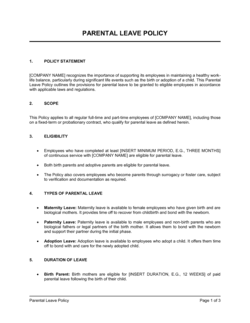
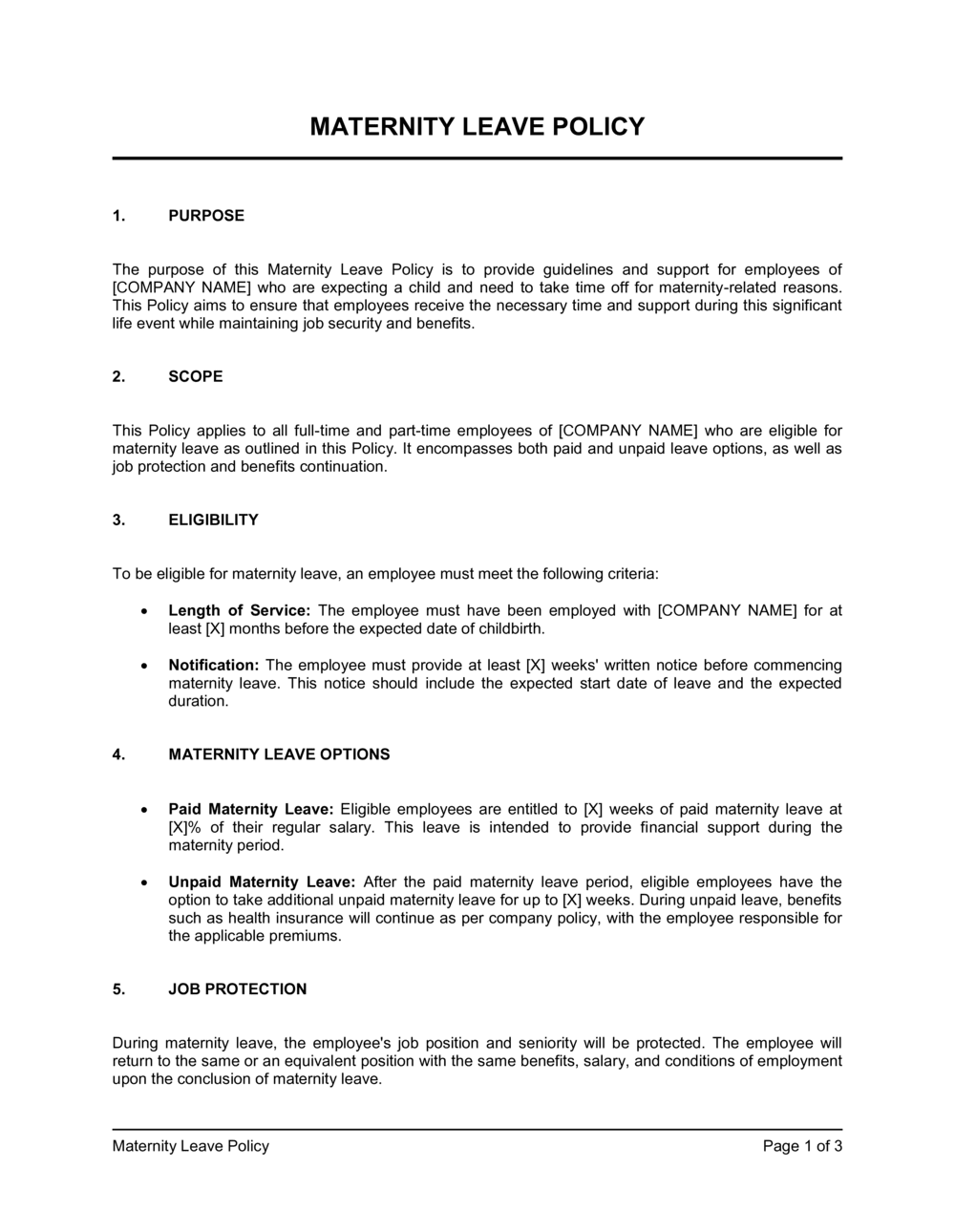
A Maternity Leave Policy is a formal employer document that defines the leave entitlements, pay continuation, notification procedures, and return-to-work steps available to employees who give birth or adopt. This free Word download gives HR teams and small business owners a ready-to-edit policy they can tailor to their jurisdiction, headcount, and pay structure, then export as PDF for the employee handbook or onboarding package.
When you need it
Use it when formalizing employee benefits for a growing team, updating an existing handbook to reflect current legislation, or responding to a first request for maternity leave and realizing no written policy exists. Having the document in place before a request arrives eliminates inconsistency and reduces legal exposure.
What's inside
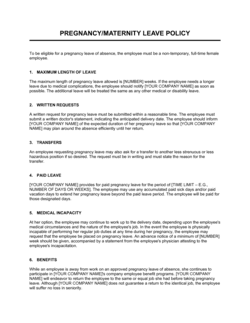
The policy covers eligibility criteria, statutory and company-paid leave entitlements, notification and documentation requirements, pay continuity during leave, health benefits continuation, a return-to-work process including flexible arrangements, manager responsibilities, and confidentiality obligations.

What is a Maternity Leave Policy?

A Maternity Leave Policy is a formal employer document that defines the leave entitlements, pay continuation, notification procedures, benefits maintenance, and return-to-work steps available to employees who give birth or adopt a child. It translates statutory requirements β€” FMLA in the US, provincial employment standards in Canada, the Employment Rights Act in the UK β€” into a clear operational framework that HR teams, payroll administrators, and line managers can apply consistently. Beyond statutory compliance, the policy typically documents any company-enhanced provisions: additional paid weeks, pension contributions during leave, or structured flexible return arrangements that go beyond the legal floor.

Why You Need This Document

Without a written maternity leave policy, every request is handled ad hoc β€” and inconsistent treatment is the fastest path to a discrimination claim. When one employee receives 12 weeks of full pay and the next receives statutory minimum because a different manager handled the conversation, the gap is legally and reputationally costly. Statutory obligations apply regardless of whether a policy exists, so the practical question is not whether to comply, but whether managers will comply correctly and consistently. A published policy closes that gap: it tells employees exactly what they are entitled to before they ask, tells managers exactly what to do from the first disclosure conversation, and gives payroll the phase-by-phase pay schedule needed to process leave accurately. This template gives you a complete, editable starting point that covers every material section β€” from eligibility and notification to return-to-work and policy review β€” so you can have a compliant, professional policy in place before the next leave request arrives.

Which variant fits your situation?

If your situation is…Use this template
Covering all parents regardless of gender or birth methodParental Leave Policy
Short-term disability integration for pregnancy-related leaveShort-Term Disability Policy
Documenting a formal employee absence management frameworkEmployee Leave of Absence Policy
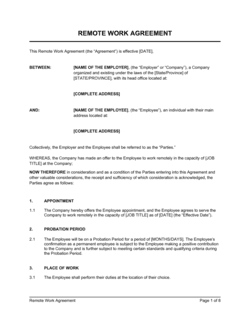
Establishing a flexible or remote return-to-work arrangementRemote Work Agreement
Creating a standalone paternity or adoption leave policyPaternity Leave Policy
Documenting FMLA compliance procedures for US employersFMLA Leave Policy
Adding leave terms to a comprehensive employee handbookEmployee Handbook

Common mistakes to avoid

❌ Copying statutory minimums as company policy without distinguishing them

Why it matters: Employees read the policy as the full entitlement. When statutory rates change and the policy is not updated, the company pays the wrong amount or creates an inadvertent contractual obligation at old rates.

Fix: Reference statutory entitlements by law name rather than specific figures, and state company top-ups separately so only the enhanced portion needs manual updates.

❌ Omitting pension and retirement benefit treatment during leave

Why it matters: Payroll and the pension provider make inconsistent decisions when the policy is silent, resulting in underpayments or overpayments that are expensive to unwind.

Fix: Add a dedicated benefits continuation section that addresses pension contributions explicitly for each leave phase β€” paid, unpaid, and phased return.

❌ No documented return-to-work process

Why it matters: Employees return to find changed responsibilities, missed communications, or an unanswered flexible-working request β€” all of which generate grievances and, in some jurisdictions, legal claims.

Fix: Require a return-to-work meeting within five business days of return and document the agreed role, hours, and any flexible arrangement in a written addendum.

❌ Setting notification requirements stricter than statutory minimums

Why it matters: Requiring earlier notice than the law mandates does not create a binding obligation on the employee but does create a perception of overreach that damages trust.

Fix: Align your notification deadline with the applicable statutory requirement and frame any earlier notice as preferred rather than required.

❌ Failing to include a manager responsibilities section

Why it matters: Line managers handle the initial disclosure conversation without guidance, increasing the risk of discriminatory comments, premature role changes, or failure to notify HR.

Fix: Add a numbered checklist of manager actions β€” from receipt of notice through coverage planning β€” and include it in manager training materials alongside the policy.

❌ No policy review clause or scheduled review date

Why it matters: Statutory pay rates, qualifying conditions, and leave structures change regularly. An unreviewed policy can reference figures or rules that are years out of date.

Fix: Include a review clause naming the responsible role and a specific review cadence β€” at minimum annually, and immediately following any relevant legislative change.

The 10 key sections, explained

Policy purpose and scope

Eligibility criteria

Leave entitlement and duration

Notification and documentation requirements

Pay during leave

Health benefits and pension continuation

Return-to-work process

Flexible and phased return arrangements

Manager responsibilities

Policy review and amendments

How to fill it out

  1. 1

    Set the scope and employment types covered

    Identify which employment classifications β€” full-time, part-time, fixed-term, probationary β€” are included and in which locations. If your business operates in multiple jurisdictions, note that statutory minimums apply in each location regardless of company policy.

    πŸ’‘ If you operate in the US, Canada, and the UK simultaneously, add a jurisdiction appendix rather than trying to merge three statutory frameworks into one policy body.

  2. 2

    Define the qualifying service period

    Enter the minimum continuous service period required to access company-enhanced benefits. Confirm this threshold meets β€” but does not exceed β€” the statutory minimum in your jurisdiction.

    πŸ’‘ In the UK, there is no qualifying period for Statutory Maternity Leave (26 weeks); in the US, FMLA requires 12 months of service. Confirm the floor before setting your threshold.

  3. 3

    Complete the leave duration and pay schedule

    Fill in the total weeks of leave available, broken into phases with the corresponding pay rate at each phase. Separate statutory entitlements from company top-ups clearly.

    πŸ’‘ Use a simple table format β€” weeks, pay rate, and funding source β€” so payroll can process each phase without calling HR for clarification.

  4. 4

    Specify notification timelines and documentation

    Enter the number of weeks' advance notice required and list the supporting documents the employee must provide (e.g., MATB1 certificate in the UK, a medical letter confirming due date elsewhere).

    πŸ’‘ Mirror the statutory notice deadline rather than requiring earlier notice β€” more restrictive requirements are often unenforceable and create friction with employees.

  5. 5

    Confirm benefits continuation terms

    State explicitly whether health insurance, pension or retirement contributions, and other contractual benefits continue during each phase of leave, and whether employee contributions are expected from maternity pay.

    πŸ’‘ Check with your benefits provider before publishing β€” some group plans have specific rules about leave periods that override the policy language.

  6. 6

    Write the return-to-work and flexible working process

    Define the notice period for changes to the return date, the return-to-work meeting format, and the process for submitting and evaluating a flexible working request.

    πŸ’‘ Set a written deadline for flexible working requests (e.g., 8 weeks before return) β€” this gives the business time to assess operational impact before the employee is back.

  7. 7

    List manager action steps explicitly

    Write out the numbered steps a line manager must take from the moment an employee discloses a pregnancy. Include HR notification, written acknowledgment, coverage planning, and the confidentiality obligation.

    πŸ’‘ Turn this section into a one-page checklist managers can print β€” most maternity leave complaints originate from a manager's uninformed response in the first conversation.

  8. 8

    Add a review date and owner

    Enter the next scheduled review date (typically 12 months or sooner if legislation changes) and name the HR role responsible for updating the policy.

    πŸ’‘ Set a calendar reminder when you publish the policy β€” statutory pay rates and notice periods change annually in many jurisdictions and will silently invalidate your figures if not updated.

Frequently asked questions

What is a maternity leave policy?

A maternity leave policy is a formal employer document that defines the leave entitlements, pay, and return-to-work procedures available to employees before and after giving birth or adopting a child. It sets out eligibility criteria, notification requirements, how pay continues during leave, whether benefits are maintained, and the process for returning to work β€” including any flexible arrangements. Having a written policy ensures consistent treatment and reduces legal exposure for the employer.

Is a maternity leave policy legally required?

A written maternity leave policy is not universally mandated by law, but statutory maternity leave entitlements are required in most jurisdictions β€” including the US (FMLA), Canada (provincial employment standards), and the UK (the Employment Rights Act). Documenting those entitlements in a policy protects the employer from claims of inconsistent treatment and ensures managers apply the rules correctly. In the UK, employers with more than one employee are effectively required to have written procedures in place.

How much maternity leave should a policy provide?

At minimum, the policy must meet the statutory floor in the applicable jurisdiction β€” 12 weeks unpaid under FMLA in the US, up to 52 weeks in the UK, and varying amounts under provincial legislation in Canada. Many employers offer enhanced provisions: 12–26 weeks of fully or partially paid leave is common among mid-size and large employers. The right level depends on budget, talent competition, and what peer employers in your industry offer.

What is the difference between maternity leave and parental leave?

Maternity leave is specifically for the birthing parent, typically beginning around the expected due date. Parental leave is a broader category available to all parents β€” including partners, adoptive parents, and in some jurisdictions, any primary caregiver β€” and usually follows the initial maternity leave period. Some employers consolidate both into a single parental leave policy; others maintain separate policies to reflect different statutory frameworks.

Do small businesses need a maternity leave policy?

Yes. Statutory maternity leave obligations apply to most employers regardless of size, though some thresholds vary β€” US FMLA, for example, applies to employers with 50 or more employees, but many states have lower thresholds. A written policy protects small business owners from claims of unfair treatment and gives managers clear guidance when a request arises. The cost of creating the policy is trivial compared to the cost of a discrimination claim.

How should pay during maternity leave be structured?

Most structured policies divide leave into phases: a fully paid period (typically 2–16 weeks depending on the employer), a partially paid period where the employee receives a percentage of base salary or statutory benefit only, and an unpaid extended leave phase. Employer top-up payments should be described as inclusive of β€” not in addition to β€” statutory benefits, unless the budget supports paying both.

What happens to health insurance and pension during maternity leave?

In most jurisdictions, employers are required to maintain health insurance on the same terms as active employment during approved leave. Pension treatment varies: during paid leave, employer contributions typically continue; during unpaid leave, contributions may be suspended unless the employee elects to continue their own contributions. The policy should state the treatment for each phase explicitly rather than leaving it to payroll's discretion.

Can an employer change an employee's role while they are on maternity leave?

In most jurisdictions, employees on maternity leave have a right to return to the same or a substantially similar role on terms no less favorable than those that applied before leave. Changing an employee's role, grade, or pay without consent during leave typically constitutes unlawful detriment or discrimination. Any organizational change affecting an employee on leave should be handled with HR and legal guidance before being communicated.

How do you handle a maternity leave request when no policy exists?

Apply the statutory minimums that apply in your jurisdiction immediately and in writing. Confirm the leave start date, pay entitlements, and return date in a letter to the employee. Then use this template to draft a formal policy before the next request arrives. Retroactive consistency β€” treating the first employee the same way you would treat all future employees under the written policy β€” is the key protection if the situation is later reviewed.

How this compares to alternatives

vs Parental Leave Policy

A parental leave policy covers all parents β€” including partners and adoptive parents β€” under a single framework. A maternity leave policy is specific to the birthing parent and typically provides longer paid leave aligned with statutory maternity frameworks. Employers often need both documents: maternity leave for the primary caregiver and a separate parental or paternity leave policy for partners.

vs Employee Handbook

An employee handbook aggregates all HR policies into one reference document. A standalone maternity leave policy provides more detail, is easier to update when statutory rules change, and can be issued to employees independently of the full handbook. The standalone policy is typically embedded by reference in the handbook rather than duplicated.

vs FMLA Leave Policy

An FMLA leave policy covers the full range of qualifying US federal leave events β€” including serious illness, military family leave, and caregiving β€” not just maternity. A maternity leave policy can sit alongside an FMLA policy as the company's enhanced benefit layer, provided the two documents are cross-referenced so employees understand how they interact.

vs Return-to-Work Agreement

A return-to-work agreement is a signed document between employer and employee confirming the specific terms of the return β€” hours, role, flexible arrangement, and trial period. A maternity leave policy sets the framework rules; the return-to-work agreement executes the individual arrangement within that framework. Both documents are needed when a flexible return is agreed.

Industry-specific considerations

Technology / SaaS

Competitive talent markets make enhanced paid leave (16–26 weeks) a standard retention and recruiting tool; remote-first policies add cross-jurisdiction complexity to statutory compliance.

Healthcare

Clinical staffing ratios require detailed coverage and backfill planning tied to the leave notification timeline; shift-based pay structures complicate the calculation of normal pay during leave.

Retail / Hospitality

High proportion of part-time and variable-hours workers means eligibility thresholds and pro-rata pay calculations must be explicitly addressed; seasonal hiring patterns affect coverage planning.

Professional Services

Client assignment continuity and billable hour expectations require early notification timelines and explicit handoff procedures built into the return-to-work section.

Template vs pro β€” what fits your needs?

PathBest forCostTime
Use the templateSmall and mid-size employers in a single jurisdiction creating or updating a standard maternity leave policyFree1–2 hours
Template + professional reviewEmployers operating in multiple jurisdictions, those offering enhanced pay above statutory minimums, or companies updating after a legislative change$200–$600 (HR consultant or employment lawyer review)2–5 business days
Custom draftedLarge employers with complex pay structures, unionized workforces, or operations across multiple countries requiring jurisdiction-specific appendices$1,000–$3,5001–3 weeks

Glossary

Statutory Maternity Leave
The minimum leave period an employer is legally required to provide to a birthing parent, set by applicable federal, state, or provincial law.
Maternity Pay
Compensation paid to an employee during maternity leave, which may be a combination of statutory government benefits and employer top-up payments.
Qualifying Period
The minimum length of continuous employment an employee must complete before becoming eligible for maternity leave or pay benefits.
Top-Up Payment
An employer-funded supplement that bridges the gap between a statutory government benefit and the employee's normal salary during leave.
FMLA
The US Family and Medical Leave Act, which entitles eligible employees at covered employers to up to 12 weeks of unpaid, job-protected leave for qualifying family and medical reasons.
Health Benefits Continuation
The employer's obligation to maintain group health insurance coverage for an employee during approved leave on the same terms as active employees.
Return-to-Work Plan
A documented agreement between employer and employee covering the start date, hours, role, and any phased or flexible arrangement upon return from leave.
Keeping-in-Touch (KIT) Days
Optional days when an employee on maternity leave can perform work for the employer without formally ending the leave period β€” recognized under UK law and adopted informally by many employers elsewhere.
Adoption Leave
Leave granted to an employee who is adopting a child, typically mirroring maternity leave entitlements under the same policy.
Concurrent Leave
A period when both parents take leave at the same time, recognized under some parental leave frameworks and relevant when drafting a policy that interacts with a partner's entitlements.

Part of your Business Operating System

This document is one of 3,000+ business & legal templates included in Business in a Box.

  • Fill-in-the-blanks β€” ready in minutes
  • 100% customizable Word document
  • Compatible with all office suites
  • Export to PDF and share electronically

Create your document in 3 simple steps.

From template to signed document β€” all inside one Business Operating System.
1
Download or open template

Access over 3,000+ business and legal templates for any business task, project or initiative.

2
Edit and fill in the blanks with AI

Customize your ready-made business document template and save it in the cloud.

3
Save, Share, Send, Sign

Share your files and folders with your team. Create a space of seamless collaboration.

Save time, save money, and create top-quality documents.

β˜…β˜…β˜…β˜…β˜…

"Fantastic value! I'm not sure how I'd do without it. It's worth its weight in gold and paid back for itself many times."

Managing Director Β· Mall Farm
Robert Whalley
Managing Director, Mall Farm Proprietary Limited
β˜…β˜…β˜…β˜…β˜…

"I have been using Business in a Box for years. It has been the most useful source of templates I have encountered. I recommend it to anyone."

Business Owner Β· 4+ years
Dr Michael John Freestone
Business Owner
β˜…β˜…β˜…β˜…β˜…

"It has been a life saver so many times I have lost count. Business in a Box has saved me so much time and as you know, time is money."

Owner Β· Upstate Web
David G. Moore Jr.
Owner, Upstate Web

Run your business with a system β€” not scattered tools

Stop downloading documents. Start operating with clarity. Business in a Box gives you the Business Operating System used by over 250,000 companies worldwide to structure, run, and grow their business.

Start freeΒ Β·Β No credit card required