Leave Of Absence Policy Template

Free Word download β€’ Edit online β€’ Save & share with Drive β€’ Export to PDF

4 pagesβ€’20–30 min to fillβ€’Difficulty: Standard
Learn more ↓
FreeLeave Of Absence Policy Template

At a glance

What it is
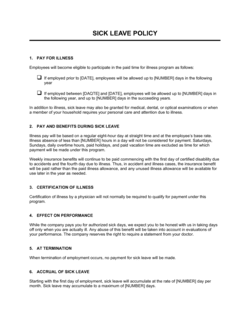
A Leave of Absence Policy is a written HR policy document that defines the types of leave available to employees, the eligibility rules, the request and approval process, and the employee's rights and obligations during an approved absence. This free Word download gives you a structured, customizable starting point you can edit online and incorporate directly into your employee handbook or HR manual.
When you need it
Use it when building an employee handbook for the first time, when headcount growth exposes gaps in your informal leave practices, or when a specific leave request β€” medical, military, or family β€” surfaces the need for a documented, consistent process.
What's inside
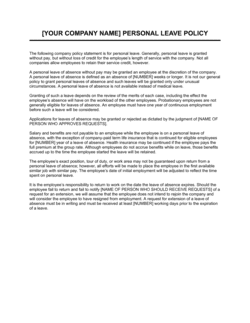
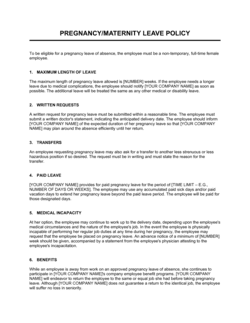
Policy scope and purpose, definitions of each leave type, employee eligibility criteria, the step-by-step request and approval process, benefits continuation rules during leave, return-to-work procedures, and manager responsibilities.

What is a Leave of Absence Policy?

A Leave of Absence Policy is a formal HR document that defines the types of extended leave available to employees, the eligibility requirements for each, the process for requesting and approving an absence, and the rights and obligations of both the employee and the employer during the leave period. It covers statutory leave types β€” such as medical, family, and military leave β€” alongside any discretionary leaves the company chooses to offer. By setting out clear procedures and documentation requirements in a single reference document, it gives managers a consistent framework to follow and gives employees a transparent understanding of their entitlements before a leave need arises.

Why You Need This Document

Without a written leave of absence policy, every request becomes a judgment call β€” and inconsistent decisions create discrimination exposure, erode employee trust, and leave managers unprepared to recognize when an absence triggers legal protections they cannot lawfully deny. Under the FMLA and comparable state laws, an employer's failure to designate a qualifying absence as protected leave β€” even when the employee never formally invokes FMLA β€” can constitute unlawful interference. A policy that trains managers to identify triggering conditions and route requests to HR closes that gap before it becomes a lawsuit. For employees, a clear policy reduces anxiety during already stressful personal circumstances, accelerates the request process, and prevents misunderstandings about pay, benefits, and job security during the absence. This template gives you a complete, customizable starting point that you can tailor to your jurisdiction, headcount, and leave philosophy in a single afternoon.

Which variant fits your situation?

If your situation is…Use this template
Comprehensive policy covering all leave types for a mid-size employerLeave of Absence Policy
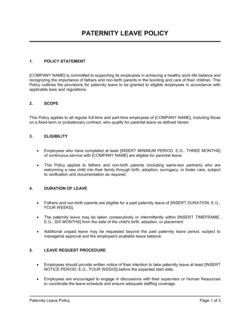
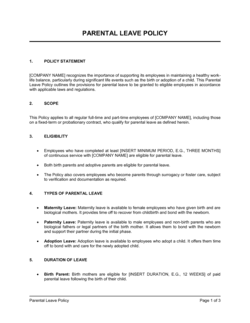
Documenting parental and family leave entitlements specificallyParental Leave Policy
Addressing paid time off, vacation, and sick days in a unified policyPTO Policy
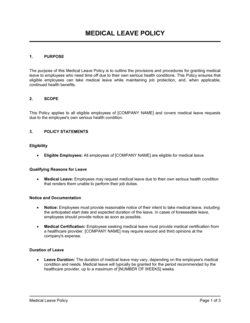
Managing extended medical absences and return-to-work plansMedical Leave of Absence Policy
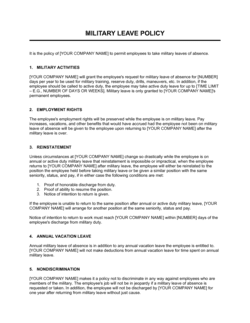
Defining military leave obligations under USERRAMilitary Leave Policy
Setting out bereavement leave entitlements and proceduresBereavement Leave Policy
Creating an all-in-one employee handbook incorporating leave policiesEmployee Handbook

Common mistakes to avoid

❌ Setting eligibility rules stricter than statutory minimums

Why it matters: A policy that grants leave only after 18 months of service is overridden by FMLA's 12-month threshold β€” employees who qualify under law take protected leave regardless of what the policy says, creating inconsistency and potential legal exposure.

Fix: Review the eligibility thresholds for every leave type against the applicable statutory minimum and ensure the policy matches or is more generous, never more restrictive.

❌ Omitting intermittent leave procedures

Why it matters: Intermittent leave is the most administratively complex and most frequently disputed form of FMLA leave. A policy silent on the subject leaves managers without guidance and creates inconsistent handling.

Fix: Add a dedicated subsection covering intermittent leave scheduling, the minimum increment of leave, and the employee's obligation to notify as soon as practicable for each intermittent absence.

❌ Failing to address premium payment obligations during unpaid leave

Why it matters: When an employee on unpaid leave stops paying their health insurance premium share, coverage lapses β€” but if the policy does not document the lapse process, the employer faces disputes about retroactive reinstatement and missed claims.

Fix: State the grace period for missed premium payments, the notification process when coverage is about to lapse, and the employee's right to reinstatement upon return.

❌ Not training managers to recognize statutory leave triggers

Why it matters: A manager who treats an FMLA-qualifying absence as an unexcused absence β€” and disciplines the employee β€” exposes the company to interference claims under federal law, even if the employee never formally requested FMLA leave.

Fix: Add a manager responsibilities section to the policy and back it up with a brief manager training checklist that lists the conditions that require an immediate HR referral.

❌ Omitting the no-contract disclaimer

Why it matters: A detailed written policy can be interpreted as an implied employment contract in some jurisdictions, limiting the employer's ability to modify or revoke discretionary leave benefits.

Fix: Include an explicit statement that the policy does not create a contract of employment and that the company reserves the right to amend or discontinue any discretionary leave benefit with reasonable notice.

❌ Treating all leave types identically in a single process

Why it matters: Medical leave, military leave, and personal leave each carry different statutory rules, documentation requirements, and employer obligations β€” a one-size process leads to either over-compliance cost or statutory violations.

Fix: Structure the policy with a general process section and then leave-type-specific addenda that call out the documentation, notice, and reinstatement rules unique to each type.

The 10 key sections, explained

Policy purpose and scope

Definitions of leave types

Eligibility requirements

Request and approval process

Pay and benefits during leave

Employee obligations during leave

Return-to-work procedures

Manager responsibilities

Policy violations and consequences

Policy review and updates

How to fill it out

  1. 1

    Identify the leave types your organization will cover

    Review applicable federal, state, or provincial laws to determine which leave types are legally required in your jurisdiction, then decide which additional discretionary leaves (personal, sabbatical) you want to offer.

    πŸ’‘ List statutory leave types first, then add discretionary ones in a separate section β€” keeping them clearly separated prevents employees from treating discretionary leave as a legal entitlement.

  2. 2

    Set eligibility thresholds at or below statutory minimums

    Enter the minimum service length and hours-worked threshold for each leave type. Cross-check against FMLA (12 months, 1,250 hours) or your applicable jurisdiction's statutory standard and ensure your thresholds do not exceed those floors.

    πŸ’‘ Consider offering slightly lower thresholds than the statutory minimum for discretionary leaves β€” it signals goodwill without creating legal risk.

  3. 3

    Define the request and documentation process

    Specify the notice period required for foreseeable leave (typically 30 days under FMLA), the form the request must take (written, via HR system, or email), and the supporting documentation required for each leave type.

    πŸ’‘ Attach a Leave Request Form as Exhibit A to the policy rather than describing the form within the policy body β€” this lets you update the form without amending the policy.

  4. 4

    Clarify pay substitution rules

    Decide whether employees are required or merely permitted to substitute accrued PTO during unpaid statutory leave. State this clearly for each leave type, as different leave laws have different substitution rules.

    πŸ’‘ Under FMLA, employers may require substitution of accrued PTO; under some state laws, they may not. Confirm which rule applies in your jurisdiction before drafting this section.

  5. 5

    Draft benefits continuation language

    State which benefits continue during leave, on what terms, and what happens if the employee fails to pay their premium share during an unpaid period.

    πŸ’‘ Specify the grace period β€” typically 30 days β€” before coverage lapses for non-payment, and the reinstatement process so employees are not surprised.

  6. 6

    Write the return-to-work and fitness-for-duty requirements

    Enter the documentation required before an employee returns from medical leave, the timeframe for job restoration, and the process for accommodating modified duty if full reinstatement is not immediately possible.

    πŸ’‘ For employees returning with ongoing limitations, reference your Accommodation Policy or ADA/AODA process in this section rather than trying to address accommodation fully within the LOA policy.

  7. 7

    Add the no-contract disclaimer and review schedule

    Insert the disclaimer that the policy does not create a contract of employment, reserve the right to amend, and set a specific annual review month β€” for example, January of each year to align with legislative updates.

    πŸ’‘ Note the date the policy was last reviewed in the header or footer of the document so managers and employees can quickly determine whether they have the current version.

  8. 8

    Distribute and obtain acknowledgment

    Publish the policy in the employee handbook and collect a signed acknowledgment from each employee confirming they have read and understood it. Store acknowledgments in each employee's personnel file.

    πŸ’‘ If you update the policy mid-year, send a revised copy with a new acknowledgment request β€” a signed acknowledgment for the old version does not cover material changes.

Frequently asked questions

What is a leave of absence policy?

A leave of absence policy is a written HR document that defines the types of leave available to employees, who is eligible, how to request leave, what documentation is required, and what rights the employee retains during the absence. It creates a consistent, documented process for both employees and managers to follow and helps ensure the employer meets statutory obligations under laws like FMLA in the United States.

Is a leave of absence policy legally required?

No federal or state law in the United States explicitly requires employers to have a written leave of absence policy. However, several laws β€” including the FMLA, ADA, USERRA, and various state leave statutes β€” impose specific obligations on covered employers. A written policy is the most reliable way to demonstrate consistent compliance, reduce manager error, and defend against claims of discriminatory or inconsistent treatment.

What types of leave should a leave of absence policy cover?

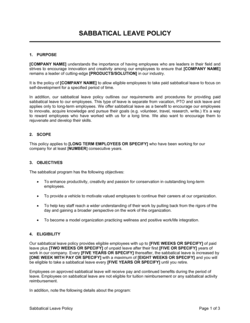
A comprehensive policy typically covers medical leave (including FMLA for covered employers), family leave for birth or adoption, military leave, personal leave, bereavement leave, and jury duty or civic leave. Larger employers often add domestic violence leave, sabbatical leave, and disability-related leave as separate or combined sections depending on applicable state law.

How is a leave of absence different from PTO or sick leave?

PTO and sick leave are short-duration, accrual-based benefits typically used for absences measured in hours or days. A leave of absence is an extended, formally approved absence β€” usually measured in weeks or months β€” that involves a structured request process, documentation requirements, and specific legal protections. Accrued PTO may be substituted for unpaid leave during a formal leave of absence, but the two are administratively distinct categories.

Does an employee on leave of absence continue to accrue PTO?

This depends on whether the leave is paid or unpaid and on your company policy. During paid leave where the employee is using accrued PTO, most employers continue accrual. During unpaid leave, many employers suspend accrual. Some state laws require PTO accrual to continue during certain types of protected leave. Your policy should state the accrual rule for each leave type explicitly rather than relying on a general statement.

What documentation can an employer require for a leave of absence?

For medical leave, employers may require a completed healthcare provider certification confirming the nature and expected duration of the condition β€” but generally cannot ask for a diagnosis. For military leave, deployment orders suffice. For family leave related to birth or adoption, a birth certificate or adoption papers are standard. Employers may also require a fitness-for-duty certification before an employee returns from medical leave.

Can an employer deny a leave of absence request?

Employers cannot deny leave that is required by law β€” FMLA, military leave under USERRA, or state-mandated leave. Discretionary leave requests (personal leave, extended unpaid leave beyond statutory entitlements) may be denied based on business need, staffing requirements, or failure to meet policy eligibility criteria. Denials should be documented with the specific reason to protect against claims of discriminatory treatment.

What happens to an employee's job during a leave of absence?

Under FMLA and most state equivalents, the employee is entitled to reinstatement to the same or an equivalent position upon return from protected leave. For discretionary leave beyond statutory entitlement, job protection depends on what the employer commits to in the policy. Your policy should state clearly whether job protection applies, and for how long, so both parties have aligned expectations before the leave begins.

How often should a leave of absence policy be reviewed?

At minimum, annually β€” leave laws at the federal, state, and municipal level change frequently, and a policy that was compliant two years ago may no longer reflect current obligations. Many HR teams schedule the review in January to coincide with the start of the legislative year. Triggering events such as expanding to a new state or crossing an employee-count threshold that activates FMLA coverage should also prompt an immediate policy review.

How this compares to alternatives

vs PTO Policy

A PTO policy governs how employees accrue and use paid time off for short absences β€” vacation, sick days, personal days. A leave of absence policy governs extended, formally approved absences with legal protections and documentation requirements. The two documents are complementary; PTO may be substituted during an LOA but they serve different administrative and legal functions.

vs Employee Handbook

An employee handbook is a comprehensive reference covering all workplace policies in one document β€” of which a leave of absence policy is typically one section or appendix. A standalone LOA policy provides more detail than a handbook section and is easier to update independently when leave laws change without reprinting the entire handbook.

vs Return-to-Work Policy

A return-to-work policy focuses specifically on the steps and conditions under which an employee transitions back to full duties after an absence β€” fitness-for-duty requirements, modified duty options, and graduated return schedules. A leave of absence policy covers the full lifecycle from request through return; a standalone return-to-work policy is used when employers need deeper process detail for post-absence reintegration.

vs Attendance Policy

An attendance policy governs day-to-day punctuality, unplanned absences, and tardiness β€” and typically includes a progressive discipline framework for violations. A leave of absence policy governs approved, extended absences that are explicitly excluded from attendance discipline. The two must cross-reference each other to ensure that FMLA-protected absences are never counted as attendance violations.

Industry-specific considerations

Healthcare

High rates of compassion fatigue and physical injury make medical leave claims more frequent; policies must address shift coverage obligations and licensing maintenance during extended absences.

Manufacturing

Production scheduling and safety compliance are disrupted by unplanned absences; return-to-work and modified-duty provisions are especially critical for employees recovering from workplace injuries.

Professional Services

Client continuity concerns during extended absences require the policy to address matter handoff obligations and client communication restrictions while the employee is on leave.

Retail / Hospitality

High turnover and variable scheduling make leave administration complex; policies must address part-time and seasonal worker eligibility clearly given uneven eligibility thresholds under FMLA.

Template vs pro β€” what fits your needs?

PathBest forCostTime
Use the templateSmall to mid-size employers creating or updating a standard leave policy for a single jurisdictionFree2–4 hours
Template + professional reviewEmployers operating in multiple states, those crossing the 50-employee FMLA threshold, or those adding discretionary leave types with potential contractual implications$300–$800 for an HR consultant or employment lawyer review3–5 business days
Custom draftedMulti-jurisdiction employers, heavily regulated industries (healthcare, government contractors), or organizations with complex union or collective bargaining considerations$1,500–$4,000+2–4 weeks

Glossary

Leave of Absence
An approved period during which an employee is temporarily excused from work duties while retaining their employment status.
FMLA
The Family and Medical Leave Act β€” a US federal law requiring covered employers to provide up to 12 weeks of unpaid, job-protected leave per year for qualifying medical and family reasons.
Intermittent Leave
Leave taken in separate blocks of time or by reducing the normal weekly or daily work schedule, rather than in one continuous period.
Job Protection
A guarantee that the employee will be restored to the same or an equivalent position upon returning from an approved leave.
Benefits Continuation
The employer's obligation to maintain group health insurance and other benefits during an approved leave, typically on the same terms as if the employee were actively working.
Paid Leave
A leave period during which the employee continues to receive some or all of their regular compensation, funded by accrued PTO, short-term disability, or a company-funded benefit.
Unpaid Leave
A leave period during which the employee retains employment status but does not receive regular compensation from the employer.
Return-to-Work Plan
A documented schedule and set of conditions under which an employee transitions back to full duties after an extended absence, sometimes including modified duties or a graduated return.
Fitness-for-Duty Certification
Written clearance from a healthcare provider confirming that an employee returning from medical leave is able to perform the essential functions of their job.
Qualifying Exigency
A specific circumstance β€” such as a family member's military deployment β€” that entitles an employee to FMLA-protected leave under the military family leave provisions.

Part of your Business Operating System

This document is one of 3,000+ business & legal templates included in Business in a Box.

  • Fill-in-the-blanks β€” ready in minutes
  • 100% customizable Word document
  • Compatible with all office suites
  • Export to PDF and share electronically

Create your document in 3 simple steps.

From template to signed document β€” all inside one Business Operating System.
1
Download or open template

Access over 3,000+ business and legal templates for any business task, project or initiative.

2
Edit and fill in the blanks with AI

Customize your ready-made business document template and save it in the cloud.

3
Save, Share, Send, Sign

Share your files and folders with your team. Create a space of seamless collaboration.

Save time, save money, and create top-quality documents.

β˜…β˜…β˜…β˜…β˜…

"Fantastic value! I'm not sure how I'd do without it. It's worth its weight in gold and paid back for itself many times."

Managing Director Β· Mall Farm
Robert Whalley
Managing Director, Mall Farm Proprietary Limited
β˜…β˜…β˜…β˜…β˜…

"I have been using Business in a Box for years. It has been the most useful source of templates I have encountered. I recommend it to anyone."

Business Owner Β· 4+ years
Dr Michael John Freestone
Business Owner
β˜…β˜…β˜…β˜…β˜…

"It has been a life saver so many times I have lost count. Business in a Box has saved me so much time and as you know, time is money."

Owner Β· Upstate Web
David G. Moore Jr.
Owner, Upstate Web

Run your business with a system β€” not scattered tools

Stop downloading documents. Start operating with clarity. Business in a Box gives you the Business Operating System used by over 250,000 companies worldwide to structure, run, and grow their business.

Start freeΒ Β·Β No credit card required