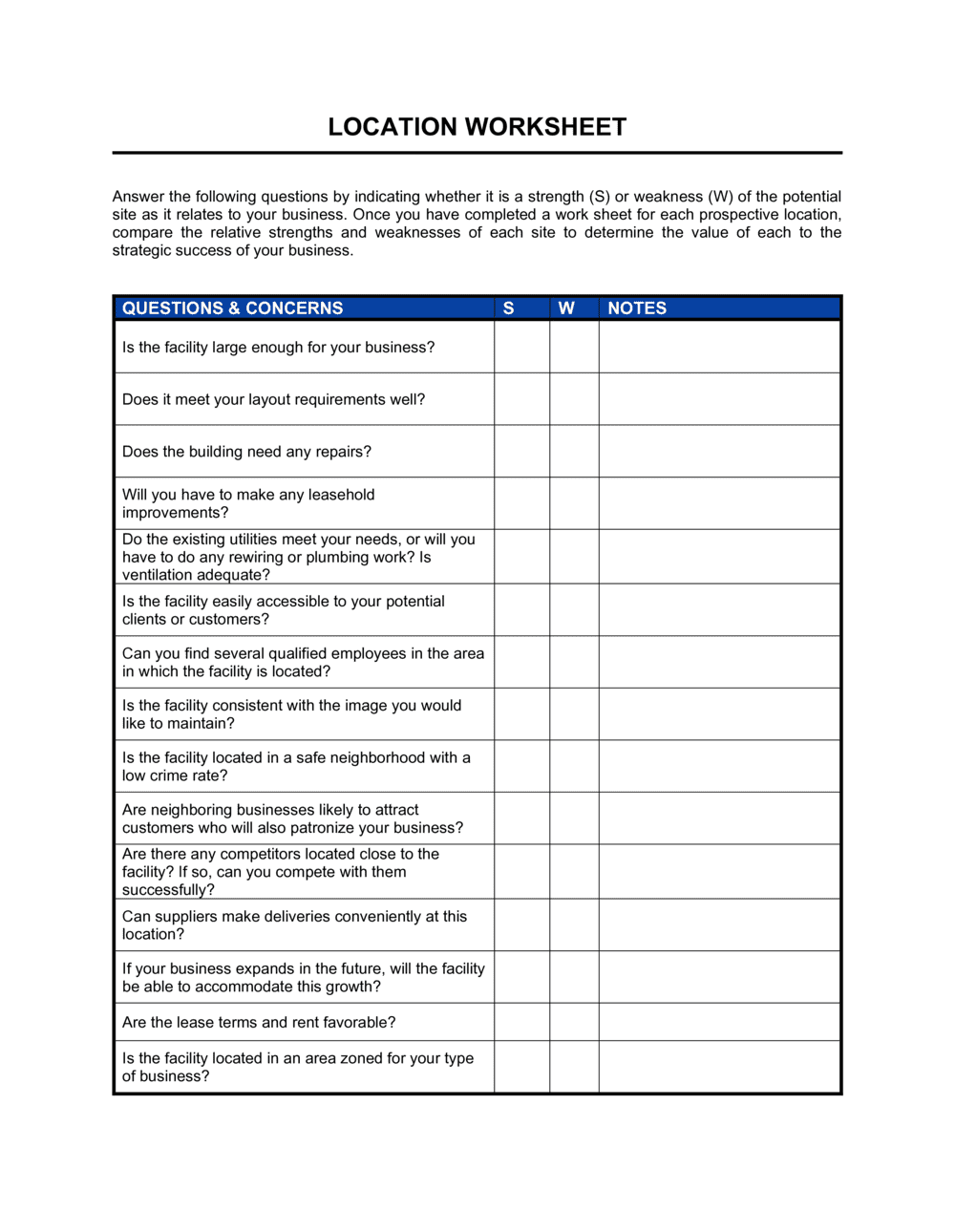
Worksheet_Location Conditions

Free Word download β€’ Edit online β€’ Save & share with Drive β€’ Export to PDF

1 pageβ€’20–30 min to fillβ€’Difficulty: Standardβ€’Signature requiredβ€’Legal review recommended
Learn more ↓
FreeWorksheet_Location Conditions Template

At a glance

What it is
A Worksheet Location Conditions document is a legally binding agreement that sets out the terms, requirements, and restrictions governing how a specific location may be accessed and used for a defined scope of work. This free Word download gives businesses a structured, editable template they can tailor to any physical work site β€” from retail premises and construction zones to office facilities and production locations β€” and export as PDF for signature before work begins.
When you need it
Use it whenever a contractor, vendor, employee, or third party will be performing work at or accessing a location you own, lease, or manage. It is particularly important when the site has specific safety requirements, access restrictions, equipment handling rules, or environmental conditions that must be documented before entry is permitted.
What's inside
The document covers site identification and access authorization, condition and state-of-site representations, safety and compliance obligations, equipment and materials handling rules, liability and indemnification terms, and procedures for reporting damage, hazards, or non-conforming conditions discovered on site. A signature block confirms all parties have reviewed and accepted the stated conditions before work commences.

What is a Worksheet Location Conditions Document?

A Worksheet Location Conditions document is a legally binding agreement that records the physical, regulatory, and operational state of a specific work site and establishes the terms under which an authorized party β€” contractor, vendor, crew, or other third party β€” may access and use that location. It captures pre-existing site conditions through a jointly signed checklist, discloses known hazards and access restrictions, allocates liability between the site owner and the authorized party, and sets out the safety and compliance obligations each party must meet before, during, and after the work period. Because it is executed before access is granted, it creates a clear, enforceable baseline that protects both parties if a dispute over damage, injury, or non-compliance arises.

Why You Need This Document

Without a signed location conditions agreement, both site owners and authorized parties operate in a liability vacuum that becomes expensive the moment something goes wrong. A contractor who damages a floor, wall, or utility line has no agreed baseline to distinguish their damage from pre-existing conditions β€” and the site owner has no signed record to enforce remediation. A site owner who fails to disclose a known hazard β€” asbestos, structural instability, or a restricted utility zone β€” faces negligence exposure under occupational health and safety law in virtually every jurisdiction. Insurance claims are disputed, remediation timelines are contested, and damage responsibility defaults to costly litigation. This template gives both parties a structured, professionally drafted agreement they can complete in under 30 minutes β€” closing the four most common exposure gaps: undisclosed conditions, unverified insurance, unauthorized access, and unallocated liability β€” before the first worker sets foot on site.

Which variant fits your situation?

If your situation is…Use this template
Construction or renovation project with multiple subcontractorsConstruction Site Conditions Agreement
Short-term vendor or service provider access to a commercial facilityFacility Access Authorization Form
Film, photo, or event production at a third-party locationLocation Release Agreement
Tenant improvement work before or during a commercial leaseTenant Work Letter / Improvement Agreement
Ongoing maintenance contract covering multiple site visitsMaintenance Services Agreement
Temporary access to a hazardous or regulated industrial siteSite Access Permit and Safety Acknowledgment
Pre-inspection documentation of a site's existing conditionSite Condition Report

Common mistakes to avoid

❌ No pre-work joint inspection

Why it matters: Without a jointly executed condition checklist, any damage discovered at work completion becomes a he-said/she-said dispute. Site owners cannot prove the damage didn't exist before; contractors cannot prove they didn't cause it.

Fix: Require a joint walk-through and a signed Site Condition Checklist as a condition precedent to commencement of any work. Attach the signed checklist and timestamped photographs to the agreement.

❌ Allowing work to begin before insurance certificates are received

Why it matters: If an incident occurs before the contractor's insurance is confirmed on file, the site owner may bear the full cost of the claim β€” and may be unable to recover from an underinsured or uninsured contractor.

Fix: Insert a hard condition in the agreement: access is not granted and work may not begin until certificates of insurance naming the site owner as additional insured have been received and verified.

❌ Vague or absent scope of work description

Why it matters: An open-ended scope allows the authorized party to interpret their access broadly, enter restricted areas, or perform activities that cause damage the site owner never anticipated or authorized.

Fix: List the specific tasks, the exact areas of the site where each task will be performed, and any activities that are expressly prohibited. Attach a site plan showing authorized work zones.

❌ Mutual indemnification language that indemnifies a party for their own negligence

Why it matters: Courts in many jurisdictions β€” including California, New York, and Ontario β€” refuse to enforce indemnification clauses that require a party to cover losses caused by their own negligence, making the clause void when you need it most.

Fix: Draft indemnification obligations to be proportionate to each party's fault. Use language limiting each party's indemnity obligation to claims arising from their own acts or omissions.

The 10 key clauses, explained

Site Identification and Work Authorization

In plain language: Identifies the specific location by address and legal description, names the authorized party permitted to access it, and states the precise scope and dates of permitted work.

Sample language
This Agreement authorizes [AUTHORIZED PARTY NAME] ('Contractor') to access the premises located at [FULL SITE ADDRESS] ('Site') solely for the purpose of [SCOPE OF WORK DESCRIPTION] during the period commencing [START DATE] and ending [END DATE].

Common mistake: Using a trade name or informal address instead of the full legal property description. Vague site identification makes it difficult to enforce conditions if a dispute arises about which location or which portion of the location the agreement covers.

Disclosure of Existing Site Conditions

In plain language: Requires the site owner or manager to disclose all known material conditions β€” hazards, defects, access restrictions, and pre-existing damage β€” before the authorized party begins work.

Sample language
Site Owner represents and warrants that, as of the date of this Agreement, the Site conditions are as described in Schedule A attached hereto, and that Site Owner has disclosed all known material conditions, defects, hazardous materials, and access restrictions affecting the Site.

Common mistake: Omitting a Schedule A or condition checklist attachment. Inline text descriptions are ambiguous; a signed, itemized schedule of conditions creates a clear baseline record that protects both parties against post-work damage disputes.

Pre-Work Condition Inspection and Documentation

In plain language: Requires both parties to jointly inspect and document the site's condition immediately before work begins, creating a signed baseline record used to assess any damage or change at completion.

Sample language
Prior to commencement of any work, both parties shall conduct a joint walk-through of the Site and execute a Site Condition Checklist in the form attached as Exhibit B, documenting the condition of all surfaces, fixtures, utilities, and adjacent areas. The executed Checklist shall be deemed incorporated into this Agreement.

Common mistake: Skipping the joint walk-through and relying on a unilateral site visit report. A one-party record lacks the evidentiary weight of a jointly signed inspection and is routinely challenged in damage disputes.

Safety and Regulatory Compliance Obligations

In plain language: States which party is responsible for ensuring the work complies with applicable health, safety, and environmental regulations, and requires the authorized party to follow all site-specific safety rules.

Sample language
Contractor shall comply with all applicable federal, state, and local health and safety laws and regulations, including [OSHA / applicable jurisdiction's safety standards], and shall adhere to the Site-specific safety rules set out in Schedule B. Contractor shall maintain all required licenses and insurance throughout the work period.

Common mistake: Assigning compliance responsibility to both parties without defining whose obligation is primary. Shared compliance language creates confusion about who is liable when a regulator issues a citation or an incident occurs.

Equipment, Materials, and Storage Conditions

In plain language: Sets out the rules for bringing equipment and materials onto the site β€” what is permitted, how items must be stored, and who bears responsibility for loss or damage while on site.

Sample language
Contractor may bring only the equipment and materials listed in Schedule C onto the Site. All equipment and materials must be stored in the designated areas shown in Exhibit A. Contractor assumes all risk of loss or damage to its equipment and materials while on Site, except to the extent caused by the gross negligence or willful misconduct of Site Owner.

Common mistake: No storage restriction or approved equipment list. Without defined storage areas, contractors occupy unauthorized zones, obstruct operations, or create liability exposure for the site owner if equipment is damaged or causes injury.

Damage Reporting and Remediation

In plain language: Requires the authorized party to immediately notify the site owner of any damage caused to the site or its systems during the work period and to restore the site to its pre-work condition at their own expense.

Sample language
Contractor shall immediately notify Site Owner's Representative in writing of any damage to the Site, its systems, fixtures, or adjacent properties caused during Contractor's access. Contractor shall, at its sole cost, restore any damaged area to its pre-existing condition within [X] business days of notification, or reimburse Site Owner for the reasonable cost of restoration.

Common mistake: No defined restoration timeline. Open-ended remediation obligations create disputes about urgency β€” specifying a deadline (e.g., 5 business days) gives both parties a measurable standard and reduces escalation.

Liability Allocation and Indemnification

In plain language: Allocates legal and financial responsibility between the parties for injuries, property damage, and third-party claims arising out of the work, and requires the authorized party to indemnify the site owner for claims caused by their conduct.

Sample language
Contractor shall indemnify, defend, and hold harmless Site Owner and its officers, employees, and agents from and against any claims, damages, losses, and expenses β€” including reasonable attorneys' fees β€” arising out of or resulting from Contractor's performance of work at the Site, to the extent caused by the negligent or wrongful acts of Contractor or its subcontractors.

Common mistake: Mutual indemnification language that inadvertently requires the site owner to indemnify the contractor for the contractor's own negligence. Courts in several jurisdictions refuse to enforce this result β€” draft indemnification obligations proportionate to each party's fault.

Insurance Requirements

In plain language: Specifies the types and minimum coverage amounts of insurance the authorized party must maintain throughout the work period, and requires them to name the site owner as an additional insured.

Sample language
Prior to commencing work, Contractor shall obtain and maintain: (a) Commercial General Liability insurance with limits of not less than $[AMOUNT] per occurrence and $[AMOUNT] aggregate; (b) Workers' Compensation insurance as required by law; and (c) such other coverage as specified in Schedule D. Site Owner shall be named as an additional insured on all policies.

Common mistake: Failing to specify that certificates of insurance must be provided before work begins. A certificate requested after an incident has occurred provides no protection to the site owner.

Access Restrictions and Hours of Operation

In plain language: Defines when and how the authorized party may access the site β€” permitted hours, entry points, restricted zones, and any escort or check-in requirements.

Sample language
Contractor's access to the Site is limited to the hours of [START TIME] to [END TIME] on [PERMITTED DAYS], using only the entry points designated in Exhibit A. Contractor must check in with Site Owner's Representative upon each arrival. Access to areas marked as Restricted Zones in Exhibit A is prohibited without prior written consent.

Common mistake: No check-in or escort requirement for restricted or sensitive areas. Without a check-in protocol, unauthorized access to server rooms, hazardous zones, or occupied tenant spaces creates safety and liability exposure that is difficult to document after the fact.

Termination and Removal of Personnel

In plain language: States the conditions under which the site owner may immediately revoke access and require the authorized party to vacate the site, and the authorized party's obligations upon termination.

Sample language
Site Owner may immediately revoke Contractor's access to the Site upon written or verbal notice if Contractor breaches any material term of this Agreement, creates a safety hazard, or fails to comply with applicable law. Upon revocation, Contractor shall immediately cease all work, remove its personnel and equipment from the Site within [X] hours, and leave all affected areas in a clean and safe condition.

Common mistake: No timeframe for equipment removal after termination. Leaving removal timing undefined means disputes about abandoned tools, materials, or waste β€” and may shift cleanup liability back to the site owner.

How to fill it out

  1. 1

    Identify the site and authorized parties

    Enter the full legal address and, where applicable, the legal property description of the site. Identify both the site owner or manager and every authorized party β€” contractor, vendor, or individual β€” who will access the location.

    πŸ’‘ If multiple subcontractors will access the site under a general contractor, name the general contractor as the primary authorized party and require them to bind subcontractors to the same conditions via a flow-down clause.

  2. 2

    Specify the scope of work and permitted dates

    Write a precise description of the work authorized to take place β€” task type, areas of the site affected, and the exact start and end dates. Vague scope descriptions are the most common source of on-site disputes.

    πŸ’‘ If the work schedule is subject to change, add a clause requiring written approval for any extension rather than leaving the end date blank or open-ended.

  3. 3

    Complete the site condition disclosure schedule

    Walk through the site and document all known material conditions β€” existing damage, hazardous materials, utility locations, access limitations, and any ongoing operations that could affect the work. Attach this as Schedule A and have both parties sign it.

    πŸ’‘ Photograph every pre-existing condition noted in the schedule and attach the photos as a labeled exhibit. Timestamped photographs are far stronger evidence than written descriptions alone.

  4. 4

    Define access hours, entry points, and restricted zones

    Enter the permitted hours of access, designated entry and exit points, any areas that are off-limits without additional approval, and the check-in protocol the authorized party must follow on each visit.

    πŸ’‘ Map restricted zones clearly on a site plan attached as an exhibit rather than describing them in prose β€” ambiguous zone descriptions are frequently disputed.

  5. 5

    Set the insurance requirements and collect certificates

    Enter the required coverage types, per-occurrence and aggregate limits, and name the site owner as an additional insured. Do not allow work to commence until certificates of insurance meeting these requirements are in hand.

    πŸ’‘ Request certificates directly from the insurer β€” not just from the contractor β€” to reduce the risk of receiving an outdated or falsified document.

  6. 6

    Confirm indemnification and liability terms

    Review the indemnification clause to ensure it allocates liability proportionate to each party's conduct. Confirm that the limitation of liability cap, if any, is set at a commercially reasonable level relative to the value of the work.

    πŸ’‘ For high-value sites or complex projects, have a lawyer review the indemnification and insurance sections specifically β€” these two clauses drive most of the financial exposure in site condition disputes.

  7. 7

    Sign before access is granted

    Both the site owner's representative and the authorized party's signatory must execute the agreement before the first day of site access. Issue a signed copy to both parties and file it with the project documentation.

    πŸ’‘ Use a timestamped electronic signature tool so the executed date is automatically recorded β€” this eliminates disputes about whether the agreement was in place before an incident occurred.

Frequently asked questions

What is a worksheet location conditions document?

A worksheet location conditions document is a legally binding agreement that records the physical and regulatory state of a work site and sets out the terms under which an authorized party β€” contractor, vendor, or third party β€” may access and use that location. It protects both the site owner and the authorized party by creating a shared, signed record of pre-existing conditions, permitted activities, safety obligations, and liability allocation before any work begins.

When should I use a location conditions agreement?

Use it any time a contractor, vendor, or third party will perform work at a location you own, lease, or manage. It is especially important when the site has known hazards, sensitive equipment, active operations, or restricted zones; when the work involves structural, electrical, or environmental risk; or when the value of the site or the scope of the work creates meaningful liability exposure for either party.

Is a worksheet location conditions document legally binding?

Yes, when properly executed β€” meaning signed by both parties before work commences, supported by adequate consideration, and not in conflict with applicable law. Like any contract, its enforceability depends on the clarity of its terms, the capacity of the parties to contract, and compliance with jurisdiction-specific requirements such as written-form mandates for certain types of agreements.

What is the difference between a site condition report and a location conditions agreement?

A site condition report is a unilateral factual document β€” typically prepared by one party β€” that records the physical state of a location at a point in time. A location conditions agreement is a bilateral contract: both parties sign it, accept its terms, and are legally bound by its conditions, obligations, and liability allocations. The report creates a record; the agreement creates enforceable rights and duties.

Who is responsible for disclosing hazardous materials on site?

In most jurisdictions, the site owner or operator bears a primary legal duty to disclose known hazardous conditions to anyone they authorize to work on the site. The location conditions agreement formalizes this duty β€” the site owner signs a representation that all known hazardous materials and conditions have been disclosed. Failure to disclose can expose the site owner to negligence claims and, in many jurisdictions, statutory penalties under occupational health and safety legislation.

Does a location conditions agreement replace a construction contract?

No. A location conditions agreement addresses site-specific access, condition, and safety terms β€” it governs the where and in what state of a project. A construction or services contract governs the what, how much, and by when β€” scope, price, deliverables, and performance standards. Both documents serve distinct functions; for any substantive project, you typically need both.

Do I need a lawyer to draft a worksheet location conditions document?

For straightforward vendor access or routine maintenance visits at low-risk sites, a high-quality template is generally sufficient when both parties review it carefully. Engage a lawyer when the site involves regulated hazardous materials, the work is high-value or structurally complex, the indemnification exposure is material, or when the site is in a jurisdiction with specific statutory requirements for work site agreements.

What happens if conditions change after the agreement is signed?

Any material change in site conditions discovered after execution β€” such as uncovering asbestos, finding structural damage, or a change in access restrictions β€” should trigger a written amendment to the agreement before work continues in the affected area. Proceeding without amending the agreement when material conditions change can void indemnification protections and expose both parties to unallocated liability for the new condition.

Can a location conditions agreement limit liability for pre-existing damage?

Yes. A clearly drafted pre-existing conditions clause, supported by a jointly signed condition checklist with photographic evidence, typically protects the authorized party from liability for damage that predated their access. Courts generally enforce these clauses when the baseline condition record is specific, signed by both parties, and created before work begins β€” not after a dispute arises.

How this compares to alternatives

vs Site Inspection Report

A site inspection report is a factual, typically unilateral record of a location's condition at a point in time β€” it is not a contract. A worksheet location conditions document is a bilateral agreement: both parties sign, accept obligations, and are bound by its terms. Use the inspection report to support the conditions agreement, not as a substitute for it.

vs Independent Contractor Agreement

An independent contractor agreement governs the commercial relationship between a client and contractor β€” scope, fees, deliverables, IP, and termination. A location conditions agreement governs the physical site where that work is performed β€” access terms, safety obligations, and condition liability. Both documents are typically needed when a contractor is performing work at a client-controlled location.

vs Facility Use Agreement

A facility use agreement grants temporary permission to use a venue or facility for a specific event or purpose, covering scheduling, fees, and general rules of use. A location conditions agreement is narrower and more technical β€” focused on the physical state of the site, safety compliance, and liability for conditions discovered or caused during a defined work period.

vs Construction Contract

A construction contract governs the full commercial arrangement for a build or renovation project β€” scope, schedule, price, change orders, and completion standards. A location conditions agreement is an adjunct document addressing site access and pre-existing condition liability specifically. For any substantive construction project, both documents should be executed before work begins.

Industry-specific considerations

Construction and Real Estate

Pre-work inspections, hazardous material disclosure (asbestos, lead), subcontractor access control, and phased site handover conditions are standard requirements on every project.

Film, Media, and Events

Location condition agreements document the state of a venue before crew load-in and establish clear liability for set-related damage to floors, walls, utilities, and landscaping.

Facilities Management and Property Services

Regular vendor access for HVAC, electrical, cleaning, and security services requires baseline condition records to isolate liability for damage discovered between service visits.

Manufacturing and Industrial Operations

Third-party contractors accessing production floors, warehouses, or regulated industrial sites must acknowledge specific safety protocols, restricted zones, and chemical handling rules before entry.

Jurisdictional notes

United States

OSHA standards impose specific disclosure and safety obligations on site owners and general contractors for hazardous conditions including asbestos and lead paint. Anti-indemnity statutes in states such as California, Texas, and New York may limit or void indemnification clauses that require a party to indemnify another for their own negligence. State-specific mechanic's lien laws may also affect rights arising from on-site work performed under these conditions.

Canada

Occupational health and safety legislation in each province β€” including Ontario's OHSA and BC's WorkSafeBC regulations β€” imposes positive duties on site owners to disclose known hazards and maintain safe conditions for all workers on site. Construction projects must designate a constructor responsible for site safety compliance. Quebec requires that agreements involving construction work on immovable property comply with the Act Respecting Labour Relations in the Construction Industry.

United Kingdom

The Construction (Design and Management) Regulations 2015 impose formal duties on clients, principal designers, and principal contractors to manage health and safety conditions on construction sites. The Occupiers' Liability Acts 1957 and 1984 create a duty of care owed by site occupiers to lawful visitors and, in some circumstances, trespassers. Asbestos-containing materials are subject to the Control of Asbestos Regulations 2012, which require a management survey and disclosure before any work begins on affected premises.

European Union

EU Directive 92/57/EEC on the implementation of minimum safety and health requirements at temporary or mobile construction sites requires member states to mandate written site safety plans and coordination documentation for construction projects above defined thresholds. GDPR considerations may arise where access logs or surveillance recordings are maintained at the site. Individual member states β€” particularly Germany, France, and the Netherlands β€” impose additional statutory duties on site owners to disclose known environmental contamination before authorizing third-party work.

Template vs lawyer β€” what fits your deal?

PathBest forCostTime
Use the templateLow-risk vendor access, routine maintenance visits, and short-term third-party use of standard commercial premisesFree20–30 minutes
Template + legal reviewConstruction projects, sites with known hazards or regulated materials, or agreements with significant indemnification exposure$300–$6001–3 days
Custom draftedHigh-value sites, regulated industrial or environmental locations, complex multi-party access arrangements, or projects where site conditions are disputed$1,000–$4,000+1–2 weeks

Glossary

Location Conditions
The documented physical, regulatory, and operational state of a work site at a specified point in time, including access restrictions, hazards, and permitted activities.
Site Access Authorization
Formal written permission granted to a specific person or entity to enter and work within a defined location during a stated period.
Pre-Existing Condition
Any physical defect, damage, contamination, or non-conformity present at the site before the authorized party commences work.
Indemnification
A contractual obligation by one party to compensate the other for specified losses, damages, or liabilities arising from defined events or conduct.
Scope of Work
The specific tasks, activities, and deliverables authorized to be performed at the location, as agreed in writing between the parties.
Material Condition
A site characteristic significant enough that a reasonable party would alter their decision to proceed, price their services differently, or require additional safety measures if aware of it.
Force Majeure
An unforeseeable event β€” such as a natural disaster, flood, or government order β€” that prevents a party from meeting their obligations under the agreement without liability.
Site Representative
The individual designated by the site owner or manager as the primary point of contact during the work period, responsible for granting access and resolving on-site issues.
Hazardous Materials
Substances present at a location that pose a risk to health, safety, or the environment, including asbestos, lead paint, chemicals, or biological contaminants.
Limitation of Liability
A clause capping the maximum financial exposure of one or both parties under the agreement, typically expressed as a fixed dollar amount or multiple of fees paid.
Consequential Damages
Indirect losses flowing from a breach that are not the direct result of the breach itself β€” such as lost profits, business interruption, or reputational harm.

Part of your Business Operating System

This document is one of 3,000+ business & legal templates included in Business in a Box.

  • Fill-in-the-blanks β€” ready in minutes
  • 100% customizable Word document
  • Compatible with all office suites
  • Export to PDF and share electronically

Create your document in 3 simple steps.

From template to signed document β€” all inside one Business Operating System.
1
Download or open template

Access over 3,000+ business and legal templates for any business task, project or initiative.

2
Edit and fill in the blanks with AI

Customize your ready-made business document template and save it in the cloud.

3
Save, Share, Send, Sign

Share your files and folders with your team. Create a space of seamless collaboration.

Save time, save money, and create top-quality documents.

β˜…β˜…β˜…β˜…β˜…

"Fantastic value! I'm not sure how I'd do without it. It's worth its weight in gold and paid back for itself many times."

Managing Director Β· Mall Farm
Robert Whalley
Managing Director, Mall Farm Proprietary Limited
β˜…β˜…β˜…β˜…β˜…

"I have been using Business in a Box for years. It has been the most useful source of templates I have encountered. I recommend it to anyone."

Business Owner Β· 4+ years
Dr Michael John Freestone
Business Owner
β˜…β˜…β˜…β˜…β˜…

"It has been a life saver so many times I have lost count. Business in a Box has saved me so much time and as you know, time is money."

Owner Β· Upstate Web
David G. Moore Jr.
Owner, Upstate Web

Run your business with a system β€” not scattered tools

Stop downloading documents. Start operating with clarity. Business in a Box gives you the Business Operating System used by over 250,000 companies worldwide to structure, run, and grow their business.

Free Forever PlanΒ Β·Β No credit card required