Business Partnership Checklist

Free download β€’ Use as a template β€’ Print or share

5 pagesβ€’20–30 min to useβ€’Difficulty: Standard
Learn more ↓
FreeBusiness Partnership Checklist Template

At a glance

What it is
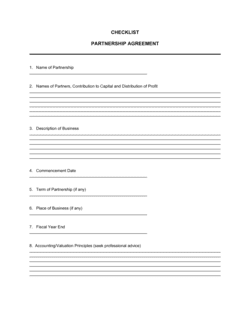
A Business Partnership Checklist is a structured form that guides founders, owners, and executives through every critical item to verify, discuss, and confirm before formalizing a business partnership. This free Word download organizes due diligence, structural decisions, and documentation requirements into a single scannable reference you can edit online and export as PDF.
When you need it
Use it when evaluating a prospective business partner, preparing to draft a partnership agreement, or auditing an existing partnership for gaps in governance, documentation, or financial structure. It is equally useful for new ventures and for existing businesses bringing on a second partner.
What's inside
Partner identification and background verification, ownership and capital contribution details, roles and decision-making authority, profit and loss allocation, exit and buyout provisions, insurance and liability checks, and required documentation sign-off items.

What is a Business Partnership Checklist?

A Business Partnership Checklist is a structured form that guides prospective partners through every critical item to verify, discuss, and confirm before formalizing a business partnership. It organizes due diligence on each partner's background, capital contributions, ownership and profit splits, roles and authority limits, tax elections, exit and buyout provisions, insurance coverage, and required documentation into a single scannable reference. Rather than leaving these decisions to informal conversation, the checklist creates a written record that both parties have reviewed and agreed upon β€” reducing the risk that any foundational item is overlooked before the partnership agreement is signed.

Why You Need This Document

Partnerships that skip a structured pre-formation review are the most common source of small business disputes. Without a checklist, partners routinely discover β€” after the business is operating β€” that they assumed different things about who controls daily decisions, how profits are split, what happens when one partner wants to leave, and whether the other partner had undisclosed debts or legal history. Each of those gaps is manageable before formation and expensive after it. A completed checklist ensures that capital contributions are valued and documented, authority limits are set before the first disagreement, and exit provisions are agreed while the relationship is still positive. This template gives you a systematic way to close every gap before any money changes hands or any agreement is signed.

Which variant fits your situation?

If your situation is…Use this template
Forming a general partnership between two individualsGeneral Partnership Agreement
Creating a limited partnership with active and passive partnersLimited Partnership Agreement
Evaluating a prospective partner's background and financialsBusiness Partner Due Diligence Checklist
Documenting each partner's initial capital contributionCapital Contribution Agreement
Planning the dissolution or buyout of a partnerPartnership Dissolution Agreement
Setting up a joint venture instead of a formal partnershipJoint Venture Agreement
Protecting confidential information during partnership negotiationsNon-Disclosure Agreement

Common mistakes to avoid

❌ Skipping the background verification section

Why it matters: Undisclosed judgments, tax liens, or prior business failures can become the partnership's problem from day one. Partners share liability in a general partnership regardless of who caused the debt.

Fix: Complete every due-diligence item before any money changes hands or any agreement is signed β€” not after the relationship is already underway.

❌ Leaving authority limits blank

Why it matters: Without defined spending and signing limits, any partner can bind the business to a lease, loan, or contract the others never saw. This is the single most common source of early-stage partnership disputes.

Fix: Agree on a specific dollar threshold for unilateral decisions and record it in both the checklist and the partnership agreement.

❌ Using equal ownership without a deadlock mechanism

Why it matters: A 50/50 split sounds fair, but it means every unresolved disagreement is a full business stalemate β€” with no majority to break the tie.

Fix: If you choose equal ownership, add a deadlock provision: mediation within 30 days, followed by binding arbitration, or a pre-agreed right for either partner to trigger a buy-sell process.

❌ Treating the checklist as a substitute for the partnership agreement

Why it matters: A checklist confirms that items have been addressed; it does not create legally binding obligations between the partners. Operating on a checklist alone leaves every term unenforceable.

Fix: Use this checklist to prepare for and verify completion of the partnership agreement β€” then execute the agreement before conducting any business together.

The 10 key fields, explained

Partner identification and contact details

Background and reference verification

Capital contribution commitments

Ownership and profit/loss allocation

Roles, responsibilities, and authority limits

Banking and financial controls

Tax elections and filing responsibilities

Exit, buyout, and dissolution triggers

Insurance and liability coverage

Required documentation sign-off

How to fill it out

  1. 1

    Enter each partner's legal information

    Fill in full legal names, addresses, and proposed ownership percentages for every prospective partner. Verify each name against a government-issued ID before proceeding.

    πŸ’‘ Ownership percentages must add up to exactly 100%. If you have not yet agreed on splits, leave this section blank and complete it as part of the partnership agreement negotiation.

  2. 2

    Complete the background verification items

    Work through each due-diligence checkbox β€” credit report, litigation search, and reference calls. Note findings and attach supporting documents where relevant.

    πŸ’‘ A free litigation check using PACER (US federal courts) and your state's court search tool takes under 30 minutes and has identified undisclosed judgments in a surprisingly high share of cases.

  3. 3

    Document each partner's capital contributions

    Enter the cash amount, asset description, or service commitment each partner will contribute. For non-cash items, record the agreed valuation method and the supporting basis (appraisal, book value, or market comparable).

    πŸ’‘ Get a written appraisal for any non-cash contribution valued above $10,000. Verbal agreement on asset values rarely survives a dispute.

  4. 4

    Define roles, authority limits, and decision thresholds

    Assign each partner's primary duties and the spending or contractual limit beyond which all partners must agree. Write these limits as specific dollar amounts, not vague descriptions.

    πŸ’‘ A $5,000 unilateral authority limit works for most small businesses. Adjust upward only if a managing partner's role genuinely requires larger independent decisions.

  5. 5

    Confirm tax and banking setup

    Record the EIN, chosen tax treatment, designated tax matters partner, and the bank account details. Check the dual-signature threshold and confirm the fiscal year end.

    πŸ’‘ Set your fiscal year end before you file for the EIN β€” the IRS records it at registration and changing it later requires a formal election.

  6. 6

    Fill in the exit and buyout terms

    Agree on the triggers, valuation method, and payment schedule for a partner buyout before any conflict arises. Record the agreed formula explicitly.

    πŸ’‘ A simple valuation formula β€” such as 3Γ— the prior year's adjusted EBITDA β€” is far easier to apply under stress than 'fair market value as agreed by the parties.'

  7. 7

    Check off the required documentation items

    Review the final sign-off section and confirm that each foundational document has been drafted, signed, and filed. Do not consider the partnership formation complete until every item is checked.

    πŸ’‘ Use this checklist as your closing checklist the week before the partnership launch date, not as a planning tool months before β€” it is most valuable as a final readiness gate.

Frequently asked questions

What is a business partnership checklist?

A business partnership checklist is a structured form that organizes every critical item two or more prospective partners need to verify, discuss, and confirm before formalizing their relationship. It covers due diligence on each partner, capital contributions, ownership splits, roles, tax setup, exit terms, and required documents. It functions as a pre-agreement readiness tool, not a substitute for a signed partnership agreement.

What should a business partnership checklist include?

At minimum: partner identification and background checks, capital contribution amounts and valuation, ownership percentages and profit allocation, roles and decision-making authority, banking and financial controls, tax elections and filing responsibilities, exit and buyout triggers with a valuation formula, insurance coverage, and a final documentation sign-off section. Missing any of these creates gaps that typically surface as disputes within the first two years.

Do I need a lawyer to use this checklist?

No lawyer is required to complete the checklist itself β€” it is designed for founders and business owners to work through on their own. However, once the checklist reveals the agreed terms, you should engage a lawyer to draft or review the partnership agreement, especially if capital contributions exceed $50,000, the business involves real estate or IP, or either partner is bringing in outside investors.

What is the difference between a partnership checklist and a partnership agreement?

A partnership checklist is a planning and verification tool β€” it helps you confirm that every important topic has been discussed and every document is in place. A partnership agreement is the binding legal contract that records the agreed terms and creates enforceable obligations. The checklist prepares you to draft the agreement; it does not replace it.

How do I split ownership in a business partnership?

Ownership splits should reflect each partner's capital contribution, ongoing role, and risk exposure β€” not simply default to equal shares because it feels fair. A 60/40 split with a clear managing partner often reduces decision-making friction compared to a 50/50 structure. Whatever split you choose, document both the ownership percentage and the profit/loss allocation separately, as they do not need to match.

What happens if a business partner wants to leave?

Without a pre-agreed buyout provision, a departing partner can either force a dissolution of the entire partnership or hold the remaining partner hostage to an unreasonable price demand. The checklist prompts you to agree on exit triggers, a valuation formula, and a payment schedule before any conflict arises. Documenting these terms while the relationship is positive is far cheaper than litigating them after it breaks down.

Should a business partnership checklist be signed?

The checklist itself does not need to be signed to be useful β€” its purpose is to organize your preparation, not to create binding obligations. That said, having both partners initial the completed checklist creates a useful paper trail confirming that all topics were reviewed before the partnership agreement was executed. Some attorneys request the completed checklist as part of their intake process.

What is a buy-sell agreement and why does the checklist ask about it?

A buy-sell agreement (also called a buyout provision) sets the rules for how one partner's interest can be transferred, sold, or bought out β€” triggered by voluntary exit, death, disability, divorce, or breach. The checklist flags it because it is the most commonly skipped item in informal partnerships and the most expensive omission when something goes wrong. A simple pre-agreed formula eliminates the need for litigation to establish value.

Can I use this checklist for an LLC with multiple members?

Yes. While this checklist is titled for business partnerships, the core items β€” capital contributions, ownership percentages, authority limits, tax elections, exit provisions, and documentation β€” apply equally to multi-member LLCs. For an LLC, you would reference the operating agreement instead of the partnership agreement in the documentation section, and note the relevant LLC-specific tax elections such as the S-Corp or C-Corp classification choice.

How this compares to alternatives

vs General Partnership Agreement

A partnership agreement is the binding legal contract that records each partner's rights and obligations. The checklist is the preparation tool you complete before drafting that agreement. Use the checklist to align on terms, then reflect those terms in the signed agreement β€” the checklist alone creates no enforceable obligations.

vs Joint Venture Agreement

A joint venture agreement governs a specific, time-limited project between two businesses that remain separate entities. A partnership checklist prepares for an ongoing general partnership where the parties merge their operations into a shared business. Use the joint venture agreement when the collaboration is project-based with a defined end; use the partnership checklist when forming a lasting shared enterprise.

vs Business Plan

A business plan defines the venture's strategy, market, and financial projections for investors or lenders. A partnership checklist addresses the internal governance and structural decisions between the partners themselves. Both are needed before launch, but they serve entirely different audiences and purposes.

vs LLC Operating Agreement

An LLC operating agreement governs a limited liability company and its members, providing liability protection the checklist's general partnership structure does not offer. The checklist's due diligence, contribution, and exit items translate directly into an operating agreement for multi-member LLCs. If liability protection is a priority, form an LLC and use the checklist to prepare for the operating agreement.

Industry-specific considerations

Professional Services

Non-solicitation and client ownership terms are especially critical when two practitioners β€” attorneys, accountants, or consultants β€” merge practices, as client relationships are the primary asset.

Retail and E-commerce

Capital contribution verification is particularly important for inventory-heavy retail partnerships where one partner may contribute stock rather than cash, requiring a clear valuation basis.

Construction and Trades

Licensing and insurance verification items in the checklist carry extra weight in construction, where a partner's lapsed contractor license or inadequate liability coverage can void contracts and create personal liability.

Food and Beverage

Key-person insurance and buyout provisions are particularly important in restaurant partnerships, where one partner often holds the primary operating role and the business depends heavily on their daily presence.

Template vs pro β€” what fits your needs?

PathBest forCostTime
Use the templateFounders and small business owners preparing for a straightforward two-partner business formationFree1–2 hours to complete
Template + professional reviewPartnerships involving significant capital contributions, real estate, IP, or unequal ownership structures$300–$800 for a lawyer or accountant review session2–5 business days
Custom draftedComplex multi-partner arrangements, regulated industries, or partnerships with outside investors$1,000–$3,500+ for full partnership agreement and checklist review1–3 weeks

Glossary

General Partnership
A business structure in which two or more partners share management, profits, and unlimited personal liability for the business's debts.
Limited Partnership
A partnership with at least one general partner who manages the business and bears full liability, and one or more limited partners whose liability is capped at their investment.
Capital Contribution
The cash, property, or services a partner puts into the partnership in exchange for their ownership interest.
Profit and Loss Allocation
The agreed formula or percentage by which partnership income and losses are divided among partners, which does not need to match ownership percentages.
Buy-Sell Agreement
A provision or separate agreement that sets the process and price formula for one partner to buy out another upon death, disability, retirement, or voluntary exit.
Fiduciary Duty
The legal obligation each partner owes the partnership to act in its best interest, avoid self-dealing, and disclose conflicts of interest.
Right of First Refusal
A clause giving existing partners the option to purchase a departing partner's interest before it can be sold to an outside third party.
Managing Partner
The partner designated with day-to-day operational authority and signing rights on behalf of the partnership.
Sweat Equity
An ownership interest granted in exchange for labor, expertise, or services rather than a cash capital contribution.
Deadlock Provision
A mechanism for resolving disputes when partners hold equal voting weight and cannot reach a majority decision β€” typically mediation, arbitration, or a designated tiebreaker.

Part of your Business Operating System

This document is one of 3,000+ business & legal templates included in Business in a Box.

  • Fill-in-the-blanks β€” ready in minutes
  • 100% customizable Word document
  • Compatible with all office suites
  • Export to PDF and share electronically

Create your document in 3 simple steps.

From template to signed document β€” all inside one Business Operating System.
1
Download or open template

Access over 3,000+ business and legal templates for any business task, project or initiative.

2
Edit and fill in the blanks with AI

Customize your ready-made business document template and save it in the cloud.

3
Save, Share, Send, Sign

Share your files and folders with your team. Create a space of seamless collaboration.

Save time, save money, and create top-quality documents.

β˜…β˜…β˜…β˜…β˜…

"Fantastic value! I'm not sure how I'd do without it. It's worth its weight in gold and paid back for itself many times."

Managing Director Β· Mall Farm
Robert Whalley
Managing Director, Mall Farm Proprietary Limited
β˜…β˜…β˜…β˜…β˜…

"I have been using Business in a Box for years. It has been the most useful source of templates I have encountered. I recommend it to anyone."

Business Owner Β· 4+ years
Dr Michael John Freestone
Business Owner
β˜…β˜…β˜…β˜…β˜…

"It has been a life saver so many times I have lost count. Business in a Box has saved me so much time and as you know, time is money."

Owner Β· Upstate Web
David G. Moore Jr.
Owner, Upstate Web

Run your business with a system β€” not scattered tools

Stop downloading documents. Start operating with clarity. Business in a Box gives you the Business Operating System used by over 250,000 companies worldwide to structure, run, and grow their business.

Free Forever PlanΒ Β·Β No credit card required