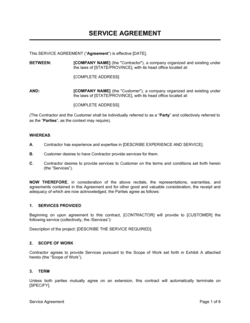
Construction Agreement Template

Free Word download • Edit online • Save & share with Drive • Export to PDF

25 pages35–50 min to fillDifficulty: ComplexSignature requiredLegal review recommended
Learn more ↓
FreeConstruction Agreement Template

At a glance

What it is
A Construction Agreement is a legally binding contract between a property owner (or developer) and a general contractor that governs every material aspect of a construction or renovation project. This free Word download covers scope of work, project timeline, payment schedule, change order procedures, warranties, insurance requirements, and termination — in a single structured document you can edit online and export as PDF before breaking ground.
When you need it
Use it before any contractor begins work on a residential, commercial, or renovation project where the total contract value, complexity, or duration makes an oral arrangement or simple letter of intent inadequate. It is essential when engaging a general contractor, subcontractors through a GC, or managing a multi-phase build.
What's inside
Parties and project description, detailed scope of work, contract price and payment schedule (including draws and retainage), change order process, project schedule and milestones, insurance and bonding requirements, warranties, dispute resolution, and termination provisions.

What is a Construction Agreement?

A Construction Agreement is a legally binding contract between a property owner (or developer) and a general contractor that governs every material dimension of a construction or renovation project — from the defined scope of work and contract price to the payment draw schedule, change order process, insurance requirements, workmanship warranties, and termination rights. Unlike a verbal arrangement or a simple estimate, a properly executed construction agreement creates clear, enforceable obligations on both sides and establishes a documented framework for resolving the disputes, scope changes, and unforeseen conditions that arise on virtually every project of meaningful size.

Why You Need This Document

Starting construction without a written agreement exposes both the owner and the contractor to significant financial and legal risk. Owners who rely on verbal scopes routinely face claims for work they never intended to authorize, pay for delays they cannot prove were the contractor's fault, and discover after substantial completion that the contractor's insurance lapsed months earlier. Contractors who work without a signed contract have no clear basis to demand payment draws, defend against scope-reduction claims, or recover costs for legitimate change orders. In many US states and Canadian provinces, an unlicensed or unsigned contract can void the owner's right to file a mechanic's lien or the contractor's right to collect payment entirely. This template gives both parties a structured, professional starting point — covering the ten clauses that experienced construction attorneys identify as non-negotiable — so that projects begin on a clear contractual footing and disputes can be resolved quickly rather than litigated for years.

Which variant fits your situation?

If your situation is…Use this template
Owner engaging a single contractor for a complete residential buildResidential Construction Agreement
Developer contracting a GC for a commercial or mixed-use projectCommercial Construction Agreement
GC engaging a specialist trade for a portion of the workSubcontractor Agreement
Homeowner hiring a contractor for a kitchen, bath, or additionHome Improvement Contract
Owner and contractor agreeing only on hourly rates before full scope is definedTime and Materials Contract
Large public or infrastructure project requiring formal bid termsConstruction Bid Proposal
Owner hiring a design-build firm responsible for both design and constructionDesign-Build Agreement

Common mistakes to avoid

❌ Using a vague proposal as the scope of work

Why it matters: A one-page estimate with no drawings or specifications leaves every detail open to interpretation. Scope disputes are the primary driver of construction litigation and arbitration.

Fix: Attach a complete set of drawings, specifications, and a materials schedule as Exhibit A before signing. If plans are not final, use an interim scope and require a signed change order to incorporate final plans.

❌ No written change order requirement

Why it matters: Oral approvals for scope additions are routinely disputed after the fact, resulting in unpaid contractor claims or owner overpayments for work never explicitly agreed to.

Fix: Include an explicit clause stating that no change to scope, price, or schedule is binding unless documented in a signed written change order before work on the change begins.

❌ Releasing retainage before punch-list completion

Why it matters: Retainage is the owner's primary financial lever to ensure the contractor returns to complete outstanding items and correct defects. Releasing it early removes all incentive.

Fix: Hold retainage until final completion — defined as the resolution of all punch-list items and receipt of all lien waivers from the contractor and subcontractors.

❌ No insurance certificate before work begins

Why it matters: A contractor who starts work without verified insurance leaves the owner personally exposed to third-party bodily injury, property damage, and workers' compensation claims on the job site.

Fix: Make receipt of a current certificate of insurance — with the owner named as additional insured — a condition precedent to the contractor's right to commence work.

❌ Front-loading the payment schedule with a large deposit

Why it matters: A deposit exceeding 15–20% of the contract price gives the contractor most of their profit margin before meaningful work is complete, reducing their incentive to perform and the owner's leverage to enforce the contract.

Fix: Structure payments as milestone-based draws tied to verified completion of defined phases. Tie the final 10% to substantial completion and the retainage release to final completion.

❌ No dispute resolution clause

Why it matters: Without a specified resolution mechanism, any disagreement defaults to litigation — which is slow, expensive, and public. Construction litigation routinely takes 2–4 years and costs more than the original dispute.

Fix: Include a tiered dispute resolution clause: good-faith negotiation (30 days), then mediation, then binding arbitration. Specify the arbitration service and venue to avoid a second dispute about process.

The 10 key clauses, explained

Parties and project identification

In plain language: Names the owner and contractor as legal entities, describes the project site, and states the type of work being performed.

Sample language
This Construction Agreement ('Agreement') is entered into as of [DATE] between [OWNER LEGAL NAME] ('Owner'), located at [ADDRESS], and [CONTRACTOR LEGAL NAME], licensed under [LICENSE NUMBER] ('Contractor'), for construction of [PROJECT DESCRIPTION] at [PROJECT SITE ADDRESS].

Common mistake: Using a contractor's trade name instead of their licensed legal entity name. If the entity on the contract doesn't match the license, lien rights and insurance claims become difficult to enforce.

Scope of work

In plain language: Defines exactly what the contractor will build, install, or renovate — including plans, specifications, and materials — and what is explicitly excluded.

Sample language
Contractor shall furnish all labor, materials, equipment, and supervision necessary to complete the following work in accordance with the plans and specifications attached as Exhibit A: [DESCRIPTION]. The following are expressly excluded from this scope: [EXCLUSIONS].

Common mistake: Attaching a vague proposal or estimate as the scope rather than detailed plans and specifications. Ambiguous scope is the single most common trigger for cost overruns and disputes.

Contract price and payment schedule

In plain language: States the total contract price, the payment structure (lump sum, cost-plus, or GMP), the draw schedule tied to milestones, and retainage terms.

Sample language
Owner shall pay Contractor a lump sum of $[AMOUNT] ('Contract Price'), payable as follows: [X]% upon execution ($[AMOUNT]); [X]% upon [MILESTONE] ($[AMOUNT]); balance less [10]% retainage upon substantial completion. Retainage shall be released within [30] days of final completion.

Common mistake: Front-loading payments with a large deposit before significant work is complete. This removes the owner's financial leverage if performance falls short and may violate consumer protection laws in some jurisdictions.

Change order procedure

In plain language: Establishes that any change to the scope, price, or schedule must be agreed in writing before work begins, and specifies how change order pricing is calculated.

Sample language
No change to the scope, Contract Price, or schedule shall be binding unless documented in a written Change Order signed by both parties. Contractor's markup on change order work shall not exceed [X]% for overhead and [X]% for profit. Contractor shall submit a written change order proposal within [5] business days of identifying a scope change.

Common mistake: Allowing oral change order approvals 'to save time.' Verbal approvals are routinely disputed; written sign-off before work starts is the only protection for both parties.

Project schedule and milestones

In plain language: Sets the project start date, key milestone dates, substantial completion date, and the consequences — including liquidated damages — for delays not excused by force majeure or owner-caused events.

Sample language
Work shall commence on [START DATE] and reach substantial completion by [COMPLETION DATE]. Time is of the essence. Failure to achieve substantial completion by the agreed date, not caused by Owner or force majeure events, shall entitle Owner to liquidated damages of $[AMOUNT] per calendar day of delay.

Common mistake: No liquidated damages clause and no consequence for late completion. Without it, the owner must prove actual damages in court — which is expensive and uncertain.

Insurance and bonding requirements

In plain language: Specifies the types and minimum coverage amounts of insurance the contractor must maintain throughout the project, and whether a performance or payment bond is required.

Sample language
Contractor shall maintain, at its own expense: (a) Commercial General Liability insurance with limits of not less than $[AMOUNT] per occurrence and $[AMOUNT] aggregate; (b) Workers' Compensation insurance as required by law; (c) Builder's Risk insurance covering the full replacement value of the project. Owner shall be named as an additional insured on all policies.

Common mistake: Not requiring the contractor to name the owner as an additional insured. Without this, the owner has no direct coverage under the contractor's policy if a third-party claim arises on site.

Warranties

In plain language: States the contractor's obligation to correct defective work and the duration of the warranty — typically one year from substantial completion for workmanship, plus any manufacturer warranties passed through to the owner.

Sample language
Contractor warrants that all work will be free from defects in workmanship and materials for a period of [ONE (1) YEAR] following the date of substantial completion. Contractor shall, at no cost to Owner, promptly correct any defective work identified within the warranty period. Manufacturer warranties for installed materials are hereby assigned to Owner.

Common mistake: Accepting a warranty that only covers defects reported during construction. A post-completion warranty period is essential because many defects — leaks, settling, HVAC failures — only manifest months after the project ends.

Dispute resolution

In plain language: Sets out the process for resolving disagreements — typically a mandatory negotiation period, then mediation, then arbitration or litigation — and names the governing jurisdiction.

Sample language
Any dispute arising under this Agreement shall first be subject to good-faith negotiation for [30] days. If unresolved, the parties shall submit to non-binding mediation before [MEDIATION SERVICE]. If mediation fails, disputes shall be resolved by binding arbitration under the rules of the [AAA] in [CITY, STATE], except claims for injunctive relief.

Common mistake: No dispute resolution clause, defaulting to litigation. Construction disputes litigated in court routinely cost $50,000–$200,000+ and take 2–4 years to resolve; arbitration is faster and cheaper.

Termination

In plain language: Defines the conditions under which either party may terminate the contract, the notice required, and the contractor's entitlement to payment for work completed before termination.

Sample language
Owner may terminate this Agreement for cause upon [7] days' written notice if Contractor fails to cure a material breach. Owner may terminate for convenience upon [14] days' written notice, in which case Contractor is entitled to payment for all work completed plus reasonable demobilization costs. Contractor may terminate upon [14] days' written notice if Owner fails to make any payment when due and does not cure within [7] days of written demand.

Common mistake: No termination-for-convenience clause. Without it, an owner who needs to stop a project mid-stream has no clean exit and may face a contractor claim for lost profits on the entire remaining contract.

Governing law and entire agreement

In plain language: Specifies which jurisdiction's law governs the contract and confirms that the written agreement supersedes all prior negotiations, proposals, and representations.

Sample language
This Agreement shall be governed by the laws of [STATE / PROVINCE], without regard to conflict-of-law principles. This Agreement, together with all exhibits, constitutes the entire agreement between the parties and supersedes all prior proposals, representations, and understandings. Any amendment must be in writing and signed by both parties.

Common mistake: No entire-agreement clause. Without it, prior emails, proposals, and verbal representations can be introduced as contract terms, turning every pre-contract communication into potential evidence.

How to fill it out

  1. 1

    Enter the legal names, license numbers, and project site

    Use the contractor's full registered legal entity name and their contractor license number for the applicable jurisdiction. Include the owner's legal name and the precise address of the construction site.

    💡 Verify the contractor's license status on the state or provincial licensing board's website before signing — an unlicensed contractor may void your insurance coverage and limit your legal remedies.

  2. 2

    Attach detailed plans and specifications as Exhibit A

    The scope of work clause must reference a complete set of drawings, specifications, and a materials schedule. Attach these as Exhibit A rather than summarizing them in the contract body.

    💡 If final plans are not yet approved, include an interim scope and specify that a formal change order will incorporate the final plans before construction begins.

  3. 3

    Set the contract price and draw schedule

    State whether the price is a lump sum, cost-plus-fee, or guaranteed maximum price. Define each payment draw as a dollar amount tied to a specific milestone — foundation complete, framing complete, rough-ins complete — rather than a calendar date.

    💡 Limit the upfront deposit to 10–15% of the contract price. Several jurisdictions (California, New York, and others) cap contractor deposits by law.

  4. 4

    Define the change order markup and approval process

    Negotiate and fill in the overhead and profit markup percentages for change order work before signing. Specify that no change order work begins until both parties sign the written change order.

    💡 A 15% combined overhead-and-profit markup is common for change orders; anything above 20% should be negotiated down or justified by the contractor.

  5. 5

    Complete the project schedule and liquidated damages rate

    Insert the start date, key milestone dates, and substantial completion date. Set a liquidated damages rate that reflects the owner's actual daily cost of delay — carrying costs, lost rent, or business interruption.

    💡 Courts will only enforce liquidated damages rates that are a genuine pre-estimate of loss, not a penalty. A rate of $500–$1,000 per day is typical for residential projects; commercial projects vary widely.

  6. 6

    Specify insurance coverage types and minimum limits

    Fill in the minimum coverage amounts required for CGL, workers' compensation, and builder's risk. Confirm the owner is named as an additional insured, and require the contractor to provide certificates of insurance before work begins.

    💡 Request insurance certificates directly from the contractor's insurer — not a copy provided by the contractor — and verify the policy expiration dates cover the full project duration.

  7. 7

    Set the warranty period and defect notification process

    Enter the workmanship warranty period (minimum one year is standard; two years is better for complex projects) and define how the owner must notify the contractor of a warranty claim.

    💡 Include a clause requiring the contractor to respond to warranty claims within 5 business days and commence repairs within 14 days — vague 'prompt' language leads to delays.

  8. 8

    Sign before any work or mobilization begins

    Both parties must sign the agreement — along with all exhibits — before the contractor orders materials, mobilizes equipment, or begins any site work. Confirm the contractor's insurance certificates are in hand before signing.

    💡 Use a timestamped eSign platform to create an unambiguous execution record. Undated signatures create disputes about which version of the contract controls.

Frequently asked questions

What is a construction agreement?

A construction agreement is a legally binding contract between a property owner and a contractor that defines the terms governing a construction or renovation project. It covers the scope of work, contract price, payment schedule, project timeline, change order procedures, insurance requirements, warranties, and termination rights. A properly executed construction agreement protects both parties by creating clear, enforceable obligations before any work begins.

What should a construction agreement include?

At minimum, a construction agreement should include the parties' legal names and contractor license numbers, a detailed scope of work by reference to plans and specifications, the total contract price and draw schedule, a written change order process, the project start and completion dates with liquidated damages for delay, insurance and bonding requirements, a workmanship warranty, dispute resolution terms, and governing law. Missing any of these creates gaps that are expensive to resolve after work is underway.

Is a construction agreement required by law?

Many US states and Canadian provinces require written contracts for construction projects above a certain dollar threshold — California mandates a written contract for any home improvement project over $500, for example. Even where not legally required, a written agreement is essential for projects of any material size because it documents scope, price, and obligations in a way that is enforceable if a dispute arises. Oral construction agreements are difficult and expensive to enforce.

What is retainage and how does it work?

Retainage is a percentage of each progress payment — typically 5–10% — that the owner withholds until the project reaches substantial or final completion. It functions as a financial incentive for the contractor to return and complete outstanding work and correct defects. Most US states regulate maximum retainage amounts on public projects; private projects are governed by the contract. Retainage should only be released after all punch-list items are resolved and lien waivers from all subcontractors and suppliers are received.

What is a change order and when is one required?

A change order is a written amendment to the original contract that formally documents any agreed change to the scope of work, contract price, or project schedule. A change order is required any time the owner requests work not covered in the original scope, the contractor encounters unforeseen conditions that affect cost or schedule, or either party agrees to modify a contract term. Work on a change should never begin without a signed change order — oral approvals are routinely disputed and difficult to prove.

What is the difference between a construction agreement and a subcontractor agreement?

A construction agreement governs the relationship between the property owner and a general contractor responsible for the overall project. A subcontractor agreement governs the relationship between the general contractor and a specialty trade — electricians, plumbers, or framers — who perform a defined portion of the work. Subcontractor agreements typically flow down key obligations from the prime contract, including insurance requirements, schedule, and dispute resolution terms, but the owner is not a party to them.

Do I need a performance bond on a construction project?

Performance bonds are required on most US federal and state public construction projects by law (under the Miller Act and state Little Miller Acts). On private projects, they are optional but recommended for large contracts where contractor default would cause significant financial harm. A performance bond guarantees that a surety company will complete the project or compensate the owner if the contractor defaults. The cost is typically 1–3% of the contract value, paid by the contractor.

What are liquidated damages in a construction contract?

Liquidated damages are a pre-agreed daily or weekly dollar amount the contractor pays the owner for each day the project exceeds the contracted completion date, without an excused cause. They must represent a genuine pre-estimate of the owner's daily loss — carrying costs, lost rental income, or business interruption — not a penalty. Courts will not enforce liquidated damages that appear punitive rather than compensatory. A typical residential rate is $500–$1,000 per day; commercial rates vary by project size.

Can I terminate a construction agreement if the contractor is performing poorly?

Yes, in most cases — but the contract must include a termination-for-cause clause that defines what constitutes a material breach and requires written notice and a cure period (typically 7–14 days) before termination takes effect. Terminating without following the contractual procedure can expose the owner to a wrongful termination claim. Document all performance deficiencies in writing before serving a termination notice, and consult a construction attorney when terminating a contract on a large project.

How do mechanic's liens affect a construction project?

A mechanic's lien is a legal claim filed against a property by an unpaid contractor, subcontractor, or supplier. It encumbers the title and can prevent the owner from selling or refinancing the property until the lien is resolved. Owners protect themselves by requiring lien waivers from the general contractor — and ideally from all major subcontractors and suppliers — with each progress payment. Joint checks payable to both the GC and subcontractors are another common protection for large projects.

How this compares to alternatives

vs Subcontractor Agreement

A subcontractor agreement governs the relationship between a general contractor and a specialty trade engaged to complete a defined portion of the project. The owner is not a party. A construction agreement governs the owner-GC relationship and is the prime contract from which subcontractor agreements flow down obligations. Use both when a GC is managing multiple trades.

vs Home Improvement Contract

A home improvement contract is designed for smaller residential renovation and repair work — kitchens, baths, roofing, or additions — with simpler payment schedules and consumer protection language required by most states. A construction agreement is more comprehensive and better suited to new builds, large renovations, and commercial projects where GMP pricing, bonding, and multi-phase milestone structures are needed.

vs Independent Contractor Agreement

An independent contractor agreement engages a self-employed individual or firm for general services and is not designed for construction work. It lacks scope-of-work exhibits, draw payment structures, builder's risk insurance requirements, lien waiver protocols, and construction-specific warranties. A construction agreement is the correct instrument for any project involving physical improvements to real property.

vs Service Agreement

A service agreement covers ongoing or project-based professional services — consulting, maintenance, or skilled labor — without the site-specific, insurance, lien, and completion structure that construction work requires. When a contractor is improving real property, a construction agreement with detailed scope exhibits and a milestone payment schedule is required to protect both parties adequately.

Industry-specific considerations

Residential construction

New home builds and major renovations require draw schedules tied to inspections and certificate-of-occupancy milestones, consumer protection disclosures, and deposit caps mandated by state law.

Commercial real estate

Tenant improvement and ground-up commercial projects rely on guaranteed maximum price structures, substantial completion tied to lease commencement, and enhanced insurance and bonding requirements.

Infrastructure and civil engineering

Public infrastructure projects typically require performance and payment bonds under the Miller Act or provincial equivalents, Davis-Bacon prevailing wage compliance, and formal differing site conditions clauses.

Property development and investment

Fix-and-flip and rental renovation projects depend on tight milestone schedules, cost controls, and lien waiver protocols that protect title and enable timely refinancing or sale after completion.

Jurisdictional notes

United States

Construction contracts are governed primarily by state law, and requirements vary significantly. California, New York, and Florida mandate written contracts for home improvement above specific dollar thresholds and cap contractor deposits. The federal Miller Act requires performance and payment bonds on federal projects over $150,000. Many states impose statutory lien notice requirements — failure to serve preliminary lien notices within a set deadline (often 20 days of first furnishing) can forfeit lien rights entirely.

Canada

Construction liens are governed by provincial legislation — Ontario's Construction Act (2018), British Columbia's Builders Lien Act, and Alberta's Builders' Lien Act each impose distinct notice, registration, and holdback requirements. Most provinces mandate a statutory holdback of 10% on all progress payments, which must be maintained in a trust account. Prompt payment legislation is now in force in several provinces, imposing strict timelines for payment down the contracting chain.

United Kingdom

Construction contracts in the UK must comply with the Housing Grants, Construction and Regeneration Act 1996 (as amended), which mandates a right to interim payments, a payment notice and pay-less notice regime, and a statutory right to adjudication for all parties. JCT (Joint Contracts Tribunal) and NEC standard form contracts are widely used as the basis for commercial construction agreements. The Construction Industry Scheme (CIS) imposes tax deduction obligations on payments to subcontractors.

European Union

Construction contracts in EU member states are governed primarily by national civil and commercial law, which varies substantially across jurisdictions. The EU Late Payment Directive (2011/7/EU) sets maximum 60-day payment terms for public authorities and 60-day terms (30 days as default) for private commercial transactions. FIDIC standard form contracts are commonly used for cross-border infrastructure projects. France, Germany, and Spain each impose mandatory defect liability periods of 10 years for structural defects, which cannot be contracted out.

Template vs lawyer — what fits your deal?

PathBest forCostTime
Use the templateStraightforward residential renovations, small commercial fit-outs, and projects under $100,000 with a reputable licensed contractorFree30–60 minutes
Template + legal reviewProjects between $100,000 and $500,000, multi-phase builds, or commercial projects with lease-commencement milestones$500–$1,500 for a 1–2 hour construction attorney review2–5 days
Custom draftedLarge commercial or mixed-use developments, public projects requiring bonding and prevailing wage compliance, or any project with GMP or cost-plus structures above $500,000$2,500–$10,000+2–4 weeks

Glossary

Scope of Work
The detailed written description of all construction tasks, materials, and deliverables the contractor is obligated to complete under the contract.
Change Order
A written amendment to the original contract that documents a change in scope, cost, or schedule agreed to by both parties after execution.
Retainage
A percentage of each progress payment — typically 5–10% — withheld by the owner until substantial completion, protecting against incomplete or defective work.
Substantial Completion
The point at which the project is sufficiently complete for the owner to occupy or use it for its intended purpose, even if minor punch-list items remain.
Lien Waiver
A document signed by a contractor or subcontractor confirming they have been paid and waiving their right to file a mechanic's lien against the property for that payment.
Mechanic's Lien
A legal claim filed against a property by an unpaid contractor, subcontractor, or supplier, which can encumber the title until the debt is resolved.
Performance Bond
A surety bond guaranteeing that the contractor will complete the project according to the contract terms, protecting the owner if the contractor defaults.
Liquidated Damages
A pre-agreed daily or weekly dollar amount the contractor pays the owner for each day the project exceeds the contracted completion date, set in the contract rather than litigated after the fact.
Force Majeure
A clause excusing a party from performance obligations due to extraordinary events outside their control — such as natural disasters, strikes, or material shortages.
Punch List
A list of minor outstanding tasks or defects identified at or near substantial completion that the contractor must remedy before final payment is released.
Indemnification
A contractual obligation by one party to compensate the other for specified losses, damages, or legal costs arising from the indemnifying party's actions or negligence.
Contract Price
The total amount the owner agrees to pay the contractor for completing the defined scope of work, stated as a lump sum, guaranteed maximum price, or cost-plus formula.

Part of your Business Operating System

This document is one of 3,000+ business & legal templates included in Business in a Box.

  • Fill-in-the-blanks — ready in minutes
  • 100% customizable Word document
  • Compatible with all office suites
  • Export to PDF and share electronically

Create your document in 3 simple steps.

From template to signed document — all inside one Business Operating System.
1
Download or open template

Access over 3,000+ business and legal templates for any business task, project or initiative.

2
Edit and fill in the blanks with AI

Customize your ready-made business document template and save it in the cloud.

3
Save, Share, Send, Sign

Share your files and folders with your team. Create a space of seamless collaboration.

Save time, save money, and create top-quality documents.

★★★★★

"Fantastic value! I'm not sure how I'd do without it. It's worth its weight in gold and paid back for itself many times."

Managing Director · Mall Farm
Robert Whalley
Managing Director, Mall Farm Proprietary Limited
★★★★★

"I have been using Business in a Box for years. It has been the most useful source of templates I have encountered. I recommend it to anyone."

Business Owner · 4+ years
Dr Michael John Freestone
Business Owner
★★★★★

"It has been a life saver so many times I have lost count. Business in a Box has saved me so much time and as you know, time is money."

Owner · Upstate Web
David G. Moore Jr.
Owner, Upstate Web

Run your business with a system — not scattered tools

Stop downloading documents. Start operating with clarity. Business in a Box gives you the Business Operating System used by over 250,000 companies worldwide to structure, run, and grow their business.

Free Forever Plan · No credit card required