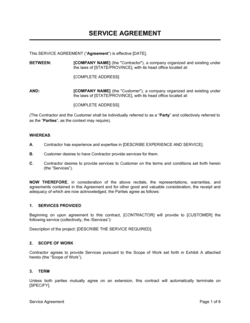
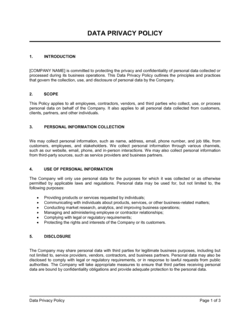
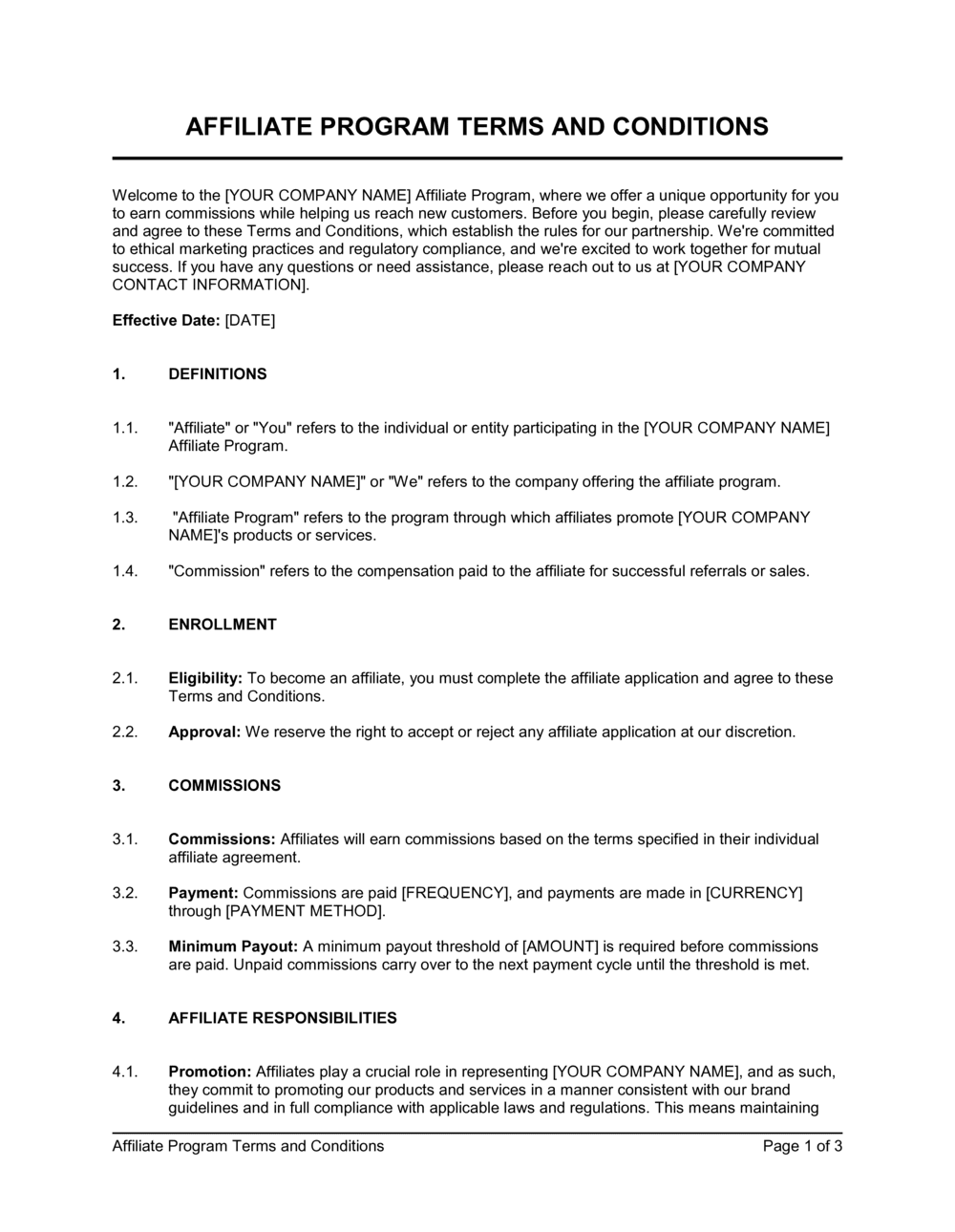
Affiliate Program Terms and Conditions Template

Free Word download • Edit online • Save & share with Drive • Export to PDF

3 pages25–30 min to fillDifficulty: StandardSignature requiredLegal review recommended
Learn more ↓
FreeAffiliate Program Terms and Conditions Template

At a glance

What it is
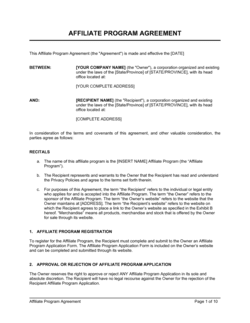
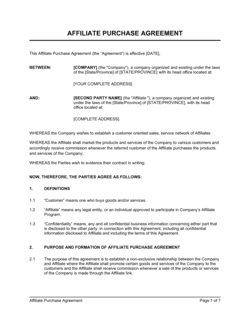
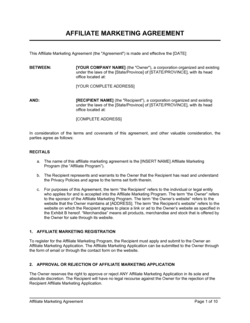
Affiliate Program Terms and Conditions is a legally binding agreement between a merchant (the program operator) and each affiliate (the publisher or promoter) that governs how the affiliate may promote the merchant's products or services, how commissions are calculated and paid, and what conduct is prohibited. This free Word download gives merchants a structured, enforceable starting point they can edit online and export as PDF for affiliate onboarding.
When you need it
Use it before launching any affiliate or referral program — whether you are onboarding your first handful of partners or building a network of thousands. It is also needed when an existing informal program requires formalization to reduce fraud exposure, FTC compliance risk, or payment disputes.
What's inside
Program eligibility and enrollment criteria, commission structure and tracking methodology, payment schedule and minimum thresholds, approved and prohibited promotional methods, intellectual property usage rights, FTC disclosure obligations, representations and warranties, termination rights, and governing law.

What is an Affiliate Program Terms And Conditions?

Affiliate Program Terms and Conditions is a legally binding agreement between a merchant — the business operating the affiliate program — and each affiliate who enrolls to promote that merchant's products or services. It establishes the rules of engagement for the entire relationship: how referrals are tracked and attributed, what commission rate applies and on which qualifying actions, when and how payment is issued, which promotional tactics are permitted or forbidden, and under what circumstances the merchant may terminate an affiliate's access. Because affiliate programs typically operate at scale with dozens or thousands of self-enrolled publishers, these terms function as a standing contract accepted by each affiliate at enrollment through a clickwrap mechanism — making a rigorous, clearly drafted agreement the foundation of a legally defensible program.

Why You Need This Document

Operating an affiliate program without formal terms exposes a merchant to four compounding risks simultaneously. First, payment disputes over commissions on refunded orders, contested attribution, or suspected fraud have no written framework for resolution — every disagreement becomes a credibility contest. Second, affiliates who bid on your brand keywords, make false health or performance claims, or spam purchased email lists can expose the merchant to FTC enforcement action and consumer litigation if the terms did not explicitly prohibit and enforce against those behaviors. Third, in the absence of a governing-law clause and arbitration agreement, a disgruntled affiliate can file suit in any jurisdiction where they operate — including those with affiliate-favorable laws. Fourth, without a clear IP license, affiliates may continue displaying your brand marks and links after termination, creating trademark misuse that is difficult to remedy without the contractual removal obligation. This template gives merchants a structured, enforceable starting point that closes each of these gaps before the first affiliate link goes live.

Which variant fits your situation?

If your situation is…Use this template
Running a straightforward referral program with a flat per-sale feeAffiliate Program Terms And Conditions
Engaging a single high-volume publisher with negotiated custom ratesAffiliate Agreement (Individual)
Paying influencers a flat fee plus performance bonus for promotionsInfluencer Marketing Agreement
Appointing a company to resell your product under their own brandReseller Agreement
Bringing in a partner to jointly develop and sell a productJoint Venture Agreement
Compensating a sales agent on commission without employment statusCommission Sales Agreement
Referring clients between two professional services firmsReferral Fee Agreement

Common mistakes to avoid

❌ No explicit brand-keyword bidding prohibition

Why it matters: Affiliates bidding on your brand name in paid search cannibalize your own campaigns, inflate your CPC, and erode brand positioning — costs that can exceed the affiliate commissions earned.

Fix: Name paid-search brand-keyword bidding as a prohibited method by name, specify that it covers exact, phrase, and broad-match variants, and state that violation results in immediate termination and commission forfeiture.

❌ Paying commissions before the return window closes

Why it matters: If your return policy is 30 days and you pay affiliates in the same month, every subsequent refund leaves you paying commission on a sale that no longer exists.

Fix: Set a commission hold period equal to or longer than your maximum return window — typically 60–90 days — and state this clearly in the payment terms clause.

❌ Vague FTC disclosure requirement

Why it matters: If an affiliate buries a disclosure in a footer or omits it entirely, the FTC can investigate both the affiliate and the merchant — especially if the merchant's terms did not clearly require compliant disclosure.

Fix: Require disclosures that are clear, conspicuous, and placed near the beginning of any promotional content. Provide an example disclosure phrase and specify that it must appear before affiliate links.

❌ No termination clause covering pending commissions

Why it matters: Without explicit language, a terminated affiliate can argue they are owed commissions on all orders placed before termination — including those still within the chargeback hold window.

Fix: State that post-termination commissions are paid only after the standard hold period clears and remain subject to chargeback reversal; include a clause requiring affiliate link removal within 48 hours of termination.

❌ Omitting sub-affiliate and coupon-site restrictions

Why it matters: Unrestricted sub-affiliate arrangements create multi-layer attribution complexity; coupon sites often generate no incremental sales while claiming last-click commissions on purchases the customer would have made anyway.

Fix: Require written approval for sub-affiliate recruitment and restrict coupon or deal-site participation unless explicitly whitelisted in writing.

❌ Using a governing-law clause with no connection to the merchant's operations

Why it matters: Choosing a favorable jurisdiction with no operational tie to the merchant can render the clause unenforceable, leaving the governing law defaulting to the affiliate's home jurisdiction instead.

Fix: Select the state or country where the merchant is incorporated or primarily operates. For international programs, confirm the arbitration venue and governing law are mutually enforceable with a lawyer.

The 10 key clauses, explained

Program enrollment and eligibility

In plain language: Establishes who may apply to join the program, what the merchant's approval rights are, and that acceptance is at the merchant's sole discretion.

Sample language
Participation in the [COMPANY NAME] Affiliate Program ('Program') is subject to approval by [COMPANY NAME] in its sole discretion. Applicants must be at least [18] years of age, operate a website or marketing channel that complies with applicable law, and agree to these Terms as a condition of enrollment.

Common mistake: Omitting explicit approval discretion — without it, a rejected applicant may argue they were automatically entitled to join once they submitted an application.

Commission structure and qualifying actions

In plain language: Defines the commission rate or flat fee, what constitutes a qualifying referral (sale, lead, click), and any tiered or time-limited rate structures.

Sample language
Affiliate shall earn a commission of [X]% of Net Sales for each Qualifying Purchase completed by a Referred Customer within [30] days of clicking the Affiliate Link. Commissions are not earned on purchases of gift cards, taxes, or shipping charges.

Common mistake: Failing to define 'Net Sales' or 'Qualifying Purchase' precisely, leaving room for disputes over whether refunded or discounted orders count toward commission.

Tracking, attribution, and cookie duration

In plain language: Specifies how referrals are tracked, the cookie window, and the rule for resolving last-click versus first-click attribution conflicts.

Sample language
Referrals are tracked via Affiliate Links containing a unique identifier. A tracking cookie with a duration of [30] days is set upon click. [COMPANY NAME] uses last-click attribution. In the event of a tracking failure due to cookie blocking, no commission shall be payable.

Common mistake: Not addressing what happens when a tracking cookie is blocked or expires — ambiguity here drives the most frequent affiliate payment disputes.

Payment terms and minimum threshold

In plain language: States the payment schedule, accepted payment methods, minimum balance required before payout, and the currency used.

Sample language
Commissions are paid [monthly] on or before the [15th] day of the following month for the prior month's Qualifying Purchases, provided the Affiliate's unpaid balance equals or exceeds $[50.00] USD. Payments are made via [PayPal / bank transfer / check]. [COMPANY NAME] may withhold payment for up to [90] days to account for chargebacks and refunds.

Common mistake: Setting a payment schedule without a chargeback hold period — paying commissions immediately exposes the merchant to net-negative positions when orders are later refunded.

Approved and prohibited promotional methods

In plain language: Lists the marketing channels and tactics affiliates are permitted to use, and explicitly prohibits methods that create legal, brand, or fraud risk for the merchant.

Sample language
Affiliate may promote [COMPANY NAME] products through organic content, email newsletters to opted-in subscribers, and social media posts that comply with Section [X] (Disclosure). Prohibited methods include: (a) paid search ads bidding on [COMPANY NAME] brand keywords; (b) cookie stuffing or click fraud; (c) unsolicited bulk email (spam); (d) false or misleading claims about the products.

Common mistake: Writing a generic 'no deceptive practices' prohibition without specifying brand-keyword bidding — this is one of the most common and costly violations and must be named explicitly.

Intellectual property and brand usage

In plain language: Grants affiliates a limited, non-exclusive license to use the merchant's approved logos, product images, and marketing materials — and prohibits unapproved modifications.

Sample language
Subject to these Terms, [COMPANY NAME] grants Affiliate a limited, non-exclusive, revocable, non-transferable license to display the approved [COMPANY NAME] Marks solely for the purpose of promoting the Program. Affiliate shall not alter, distort, or create derivative works from any [COMPANY NAME] Mark without prior written consent.

Common mistake: Granting a brand license without specifying it is revocable and limited to approved materials — affiliates who use outdated logos or edited images create compliance and brand problems that are hard to remedy retroactively.

FTC disclosure and compliance obligations

In plain language: Requires affiliates to disclose their material financial relationship with the merchant clearly and conspicuously on every piece of promotional content.

Sample language
Affiliate must clearly and conspicuously disclose its material connection to [COMPANY NAME] in each piece of promotional content, in compliance with the FTC's Guides Concerning the Use of Endorsements and Testimonials (16 C.F.R. Part 255). An acceptable disclosure includes language such as: 'I earn a commission from purchases made through links on this page.'

Common mistake: Requiring disclosure without specifying what 'clear and conspicuous' means — vague compliance language shifts FTC investigation risk back to the merchant when an affiliate uses buried footnote disclosures.

Representations, warranties, and indemnification

In plain language: Each party warrants they have authority to enter the agreement and will comply with applicable law; the affiliate indemnifies the merchant against claims arising from the affiliate's promotional content.

Sample language
Affiliate represents and warrants that: (a) it has full authority to enter into these Terms; (b) its promotional content does not infringe any third-party rights; and (c) it will comply with all applicable laws. Affiliate shall indemnify, defend, and hold harmless [COMPANY NAME] from any claim, loss, or expense arising from Affiliate's breach of these Terms or its promotional activities.

Common mistake: Omitting an indemnification clause entirely — without it, the merchant bears legal costs when an affiliate publishes false advertising or infringing content.

Termination and effect of termination

In plain language: States the conditions under which either party may terminate the agreement, the notice period, and what happens to unpaid commissions upon termination.

Sample language
Either party may terminate Affiliate's participation in the Program at any time, with or without cause, upon [7] days' written notice. [COMPANY NAME] may terminate immediately upon Affiliate's breach of these Terms. Upon termination, Affiliate shall remove all Affiliate Links and [COMPANY NAME] Marks from its channels within [48] hours. Commissions earned prior to termination and confirmed after the standard [90]-day hold period shall be paid; commissions on in-flight orders remain subject to chargeback reversal.

Common mistake: Not specifying what happens to pending commissions at termination — this single gap generates the majority of post-termination disputes in affiliate programs.

Governing law, dispute resolution, and entire agreement

In plain language: Specifies the jurisdiction whose law governs the agreement, how disputes are resolved, and that the written terms supersede all prior representations or promises.

Sample language
These Terms are governed by the laws of [STATE / PROVINCE / COUNTRY], without regard to conflict-of-law principles. Any dispute shall be resolved by binding arbitration administered by [AAA / JAMS] in [CITY], except claims for injunctive relief. These Terms constitute the entire agreement between the parties and supersede all prior communications regarding the Program.

Common mistake: Choosing a governing-law jurisdiction without considering where most affiliates are located — if the merchant's chosen forum is impractical for affiliates in other countries, enforcing judgments becomes difficult.

How to fill it out

  1. 1

    Identify both parties and define the program

    Enter your company's full legal name and the program name at the top of the agreement. Confirm the legal entity — not a trade name — so the agreement is enforceable against the correct registrant.

    💡 Cross-check the entity name against your corporate registry filing before finalizing — a mismatch between the agreement and your business registration can complicate enforcement.

  2. 2

    Set the commission structure and qualifying actions

    Define the commission rate or flat fee, specify what constitutes a qualifying action (sale, lead, or click), and list any exclusions such as taxes, shipping, or gift card purchases.

    💡 If you plan to offer tiered rates for high-volume affiliates, add a Schedule A to keep the main agreement clean and allow rate updates without amending the core terms.

  3. 3

    Configure tracking and attribution rules

    State your cookie duration (30, 60, or 90 days is typical), specify your attribution model (last-click is standard), and clarify what happens when cookies are blocked or cleared.

    💡 Shorter cookie windows reduce commission liability on organic repeat purchasers; longer windows attract higher-quality affiliates. Settle on the duration before launching and document it clearly.

  4. 4

    Define payment terms and the chargeback hold

    Enter the payment schedule, minimum payout threshold, accepted payment methods, and the number of days commissions are held to cover returns and chargebacks.

    💡 A 60–90 day hold period aligned to your return policy is standard practice — paying commissions within 30 days creates a net-negative position if your return window is longer.

  5. 5

    List approved and prohibited promotional methods

    Write out the specific channels affiliates may use (organic content, email to opted-in lists, social media) and explicitly name prohibited tactics — brand-keyword bidding, cookie stuffing, and spam must be named individually.

    💡 Check your paid-search platform's terms: Google and Microsoft both have policies on affiliate brand-keyword bidding that can result in account suspension, not just contract breach.

  6. 6

    Include the FTC disclosure requirement with example language

    Require affiliates to display a clear, conspicuous disclosure on every promotional page or post. Provide an example disclosure statement so affiliates have no ambiguity about what is acceptable.

    💡 The FTC expects disclosures to appear near the beginning of content, not buried in footers or behind 'More info' links — specify this placement requirement explicitly.

  7. 7

    Add the governing law, arbitration clause, and entire-agreement statement

    Select a governing jurisdiction aligned to your place of business, specify binding arbitration for cost-efficient dispute resolution, and confirm the integration clause displaces all prior emails and verbal promises.

    💡 If you operate internationally, confirm that your chosen arbitration venue and governing law are enforceable in the countries where your largest affiliate partners are located.

  8. 8

    Publish the terms and require acknowledgment at enrollment

    Post the finalized terms at a stable public URL. Require each affiliate to check an 'I agree' box that logs their IP address and timestamp at enrollment — this creates a binding acceptance record.

    💡 Store enrollment acceptance records in your affiliate platform or CRM alongside the version of the terms they agreed to — version control is critical if you update the terms later.

Frequently asked questions

What are affiliate program terms and conditions?

Affiliate program terms and conditions are the legally binding rules that govern the relationship between a merchant and its affiliate partners. They define how affiliates may promote the merchant's products, how commissions are calculated and tracked, when and how payment is made, what conduct is prohibited, and under what circumstances the merchant can terminate an affiliate. Without them, every commission dispute, fraud incident, or FTC investigation defaults to verbal understandings that are nearly impossible to enforce.

Are affiliate program terms and conditions legally binding?

Yes — when an affiliate clicks an 'I agree' checkbox at enrollment or otherwise manifests assent (such as using an affiliate link after being presented with the terms), the agreement is generally enforceable as a binding contract in most jurisdictions. To maximize enforceability, the merchant should log the affiliate's acceptance with a timestamp and IP address and specify a clear governing law. Courts in the US, Canada, and the UK have consistently enforced well-drafted clickwrap agreements.

What should affiliate program terms and conditions include?

At minimum: enrollment eligibility and approval rights, commission rate and qualifying-action definition, tracking and attribution methodology, cookie duration, payment schedule and minimum threshold, chargeback hold period, approved and prohibited promotional methods, FTC disclosure requirements, intellectual property usage license, indemnification, termination conditions and effect on pending commissions, and governing law. Missing any of these creates gaps that generate the most common affiliate program disputes.

Do I need to include an FTC disclosure requirement in my affiliate terms?

Yes, if you operate in the United States or have US-based affiliates. The FTC's Guides Concerning the Use of Endorsements and Testimonials (16 C.F.R. Part 255) require affiliates to clearly disclose material financial relationships with merchants. As the program operator, your terms should mandate this disclosure and provide example language. Failure to require it exposes both you and your affiliates to FTC enforcement action, which can include fines and public consent orders.

Can I terminate an affiliate without paying pending commissions?

Generally, you may terminate an affiliate for cause — such as fraud or breach of the prohibited-methods clause — and withhold commissions earned through fraudulent activity. For termination without cause, most well-drafted agreements require payment of confirmed commissions that have cleared the chargeback hold period. Attempting to forfeit all pending commissions on a no-cause termination creates unjust-enrichment claims in most jurisdictions. Always specify the exact treatment of pending commissions in the termination clause.

Do affiliate terms need to be updated when I change commission rates?

Yes — commission rates are a material term of the agreement. Best practice is to include a clause reserving your right to modify the program terms with reasonable notice (typically 30 days), to send affiliates written notice of any change, and to update the version date on the published terms. Changes applied retroactively to already-earned commissions are generally unenforceable without fresh consideration. Moving rate changes to a separate Schedule A makes updates easier without amending the core agreement.

What is the difference between an affiliate agreement and a reseller agreement?

An affiliate agreement compensates a third party for referring customers to the merchant — the affiliate never takes ownership of the product, handles payment, or sets pricing. A reseller agreement authorizes a third party to purchase the merchant's product at wholesale and resell it under their own or the merchant's brand at a markup. Affiliates earn commissions on referrals; resellers earn margin on sales. Misclassifying a reseller as an affiliate can create revenue recognition and tax issues.

Are non-compete or exclusivity clauses common in affiliate terms?

Non-exclusive arrangements are the overwhelming norm in affiliate programs — most affiliates promote multiple merchants simultaneously. Exclusivity clauses are occasionally used for premium or launch-phase partnerships with high-volume publishers, but they require additional compensation to be enforceable and dramatically narrow the pool of willing affiliates. If you want exclusivity with a specific publisher, negotiate it in a separate bilateral agreement rather than embedding it in your general program terms.

Do I need a lawyer to draft affiliate program terms and conditions?

For straightforward programs with standard commission structures, a high-quality template is sufficient for most small and mid-size merchants. Engage a lawyer when your program operates across multiple jurisdictions with varying affiliate-law requirements, when commission exposure exceeds $100,000 annually, when you are integrating sub-affiliate or multi-tier structures, or when FTC compliance risk is elevated due to your industry (health, finance, or supplements). A focused legal review typically costs $500–$1,500 and is worthwhile before a large-scale program launch.

How this compares to alternatives

vs Referral fee agreement

A referral fee agreement is a simple bilateral contract between a merchant and a single named referrer, typically covering a one-time or fixed-fee arrangement for a specific lead or client introduction. Affiliate program terms govern an open, scalable program where any approved publisher can enroll. Use a referral fee agreement for one-off business development arrangements; use affiliate terms for an ongoing multi-partner program.

vs Influencer marketing agreement

An influencer marketing agreement covers a specific paid partnership with a named content creator — typically a flat fee, gifting arrangement, or hybrid flat-plus-commission deal with deliverable specifications and approval rights. Affiliate terms are evergreen program rules for self-enrolled publishers with no flat fee and performance-only commissions. Most influencer relationships require a bilateral agreement; most affiliate relationships use standard program terms accepted by clickwrap.

vs Reseller agreement

A reseller agreement authorizes a third party to purchase the merchant's product and resell it at a markup, taking on inventory risk and customer relationships. An affiliate agreement compensates for referrals only — the affiliate never owns the product, handles payment, or sets the price. Misclassifying a reseller as an affiliate creates revenue recognition, tax, and liability exposure.

vs Independent contractor agreement

An independent contractor agreement governs an ongoing service relationship where the contractor performs defined work for compensation — creating a direct business relationship with tax and classification implications. An affiliate agreement creates a pure referral arrangement with no service obligation. If an affiliate is also performing marketing services (content creation, campaign management), a contractor agreement should be layered on top of or replace the affiliate terms for that specific partner.

Industry-specific considerations

E-commerce and retail

Per-sale percentage commissions, SKU-level exclusions (clearance or bundled items), coupon-site whitelisting, and return-window-aligned chargeback holds are all standard program features in this sector.

SaaS and software

Recurring commission structures (monthly or annual subscription revenue shares), trial-to-paid conversion tracking, and sub-affiliate terms for integration marketplaces require additional specificity in the commission and tracking clauses.

Financial services and fintech

FTC and CFPB advertising guidelines impose strict limits on affiliate claims; cost-per-lead (CPL) structures are common; affiliates promoting financial products typically require compliance pre-approval of all promotional content.

Health, wellness, and supplements

FTC health-claims rules and FDA regulations prohibit affiliates from making unsubstantiated medical claims; affiliate content approval rights and indemnification for non-compliant health representations are essential clause additions.

Education and online courses

High refund rates in online education require extended chargeback holds of 60–90 days; recurring cohort or subscription commission structures and launch-period promotional windows are common term variations.

Travel and hospitality

Commission calculation on net booking value after cancellations requires explicit cancellation-reversal language; cookie durations are typically extended to 60–90 days to match longer booking consideration cycles.

Jurisdictional notes

United States

FTC Guides on Endorsements and Testimonials (16 C.F.R. Part 255) require clear affiliate disclosure and apply regardless of state. Several states — including Arkansas, Colorado, and California — have affiliate nexus tax laws that may trigger sales-tax collection obligations when affiliates are based in those states. Non-compete and exclusivity clauses in affiliate programs face the same enforceability scrutiny as employment agreements in California and a growing number of states.

Canada

Canada's Anti-Spam Legislation (CASL) imposes strict consent requirements on commercial electronic messages, affecting affiliates who promote via email. PIPEDA and provincial privacy laws (Quebec's Law 25 in particular) govern how affiliate tracking data is collected and processed. Commission structures should state currency explicitly — CAD versus USD confusion is common in cross-border programs. Quebec's Charter of the French Language requires that consumer-facing terms be available in French for Quebec-based affiliates.

United Kingdom

The UK's Committee of Advertising Practice (CAP) Code and the Advertising Standards Authority (ASA) require affiliates to clearly label promotional content as advertising. The Consumer Protection from Unfair Trading Regulations 2008 prohibit misleading affiliate claims. Post-Brexit, UK programs must comply with UK GDPR separately from EU GDPR. Affiliate cookie tracking requires a compliant consent mechanism under the Privacy and Electronic Communications Regulations (PECR).

European Union

EU GDPR imposes obligations on both merchants and affiliates regarding the collection and processing of referral tracking data — including cookie consent requirements under the ePrivacy Directive. The EU's Digital Services Act (DSA) introduces additional transparency obligations for affiliate-driven commercial content on large platforms. Commission payment obligations may interact with VAT rules in the affiliate's member state, requiring merchants to issue correct invoices or reverse-charge documentation.

Template vs lawyer — what fits your deal?

PathBest forCostTime
Use the templateSmall and mid-size merchants launching standard performance-based affiliate programs in one or two jurisdictionsFree30–60 minutes
Template + legal reviewPrograms in regulated industries (health, finance), multi-tier sub-affiliate structures, or annual commission exposure above $50,000$500–$1,5003–7 days
Custom draftedEnterprise affiliate networks, multi-jurisdiction programs with localized legal requirements, or programs integrated into a regulated financial or healthcare platform$2,000–$6,000+2–4 weeks

Glossary

Affiliate
A third-party publisher, website operator, or individual who promotes the merchant's products or services in exchange for a commission on referred sales or actions.
Merchant
The business that operates the affiliate program, supplies the products or services being promoted, and pays commissions to affiliates.
Commission
The fee paid to the affiliate for each qualifying referral — typically a percentage of the sale price or a fixed amount per completed action.
Tracking Cookie
A small data file placed on a referred visitor's browser that attributes subsequent purchases to the originating affiliate for a defined window of time.
Cookie Duration
The length of time — commonly 30, 60, or 90 days — a tracking cookie remains active after a referred visitor first clicks an affiliate link.
Chargeback
A reversal of a credited commission when the underlying sale is refunded, disputed, or determined to be fraudulent.
Payment Threshold
The minimum accumulated commission balance an affiliate must reach before the merchant is obligated to issue a payment.
FTC Disclosure
A clear, conspicuous statement required by the US Federal Trade Commission that notifies consumers when an affiliate has a material financial relationship with the merchant.
Sub-Affiliate
A publisher recruited by an existing affiliate to promote the same merchant program, with commissions flowing through the recruiting affiliate.
Prohibited Methods
A list of promotional tactics the merchant bans — commonly including cookie stuffing, brand bidding on paid search, spam email, and misleading claims.
Net Sales
Gross revenue from a referred transaction minus returns, refunds, taxes, and shipping — the base on which percentage commissions are typically calculated.
Affiliate Link
A unique URL containing the affiliate's tracking ID that records referrals and attributes conversions to the correct affiliate account.

Part of your Business Operating System

This document is one of 3,000+ business & legal templates included in Business in a Box.

  • Fill-in-the-blanks — ready in minutes
  • 100% customizable Word document
  • Compatible with all office suites
  • Export to PDF and share electronically

Create your document in 3 simple steps.

From template to signed document — all inside one Business Operating System.
1
Download or open template

Access over 3,000+ business and legal templates for any business task, project or initiative.

2
Edit and fill in the blanks with AI

Customize your ready-made business document template and save it in the cloud.

3
Save, Share, Send, Sign

Share your files and folders with your team. Create a space of seamless collaboration.

Save time, save money, and create top-quality documents.

★★★★★

"Fantastic value! I'm not sure how I'd do without it. It's worth its weight in gold and paid back for itself many times."

Managing Director · Mall Farm
Robert Whalley
Managing Director, Mall Farm Proprietary Limited
★★★★★

"I have been using Business in a Box for years. It has been the most useful source of templates I have encountered. I recommend it to anyone."

Business Owner · 4+ years
Dr Michael John Freestone
Business Owner
★★★★★

"It has been a life saver so many times I have lost count. Business in a Box has saved me so much time and as you know, time is money."

Owner · Upstate Web
David G. Moore Jr.
Owner, Upstate Web

Run your business with a system — not scattered tools

Stop downloading documents. Start operating with clarity. Business in a Box gives you the Business Operating System used by over 250,000 companies worldwide to structure, run, and grow their business.

Start free · No credit card required