Location Release Agreement Template

Free Word download β€’ Edit online β€’ Save & share with Drive β€’ Export to PDF

3 pagesβ€’25–30 min to fillβ€’Difficulty: Standardβ€’Signature requiredβ€’Legal review recommended
Learn more ↓
FreeLocation Release Agreement Template

At a glance

What it is
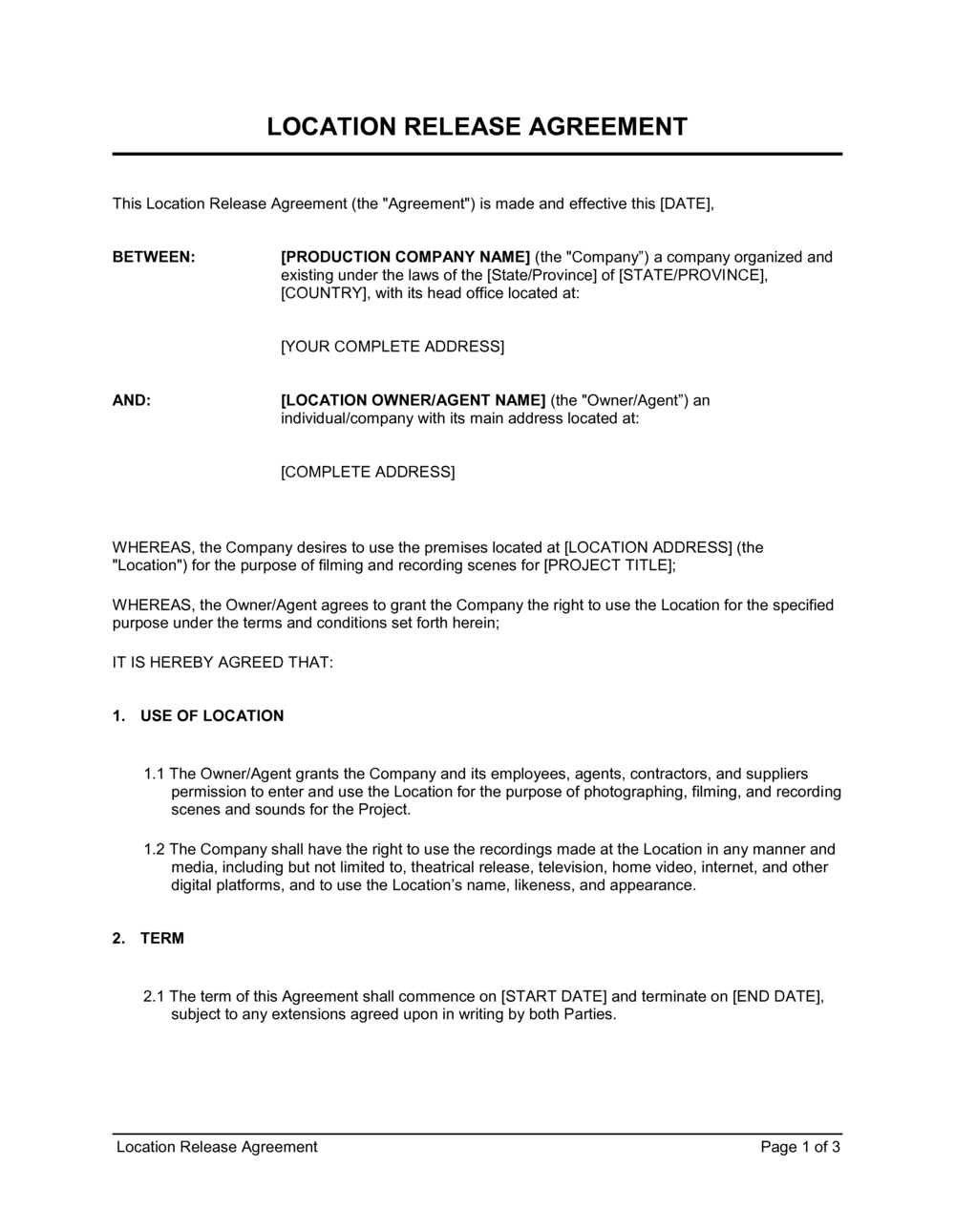
A Location Release Agreement is a legally binding contract between a property owner or occupant (the "Licensor") and a production company, photographer, or filmmaker (the "Licensee") that grants permission to use a specific physical location for filming, photography, or other media production. This free Word download covers access dates, fees, permitted uses, liability, indemnification, and restoration obligations in a single concise document you can edit online and export as PDF.
When you need it
Use it any time you need to film, photograph, or record at a property you do not own β€” whether for a commercial, feature film, music video, corporate video, or photo shoot. Property owners use it before granting access to ensure their premises, business operations, and legal interests are protected throughout the production.
What's inside
Parties and property description, permitted use and scope, access schedule and duration, location fee and payment terms, production conduct and restrictions, liability waiver and indemnification, insurance requirements, restoration and damage obligations, and governing law.

What is a Location Release Agreement?

A Location Release Agreement is a legally binding contract between a property owner (the "Licensor") and a production company, photographer, or filmmaker (the "Licensee") that formally grants permission to access and use a specific physical location for filming, photography, or audio recording. It specifies which areas of the property may be accessed, on which dates and times, for what production purpose, and under what financial and liability terms. Beyond granting access, a properly executed location release transfers the production rights needed for the finished content to be distributed, broadcast, or licensed β€” rights that a simple verbal permission cannot convey.

Why You Need This Document

Without a signed location release agreement, a production has no documented legal basis to use footage of a private property in commercial distribution β€” and every major distributor, broadcaster, and streaming platform will require one before accepting a finished film, commercial, or branded video. A verbal agreement with a property owner gives the crew access on the day of the shoot but provides no protection if the owner later objects to how the location appears in the content, claims the crew caused damage, or demands additional compensation after seeing the finished work. The agreement also protects the property owner: it caps crew size, requires adequate insurance naming the owner as an additional insured, mandates restoration of the premises, and limits liability for crew injuries. Executing this document before the first day of access closes the gap between a handshake and an enforceable set of obligations β€” protecting both sides and preserving the production's ability to bring the finished work to market.

Which variant fits your situation?

If your situation is…Use this template
Filming at a private residential propertyResidential Location Release Agreement
Using a commercial building, office, or retail space for a shootCommercial Property Location Release
Photographing or filming in a public park or government-owned spacePublic Location Permit Application
Filming on a university or school campusEducational Institution Location Release
Granting ongoing multi-day or multi-week access to a recurring set locationLocation License Agreement (Long-Form)
Releasing a person's likeness captured during a shoot, not a propertyModel Release Form
Using stock footage of a location without a live crewStock Footage License Agreement

Common mistakes to avoid

❌ Vague property description that omits restricted areas

Why it matters: Without a precise description of which areas are in scope, a crew may access rooms, storage areas, or outbuildings the owner never intended to include β€” leading to privacy violations and property damage claims with no contractual basis for recovery.

Fix: List every included area by room or zone, and explicitly name any excluded areas. Attach a floor plan or site map as an exhibit if the property is large or complex.

❌ No pre-shoot inspection and documentation

Why it matters: If existing damage to the property is not documented before the crew arrives, the owner can attribute pre-existing conditions to the production β€” and the Licensee has no evidence to contest it.

Fix: Conduct a joint walk-through with timestamped photographs immediately before crew setup, and have both parties sign a condition report at that time.

❌ Omitting crew size and equipment caps

Why it matters: A production that arrives with twice the agreed crew and heavy equipment can overwhelm a residential property, causing structural wear, noise complaints, and neighbor disputes that the owner has no contractual right to stop.

Fix: Specify a maximum headcount, a list of permitted equipment types, and a requirement for written approval before any additional equipment or crew is added on the day.

❌ Failing to require the Licensor to be named as an additional insured

Why it matters: A certificate of insurance proves a policy exists but gives the property owner no direct claim against the insurer if a crew member is injured on the premises β€” only additional insured status does that.

Fix: Require the Licensee to deliver a certificate of insurance naming the Licensor as an additional insured at least [X] days before the first day of access, as a condition precedent to the grant of license.

❌ No overtime or extension fee mechanism

Why it matters: Productions routinely run over schedule. Without an agreed hourly or daily rate for extensions, the owner has no contractual basis to charge for extra time, and the crew has no incentive to wrap on schedule.

Fix: Include a specific overtime rate β€” typically 1.5Γ— to 2Γ— the pro-rated daily fee β€” that applies automatically to each hour or portion thereof beyond the contracted access window.

❌ Using a verbal agreement or email chain instead of a signed release

Why it matters: An oral permission to film on a property does not transfer the rights needed to distribute, broadcast, or license the resulting content β€” distributors and broadcasters require a signed location release for every identifiable location in a film or commercial.

Fix: Execute a signed written location release before the shoot begins. Attempting to obtain retroactive signatures after distribution problems arise is legally uncertain and practically difficult.

The 10 key clauses, explained

Parties, property description, and recitals

In plain language: Identifies the Licensor and Licensee by full legal name, describes the physical address and specific areas of the property covered, and states the purpose of the agreement.

Sample language
This Location Release Agreement is entered into as of [DATE] between [LICENSOR FULL LEGAL NAME] ('Licensor'), owner of the property located at [FULL PROPERTY ADDRESS] ('Location'), and [LICENSEE FULL LEGAL NAME] ('Licensee'). Licensee desires to use the Location for the purpose of [PRODUCTION TITLE / DESCRIPTION].

Common mistake: Describing the location only by street address without specifying which rooms, floors, or exterior areas are included β€” leaving the scope of access open to dispute when a crew tries to enter areas the owner considered off-limits.

Grant of license and permitted use

In plain language: Grants the Licensee a non-exclusive, limited license to access and use the property solely for the described production activity β€” photography, filming, audio recording, or a combination.

Sample language
Licensor hereby grants to Licensee a non-exclusive, non-transferable license to enter and use the Location solely for the purpose of [FILMING / PHOTOGRAPHY / AUDIO RECORDING] in connection with [PRODUCTION TITLE] ('Production'). This license does not convey any ownership interest in the Location.

Common mistake: Using broad language like 'any and all media purposes' without specifying the production. This could be read to authorize future shoots, sublicensing to third parties, or uses the owner never intended to permit.

Access schedule and duration

In plain language: States the specific dates and hours during which the crew may access the property, including setup, shooting, and wrap time.

Sample language
Licensee shall have access to the Location on the following dates and times: [DATE(S)], from [START TIME] to [END TIME] ('Shoot Period'). Access outside the Shoot Period requires Licensor's prior written consent. Any extension shall be subject to an additional fee of $[X] per [HOUR / DAY].

Common mistake: Omitting wrap and setup time from the access window. Crews consistently need an hour or more on each end β€” leaving this unspecified leads to overtime disputes and property access conflicts.

Location fee and payment terms

In plain language: Specifies the compensation the Licensee will pay, the payment schedule, the method of payment, and whether a security deposit is required.

Sample language
Licensee shall pay Licensor a location fee of $[AMOUNT] for the Shoot Period, payable as follows: $[DEPOSIT AMOUNT] upon execution of this Agreement, and the balance of $[REMAINING AMOUNT] no later than [DATE / prior to first day of access]. A security deposit of $[AMOUNT] is due upon execution and will be returned within [X] days of completion, less any documented damage.

Common mistake: Failing to specify a security deposit or damage holdback. Without one, a Licensor seeking compensation for minor damage must pursue a separate legal claim rather than making a straightforward deduction.

Production conduct and restrictions

In plain language: Sets ground rules for crew behavior on the property β€” number of crew members, prohibited areas, noise limits, equipment restrictions, parking, and the owner's right to have a representative present.

Sample language
Licensee shall limit the crew to a maximum of [NUMBER] persons on the Location at any time. The following areas are excluded from use: [LIST RESTRICTED AREAS]. No open flames, hazardous materials, or [SPECIFIC EQUIPMENT / ACTIVITY] shall be used without Licensor's prior written approval. Licensor reserves the right to have one representative present at all times.

Common mistake: No cap on crew size or equipment. A homeowner who permits a 'small film crew' can find 30 people and a generator truck on their property with no contractual basis to object.

Liability waiver and indemnification

In plain language: Allocates risk between the parties β€” typically requiring the Licensee to indemnify the Licensor against claims arising from the production's use of the property, and waiving the Licensor's liability for injury to the Licensee's crew.

Sample language
Licensee shall indemnify, defend, and hold harmless Licensor from and against any and all claims, damages, losses, and expenses (including reasonable attorneys' fees) arising out of or relating to Licensee's use of the Location. Licensor shall not be liable for any injury, loss, or damage sustained by Licensee or its crew while on the Location.

Common mistake: One-sided indemnification that places all risk on the property owner. Courts in many jurisdictions will not enforce indemnification clauses that attempt to relieve a party of liability for their own negligence β€” a balanced clause is both fairer and more likely to hold up.

Insurance requirements

In plain language: Requires the Licensee to carry and maintain adequate insurance coverage β€” typically commercial general liability with a minimum limit β€” and to name the Licensor as an additional insured for the shoot period.

Sample language
Prior to accessing the Location, Licensee shall provide Licensor with a certificate of insurance evidencing commercial general liability coverage of not less than $[AMOUNT] per occurrence and $[AMOUNT] aggregate, naming Licensor as an additional insured. Coverage must remain in force throughout the Shoot Period.

Common mistake: Requiring a certificate of insurance but not requiring the Licensor to be named as an additional insured. A certificate alone only proves the policy exists β€” additional insured status is what actually protects the owner if a crew member is injured on the premises.

Restoration and damage obligations

In plain language: Requires the Licensee to restore the property to its pre-shoot condition and establishes a process for documenting damage and calculating repair costs.

Sample language
Licensee shall, at its sole cost and expense, restore the Location to its original condition no later than [DATE / TIME] following the conclusion of the Shoot Period. Licensor and Licensee shall conduct a joint walk-through inspection before and after the shoot. Any damage identified in the post-shoot inspection not present in the pre-shoot inspection shall be repaired at Licensee's expense.

Common mistake: Skipping the pre-shoot walk-through inspection and documentation. Without a baseline record of the property's condition, any damage claim becomes a credibility contest rather than a documented contractual obligation.

Right to use name and likeness of property

In plain language: Grants or restricts the Licensee's right to identify the location by name, address, or distinctive visual features in the finished production and in promotional materials.

Sample language
Licensor [grants / does not grant] Licensee the right to identify the Location by name and address in the Production and in all promotional, advertising, and marketing materials related to the Production. Any use of the Location's name or distinctive features not expressly authorized herein requires Licensor's prior written consent.

Common mistake: Omitting this clause entirely. A production that identifies a private residence or business by name in a commercial context without permission may expose the Licensee to a separate right-of-publicity or false endorsement claim.

Governing law, dispute resolution, and entire agreement

In plain language: Specifies the jurisdiction whose law governs the contract, the mechanism for resolving disputes, and confirms the written agreement supersedes all prior oral or written understandings.

Sample language
This Agreement shall be governed by the laws of [STATE / PROVINCE / COUNTRY]. Any dispute arising hereunder shall be resolved by [binding arbitration / mediation / litigation] in [CITY, JURISDICTION]. This Agreement constitutes the entire agreement between the parties and supersedes all prior negotiations, representations, and understandings.

Common mistake: Choosing a governing law with no connection to where the property is located. Some jurisdictions require that disputes over real property interests be litigated in the state or province where the property sits β€” regardless of what the contract says.

How to fill it out

  1. 1

    Identify both parties and the property

    Enter the Licensor's full legal name (individual or entity) and the Licensee's full legal name and production company. Describe the property by full street address and list specifically which areas β€” rooms, floors, exterior zones β€” are covered.

    πŸ’‘ If the property is owned by an LLC or trust, the Licensor's name must match the entity on the deed β€” not just the individual who manages it.

  2. 2

    Define the permitted use and production title

    State the exact type of media activity permitted: filming, photography, audio recording, or a combination. Reference the production by its working title to prevent the agreement from being reused for a different project.

    πŸ’‘ Attach a one-paragraph production synopsis as Exhibit A β€” it anchors the permitted use and helps both parties agree on content boundaries before the crew arrives.

  3. 3

    Set the access schedule with setup and wrap time

    List every access date with specific start and end times. Include crew setup time (typically 1–2 hours before first shot) and wrap/strike time (typically 1–2 hours after final shot) within the permitted window.

    πŸ’‘ Build in a 30-minute buffer before the contractual end time β€” crews almost always run long, and overtime language in the agreement gives you a mechanism to charge for it.

  4. 4

    Complete the location fee and security deposit terms

    Enter the total location fee, the deposit amount due at signing, the balance due date, and the security deposit amount. Specify the timeframe within which the deposit will be returned and the conditions under which deductions are permitted.

    πŸ’‘ Research comparable location fees in your market before negotiating β€” residential rates in major metro areas run $500–$5,000 per day; commercial spaces often start at $1,500 per day.

  5. 5

    Fill in production conduct restrictions

    Specify the maximum crew size, prohibited areas, equipment restrictions, parking arrangements, and any quiet hours. If the Licensor wants a representative present, add that right explicitly.

    πŸ’‘ Ask the Licensor to walk the property with you before drafting this section β€” restrictions you discover in writing on location day one are far more disruptive than those agreed to in advance.

  6. 6

    Confirm insurance requirements and request the certificate

    Enter the required liability coverage amounts (at minimum $1M per occurrence is standard for most productions) and name the Licensor as an additional insured. Confirm receipt of the certificate before the first day of access.

    πŸ’‘ Budget productions sometimes let this slip β€” do not access the property without the certificate in hand. A single trip-and-fall claim can exceed the entire production budget.

  7. 7

    Document the property before and after the shoot

    Schedule a joint walk-through inspection immediately before crew setup begins and a second inspection immediately after strike. Use a written checklist and timestamped photographs for both.

    πŸ’‘ Have both parties sign and date the pre-shoot inspection report at the time it is completed β€” not hours later when memories and narratives diverge.

  8. 8

    Execute before the first day of access

    Both parties must sign the agreement β€” and the Licensee must deliver the deposit and certificate of insurance β€” before any crew member sets foot on the property.

    πŸ’‘ Use a digital signing tool to timestamp execution and automatically store a fully executed copy accessible to both parties.

Frequently asked questions

What is a location release agreement?

A location release agreement is a legally binding contract between a property owner and a production company or photographer that grants permission to use a specific physical location for filming, photography, or other media production. It specifies the access dates, permitted activities, compensation, insurance requirements, and liability allocation, and gives the production the documented rights needed for distribution and broadcast.

Do I need a location release agreement for every shoot?

Yes β€” any time you film or photograph on property you do not own, a signed release is required. This applies to private residences, commercial buildings, restaurants, retail stores, and even some public spaces that have restrictions on commercial filming. Distributors, broadcasters, and streaming platforms routinely require signed location releases as part of errors-and-omissions (E&O) insurance documentation before they will accept a finished production.

What is the difference between a location release agreement and a film permit?

A film permit is issued by a government authority β€” city, county, or parks department β€” authorizing production in a public space. A location release agreement is a private contract between the production and a property owner for access to privately owned premises. Many productions require both: a permit for public streets or parks and a release for any privately owned buildings or land featured in the same shoot.

Who signs a location release agreement?

The Licensor must be the property owner or a person with legal authority to grant access β€” such as a long-term tenant with a sublicense right or a property manager acting under a written authorization from the owner. The Licensee is typically the production company's authorized signatory. Both parties should sign before the first day of access, not on the day of the shoot.

How much should a location fee be?

Location fees vary by property type, market, and shoot duration. Residential properties in major US cities typically run $500–$5,000 per day. Commercial spaces, warehouses, and unique properties with production appeal often start at $1,500–$10,000 per day. For non-commercial or student productions, owners sometimes agree to a nominal fee of $1 plus a credit β€” but a proper release must still be signed regardless of the fee amount.

Can a location release agreement limit how the footage is used?

Yes β€” the agreement can restrict use to specific media (broadcast, digital, theatrical), specific territories, or a limited time period. It can also prohibit identifying the location by name or address in the finished work. Any use beyond what the agreement expressly permits requires a separate negotiation and a written amendment or new release.

What happens if the property is damaged during a shoot?

Under a properly drafted location release agreement, the Licensee is responsible for restoring the property to its pre-shoot condition and for the cost of repairing any damage. The pre-shoot inspection report and photographs are the primary evidence for determining what damage occurred during the production. If a security deposit was collected, the Licensor may deduct documented repair costs before returning the balance.

Is a location release agreement required for social media content?

Generally yes, if the content is commercial in nature β€” branded posts, sponsored content, or advertising β€” and filmed on private property. Organic personal posts are typically not subject to the same commercial use requirements, but any production intended to promote a brand or product should have a signed release to protect both the creator and the brand client from property-related claims.

Does a location release cover the people who appear in the footage?

No β€” a location release covers only the physical property, not the individuals who appear on camera. Anyone identifiable in the footage should sign a separate model or talent release form. Property owners who appear incidentally in footage should also sign a personal release, distinct from the location agreement, if their likeness will be used in the finished production.

How this compares to alternatives

vs Model Release Form

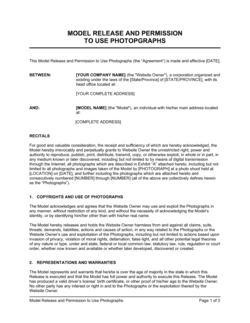
A model release form covers the right to use an individual's likeness β€” their face, voice, and image β€” in a production. A location release covers the right to use a physical property. Both are typically needed for any production involving identifiable people on private premises, but they are separate documents covering separate rights.

vs Venue Rental Agreement

A venue rental agreement governs the use of a space for an event β€” a wedding, conference, or performance β€” and typically covers catering, equipment, and event logistics. A location release is narrower, granting the right to film or photograph at a property and specifically addressing distribution rights, insurance, and the production's right to use the location's appearance in commercial content.

vs Property Lease Agreement

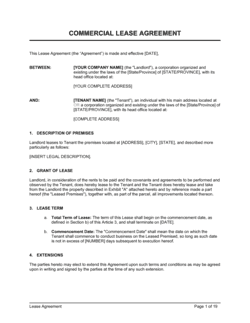
A property lease transfers possession of a premises for an extended term β€” months or years β€” for habitation or business operations. A location release grants a short-term, limited license solely for media production purposes. A lease creates a landlord-tenant relationship with statutory protections; a location release does not.

vs Film Production Agreement

A film production agreement is a broad contract between producers, crew, or financiers governing the entire production β€” budget, creative control, profit sharing, and deliverables. A location release is one narrow component of a production's legal paperwork, dealing only with rights to a specific physical location. The two documents work together but address completely different aspects of the production.

Industry-specific considerations

Film and Television

Feature films, episodic TV, and commercials require location releases for every identifiable private location as part of E&O insurance documentation submitted to distributors and broadcasters.

Advertising and Marketing

Brand campaigns and product shoots on private property need releases that specify permitted media channels β€” broadcast, digital, out-of-home β€” and usage territories to avoid downstream licensing disputes.

Real Estate

Agents and developers allowing photography or videography of listed properties for promotional use require a release confirming who owns the resulting images and how they may be distributed.

Music and Entertainment

Music video productions shot at private venues, residences, or commercial locations need releases that address overnight access, pyrotechnics, and crowd control in addition to standard filming permissions.

Corporate and Training Video

Corporate productions filming at client facilities or partner locations need releases confirming the company's right to use the footage in internal training, investor presentations, and public-facing brand content.

Photography and Creative Services

Editorial and commercial photographers shooting on private property for magazine publication or stock licensing require releases that specifically address the scope of commercial reproduction rights granted to the end client.

Jurisdictional notes

United States

Location release requirements vary by state, but all US distributors and E&O insurers require signed releases for identifiable private locations. California and New York β€” the two largest production markets β€” have well-developed case law on property rights and false light claims. Right-of-publicity statutes in several states may also apply if a property's distinctive features are commercially associated with a brand or individual. Some municipalities require additional filming permits regardless of whether a private release is in place.

Canada

Canadian productions require location releases that comply with provincial law in the jurisdiction where filming occurs. Quebec's Civil Code imposes additional privacy protections for identifiable private spaces. The Canadian Media Producers Association recommends location agreements be executed in the language of the province β€” English or French β€” where applicable. Productions co-produced under Canadian-foreign treaty arrangements typically require releases that satisfy both jurisdictions' legal standards.

United Kingdom

UK productions are subject to the UK GDPR where footage captures identifiable individuals in private spaces. The British Film Commission recommends all location agreements be in writing with clear indemnification provisions. Historic England and local councils may impose additional conditions on filming at listed buildings or in designated conservation areas. The Film London Location Release template is widely used as a baseline in London, but custom agreements are standard for larger productions.

European Union

EU productions must consider GDPR obligations when filming at locations where individuals may be captured on camera, even incidentally. Member states have differing property law traditions β€” French and German law, for example, recognize stronger privacy rights in private spaces than many common-law jurisdictions. Productions distributed across multiple EU member states should ensure the location release's governing law clause is consistent with the primary market's regulations, and that any personal data captured during the shoot is handled in accordance with applicable GDPR requirements.

Template vs lawyer β€” what fits your deal?

PathBest forCostTime
Use the templateIndependent productions, student films, small commercial shoots at straightforward residential or commercial locationsFree15–30 minutes
Template + legal reviewBranded commercial shoots, multi-day productions at high-value properties, or any location with unusual access or liability conditions$200–$500 for a one-hour entertainment or real estate attorney review1–3 days
Custom draftedFeature film productions, high-budget commercials, or properties with complex ownership structures, historic designations, or lease restrictions$1,000–$3,500+1–2 weeks

Glossary

Licensor
The property owner or authorized occupant who grants permission for a production to use the location.
Licensee
The production company, photographer, or filmmaker receiving permission to access and use the location.
Location Fee
The agreed compensation paid by the Licensee to the Licensor in exchange for access to the property.
Permitted Use
The specific type of production activity β€” filming, photography, audio recording β€” that the agreement authorizes at the property.
Call Sheet
A daily production schedule listing which crew members, talent, and equipment will be on-site and at what times, often attached as an exhibit to the release.
Indemnification
A contractual obligation requiring one party to compensate the other for losses, damages, or legal claims arising from the indemnifying party's acts or omissions.
Restoration Obligation
A requirement that the production crew return the property to its original condition by a specified date after the shoot concludes.
General Liability Insurance
A policy covering bodily injury and property damage claims that may arise during the production on the location premises.
Force Majeure
A clause excusing a party from performance when an unforeseeable event outside their control β€” weather, natural disaster, or government action β€” prevents the shoot from proceeding.
Right of Approval
A provision giving the property owner the right to review and approve specific aspects of the production, such as script content referencing the location or final edited footage.
Exclusivity
A term granting the Licensee sole access to the location during scheduled shoot periods, preventing the owner from booking other tenants or productions at the same time.

Part of your Business Operating System

This document is one of 3,000+ business & legal templates included in Business in a Box.

  • Fill-in-the-blanks β€” ready in minutes
  • 100% customizable Word document
  • Compatible with all office suites
  • Export to PDF and share electronically

Create your document in 3 simple steps.

From template to signed document β€” all inside one Business Operating System.
1
Download or open template

Access over 3,000+ business and legal templates for any business task, project or initiative.

2
Edit and fill in the blanks with AI

Customize your ready-made business document template and save it in the cloud.

3
Save, Share, Send, Sign

Share your files and folders with your team. Create a space of seamless collaboration.

Save time, save money, and create top-quality documents.

β˜…β˜…β˜…β˜…β˜…

"Fantastic value! I'm not sure how I'd do without it. It's worth its weight in gold and paid back for itself many times."

Managing Director Β· Mall Farm
Robert Whalley
Managing Director, Mall Farm Proprietary Limited
β˜…β˜…β˜…β˜…β˜…

"I have been using Business in a Box for years. It has been the most useful source of templates I have encountered. I recommend it to anyone."

Business Owner Β· 4+ years
Dr Michael John Freestone
Business Owner
β˜…β˜…β˜…β˜…β˜…

"It has been a life saver so many times I have lost count. Business in a Box has saved me so much time and as you know, time is money."

Owner Β· Upstate Web
David G. Moore Jr.
Owner, Upstate Web

Run your business with a system β€” not scattered tools

Stop downloading documents. Start operating with clarity. Business in a Box gives you the Business Operating System used by over 250,000 companies worldwide to structure, run, and grow their business.

Start freeΒ Β·Β No credit card required