List Of Business Tasks For Startups Template

Free download • Use as a template • Print or share

5 pages25–30 min to useDifficulty: ComplexSignature requiredLegal review recommended
Learn more ↓
FreeList Of Business Tasks For Startups Template

At a glance

What it is
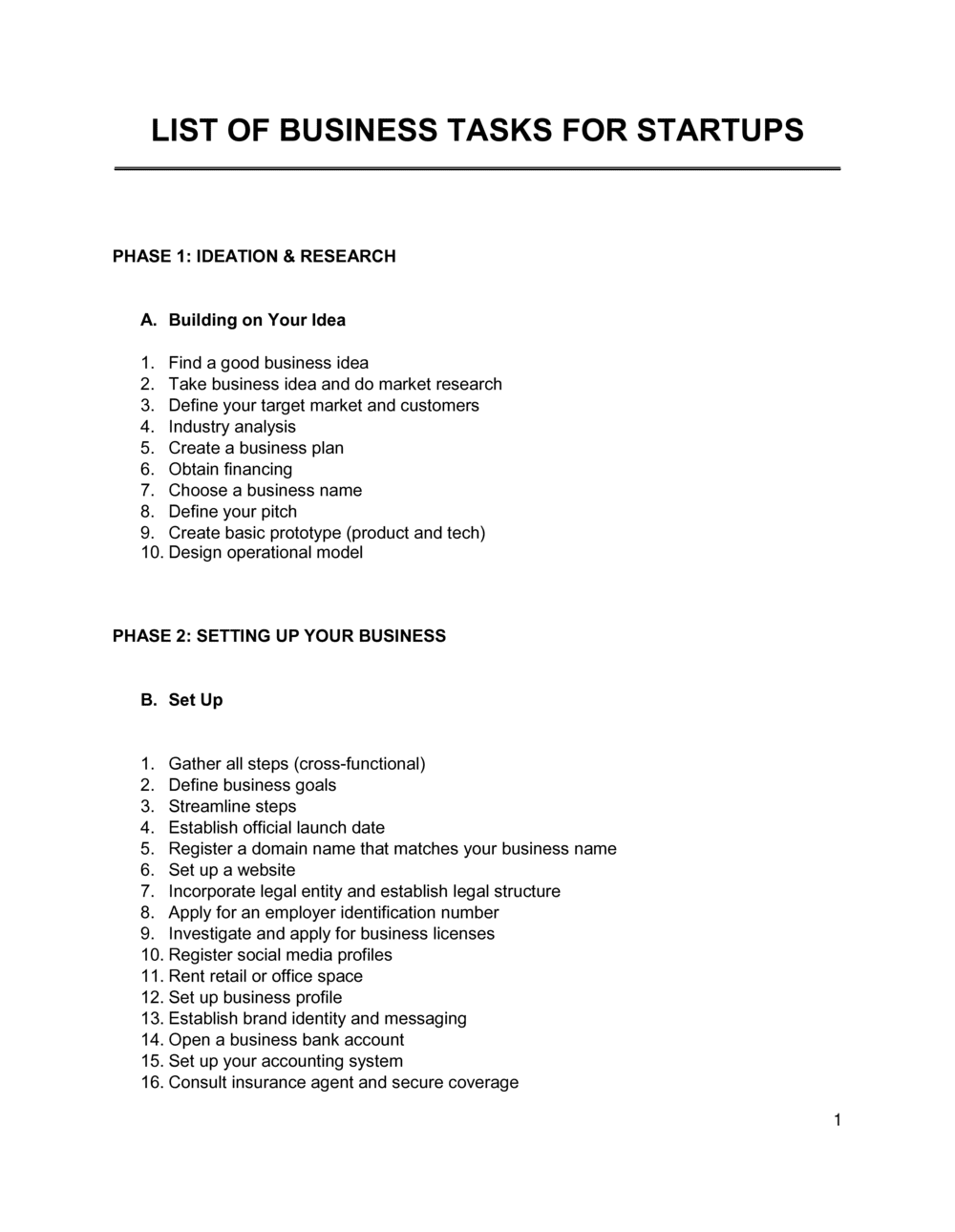
A List of Business Tasks for Startups is a structured legal and operational checklist that guides founders through every critical action required to launch, register, and govern a new company. This free Word download covers entity formation, regulatory compliance, IP protection, founding agreements, and early operational setup in a single organized document you can edit online and export as PDF.
When you need it
Use it from the moment you decide to formalize a new business — before you spend money, hire anyone, or sign a contract. The checklist is most valuable in the 0–90 days before and immediately after incorporation, when overlooked tasks create the most expensive legal and compliance problems.
What's inside
Entity formation and registration steps, tax and regulatory filings, founding document execution (shareholders agreements, bylaws, IP assignment), banking and financial setup, intellectual property registration, employment and contractor onboarding requirements, and key operational compliance tasks.

What is a List of Business Tasks for Startups?

A List of Business Tasks for Startups is a structured legal and operational checklist that guides founders through every mandatory step required to properly form, register, and govern a new company. It covers entity incorporation, federal and state tax registrations, foundational governance documents, IP assignment agreements, 83(b) elections, business licensing, banking setup, employment documentation, and ongoing compliance obligations — organized into a single signed document that creates an auditable record of completion. Unlike a casual to-do list, a formalized startup task checklist is executed by the founding team, stored with corporate records, and used as evidence during investor due diligence and regulatory audits.

Why You Need This Document

The cost of skipping or delaying early startup compliance tasks is not theoretical — it is measured in missed tax deadlines, voided equity arrangements, and blocked funding rounds. A founder who misses the 30-day 83(b) election window faces ordinary income tax on the appreciated value of their shares at every vesting event for the life of the grant. A company that fails to assign pre-incorporation IP gives investors a legitimate reason to pause or restructure a funding close. An LLC that commingles funds in a personal account loses the limited liability protection that incorporation was supposed to provide. Investors, acquirers, and lenders conduct legal due diligence that surfaces every one of these gaps — and correcting them after the fact is far more expensive than completing them correctly at launch. This template gives founding teams a single organized document to work through systematically, sign off on together, and store as evidence that the business was built on a sound legal foundation.

Which variant fits your situation?

If your situation is…Use this template
Launching a technology startup seeking venture capitalList of Business Tasks for Startups (Tech/VC Track)
Forming a single-founder LLC or sole proprietorshipLLC Formation Checklist
Setting up a co-founded company with equity and vestingCo-Founder Agreement
Registering a nonprofit or charitable organizationNonprofit Setup Checklist
Onboarding the first employee after incorporationEmployment Contract
Preparing for a seed or pre-seed funding roundInvestor Business Plan
Launching a franchise location or buying a franchiseFranchise Agreement

Common mistakes to avoid

❌ Missing the 83(b) election window

Why it matters: The IRS imposes a strict 30-day deadline with no exceptions. Founders who miss it pay ordinary income tax on the full appreciated value of their shares at each vesting date rather than on the low value at grant — a bill that can reach tens of thousands of dollars.

Fix: File the 83(b) election the same week restricted stock is granted. Use USPS certified mail, retain the postmarked receipt, and place a copy in both the employee's file and the company's records.

❌ Incorporating in Delaware without qualifying as a foreign entity at home

Why it matters: A Delaware C-Corp operating in California, New York, or Texas must also register as a foreign corporation in that state. Operating without foreign qualification carries back fees, penalties, and in some states voids contracts entered during the non-compliant period.

Fix: After incorporating in Delaware, immediately assess whether the business operates in another state and file for foreign qualification there within 30–60 days of beginning operations.

❌ Leaving pre-incorporation IP outside the assignment

Why it matters: Code, designs, or research built before the entity existed is owned by the individual founder, not the company. Venture investors run IP chain-of-title checks as standard due diligence, and a gap here can block or delay a funding close.

Fix: Ensure the IP assignment agreement explicitly covers all work product created before and after incorporation that relates to the company's business, with a retroactive effective date if needed.

❌ Commingling personal and business funds

Why it matters: Using a personal account for business transactions — or reimbursing personal expenses directly from the business account without documentation — is the most common basis on which courts pierce the corporate veil and hold founders personally liable for company debts.

Fix: Open the business bank account before the first transaction. All business income and expenses must flow exclusively through the entity account, with documented reimbursement policies for any personal expenditures.

❌ Skipping the shareholders agreement until an investor requires it

Why it matters: A co-founder who departs in the first 18 months with no vesting agreement in place may walk away holding a significant equity stake with no performance obligation attached, creating a permanent cap-table problem.

Fix: Execute the shareholders agreement — including vesting schedules, IP assignment, and transfer restrictions — before or on the date of incorporation, not when the first investor asks for it.

❌ Assuming a state business license covers all permit requirements

Why it matters: A state business registration does not substitute for local zoning permits, industry-specific federal licenses, or municipal business licenses. Operating without required permits exposes founders to fines, forced closure, and personal liability in regulated industries.

Fix: Research licensing requirements at the federal, state, county, and municipal level separately. Use the SBA permit finder as a starting point and verify with each local authority before beginning operations.

The 10 key clauses, explained

Entity formation and state registration

In plain language: Documents and confirms that the company has been legally incorporated or organized in the appropriate state or jurisdiction, with a registered agent designated.

Sample language
Entity Type: [LLC / C-Corp / S-Corp] | State of Incorporation: [STATE] | Date Filed: [DATE] | Registered Agent: [NAME / ENTITY] | State Filing Number: [NUMBER]

Common mistake: Incorporating in Delaware for perceived prestige without considering the added cost of foreign qualification in the state where the business actually operates — doubling annual fees and compliance obligations.

Federal and state tax ID registration

In plain language: Confirms that an EIN has been obtained from the IRS and that any required state tax registrations — sales tax, payroll tax, franchise tax — have been completed.

Sample language
Federal EIN: [XX-XXXXXXX] obtained [DATE]. State Tax ID: [NUMBER] registered in [STATE] on [DATE]. Sales tax permit: [APPLIED / OBTAINED / NOT REQUIRED — REASON].

Common mistake: Treating the EIN as the only tax registration needed. Many states require separate registrations for payroll withholding, sales tax, and franchise tax — each with independent deadlines and penalties.

Foundational governance documents

In plain language: Confirms that the company's core internal governance documents — bylaws (corporations) or operating agreement (LLCs) — have been drafted, adopted, and stored in the company's records.

Sample language
Bylaws / Operating Agreement adopted by the [Board / Members] on [DATE]. Executed copies stored in: [LOCATION / DRIVE]. Initial resolutions / consent actions executed: [YES / NO — DATE].

Common mistake: Using a generic online operating agreement without tailoring it to the actual ownership structure — leaving key provisions like deadlock resolution, buyout triggers, and distribution waterfalls undefined.

Shareholders and founders agreement

In plain language: Confirms that a binding agreement governs the relationship among equity holders, including vesting schedules, transfer restrictions, voting rights, and exit provisions.

Sample language
Shareholders Agreement executed between [FOUNDER 1], [FOUNDER 2], and [COMPANY NAME] on [DATE]. Vesting schedule: [4-year / 3-year] with [1-year] cliff. Right of first refusal: [YES]. Drag-along threshold: [X]%.

Common mistake: Skipping the shareholders agreement until investors require it. By that point, a co-founder who has already departed may be holding unvested equity with no contractual mechanism to reclaim it.

Intellectual property assignment

In plain language: Confirms that all founders, contractors, and early employees have signed agreements assigning their work product and pre-existing relevant IP to the company.

Sample language
IP Assignment Agreement executed by [NAME] on [DATE], covering all work product created from [START DATE] through the term of engagement relating to [DESCRIPTION OF TECHNOLOGY / PRODUCT].

Common mistake: Assigning only post-incorporation IP and leaving pre-incorporation work product — code, designs, or research built before the entity existed — unassigned, which creates a chain-of-title gap that blocks venture investment.

83(b) election filing (US equity recipients)

In plain language: Confirms that any founder or employee receiving restricted stock has filed an 83(b) election with the IRS within the mandatory 30-day window from the grant date.

Sample language
83(b) Election filed by [NAME] on [DATE] — within 30 days of [GRANT DATE]. Copy filed with IRS, copy retained by employee, copy in company records. Method: [USPS certified mail / IRS online].

Common mistake: Missing the 30-day window — the deadline is absolute with no extensions. A missed 83(b) election can result in ordinary income tax on the full appreciated value of the stock at each vesting event.

Business licenses and permits

In plain language: Confirms that all required federal, state, county, and municipal business licenses and industry-specific permits have been identified, applied for, and obtained.

Sample language
Business License: [LICENSE NAME], issued by [AUTHORITY] on [DATE], expiring [DATE]. Industry permit: [PERMIT NAME / NOT APPLICABLE]. Local zoning compliance: [CONFIRMED / PENDING].

Common mistake: Assuming a state-level business registration covers all licensing requirements. Many industries — food service, healthcare, financial services, construction — require separate local or federal permits that carry criminal penalties for non-compliance.

Banking, accounting, and financial controls

In plain language: Confirms that a dedicated business bank account has been opened, accounting software is in place, and basic financial controls — expense policies, signature authorities — are documented.

Sample language
Business checking account opened at [BANK NAME] on [DATE]. Account signatory: [NAME(S)]. Accounting platform: [QUICKBOOKS / XERO / OTHER]. Expense reimbursement policy: [ADOPTED / PENDING].

Common mistake: Commingling personal and business funds before the bank account is open, or after it is open. Commingling is the single most common basis for piercing the corporate veil and eliminating limited liability protection.

Employment, contractor, and equity documentation

In plain language: Confirms that all hired employees and contractors have executed appropriate agreements, that payroll is registered, and that any equity grants are documented in the cap table.

Sample language
Employee agreements executed: [NUMBER]. Contractor agreements executed: [NUMBER]. Payroll service: [GUSTO / ADP / OTHER] activated [DATE]. Option pool: [X]% authorized. Cap table current as of [DATE].

Common mistake: Classifying early contributors as contractors to avoid payroll obligations when the work arrangement meets the legal definition of employment — triggering back taxes, penalties, and potential personal liability for the founders.

Insurance and ongoing compliance calendar

In plain language: Confirms that required insurance policies are in place and that a compliance calendar tracking annual filings, renewals, and reporting deadlines has been established.

Sample language
General liability: [CARRIER], effective [DATE]. Professional liability / E&O: [CARRIER / NOT APPLICABLE]. Annual report due: [DATE]. Compliance calendar owner: [NAME / ROLE].

Common mistake: Setting up insurance at incorporation and never reviewing coverage as the business grows. A company that adds employees, takes on client contracts, or handles personal data will typically need additional coverage types within the first 12 months.

How to fill it out

  1. 1

    Choose and confirm your entity type and state

    Select the entity structure that fits your ownership, tax, and fundraising goals — LLC, C-Corp, or S-Corp — and choose the state of incorporation. File articles of incorporation or organization and designate a registered agent.

    💡 If you plan to raise venture capital, a Delaware C-Corp is the standard investor expectation. For a single-owner service business with no outside investors, a domestic LLC in your home state is usually simpler and cheaper.

  2. 2

    Obtain your EIN and complete state tax registrations

    Apply for a federal EIN at IRS.gov (free, instant online). Then identify and complete every state-level registration required for your entity type and industry — payroll withholding, sales tax, and franchise tax filings vary by state.

    💡 Some states require a separate state tax ID even for pass-through entities with no employees. Check your state revenue agency's new-business registration portal before assuming the EIN covers everything.

  3. 3

    Execute all founding agreements before raising money

    Have every founder sign the shareholders agreement, IP assignment, and any co-founder agreement before the company receives its first dollar of outside capital. Set vesting schedules and document the initial cap table.

    💡 IP assignment must cover pre-incorporation work product — code, designs, or research built before the entity existed — or investors will flag a chain-of-title gap during due diligence.

  4. 4

    File 83(b) elections within 30 days of equity grants

    Every founder or early employee receiving restricted stock must file an 83(b) election with the IRS within 30 days of the grant date. File via certified mail, retain the postmarked receipt, and store a copy in company records.

    💡 Calendar the deadline the day the grant is made — the IRS grants no extensions, and there is no way to retroactively file after the window closes.

  5. 5

    Identify and obtain all required licenses and permits

    Research federal, state, county, and municipal licensing requirements for your industry and location. Apply for each separately — a business license from the state does not substitute for a local zoning permit or an industry-specific federal license.

    💡 Use the SBA's business license and permit finder (sba.gov) as a starting point, then verify with your local city or county clerk for location-specific requirements.

  6. 6

    Open a business bank account and set up accounting

    Open a dedicated business checking account in the company's legal name before any revenue is received or expenses are paid. Set up accounting software and document who has signing authority.

    💡 Never use a personal account even for a single transaction after incorporation — commingling pierces the corporate veil and eliminates the limited-liability protection incorporation provides.

  7. 7

    Build and activate your compliance calendar

    Identify every recurring filing deadline — annual reports, tax returns, license renewals, beneficial ownership reports — and enter them in a shared calendar with a designated owner and 30-day advance reminders.

    💡 Assign a single person as compliance calendar owner. Tasks with no named owner get missed, and late annual reports in most states result in administrative dissolution of the entity.

  8. 8

    Review and sign the completed checklist

    Once all tasks are confirmed as completed, have the founding team sign and date the checklist. Store the executed copy alongside your corporate records book or digital records drive.

    💡 Treat the signed checklist as a living document — add a version date each time you update it so you can demonstrate to investors or auditors exactly when each task was completed.

Frequently asked questions

What is a list of business tasks for startups?

A list of business tasks for startups is a structured checklist — often formalized as a binding internal document — that guides founders through the legal, regulatory, financial, and operational steps required to properly launch a new company. It covers entity formation, tax registration, founding agreements, IP assignment, licensing, banking setup, and ongoing compliance deadlines. When signed by the founding team, it creates an auditable record that critical early tasks were completed and acknowledged.

When should a startup complete this checklist?

The ideal window is the 30 days before and 60 days immediately after incorporation. Several tasks have hard deadlines tied to the incorporation date — the 83(b) election must be filed within 30 days of a stock grant, and most states require an initial annual report within 60–90 days of formation. Completing the checklist early prevents the cascading compliance problems that arise when founders focus only on product while legal tasks are deferred.

Does a startup need a lawyer to complete this checklist?

A template is sufficient for straightforward single-jurisdiction entities with simple equity structures. Engage a startup attorney when the company has two or more co-founders (vesting and IP assignment disputes are common), when the business operates in a regulated industry, when venture capital is on the near-term horizon, or when founders are in multiple jurisdictions. A one-time startup legal audit typically costs $1,500–$3,000 and is worthwhile before approaching any outside investor.

What is the difference between articles of incorporation and an operating agreement?

Articles of incorporation are the external state-filed document that legally creates a corporation — they are a public record. An operating agreement (or bylaws for a corporation) is the internal governance document that defines how the company is run, who has voting rights, how profits are distributed, and what happens when a founder leaves. Both are required for a properly formed entity; the articles create the entity, and the operating agreement governs it.

What happens if a startup skips the IP assignment step?

If founders or early contractors never signed an IP assignment, the intellectual property they created — code, designs, patents, trademarks — may legally belong to them personally rather than to the company. This creates a chain-of-title gap that venture investors flag in due diligence. Correcting it after the fact requires tracking down former contributors and negotiating retroactive assignments, which can be expensive or impossible if relationships have soured.

Is an 83(b) election required for all startup equity?

An 83(b) election applies only to restricted stock — equity that vests over time or is subject to a repurchase right. It is a US federal tax election with no direct equivalent in Canada, the UK, or the EU, though those jurisdictions have analogous mechanisms. It is not relevant for stock options (which have a different tax treatment) or for fully vested shares issued at incorporation with no restrictions. Founders receiving restricted stock in a US entity should file it automatically unless their tax advisor recommends otherwise.

Do LLCs need to complete the same startup tasks as corporations?

Most of the same tasks apply — EIN registration, state tax filings, licenses, banking setup, IP assignment, and an operating agreement are all required. The key differences: LLCs use an operating agreement rather than bylaws, do not issue stock (so no 83(b) election applies to standard membership interests), and are not structured for equity financing in the same way as C-Corps. Founders planning to raise venture capital should typically elect C-Corp status rather than LLC before approaching investors.

What is beneficial ownership reporting and does my startup need to file?

Under the US Corporate Transparency Act, most small companies formed or registered in the US must file a Beneficial Ownership Information (BOI) report with FinCEN identifying individuals who own 25% or more or exercise substantial control over the entity. As of 2024, new companies must file within 90 days of formation; existing companies had a 2024 deadline. Exemptions exist for large operating companies and regulated entities. Non-compliance carries civil penalties of $500 per day and criminal penalties up to $10,000. Check current FinCEN guidance for the latest deadlines, as this area is subject to ongoing litigation and rulemaking.

How often should the startup task checklist be updated?

The initial checklist should be completed and signed within the first 90 days of incorporation. It should then be reviewed at each significant milestone — first hire, first outside investment, entry into a new state or country, launch of a new product line — to identify new compliance obligations triggered by growth. An annual review tied to the fiscal year-end is the minimum for any operating business.

How this compares to alternatives

vs Co-Founder Agreement

A co-founder agreement governs the relationship between founding partners — equity splits, roles, vesting, and departure terms. A startup task checklist is broader in scope, covering all entity formation, regulatory, tax, and operational steps across the entire launch phase. Both are needed; the co-founder agreement is one item that should appear on the completed checklist.

vs Business Plan

A business plan is a strategic and financial document used to attract investors or lenders. A startup task checklist is a legal and operational compliance tool used to properly form and govern the business. The business plan describes what the company will do; the checklist ensures the company is legally entitled to do it.

vs Operating Agreement

An operating agreement is one governance document that governs an LLC's internal structure. A startup task checklist is a master compliance document that confirms the operating agreement has been executed alongside dozens of other required formation, tax, and licensing steps. The operating agreement is a single line item on the checklist.

vs Corporate Bylaws

Corporate bylaws govern how a corporation is managed — board composition, meeting procedures, and officer roles. A startup task checklist covers the full scope of launch-phase legal and operational requirements, of which adopting bylaws is one step. Bylaws alone do not address tax registration, licensing, IP assignment, or banking setup.

Industry-specific considerations

Technology / SaaS

IP assignment is critical given that software and algorithms are the core asset; Delaware C-Corp formation is standard for VC-backed companies; open-source license compliance must be documented from day one.

Healthcare and MedTech

Federal and state licensing requirements are extensive, HIPAA compliance must be built into operational setup from incorporation, and FDA registration may be required before any product is used commercially.

Financial Services and Fintech

Money transmitter licenses, state-by-state broker-dealer registrations, and FinCEN beneficial ownership reporting add significant compliance layers that must be mapped before the business accepts its first customer.

Professional Services

Professional licensing boards impose personal license requirements on individual practitioners in addition to entity registration; errors-and-omissions insurance is typically required before client engagements begin.

E-commerce and Retail

Sales tax nexus obligations arise in every state where the company has significant sales, requiring state-by-state tax registration and remittance separate from the home state business license.

Food and Beverage

Local health permits, food handler certifications, zoning approvals, and state-level food service licenses must all be obtained before operations begin, with renewal dates tracked on the compliance calendar.

Jurisdictional notes

United States

Entity formation occurs at the state level — Delaware, Wyoming, and the founder's home state are common choices, each with different fee structures and statutory protections. The 83(b) election is a US-specific IRS filing with a hard 30-day window. The Corporate Transparency Act requires beneficial ownership reporting to FinCEN for most new entities. Sales tax nexus rules vary by state and are triggered by economic activity thresholds, not just physical presence.

Canada

Companies may incorporate federally under the CBCA or provincially; federal incorporation provides name protection across all provinces but requires extra-provincial registration for local operations. A business number (BN) from the CRA is the Canadian equivalent of the EIN and is required for GST/HST registration, payroll deductions, and corporate tax accounts. Quebec requires French-language compliance for any company operating in the province.

United Kingdom

Companies are incorporated through Companies House, typically as a private limited company (Ltd). Directors must be registered, a memorandum and articles of association are required, and a registered office address in the UK must be maintained. HMRC registration for Corporation Tax must occur within 3 months of starting business activity. The PSC (People with Significant Control) register is the UK equivalent of beneficial ownership reporting and must be kept current.

European Union

Company formation rules vary significantly by member state — a German GmbH, French SAS, and Dutch BV each have different minimum capital, notarization, and registration requirements. GDPR compliance is a mandatory operational task from day one for any company handling EU personal data, regardless of where the company is incorporated. VAT registration thresholds and requirements vary by member state and must be assessed for each jurisdiction where the business operates.

Template vs lawyer — what fits your deal?

PathBest forCostTime
Use the templateSolo founders or co-founders launching a straightforward domestic entity with no immediate plan for outside investmentFree1–2 weeks to complete all tasks
Template + legal reviewMulti-founder companies, VC-track startups, or businesses in regulated industries needing a one-time legal audit$1,500–$3,0001–2 weeks with attorney review
Custom draftedComplex multi-jurisdiction formations, heavily regulated industries, or companies preparing for a seed round with institutional investors$3,000–$10,000+2–4 weeks

Glossary

Articles of Incorporation
The foundational state-filed document that legally creates a corporation, recording its name, registered agent, share structure, and purpose.
Operating Agreement
An internal LLC document that governs member rights, ownership percentages, profit distribution, and management structure.
EIN (Employer Identification Number)
A federal tax ID number issued by the IRS that a business needs to open bank accounts, file taxes, and hire employees.
Registered Agent
A person or entity designated to receive official legal and government correspondence on behalf of the company in the state of incorporation.
Founder Vesting
A schedule — typically 4 years with a 1-year cliff — under which founders earn their equity over time to protect the company if a co-founder departs early.
IP Assignment Agreement
A contract transferring ownership of any intellectual property created by a founder or employee to the company, ensuring the business owns its own technology and brand.
83(b) Election
A US tax filing made within 30 days of receiving restricted stock that allows founders to pay tax on current fair market value rather than the higher value at vesting.
DBA (Doing Business As)
A trade name registration that allows a business to operate publicly under a name different from its registered legal entity name.
Cap Table
A spreadsheet listing all equity holders, their ownership percentages, and the terms of their shares or options.
Shareholders Agreement
A binding contract among the company's equity holders governing voting rights, transfer restrictions, drag-along and tag-along rights, and dispute resolution.
SAFE (Simple Agreement for Future Equity)
A financing instrument that converts into equity at a future priced round, commonly used for pre-seed and seed-stage fundraising.
Beneficial Ownership Reporting
A US federal requirement under the Corporate Transparency Act to report individuals who own or control 25% or more of a company to FinCEN.

Part of your Business Operating System

This document is one of 3,000+ business & legal templates included in Business in a Box.

  • Fill-in-the-blanks — ready in minutes
  • 100% customizable Word document
  • Compatible with all office suites
  • Export to PDF and share electronically

Create your document in 3 simple steps.

From template to signed document — all inside one Business Operating System.
1
Download or open template

Access over 3,000+ business and legal templates for any business task, project or initiative.

2
Edit and fill in the blanks with AI

Customize your ready-made business document template and save it in the cloud.

3
Save, Share, Send, Sign

Share your files and folders with your team. Create a space of seamless collaboration.

Save time, save money, and create top-quality documents.

★★★★★

"Fantastic value! I'm not sure how I'd do without it. It's worth its weight in gold and paid back for itself many times."

Managing Director · Mall Farm
Robert Whalley
Managing Director, Mall Farm Proprietary Limited
★★★★★

"I have been using Business in a Box for years. It has been the most useful source of templates I have encountered. I recommend it to anyone."

Business Owner · 4+ years
Dr Michael John Freestone
Business Owner
★★★★★

"It has been a life saver so many times I have lost count. Business in a Box has saved me so much time and as you know, time is money."

Owner · Upstate Web
David G. Moore Jr.
Owner, Upstate Web

Run your business with a system — not scattered tools

Stop downloading documents. Start operating with clarity. Business in a Box gives you the Business Operating System used by over 250,000 companies worldwide to structure, run, and grow their business.

Start free · No credit card required