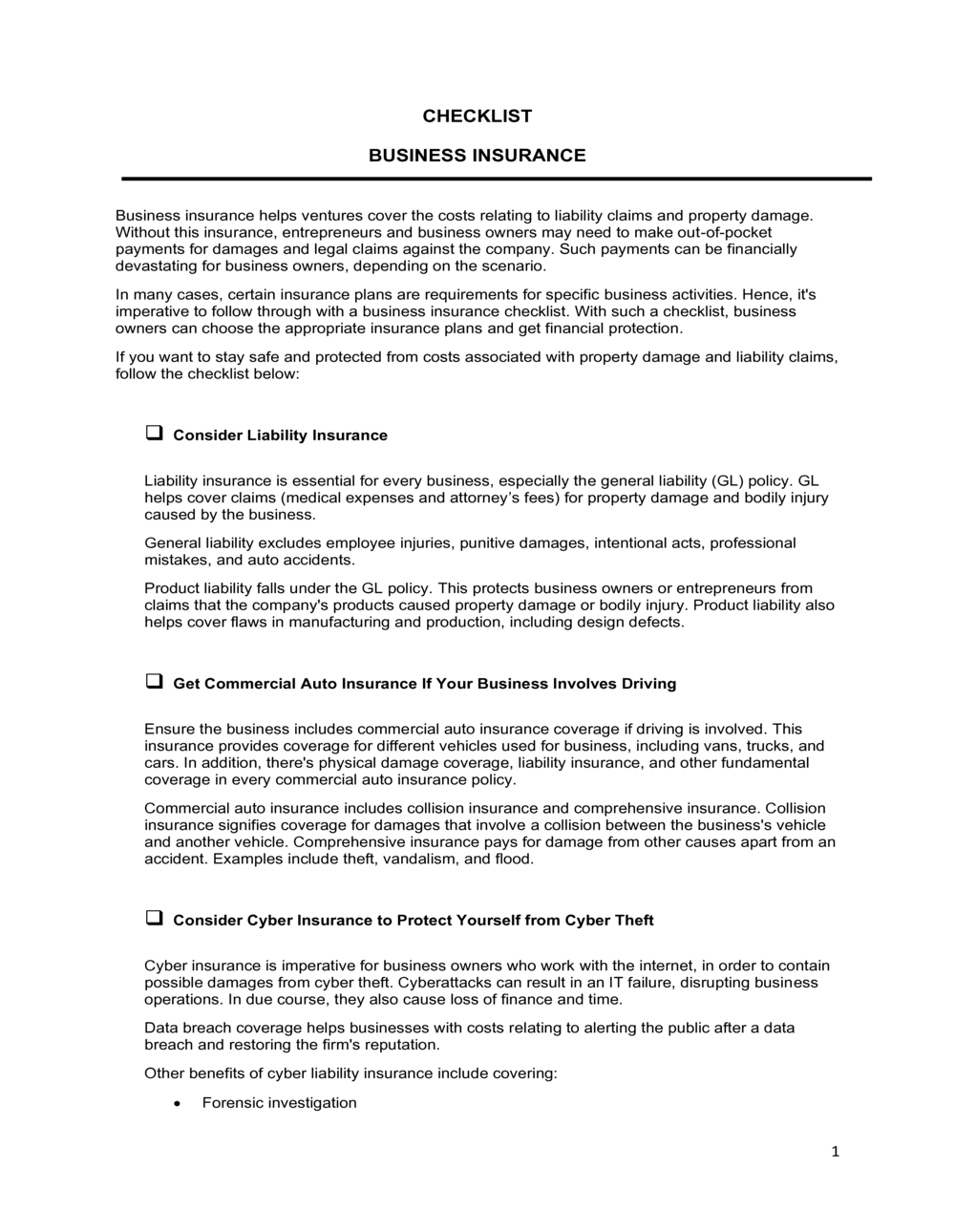
Checklist Business Insurance

Free download β€’ Use as a template β€’ Print or share

3 pagesβ€’20–25 min to useβ€’Difficulty: Standard
Learn more ↓
FreeChecklist Business Insurance Template

At a glance

What it is
A Business Insurance Checklist is a structured form that helps business owners and operations managers track every insurance policy the company holds or needs β€” including policy type, provider, coverage limits, premium, and renewal date β€” in a single reference document. This free Word download is ready to edit online and export as PDF for annual reviews, lender submissions, or risk management audits.
When you need it
Use it during annual policy renewals, when onboarding a new insurance broker, when a lender or landlord requires proof of coverage, or when auditing your risk exposure after a business expansion or new hire.
What's inside
Policy type categories, insurer and broker contact details, policy numbers, coverage limits, deductibles, annual premium, renewal dates, and a notes column for pending actions or coverage gaps identified during review.

What is a Business Insurance Checklist?

A Business Insurance Checklist is a structured reference form that helps business owners and operations managers inventory every insurance policy the company holds or needs β€” recording policy type, insurer, policy number, coverage limits, deductible, annual premium, and renewal date in a single organized document. Rather than hunting through a filing cabinet at renewal time or during a lease negotiation, you have every critical coverage detail in one place. The checklist also forces a side-by-side comparison of policies required by law, lease, or contract against policies actually held, making coverage gaps visible before they result in an uninsured loss.

Why You Need This Document

Most businesses discover insurance gaps at the worst possible moment β€” when filing a claim, signing a commercial lease, or onboarding a major client who requires proof of coverage. Without a consolidated checklist, it is easy to carry outdated limits that made sense at founding but no longer reflect a business that has added employees, a second location, or a new product line. Lenders and landlords routinely request certificates of insurance on short notice; a checklist means you can respond in minutes rather than spending hours tracking down policy documents. The annual premium review alone typically surfaces opportunities to consolidate policies or adjust limits that save more than the 30 minutes the checklist takes to complete.

Which variant fits your situation?

If your situation is…Use this template
Annual policy renewal review across all coverage typesBusiness Insurance Checklist
Signing a commercial office or retail lease requiring proof of coverageCertificate of Insurance Request Letter
Onboarding a new employee and confirming workers' compensation coverageEmployee Onboarding Checklist
Performing a full business risk assessment beyond insuranceRisk Assessment Template
Tracking vendor and contractor insurance certificates on fileVendor Insurance Compliance Log
Preparing an insurance summary for a business acquisitionDue Diligence Checklist

Common mistakes to avoid

❌ Documenting only held policies, not required ones

Why it matters: A checklist that only lists current policies cannot reveal gaps. If a client contract or lease requires a coverage type you don't hold, you won't catch it until a claim or audit.

Fix: Start the checklist with every policy category that could apply to your business, then mark each as held, not held, or under review.
❌ Recording monthly premiums as annual totals

Why it matters: Understating total insurance cost by a factor of 12 leads to budget shortfalls and inaccurate cost-per-risk comparisons across policy types.

Fix: Always record the annual premium total. Note the payment frequency separately if monthly installments are relevant for cash-flow planning.

❌ Missing additional insured endorsements required by contract

Why it matters: A landlord or client listed as additional insured by contract who is not on the policy can deny your claim or sue for breach of contract when a loss occurs.

Fix: Cross-reference every lease, client agreement, and loan covenant for additional insured requirements and confirm each with the broker before the renewal date.

❌ Not updating the checklist after a business change

Why it matters: A coverage audit done at founding becomes dangerously stale after a new location, new product line, or first employee β€” each of which changes your risk profile materially.

Fix: Schedule a checklist review whenever a major business change occurs β€” not only at annual renewal. Treat it as a living document, not a one-time exercise.

The 9 key fields, explained

Policy type

Insurer and policy number

Coverage limit (per occurrence / aggregate)

Deductible

Annual premium

Policy effective date and renewal date

Required vs. held status

Named insureds and additional insureds

Notes and action items

How to fill it out

  1. 1

    List every policy type your business may need

    Start with the full set of coverage categories β€” general liability, professional liability, commercial property, workers' comp, commercial auto, cyber, umbrella β€” before filtering to what you hold. This forces a required-vs-held comparison rather than only documenting existing policies.

    πŸ’‘ Include policy types you currently lack. A blank 'held' column next to a required coverage type is the most actionable output of the checklist.

  2. 2

    Pull each active policy document and enter the key identifiers

    For each policy, record the insurer's legal name, policy number, and your broker's name and direct phone number. These details are needed immediately in a claims situation.

    πŸ’‘ Save a digital copy of each policy declaration page in the same folder as the checklist β€” retrieval time matters when filing a claim under pressure.

  3. 3

    Record coverage limits, deductibles, and premiums

    Enter both the per-occurrence and aggregate limits for each liability policy. Record the deductible as $0 if none applies. Use the annual premium total, not the installment amount.

    πŸ’‘ Flag any policy where the per-occurrence limit is less than 50% of the aggregate β€” this asymmetry often signals the limit was set too low for the business's current exposure.

  4. 4

    Enter effective and renewal dates for every policy

    Record the policy start date and renewal date. Calculate days until renewal so you can prioritize broker outreach β€” most policies require 30–60 days to renegotiate or switch carriers.

    πŸ’‘ Set a calendar reminder 60 days before each renewal date. Insurers that receive renewal requests late have little incentive to offer competitive terms.

  5. 5

    Check named and additional insured requirements

    Review your commercial lease, client contracts, and loan agreements for additional insured requirements. Confirm each required party is listed on the relevant policy and that the endorsement is documented.

    πŸ’‘ Request an updated certificate of insurance from your broker each time a new additional insured is added β€” the COI is the only proof the requirement has been met.

  6. 6

    Document gaps and assign action items in the notes column

    For every coverage gap or pending task identified, write a specific action item with a deadline and owner. Gaps without actions are just observations β€” they need follow-through to close.

    πŸ’‘ Share the completed checklist with your broker before the next renewal meeting. It frames the conversation around specific gaps rather than a general policy review.

Frequently asked questions

What is a business insurance checklist?

A business insurance checklist is a structured reference document that lists every insurance policy type a business may need, tracks whether each is currently held, and records key policy details β€” insurer, policy number, coverage limits, deductible, premium, and renewal date. It gives business owners and operations managers a single source of truth for managing commercial coverage and identifying gaps before they result in uninsured losses.

What types of insurance should most small businesses carry?

Most small businesses need at minimum: general liability insurance, commercial property insurance (or a BOP combining both), and workers' compensation if they have employees. Service-based businesses typically add professional liability (E&O). Any business with company vehicles needs commercial auto coverage. Businesses handling customer data should consider cyber liability. A standalone umbrella policy extends limits across all underlying policies for a relatively low additional premium.

How often should I review my business insurance coverage?

At a minimum, review your coverage annually at renewal. You should also trigger an unscheduled review after any material business change β€” adding a new location, hiring your first employee, launching a new product or service, signing a significant client contract, or taking on commercial debt. Each of these events changes your risk exposure and may require new or increased coverage.

What is a certificate of insurance and when do I need one?

A certificate of insurance (COI) is a one-page summary issued by your insurer confirming your active coverage types, limits, and policy dates. Landlords require it before granting occupancy, clients often require it before signing contracts, and lenders may require it as a loan condition. Your broker can issue a COI within one to two business days of a request.

What is the difference between a per-occurrence limit and an aggregate limit?

The per-occurrence limit is the maximum your insurer pays for any single claim. The aggregate limit is the maximum it pays across all claims in the policy year. If your general liability policy has a $1M per-occurrence limit and a $2M aggregate, a single $1.5M claim is capped at $1M, and two $1M claims exhaust the aggregate. Both figures matter when assessing whether a policy provides adequate protection for your business's risk profile.

Is a Business Owner's Policy the same as general liability insurance?

No. A Business Owner's Policy (BOP) bundles general liability and commercial property insurance into a single policy, typically at a lower combined premium than purchasing each separately. General liability alone covers third-party injury and property damage claims but does not cover damage to your own business property, equipment, or inventory. A BOP is a practical starting point for most small businesses with a physical location.

Do I need professional liability insurance if I already have general liability?

Yes, if your business provides professional advice or services. General liability covers physical injury and property damage; it does not cover financial losses a client suffers because of an error, omission, or failure to deliver on a professional service. Consultants, designers, accountants, IT professionals, and similar service providers need professional liability (E&O) coverage as a separate policy.

What happens if my business operates without required insurance?

Operating without legally required insurance β€” workers' compensation, for example β€” exposes the business to regulatory fines, stop-work orders, and personal liability for the business owner. Contracts that require proof of coverage can be voided or give the other party grounds to terminate. In the event of an uninsured loss, the business pays out of pocket, which can be financially catastrophic for claims involving injury or property damage.

How this compares to alternatives

vs Risk Assessment Template

A risk assessment template identifies and scores operational, financial, and strategic risks across the business. A business insurance checklist focuses specifically on whether identified risks are covered by insurance policies currently in force. Use the risk assessment to find exposures, then the insurance checklist to confirm coverage against them.

vs Due Diligence Checklist

A due diligence checklist covers the full range of documents and disclosures needed during a business acquisition β€” legal, financial, HR, and operational. The insurance checklist is a subset of that broader review, focused solely on confirming the target company's coverage types, limits, and gaps. In an acquisition context, the insurance checklist feeds into the due diligence file.

vs Business Continuity Plan

A business continuity plan outlines how operations will continue during and after a disruptive event. A business insurance checklist records the financial protection already in place for those events. They are complementary documents β€” continuity planning identifies recovery procedures; insurance coverage funds the recovery.

vs Vendor Insurance Compliance Log

A vendor insurance compliance log tracks certificates of insurance received from third-party suppliers and contractors to confirm they carry required coverage. A business insurance checklist tracks your own company's policies. Both are needed by businesses that hire contractors regularly β€” the checklist covers your exposure; the log covers theirs.

Industry-specific considerations

Professional Services

Professional liability (E&O) is the critical coverage category; checklists help ensure limits keep pace with client contract values and engagement scope.

Construction and Trades

Contractors must track general liability, workers' comp, commercial auto, and builder's risk across multiple active job sites, each with its own additional insured requirements.

Retail and E-commerce

Product liability coverage and commercial property for inventory are the priority categories; online sellers add cyber liability for customer payment data.

Technology / SaaS

Cyber liability, technology E&O, and directors and officers (D&O) coverage are standard requirements; limits must scale with ARR and data volume handled.

Template vs pro β€” what fits your needs?

PathBest forCostTime
Use the templateSmall business owners and operations managers conducting an annual coverage reviewFree30–60 minutes
Template + professional reviewBusinesses expanding to new locations, adding employees, or reviewing coverage after a significant contract win$0–$200 (broker consultation, typically free through your existing broker)1–2 hours including broker call
Custom draftedMulti-entity businesses, regulated industries, or companies preparing for acquisition due diligence$500–$2,000 (risk consultant or commercial insurance specialist)2–5 business days

Glossary

General Liability Insurance
Coverage that pays for third-party bodily injury, property damage, and advertising injury claims arising from your business operations.
Business Owner's Policy (BOP)
A bundled policy combining general liability and commercial property insurance, typically offered at a lower premium than purchasing each separately.
Errors and Omissions (E&O)
Professional liability coverage that pays for claims alleging a service-based business made a mistake or failed to deliver promised results.
Workers' Compensation
Mandatory coverage in most US states that pays medical expenses and lost wages for employees injured on the job.
Commercial Auto Insurance
Coverage for vehicles owned, leased, or regularly used by the business β€” personal auto policies do not cover business use.
Umbrella Policy
Excess liability coverage that kicks in when a primary policy's limit is exhausted, providing an additional layer of protection above the base limit.
Coverage Limit
The maximum dollar amount an insurer will pay for a covered claim β€” stated as a per-occurrence limit and an aggregate annual limit.
Deductible
The amount the business must pay out of pocket before the insurance policy covers the remaining loss.
Renewal Date
The date on which a policy expires and must be renewed or replaced to maintain continuous coverage.
Certificate of Insurance (COI)
A one-page document issued by an insurer summarizing active coverage β€” required by landlords, lenders, and clients as proof of insurance.

Part of your Business Operating System

This document is one of 3,000+ business & legal templates included in Business in a Box.

  • Fill-in-the-blanks β€” ready in minutes
  • 100% customizable Word document
  • Compatible with all office suites
  • Export to PDF and share electronically

Create your document in 3 simple steps.

From template to signed document β€” all inside one Business Operating System.
1
Download or open template

Access over 3,000+ business and legal templates for any business task, project or initiative.

2
Edit and fill in the blanks with AI

Customize your ready-made business document template and save it in the cloud.

3
Save, Share, Send, Sign

Share your files and folders with your team. Create a space of seamless collaboration.

Save time, save money, and create top-quality documents.

β˜…β˜…β˜…β˜…β˜…

"Fantastic value! I'm not sure how I'd do without it. It's worth its weight in gold and paid back for itself many times."

Managing Director Β· Mall Farm
Robert Whalley
Managing Director, Mall Farm Proprietary Limited
β˜…β˜…β˜…β˜…β˜…

"I have been using Business in a Box for years. It has been the most useful source of templates I have encountered. I recommend it to anyone."

Business Owner Β· 4+ years
Dr Michael John Freestone
Business Owner
β˜…β˜…β˜…β˜…β˜…

"It has been a life saver so many times I have lost count. Business in a Box has saved me so much time and as you know, time is money."

Owner Β· Upstate Web
David G. Moore Jr.
Owner, Upstate Web

Run your business with a system β€” not scattered tools

Stop downloading documents. Start operating with clarity. Business in a Box gives you the Business Operating System used by over 250,000 companies worldwide to structure, run, and grow their business.

Start freeΒ Β·Β No credit card required