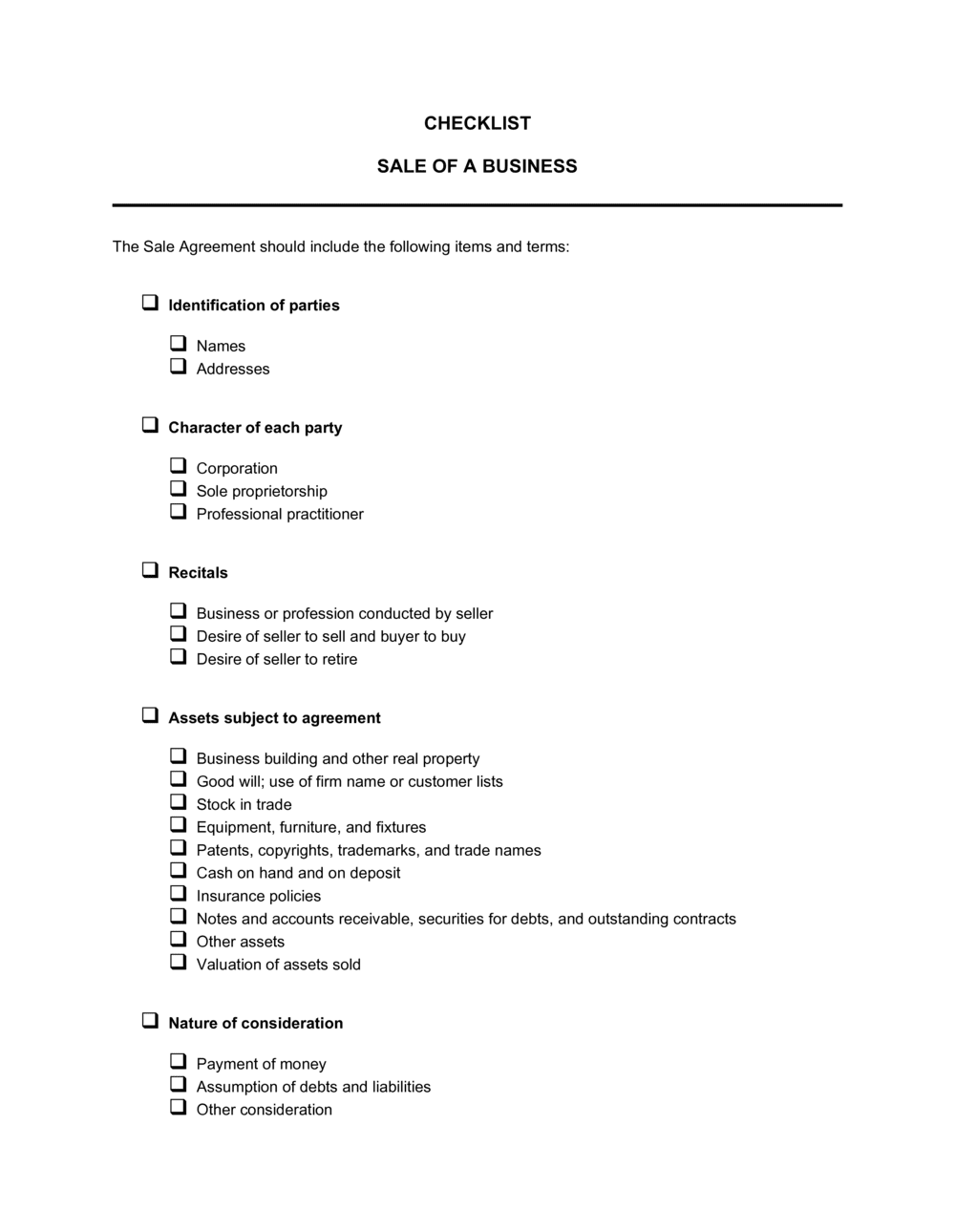
Checklist Sale of a Business

Free download β€’ Use as a template β€’ Print or share

4 pagesβ€’20–25 min to useβ€’Difficulty: Standard
Learn more ↓
FreeChecklist Sale of a Business Template

At a glance

What it is
A Checklist Sale of a Business is a structured form that tracks every task, document, and milestone required to complete the sale of a business from initial preparation through closing. This free Word download lets you assign owners, set target dates, and mark items complete β€” keeping buyers, sellers, and advisors aligned throughout the transaction.
When you need it
Use it as soon as you decide to sell or acquire a business. The checklist ensures nothing is missed during due diligence, contract negotiation, and final closing β€” stages where overlooked items routinely delay or kill deals.
What's inside
Pre-sale preparation tasks, financial and legal document assembly, due diligence item tracking, contract milestones, regulatory and compliance steps, and post-closing obligations β€” all organized into grouped sections with status, owner, and due-date columns.

What is a Checklist Sale of a Business?

A Checklist Sale of a Business is a structured tracking form that organizes every task, document, and milestone required to complete a business sale β€” from initial preparation and financial document assembly through due diligence, contract negotiation, closing, and post-closing obligations. Each item includes a status indicator, an assigned owner, and a target due date so that all parties involved β€” seller, buyer, broker, attorney, and accountant β€” are working from a single shared record of what has been done and what remains outstanding.

Why You Need This Document

Business sales involve dozens of interdependent tasks across multiple advisors, and a single missed item β€” an unassigned contract, an unresolved lien, or a license that cannot be transferred β€” can delay closing by weeks or kill a deal entirely. Without a formal checklist, sellers lose track of which documents have been delivered, buyers lose visibility into outstanding requests, and closing day becomes a scramble rather than a formality. This template gives every party a clear, current picture of the transaction's status at any point in the process, compresses the timeline by preventing repetitive document requests, and creates a permanent record of what was disclosed and when β€” reducing the risk of post-closing disputes.

Which variant fits your situation?

If your situation is…Use this template
Selling a small business with fewer than 10 employeesChecklist Sale of a Business (Simple)
Buying an existing business and running buyer-side diligenceBusiness Acquisition Checklist
Preparing the formal purchase contractBusiness Purchase Agreement
Establishing the initial offer and deal termsLetter of Intent (Business Purchase)
Valuing the business before listingBusiness Valuation Report
Transferring specific assets rather than the entire entityAsset Purchase Agreement
Retaining the seller in the business post-closingSeller Consulting Agreement

Common mistakes to avoid

❌ Starting without organized financial records

Why it matters: Buyers and their accountants will request 3 years of financial statements in the first week of diligence. Disorganized records signal risk and can reduce the offered purchase price.

Fix: Assemble CPA-reviewed financials, tax returns, and a current balance sheet before accepting any LOI or entering formal diligence.
❌ Ignoring contract assignability before signing an LOI

Why it matters: Key customer, supplier, or lease agreements that require consent to assign can block closing entirely if the third party withholds consent at the last moment.

Fix: Review all material contracts for assignment restrictions during pre-sale prep β€” not during diligence β€” and resolve issues before they become deal killers.

❌ No formal credentials and access handover list

Why it matters: Missing domain logins, bank signatories, or software licenses after closing generate expensive disputes and can leave the buyer unable to operate the business.

Fix: Add every login, credential, and access item to the closing task log with a specific handover date and confirmation signature from the buyer.

❌ Treating the checklist as complete after closing

Why it matters: Post-closing obligations β€” earn-out reporting, transition consulting, indemnification claims, and non-compete enforcement β€” can extend for 1–3 years and carry real financial consequences.

Fix: Keep the checklist active after closing with a dedicated post-closing section tracking all ongoing obligations, their deadlines, and responsible parties.

The 9 key fields, explained

Pre-sale preparation tasks

Financial document assembly

Legal document assembly

Due diligence tracking

Regulatory and compliance items

Contract and negotiation milestones

Employee and HR considerations

Closing task log

Post-closing obligations

How to fill it out

  1. 1

    Enter the transaction details at the top

    Fill in the business name, buyer and seller names, anticipated closing date, and the deal broker or advisor coordinating the process.

    πŸ’‘ Set the anticipated closing date conservatively β€” most business sales take 3–6 months from LOI to close, even for straightforward deals.

  2. 2

    Assign an owner to every task

    For each checklist item, enter the name or role responsible β€” seller, buyer, attorney, accountant, or broker. Unassigned items are the most common source of missed deadlines.

    πŸ’‘ Use role names rather than personal names for tasks shared across deals β€” this makes the template reusable without editing.

  3. 3

    Set target due dates for each section

    Work backward from the target closing date to assign realistic due dates for each phase β€” pre-sale prep, due diligence, negotiation, and closing.

    πŸ’‘ Add 10–15 business days of buffer to the due diligence section β€” buyer requests almost always expand beyond the initial scope.

  4. 4

    Check off items as they are completed

    Mark each item with the completion date and the name of the person who confirmed it. Do not mark items complete until all supporting documents have been delivered and acknowledged.

    πŸ’‘ For due diligence items, note the data room folder or email thread reference alongside the completion date so documents can be located quickly during disputes.

  5. 5

    Log open issues and blockers

    Use the notes column to flag any item that is incomplete, contested, or waiting for a third party β€” and the date it was escalated.

    πŸ’‘ Review open issues at least weekly with all parties β€” stale items at the bottom of a checklist are how deals fall apart in the final two weeks.

  6. 6

    Review the closing task log the day before closing

    Walk through every closing-day item the afternoon before the scheduled closing to confirm all documents are executed, funds are confirmed in escrow, and access credentials are ready to transfer.

    πŸ’‘ Print or share a PDF of the completed checklist at closing β€” it serves as a record of what was delivered and forms part of the closing binder.

Frequently asked questions

What is a checklist for the sale of a business?

A business sale checklist is a structured form that tracks every task, document, and milestone required to complete a business sale from initial preparation through closing and post-closing obligations. It assigns owners, due dates, and completion status to each item so that buyers, sellers, and advisors stay aligned throughout a transaction that typically spans 3–6 months.

What documents are typically required when selling a business?

The core document set includes 3 years of financial statements and tax returns, a current balance sheet, accounts receivable and payable aging reports, an inventory list, all active customer and supplier contracts, lease agreements, business licenses and permits, IP registrations, and a summary of any pending litigation. The buyer's attorney and accountant will request additional items during formal due diligence.

How long does the sale of a business typically take?

Most small to mid-size business sales take 3–9 months from the initial listing to closing. Simple asset sales with clean financials can close in 60–90 days; transactions involving real estate, regulated industries, or complex earn-out structures can exceed 12 months. A checklist helps compress the timeline by preventing the document-request loops that cause most delays.

What is due diligence in a business sale?

Due diligence is the buyer's formal investigation of the business before committing to a final purchase price and closing. It covers financial records, legal contracts, IP ownership, employee agreements, regulatory compliance, and any pending litigation. The seller's ability to respond quickly and completely to due diligence requests is one of the strongest signals of business quality β€” and a well-prepared checklist makes that possible.

Do I need a lawyer to sell a business?

For any business sale involving a purchase agreement, asset transfers, IP assignment, or employee obligations, legal review is strongly recommended even if not legally required. A business sale checklist helps you organize the process and identify what needs to be prepared β€” but the purchase agreement, representations and warranties, and any non-compete clauses should be reviewed by a qualified business attorney.

What is the difference between an asset sale and a stock sale?

In an asset sale, the buyer purchases specific assets and liabilities of the business rather than the legal entity itself. In a stock sale, the buyer acquires ownership of the entire entity, including all assets and liabilities. Asset sales are more common for small businesses and give buyers a cleaner liability profile. Stock sales are more common for larger deals where customer contracts, licenses, or continuity of entity is important.

What post-closing obligations should the seller expect?

Common post-closing obligations include a transition consulting period (typically 30–90 days), earn-out reporting if part of the price is contingent on future performance, a non-compete restriction (commonly 1–3 years), indemnification obligations for pre-closing liabilities, and final tax filings for the business entity. The post-closing section of the checklist tracks all of these with specific deadlines.

Can I use this checklist for buying a business as well as selling?

Yes. While the checklist is organized from the seller's perspective, the due diligence and closing sections are equally useful for buyers tracking their own information requests, review tasks, and closing obligations. Buyers can adapt the owner column to reflect their advisors and add buyer-specific tasks such as financing confirmation and lender approval milestones.

How this compares to alternatives

vs Business Purchase Agreement

A Business Purchase Agreement is the binding legal contract that governs the terms of the sale β€” price, representations, indemnification, and closing conditions. The sale checklist is the project-management tool that ensures every step required to reach that agreement β€” and execute it β€” is completed on time. You need both: the checklist to manage the process, the agreement to legally document the deal.

vs Letter of Intent to Purchase a Business

A Letter of Intent outlines the proposed deal terms before a formal agreement is drafted. It is typically one of the first milestones on the sale checklist, not a substitute for it. The checklist tracks the dozens of tasks that must happen between LOI execution and final closing.

vs Asset Purchase Agreement

An Asset Purchase Agreement covers the specific terms for transferring named assets rather than an entire entity. The business sale checklist applies equally to asset and stock transactions, but the legal document assembly and closing task sections must be tailored to reflect which assets are transferring and which liabilities remain with the seller.

vs Due Diligence Checklist

A standalone due diligence checklist focuses exclusively on the buyer's investigation phase β€” document requests, review status, and open questions. The business sale checklist covers the entire transaction lifecycle from pre-sale prep through post-closing obligations, making it the broader project-management document that contains the due diligence phase as one section.

Industry-specific considerations

Professional Services

Client contract assignability and non-solicitation terms are the most critical diligence items given that revenue often follows key individuals rather than the entity.

Retail and E-commerce

Inventory count and valuation, supplier agreement transfers, and point-of-sale system credential handover are high-priority closing tasks.

Food and Beverage

Health permits and food-service licenses are typically non-transferable and require the buyer to apply separately well before the target closing date.

Manufacturing

Equipment condition records, environmental compliance documentation, and warranty or service contract transfers are unique diligence priorities for manufacturing transactions.

Template vs pro β€” what fits your needs?

PathBest forCostTime
Use the templateBusiness owners, brokers, and advisors managing a straightforward small-business saleFree30 minutes to set up; ongoing updates throughout the deal
Template + professional reviewTransactions involving complex earn-outs, regulated industries, or multiple advisors who need a shared tracking tool$200–$500 for a broker or advisor to customize and manage the checklist1–2 hours of setup plus weekly review meetings
Custom draftedMid-market M&A transactions with dedicated deal teams, data rooms, and formal project management requirements$1,000–$5,000+ for a law firm or M&A advisor to build and manage a transaction checklistOngoing management throughout a 6–12 month deal process

Glossary

Due Diligence
The buyer's investigation of the seller's financial, legal, and operational records before finalizing a purchase.
Letter of Intent (LOI)
A non-binding document that outlines the key terms of a proposed business sale before a formal purchase agreement is drafted.
Purchase Price Allocation
The process of assigning portions of the total sale price to specific assets or goodwill for tax and accounting purposes.
Representations and Warranties
Statements of fact made by the seller (and sometimes buyer) in a purchase agreement that confirm the accuracy of disclosed information.
Earnout
A post-closing payment to the seller that is contingent on the business achieving defined revenue or profit targets after the sale.
Encumbrance
Any lien, mortgage, security interest, or claim against a business asset that must be resolved before ownership can transfer cleanly.
Escrow
Funds or documents held by a neutral third party until all closing conditions are met and the transaction is finalized.
Non-Compete Agreement
A post-sale restriction preventing the seller from starting or joining a competing business within a defined time and geographic area.
Closing Conditions
Specific requirements β€” regulatory approvals, financing confirmation, document delivery β€” that both parties must satisfy before the sale can close.
Bill of Sale
A document that formally transfers ownership of specific business assets from seller to buyer at closing.

Part of your Business Operating System

This document is one of 3,000+ business & legal templates included in Business in a Box.

  • Fill-in-the-blanks β€” ready in minutes
  • 100% customizable Word document
  • Compatible with all office suites
  • Export to PDF and share electronically

Create your document in 3 simple steps.

From template to signed document β€” all inside one Business Operating System.
1
Download or open template

Access over 3,000+ business and legal templates for any business task, project or initiative.

2
Edit and fill in the blanks with AI

Customize your ready-made business document template and save it in the cloud.

3
Save, Share, Send, Sign

Share your files and folders with your team. Create a space of seamless collaboration.

Save time, save money, and create top-quality documents.

β˜…β˜…β˜…β˜…β˜…

"Fantastic value! I'm not sure how I'd do without it. It's worth its weight in gold and paid back for itself many times."

Managing Director Β· Mall Farm
Robert Whalley
Managing Director, Mall Farm Proprietary Limited
β˜…β˜…β˜…β˜…β˜…

"I have been using Business in a Box for years. It has been the most useful source of templates I have encountered. I recommend it to anyone."

Business Owner Β· 4+ years
Dr Michael John Freestone
Business Owner
β˜…β˜…β˜…β˜…β˜…

"It has been a life saver so many times I have lost count. Business in a Box has saved me so much time and as you know, time is money."

Owner Β· Upstate Web
David G. Moore Jr.
Owner, Upstate Web

Run your business with a system β€” not scattered tools

Stop downloading documents. Start operating with clarity. Business in a Box gives you the Business Operating System used by over 250,000 companies worldwide to structure, run, and grow their business.

Start freeΒ Β·Β No credit card required