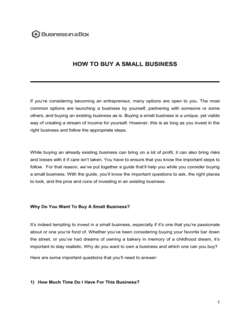
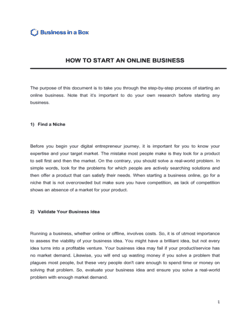
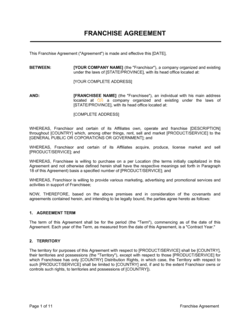
Worksheet_Franchise Comparison

Free download • Use as a template • Print or share

1 page20–30 min to useDifficulty: StandardSignature requiredLegal review recommended
Learn more ↓
FreeWorksheet_Franchise Comparison Template

At a glance

What it is
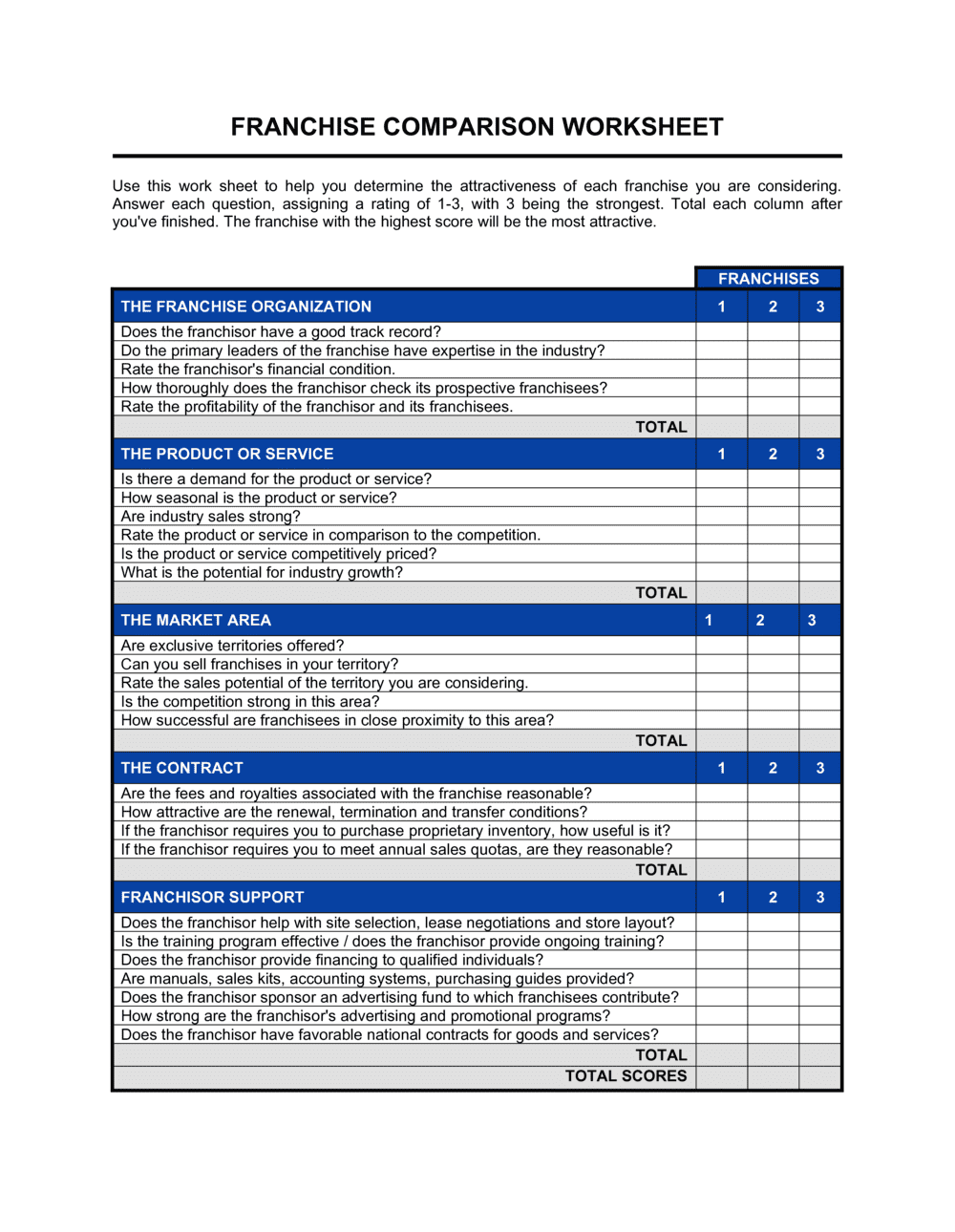
A Franchise Comparison Worksheet is a structured legal evaluation document that allows prospective franchisees to systematically compare multiple franchise opportunities across financial, operational, legal, and support criteria before committing to a franchise agreement. This free Word download provides a standardized side-by-side framework you can edit online and export as PDF to support due diligence, advisor review, and final franchisor negotiations.
When you need it
Use it when you are actively evaluating two or more franchise opportunities and need a documented, defensible basis for your selection decision — particularly before signing a Franchise Disclosure Document (FDD) or franchise agreement. It is also appropriate when applying for SBA franchise financing, where lenders expect evidence of comparative due diligence.
What's inside
Franchisor identification and background, initial investment and fee breakdown, royalty and marketing fund obligations, territory rights and exclusivity terms, training and ongoing support assessment, financial performance representations, franchisee validation data, and a weighted scoring matrix for final comparison across candidates.

What is a Franchise Comparison Worksheet?

A Franchise Comparison Worksheet is a structured legal evaluation document that enables prospective franchisees to assess and compare multiple franchise opportunities side by side across standardized financial, operational, and legal criteria before signing any binding agreement. It captures data drawn directly from each franchisor's Franchise Disclosure Document — fees, territory rights, training commitments, financial performance representations, and franchisee validation findings — and organizes that data into a weighted scoring matrix that produces a documented, defensible selection decision. Unlike informal research notes or a simple spreadsheet, a properly completed worksheet creates a due-diligence record that supports lender applications, attorney review, and franchisor negotiations.

Why You Need This Document

Selecting a franchise without a structured comparison document is one of the most common and costly errors in franchise acquisition. Buyers who rely on sales presentations and brand impressions rather than FDD data routinely underestimate total startup costs, overlook territory carve-outs that allow franchisor competition within their own market, and project median unit revenue from day one — a combination that produces undercapitalization and early-stage cash-flow shortfalls. SBA lenders increasingly expect evidence of comparative due diligence before approving franchise loans, and franchise attorneys cannot perform an effective review without knowing which specific terms the buyer found acceptable or concerning across candidates. This worksheet provides the structured foundation for all of those conversations — turning what is often an emotionally driven decision into an evidence-based one that holds up to scrutiny from advisors, lenders, and ultimately, the franchisee themselves once operations begin.

Which variant fits your situation?

If your situation is…Use this template
Comparing two or three franchise opportunities before making an offerWorksheet Franchise Comparison
Reviewing FDD disclosures received from a franchisorFranchise Disclosure Document Review Checklist
Formalizing the agreement after selecting a franchiseFranchise Agreement
Evaluating territory rights and exclusivity termsTerritory and Exclusivity Agreement
Applying for SBA financing to fund the franchise purchaseSBA Loan Business Plan
Documenting the ongoing relationship with a selected franchisorFranchise Operations Manual Template
Assessing the value of an existing franchise unit for resaleBusiness Valuation Worksheet

Common mistakes to avoid

❌ Comparing only the initial franchise fee

Why it matters: The franchise fee is typically 10–20% of total startup costs. Buyers who focus on it miss the full capital commitment and routinely enter agreements undercapitalized.

Fix: Always build the full Item 7 cost model before comparing candidates. Use the high-end estimate plus a 10% contingency as your planning number.

❌ Ignoring the effective total fee rate

Why it matters: A franchise with a lower royalty but higher marketing and technology fees can cost more annually than a higher-royalty competitor — a difference of $8,000–$15,000 per year on a $600K revenue unit.

Fix: Calculate the combined royalty plus all recurring fees as a single effective percentage of gross sales for each candidate, then compare that number — not the royalty rate alone.

❌ Contacting only franchisor-provided references

Why it matters: Franchisors curate reference lists to include satisfied operators. Validation calls limited to these contacts routinely miss systemic operational problems, support failures, and earnings shortfalls.

Fix: Pull the full franchisee roster from the FDD and contact a random or geographically diverse sample of at least five current franchisees plus two to three former franchisees.

❌ Treating Item 19 median AUV as a guaranteed floor

Why it matters: A system median of $800K AUV can mask a bottom quartile of $350K — and new units typically take 18–36 months to reach median performance. Projecting median revenue from Year 1 produces a cash flow shortfall that destroys early-stage operations.

Fix: Model Year 1 and Year 2 projections at 50–60% of the Item 19 median. Only project median or above from Year 3 onward, and stress-test even that assumption against the bottom-quartile figure.

❌ Skipping the renewal and exit terms review

Why it matters: A 10-year franchise agreement that renews only on the franchisor's then-current terms can expose a successful franchisee to substantially higher fees or materially reduced territory rights at renewal — effectively resetting the economics of a business they built.

Fix: Read and record renewal conditions, transfer fees, and right-of-first-refusal provisions for every candidate before completing the worksheet scoring.

❌ Completing the scoring matrix after franchisor sales presentations

Why it matters: Anchoring bias from an enthusiastic discovery day or sales call measurably inflates scores on subjective criteria — buyers systematically overrate the last brand they visited.

Fix: Set your criterion weights and complete the independent scoring rows from FDD data and validation calls before attending any franchisor-hosted events.

The 10 key clauses, explained

Franchisor identification and background

In plain language: Records the full legal name of the franchisor entity, years in operation, number of units open and in development, and any litigation or bankruptcy history disclosed in the FDD.

Sample language
Franchisor: [FRANCHISOR LEGAL NAME] | Founded: [YEAR] | Total units: [X] (franchised: [X], corporate: [X]) | FDD Item 3 litigation disclosures: [SUMMARY OR NONE] | Bankruptcy history (FDD Item 4): [YES/NO — DETAIL IF YES]

Common mistake: Recording only the brand name rather than the legal franchisor entity. Franchise agreements bind the legal entity, and discrepancies between brand and entity names are a common source of enforcement disputes.

Initial investment and total cost breakdown

In plain language: Captures the full range of startup costs from FDD Item 7 — initial franchise fee, build-out, equipment, inventory, working capital, and any other required outlays — to determine the total investment needed before opening.

Sample language
Initial franchise fee: $[X] | Build-out/leasehold: $[LOW]–$[HIGH] | Equipment/fixtures: $[LOW]–$[HIGH] | Initial inventory: $[X] | Working capital (3 months): $[X] | Total estimated investment: $[LOW]–$[HIGH]

Common mistake: Using only the initial franchise fee as a proxy for total investment. FDD Item 7 ranges can vary by a factor of 3× between low and high estimates — failing to model the high end leaves buyers undercapitalized at opening.

Ongoing fee structure

In plain language: Documents the royalty rate, marketing fund contribution, technology fees, and any other recurring charges expressed as a percentage of gross sales or a flat weekly/monthly amount.

Sample language
Royalty: [X]% of gross sales, due [WEEKLY/MONTHLY] | Marketing fund: [X]% of gross sales | Technology/POS fee: $[X]/month | Other recurring fees: [DESCRIPTION AND AMOUNT]

Common mistake: Comparing royalty rates in isolation without adding all recurring fees. A brand with a 5% royalty but a 3% marketing fund and a $500/month technology fee has a higher effective cost than a competitor charging a flat 7% royalty.

Territory rights and exclusivity

In plain language: Specifies whether the franchisee receives an exclusive territory, how it is defined (radius, ZIP codes, population count), and any carve-outs that allow the franchisor to sell through alternative channels within the territory.

Sample language
Territory: [DESCRIPTION — ZIP CODES / RADIUS / COUNTY] | Exclusivity: [EXCLUSIVE / NON-EXCLUSIVE / PROTECTED] | Carve-outs: [E.G., online sales, corporate accounts, alternative channels] | Encroachment remedy: [CONTRACT PROVISION OR NONE]

Common mistake: Accepting a 'protected' territory without reading the carve-out language. Many franchisors reserve the right to sell through third-party delivery platforms, corporate channels, or adjacent brand units within a franchisee's territory.

Training and support assessment

In plain language: Records the initial training program (format, duration, location, cost responsibility), ongoing field support frequency, technology and marketing assistance, and franchisor staffing levels per franchisee.

Sample language
Initial training: [X] days at [LOCATION], cost: [INCLUDED / $X ADDITIONAL] | Ongoing field visits: [FREQUENCY] | Dedicated support contact: [YES/NO] | Franchisee-to-support-staff ratio: [X:1] | Tech/marketing tools provided: [LIST]

Common mistake: Accepting the franchisor's training overview at face value without asking existing franchisees to rate support quality during validation calls. Disclosed support and delivered support frequently differ.

Financial performance representations (FDD Item 19)

In plain language: Records whether the franchisor provides earnings data, what the data covers (gross sales, net income, or both), the sample size, and any material conditions or exclusions that limit comparability.

Sample language
Item 19 provided: [YES/NO] | Data type: [GROSS SALES / NET INCOME / AUV] | Median AUV: $[X] | Sample: [X] units, [X]% of total system | Exclusions: [CORPORATE UNITS / FIRST-YEAR UNITS / OTHER]

Common mistake: Treating an Item 19 median as a guaranteed earnings floor. Medians mask wide variance between top and bottom performers — always request the full distribution range if available.

Franchisee satisfaction and validation data

In plain language: Summarizes findings from direct conversations with current and former franchisees, including satisfaction with franchisor support, profitability timeline, and any recurring operational complaints.

Sample language
Franchisees contacted: [X] | Overall satisfaction rating (1–10): [X] | % who would buy again: [X]% | Common positives: [SUMMARY] | Common concerns: [SUMMARY] | Former franchisees contacted: [X] — reason for exit: [SUMMARY]

Common mistake: Contacting only the franchisee references provided by the franchisor. Franchisors curate reference lists — independently sourcing contacts from the FDD's franchisee roster produces more candid feedback.

Renewal, transfer, and exit terms

In plain language: Documents the initial term length, renewal conditions and fees, transfer fee and approval process, and any right-of-first-refusal or repurchase provisions the franchisor holds.

Sample language
Initial term: [X] years | Renewal: [X] additional terms of [X] years each, fee: $[X] | Transfer fee: $[X] or [X]% of sale price | Franchisor right of first refusal: [YES/NO] | Termination for cause provisions: [SUMMARY]

Common mistake: Overlooking the requirement to sign the franchisor's then-current franchise agreement upon renewal. Updated agreements can materially change royalty rates, territory definitions, and technology fee obligations from the original terms.

Net worth, liquidity, and financing requirements

In plain language: Records the minimum net worth and liquid capital thresholds required for franchisee approval, any preferred or required financing sources, and the buyer's actual financial position against these benchmarks.

Sample language
Minimum net worth required: $[X] | Minimum liquid capital required: $[X] | Buyer's current net worth: $[X] | Buyer's liquid capital: $[X] | Gap/surplus: $[X] | Preferred lenders or SBA eligibility: [YES/NO — LENDER NAME]

Common mistake: Applying to franchises where liquid capital barely meets the minimum. Franchisors approve applicants at or near the minimum, but undercapitalized franchisees have materially higher failure rates in the first 24 months.

Weighted scoring matrix and final recommendation

In plain language: A structured scoring section where each evaluation criterion is assigned a priority weight and each franchise candidate receives a score, producing a weighted total that supports a documented, defensible selection decision.

Sample language
Criterion: [CRITERION NAME] | Weight: [X]% | Franchise A score (1–10): [X] | Franchise B score (1–10): [X] | Weighted score A: [X] | Weighted score B: [X] | Total weighted score A: [X] / 100 | Total weighted score B: [X] / 100 | Recommendation: [FRANCHISE NAME] based on [SUMMARY]

Common mistake: Assigning equal weight to all criteria. A buyer who prioritizes territory exclusivity should weight that criterion at 20–25%, not 10% — equal weighting inflates the scores of franchises that rank high on low-priority factors.

How to fill it out

  1. 1

    Gather FDDs from each franchise under consideration

    Request the current Franchise Disclosure Document from each franchisor under evaluation. In the US, franchisors must provide it at least 14 days before any agreement is signed. Review Items 5–7 (fees), 12 (territory), 19 (earnings), and 21 (financials) before completing the worksheet.

    💡 Request FDDs directly from the franchisor's legal or development team — not through a sales representative — to ensure you receive the most current version registered with applicable state authorities.

  2. 2

    Complete the franchisor background section for each candidate

    Enter the legal entity name, founding year, total and franchised unit counts, and any litigation or bankruptcy disclosures from FDD Items 3 and 4. Note the trend in unit openings and closings over the past three years.

    💡 A system losing more than 5% of units per year through closures or non-renewals is a material red flag — FDD Item 20 shows unit transfer, termination, and non-renewal data by year.

  3. 3

    Build the total investment comparison from FDD Item 7

    Record low and high estimates for every cost category listed in Item 7, not just the franchise fee. Sum all categories to derive the total investment range for each candidate. Model the high estimate as your planning baseline.

    💡 Add 10–15% to the Item 7 high estimate as a contingency buffer — build-out costs and working capital needs routinely exceed FDD projections, especially in inflationary environments.

  4. 4

    Calculate and compare effective ongoing fee rates

    Add royalty rate, marketing fund contribution, technology fees, and any other recurring charges to derive an effective total fee rate as a percentage of gross sales for each franchise. Use this rate — not the royalty alone — for fee comparisons.

    💡 A 1% difference in effective ongoing fees on $500K annual revenue equals $5,000 per year — compounded over a 10-year term, fee structure matters more than the initial franchise fee.

  5. 5

    Analyze Item 19 financial performance data

    For each franchise that provides an Item 19, record median AUV (average unit volume), the range from bottom to top quartile, sample size, and any exclusions. Calculate an estimated pre-royalty and post-royalty revenue range for a new unit.

    💡 Ask franchisors who do not provide an Item 19 to explain why — some decline for liability reasons, but others simply have unfavorable unit economics they prefer not to disclose.

  6. 6

    Conduct franchisee validation calls

    Contact at least five current franchisees per candidate — drawn from the full FDD roster, not just the franchisor's recommended list. Ask standardized questions covering profitability timeline, support quality, and whether they would buy again.

    💡 Also contact two to three former franchisees listed in the FDD's transfer and termination table. Their reasons for exit are often more informative than current franchisee endorsements.

  7. 7

    Set criterion weights and score each franchise

    Assign percentage weights to each evaluation criterion based on your personal priorities — territory exclusivity, total investment, brand strength, support quality, Item 19 performance — so weights sum to 100%. Score each franchise candidate on each criterion from 1 to 10, then calculate weighted totals.

    💡 Complete the scoring independently before discussing results with advisors or the franchisor — anchoring bias from a sales conversation can skew your scoring if you complete it after.

  8. 8

    Review findings with a franchise attorney before proceeding

    Present the completed worksheet and FDDs to a franchise attorney who can identify non-standard clauses, unusual carve-outs in the territory section, and renewal terms that differ materially from industry norms.

    💡 A franchise attorney review typically costs $1,500–$3,000 and takes 5–10 business days — budget both into your timeline before any FDD receipt deadline expires.

Frequently asked questions

What is a franchise comparison worksheet?

A franchise comparison worksheet is a structured evaluation document that captures and scores multiple franchise opportunities across standardized criteria — initial investment, ongoing fees, territory rights, training, financial performance, and franchisee satisfaction — in a side-by-side format. It transforms an inherently subjective decision into a documented, weighted analysis that supports due diligence, advisor review, and franchisor negotiations.

Why do I need a formal worksheet instead of just reviewing FDDs?

FDDs are disclosure documents, not comparison tools. A franchise comparison worksheet extracts the decision-relevant data from each FDD and organizes it into a consistent structure so that differences in fee rates, territory scope, and earnings data are immediately visible. Without a structured comparison, buyers systematically overweight the most recent or most enthusiastically presented opportunity — a well-documented bias that a formal worksheet corrects.

What is FDD Item 19 and why does it matter for the worksheet?

FDD Item 19 is the optional section where a franchisor discloses historical financial performance data for existing franchise units — the only legally authorized source of earnings claims under FTC rules. Franchisors are not required to provide it, but those who do give prospective buyers the only objective benchmark for evaluating unit-level revenue and profitability. The worksheet records whether Item 19 is provided, what it covers, and the full performance distribution — not just the median.

How many franchises should I compare using the worksheet?

Two to four franchise candidates is the practical range for a thorough comparison. Fewer than two defeats the purpose of comparative due diligence. More than four dilutes the depth of research on each candidate — FDD review, validation calls, and financial modeling per franchise require 20–40 hours each. A well-scoped shortlist of two to three candidates produces better decisions than a shallow review of six or more.

Do I need a franchise attorney to use this worksheet?

The worksheet itself can be completed independently using FDD data and validation calls. However, a franchise attorney review of the completed worksheet alongside the FDDs is strongly recommended before signing any franchise agreement. Attorneys identify non-standard clauses, unusual territory carve-outs, and renewal terms that a non-specialist buyer is unlikely to recognize as outliers. Legal review typically costs $1,500–$3,000 and takes 5–10 business days.

What financial documents should I review alongside the worksheet?

Review the franchisor's audited financial statements in FDD Item 21 to assess corporate financial health — a financially distressed franchisor cannot sustain the support infrastructure franchisees depend on. Cross-reference Item 19 earnings data against your own pro forma model, and obtain the franchisor's SBA lending registry status if you plan to finance the purchase.

How does a weighted scoring matrix work in the worksheet?

A weighted scoring matrix assigns a percentage importance weight to each evaluation criterion so that the weights sum to 100%. Each franchise candidate is scored 1–10 on each criterion, and the score is multiplied by the weight to produce a weighted score per criterion. Summing all weighted scores for each franchise produces a final weighted total out of 100, which reflects your personal priorities rather than a simple average that treats all criteria as equally important.

Is a franchise comparison worksheet legally binding?

The worksheet itself is an evaluation and due-diligence document, not a binding agreement. It does not commit the buyer to any franchise purchase. The binding obligation arises only upon execution of a franchise agreement, which should not be signed until the FDD receipt waiting period has elapsed and legal review is complete. Retain the completed worksheet as part of your due-diligence record.

What jurisdictions require FDD disclosure before a franchise agreement is signed?

In the United States, FTC Rule 436 requires FDD disclosure at least 14 calendar days before any franchise agreement is signed or payment made. Canada has disclosure requirements at the provincial level, with Ontario, Alberta, British Columbia, and Prince Edward Island each mandating disclosure periods of 14 days. The UK and EU do not have equivalent mandatory pre-sale disclosure requirements, though the European Franchise Federation Code of Ethics recommends 14-day disclosure as best practice.

Can this worksheet be used for international franchise comparisons?

Yes, with modifications. The FDD-specific fields apply only to US-regulated franchises. For Canadian franchises, substitute the provincial disclosure document references. For UK and EU franchises, the equivalent sections capture franchisor-provided disclosure packages and any applicable national franchise association codes. The financial comparison, scoring matrix, and validation sections apply universally regardless of jurisdiction.

How this compares to alternatives

vs Franchise Agreement

A franchise agreement is the binding legal contract executed after a franchise is selected — it governs the rights, obligations, fees, and term of the franchise relationship. The comparison worksheet is a pre-decision due-diligence tool used before any agreement is signed. The worksheet informs and precedes the agreement; the agreement creates the legal relationship.

vs Business Plan Template

A business plan projects the financial and operational performance of a chosen franchise after selection — it is lender-facing and forward-looking. The comparison worksheet is a selection tool used before a choice is made. The worksheet identifies which franchise to pursue; the business plan then models how to operate it successfully.

vs Due Diligence Checklist

A due diligence checklist is a linear list of items to verify about a single business opportunity. A franchise comparison worksheet applies that same diligence across multiple candidates simultaneously, scoring and weighting each against the others. Use a checklist for deep single-target verification and the worksheet for competitive multi-candidate evaluation.

vs Letter of Intent

A letter of intent signals a buyer's preliminary interest in a specific franchise territory or unit and initiates formal negotiation. The comparison worksheet is completed before any LOI is issued — it produces the evidence base that identifies which franchise warrants a letter of intent in the first place.

Industry-specific considerations

Food and Beverage

Build-out and equipment costs dominate the Item 7 comparison, with wide variance between quick-service (lower) and full-service (higher) formats — the worksheet prevents buyers from comparing formats with incompatible cost structures.

Health, Fitness, and Wellness

Membership-based revenue models require the worksheet to capture monthly recurring revenue benchmarks from Item 19 alongside the standard AUV metrics used in transaction-based franchise systems.

Retail and Services

Territory exclusivity and online sales carve-outs are particularly material for retail franchises where the franchisor may compete directly through e-commerce channels within the franchisee's defined geographic area.

Professional and Business Services

Low build-out costs shift the worksheet emphasis to royalty structure, lead-generation support quality, and the franchisor's proprietary technology platform — factors that determine profitability more than capital investment in service-model franchises.

Jurisdictional notes

United States

FTC Rule 436 requires franchisors to provide a Franchise Disclosure Document (FDD) at least 14 calendar days before any franchise agreement is signed or payment collected. Fifteen states have additional registration and filing requirements — California, Maryland, New York, and Illinois among them — and require FDDs to be registered and approved before offering franchises in-state. Item 19 financial performance representations are optional at the federal level but are increasingly standard among larger franchise systems.

Canada

Alberta, Ontario, British Columbia, Prince Edward Island, and New Brunswick each have franchise disclosure legislation mandating a disclosure document and a 14-day waiting period before signing or paying. Quebec does not have a standalone franchise disclosure statute but applies its Civil Code to franchise relationships. Prospective Canadian franchisees should verify which provincial statute applies based on their location and confirm the franchisor has provided a disclosure document compliant with that province's specific requirements.

United Kingdom

The UK has no statutory franchise disclosure law equivalent to the US FDD regime. Franchisors that are members of the British Franchise Association (BFA) are bound by the BFA Code of Ethics, which recommends a pre-sale disclosure period. Prospective franchisees should request a comprehensive disclosure package from any franchisor and have it reviewed by a solicitor experienced in commercial franchise law. The franchise agreement itself is governed by general UK contract and commercial law.

European Union

The EU has no unified franchise disclosure regulation. France requires a pre-contractual information document (DIP) under the Doubin Law at least 20 days before signing. Spain, Belgium, and Italy have their own disclosure requirements at the national level. The European Franchise Federation Code of Ethics recommends 14-day pre-contract disclosure as a best-practice standard across member states. GDPR considerations apply when collecting and processing franchisee personal data during the evaluation and application process.

Template vs lawyer — what fits your deal?

PathBest forCostTime
Use the templateFirst-time franchise buyers conducting initial screening and shortlisting before legal engagementFree10–20 hours across 2–4 weeks of FDD review and validation calls
Template + legal reviewBuyers who have completed the worksheet and are ready to proceed to a specific franchise — attorney reviews FDD, territory clauses, and renewal terms$1,500–$3,0005–10 business days
Custom draftedMulti-unit buyers, international franchise comparisons, or acquisitions of existing franchise units requiring SBA financing and additional legal structuring$3,000–$10,000+2–6 weeks

Glossary

Franchise Disclosure Document (FDD)
A federally mandated disclosure document in the US (and equivalent documents in other jurisdictions) that a franchisor must provide to prospective franchisees at least 14 calendar days before any agreement is signed or money is paid.
Initial Franchise Fee
A one-time upfront payment made to the franchisor upon signing the franchise agreement, granting the franchisee the right to operate under the brand.
Royalty Fee
An ongoing percentage of gross sales paid by the franchisee to the franchisor, typically ranging from 4–12% of revenue, in exchange for continued use of the brand and system.
Marketing Fund Contribution
A mandatory periodic fee, typically 1–4% of gross sales, paid into a franchisor-administered fund used for national or regional brand advertising.
Item 19 (Financial Performance Representation)
The optional FDD section where a franchisor discloses historical or projected financial performance data for existing franchise units — the only legally sanctioned source of earnings claims.
Territory Rights
The geographic area within which a franchisee has the right to operate, which may be exclusive (no competing units), protected, or open depending on the franchise system.
Franchisee Validation
The process of contacting existing franchisees within a system to gather first-hand assessments of profitability, franchisor support quality, and operational realities.
Transfer Fee
A fee charged by the franchisor when a franchisee sells or transfers their franchise unit to a new owner, typically ranging from $5,000 to $25,000 or a percentage of the sale price.
Net Worth and Liquidity Requirements
Minimum financial thresholds — total net worth and liquid assets — that a franchisor requires a prospective franchisee to meet before being approved.
Weighted Scoring Matrix
A structured evaluation tool that assigns relative importance weights to each comparison criterion so that the final score reflects the buyer's actual priorities, not a simple arithmetic average.
Renewal Term
The period for which a franchise agreement may be extended after the initial term expires, and the conditions — fee, updated agreement, remodeling — under which renewal is granted.

Part of your Business Operating System

This document is one of 3,000+ business & legal templates included in Business in a Box.

  • Fill-in-the-blanks — ready in minutes
  • 100% customizable Word document
  • Compatible with all office suites
  • Export to PDF and share electronically

Create your document in 3 simple steps.

From template to signed document — all inside one Business Operating System.
1
Download or open template

Access over 3,000+ business and legal templates for any business task, project or initiative.

2
Edit and fill in the blanks with AI

Customize your ready-made business document template and save it in the cloud.

3
Save, Share, Send, Sign

Share your files and folders with your team. Create a space of seamless collaboration.

Save time, save money, and create top-quality documents.

★★★★★

"Fantastic value! I'm not sure how I'd do without it. It's worth its weight in gold and paid back for itself many times."

Managing Director · Mall Farm
Robert Whalley
Managing Director, Mall Farm Proprietary Limited
★★★★★

"I have been using Business in a Box for years. It has been the most useful source of templates I have encountered. I recommend it to anyone."

Business Owner · 4+ years
Dr Michael John Freestone
Business Owner
★★★★★

"It has been a life saver so many times I have lost count. Business in a Box has saved me so much time and as you know, time is money."

Owner · Upstate Web
David G. Moore Jr.
Owner, Upstate Web

Run your business with a system — not scattered tools

Stop downloading documents. Start operating with clarity. Business in a Box gives you the Business Operating System used by over 250,000 companies worldwide to structure, run, and grow their business.

Start free · No credit card required