1
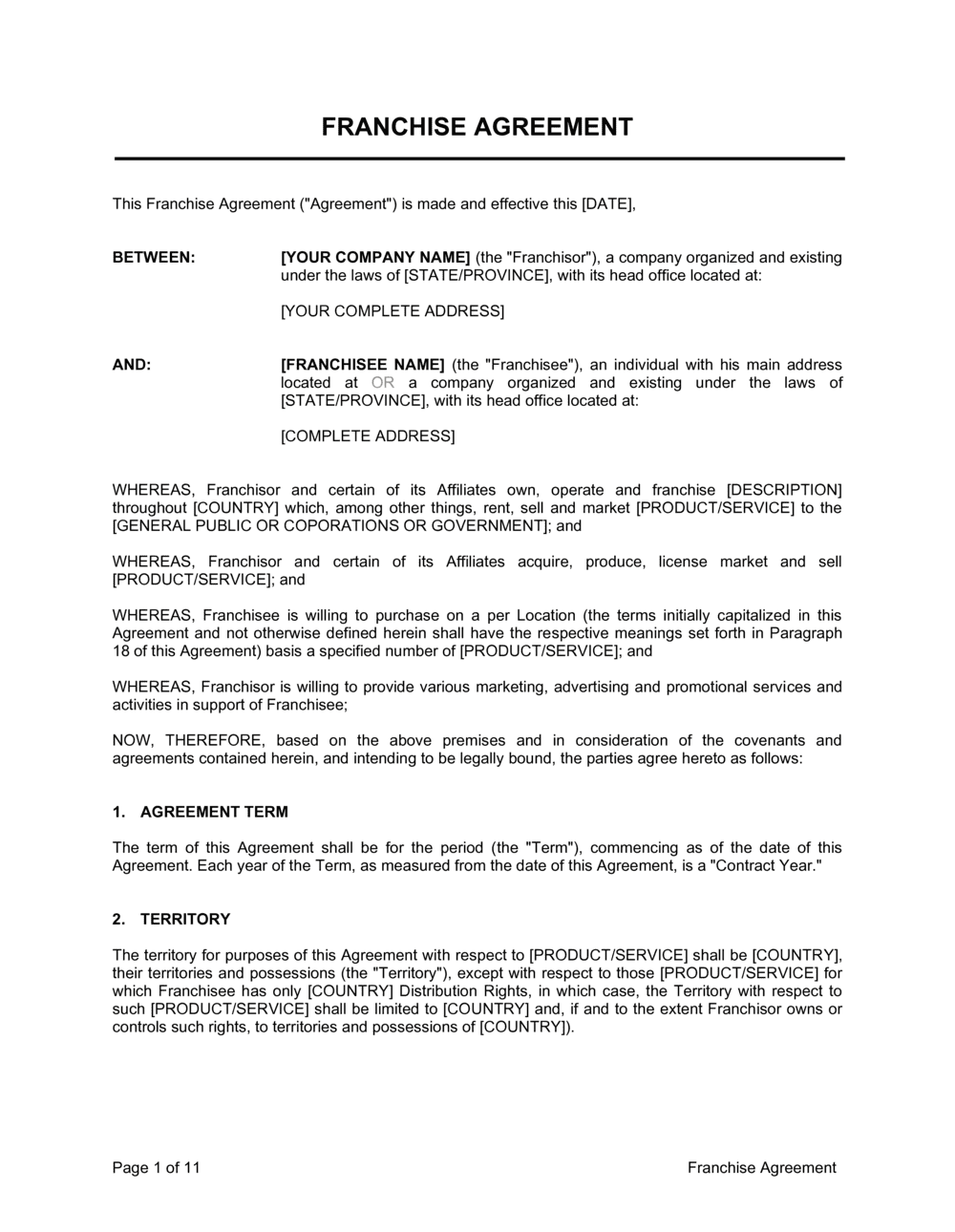
Identify both parties using legal entity names
Enter the franchisor's full registered legal name (not the brand name), the franchisee's legal entity name, and their respective addresses. If the franchisee is an individual rather than an LLC or corporation, note that personal guarantees are typically also required.
💡 Confirm the franchisee has incorporated before signing — most franchisors require the franchisee to operate through a legal entity to limit liability exposure on both sides.
2
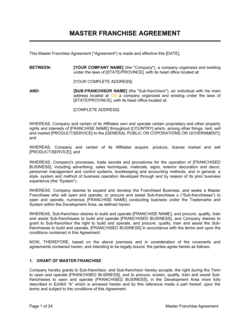
Define the territory precisely
Attach a Schedule A that maps the territory by zip codes, census tracts, city limits, or a defined radius around the approved location. Specify whether the territory is exclusive, protected, or non-exclusive, and whether it covers online orders, catering, or other alternative channels.
💡 Reserve explicit carve-outs for non-traditional venues (airports, stadiums, corporate campuses) even if no such venues are planned — failing to do so limits the franchisor's expansion options later.
3
Set the term, renewal conditions, and approved location
Enter the initial term length, the renewal period, the deadline for providing renewal notice, and the full street address of the approved location. Confirm the then-current-form renewal requirement is present.
💡 Align the franchise term with the franchisee's lease term — a 10-year franchise agreement with a 5-year lease creates a structural problem at renewal.
4
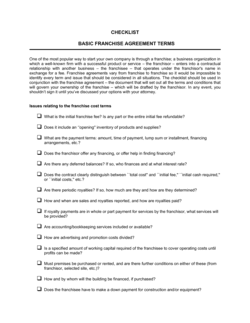
Complete all fee definitions with a single 'Gross Sales' definition
Enter the initial franchise fee amount, the royalty percentage, and the marketing fund contribution percentage. Define Gross Sales once — in a defined-terms section — and cross-reference that single definition in every fee clause.
💡 Gross Sales definitions that exclude online orders, gift card redemptions, or catering revenue consistently lead to underpayment disputes; list every revenue stream explicitly.
5
Specify training deliverables and support commitments
Enter the number of initial training days, location, and maximum attendees covered at the franchisor's cost. List the minimum number of annual field support visits and the franchisor's helpdesk response-time commitment.
💡 Training obligations that are quantified in the agreement are far easier to enforce — and far better marketing tools for recruitment — than vague 'comprehensive training' language.
6
Tailor the post-term non-compete to the actual territory
Set the geographic scope to match or slightly exceed the franchisee's territory. Use a duration of 12–24 months depending on the competitive sensitivity of the business. Confirm the scope is enforceable in the governing jurisdiction before finalizing.
💡 In states or provinces that ban or limit post-employment non-competes for individuals, franchise non-competes may be treated differently — but check jurisdiction-specific case law before relying on that distinction.
7
Confirm disclosure obligations are met before execution
In the US, verify that the FDD has been delivered at least 14 calendar days before signing. In Canada, check province-specific franchise disclosure timelines (14 days in Ontario and Alberta). Attach proof of delivery to your execution file.
💡 Disclosure timing errors are the single most common basis for franchisee rescission claims in registration states — a dated receipt signed by the franchisee is your primary defense.
8
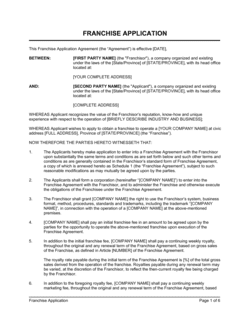
Execute with personal guarantees and notarize if required
Have both parties sign the agreement, attach a personal guarantee from the franchisee's principal owners, and confirm whether your jurisdiction requires notarization of any exhibits. Date the agreement on the actual signing date.
💡 Execute the Operations Manual acknowledgment form simultaneously with the main agreement — this confirms the franchisee received and reviewed the manual before taking on compliance obligations.