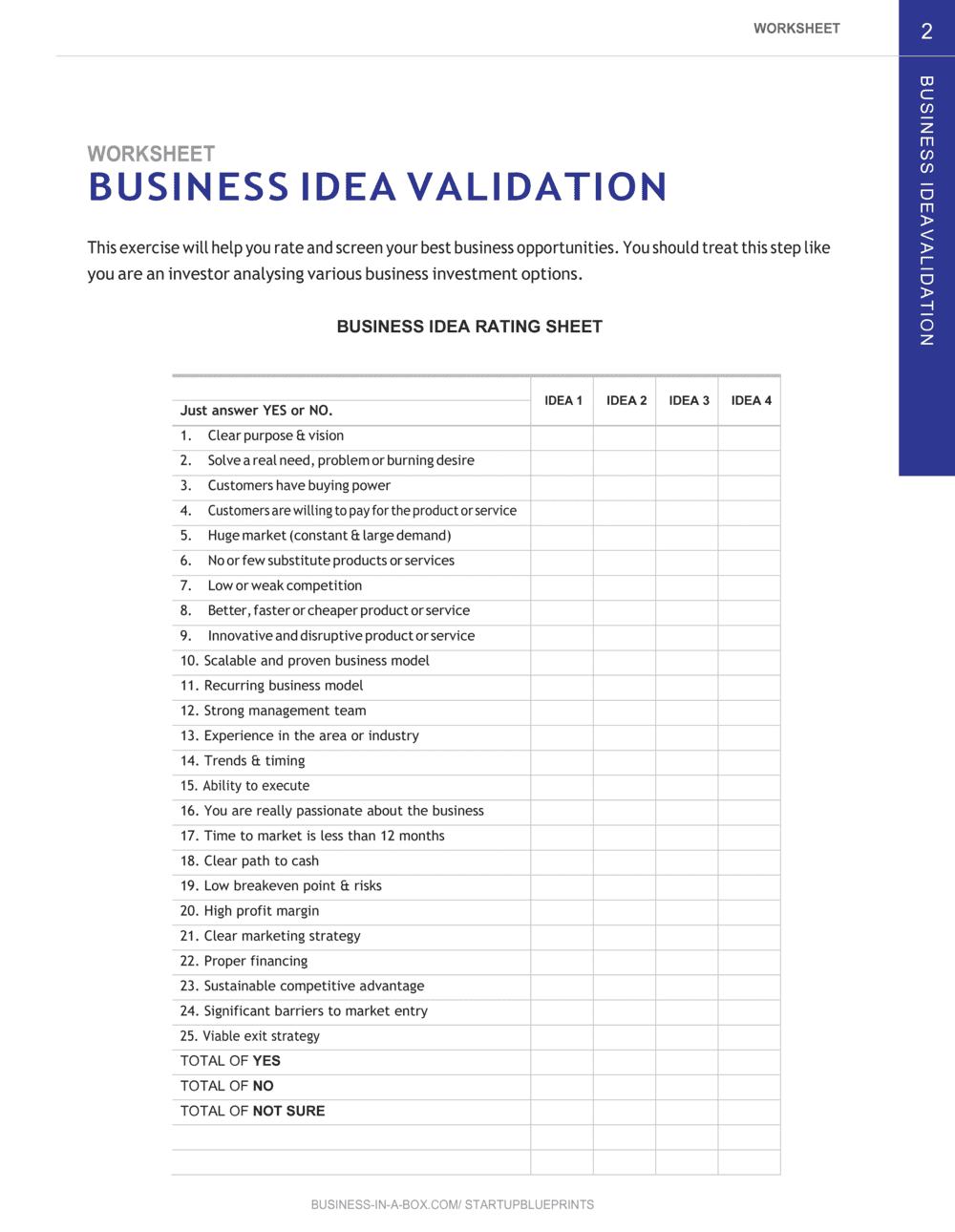
- Idea Validation
- The process of testing core assumptions about a business concept — customer need, market size, and willingness to pay — before investing significant resources.
- Problem-Solution Fit
- Confirmation that a defined group of customers experiences the problem your product or service is designed to solve, and that your proposed solution meaningfully addresses it.
- TAM / SAM / SOM
- Total Addressable Market, Serviceable Addressable Market, and Serviceable Obtainable Market — three nested market-size estimates that quantify realistic opportunity.
- Value Proposition
- A concise statement of the specific benefit a customer receives from your solution, why it is superior to alternatives, and who the intended customer is.
- Minimum Viable Product (MVP)
- The simplest version of a product that delivers enough value to attract early customers and generate actionable feedback.
- Assumption Register
- A documented list of the beliefs underlying a business concept — about customers, pricing, channels, or costs — that have not yet been empirically tested.
- Customer Discovery
- Structured interviews and observations with potential customers to verify that a problem is real, frequent, and worth paying to solve.
- Risk Register
- A table listing identified business risks, their likelihood, potential impact, and planned mitigation actions.
- Revenue Model Hypothesis
- An early-stage, untested prediction of how the business will generate income — subscription, transaction fee, licensing, or another mechanism — subject to revision after customer discovery.
- Co-Founder Acknowledgment
- A signed statement by all founders confirming they have reviewed and agree on the documented assumptions, creating a shared baseline for decision-making.
- Validation Milestone
- A specific, measurable evidence point — such as ten signed letters of intent or one hundred survey responses — that would confirm or refute a key business assumption.