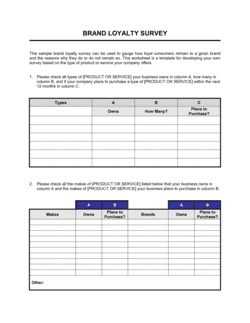
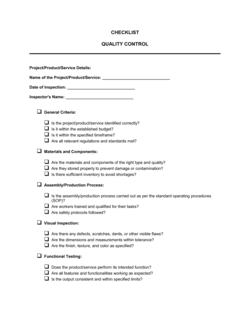
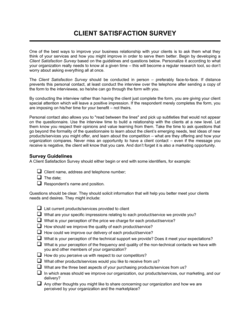
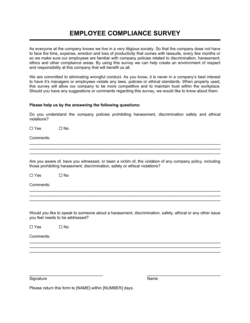
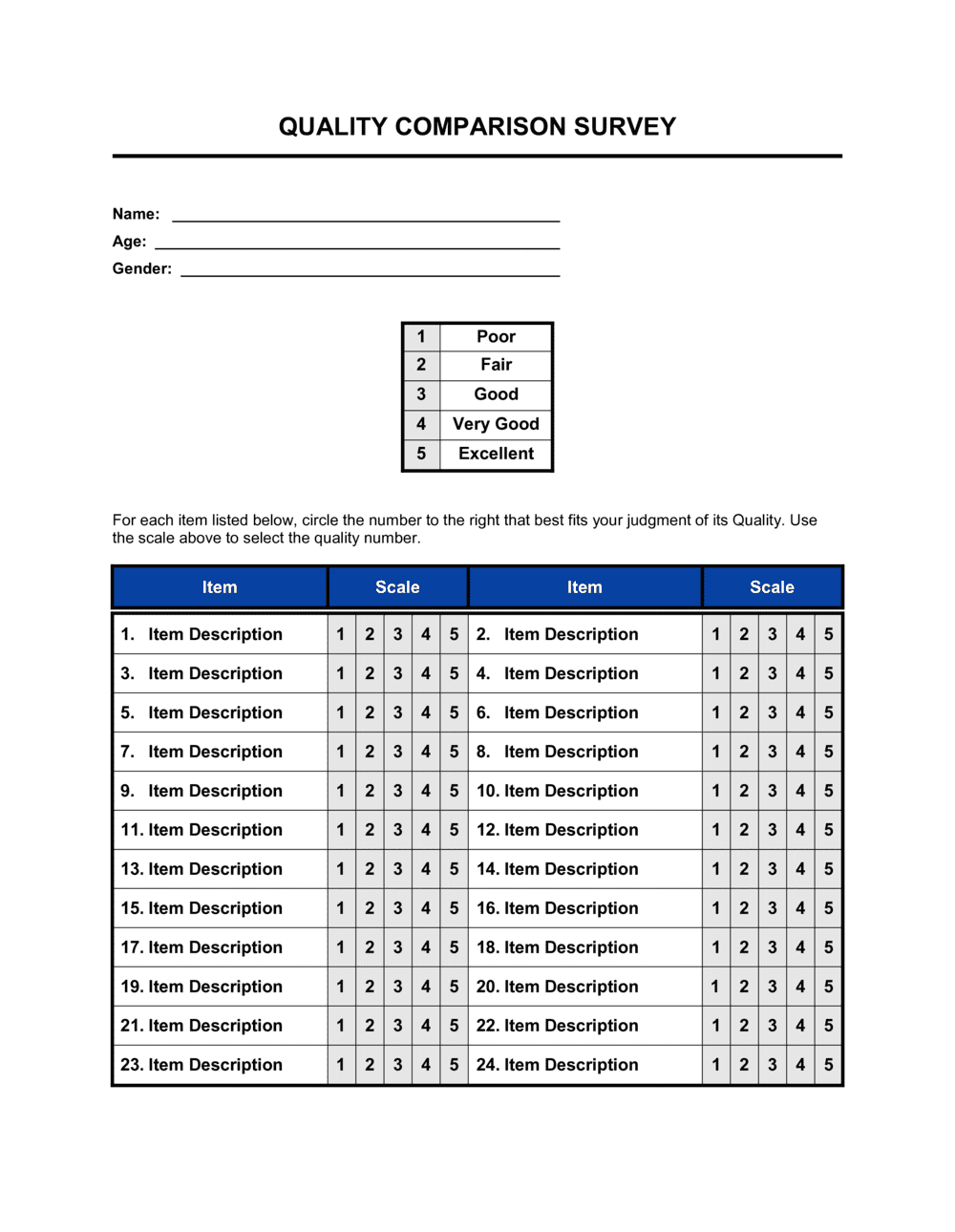
Quality Comparison Survey Template

Free Word download • Edit online • Save & share with Drive • Export to PDF

1 page20–30 min to fillDifficulty: StandardSignature requiredLegal review recommended
Learn more ↓
FreeQuality Comparison Survey Template

At a glance

What it is
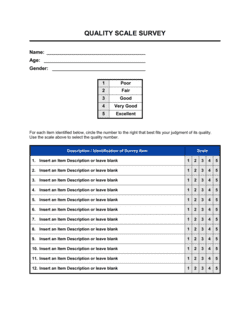
A Quality Comparison Survey is a structured, binding document used by businesses to formally evaluate and compare the quality of products, services, or suppliers against defined performance criteria. This free Word download provides a ready-to-use framework you can customize with your own rating scales, evaluation criteria, and scoring methodology, then export as PDF for distribution to evaluators or stakeholders.
When you need it
Use it when sourcing new vendors, auditing existing supplier performance, benchmarking product quality across competing offerings, or gathering documented evidence to support procurement decisions, contract renewals, or quality-improvement initiatives.
What's inside
Survey scope and objectives, evaluation criteria with weighted scoring, respondent and evaluator identification, product or service comparison fields, quality ratings and commentary sections, compliance declarations, and a signature block for formal acknowledgment of findings.

What is a Quality Comparison Survey?

A Quality Comparison Survey is a structured, formally documented evaluation instrument that businesses use to measure and rank the quality of competing products, services, or suppliers against a shared set of weighted criteria. It combines defined rating scales, evidence-backed scores, evaluator identification, and a signed acknowledgment of findings into a single document that functions both as an internal decision-support tool and as an auditable record. Unlike an informal vendor scorecard or an anonymous customer poll, a quality comparison survey is signed by named evaluators and typically reviewed and countersigned by a manager, giving it the evidentiary weight needed to support contract awards, procurement challenges, and regulatory compliance audits.

Why You Need This Document

Procurement decisions made without a documented quality evaluation process expose your organization to three compounding risks: legal challenge from unsuccessful suppliers who can claim the selection was arbitrary, regulatory non-compliance if your quality management system requires traceable supplier assessments under ISO 9001 or sector-specific regulations, and internal operational failure when the rationale for a supplier choice cannot be reconstructed months after the decision was made. A signed, evidence-backed quality comparison survey closes all three gaps by creating a defensible, replicable record of how each candidate performed against criteria that were defined before scoring began. This template gives you a ready-to-use framework so your first evaluation takes less than an hour to complete — rather than building a methodology from scratch each time a procurement decision requires documentation.

Which variant fits your situation?

If your situation is…Use this template
Evaluating multiple suppliers for the same raw material or componentSupplier Evaluation Form
Assessing employee or team performance against quality standardsEmployee Performance Review
Collecting customer feedback on product quality post-purchaseCustomer Satisfaction Survey
Auditing a single supplier's processes against ISO or regulatory criteriaSupplier Audit Checklist
Comparing service providers before signing a service-level agreementService Level Agreement
Formally scoring bids or proposals from competing vendorsRFP Evaluation Scorecard
Documenting product defect rates and quality incidents over timeQuality Control Report

Common mistakes to avoid

❌ Undefined or inconsistent rating scales

Why it matters: When evaluators interpret the same scale differently, composite scores reflect personal calibration rather than objective quality — making the entire comparison invalid.

Fix: Write a precise behavioral definition for every point on the scale and include it on every page of the survey so evaluators cannot miss it.

❌ Scores without supporting evidence

Why it matters: Unsubstantiated scores cannot be defended in a supplier dispute, regulatory audit, or internal investigation — they appear arbitrary and undermine the document's credibility.

Fix: Require evaluators to cite at least one specific, dated document — an inspection report, delivery log, or test result — for every score they assign.

❌ Omitting conflict-of-interest declarations

Why it matters: An undisclosed relationship between an evaluator and a winning supplier can expose the organization to legal challenge, procurement fraud allegations, or loss of regulatory certification.

Fix: Make the bias declaration a mandatory signed field, not an optional checkbox. Train evaluators on what constitutes a material relationship before they complete the survey.

❌ Equal weighting of unequal criteria

Why it matters: Treating defect rate on a safety-critical component the same as invoice accuracy means a supplier with dangerous quality failures can still score acceptably overall.

Fix: Assign weights based on the actual business and regulatory consequences of failure on each criterion. Review the weighting schema with operations, legal, and compliance before finalizing.

❌ No minimum threshold for individual criteria

Why it matters: Without a floor score, a supplier can score 1 out of 5 on a critical safety criterion and still achieve a passing composite — creating liability if that supplier is selected.

Fix: Define a minimum acceptable score for each criterion and flag any supplier that falls below the floor on any criterion, regardless of their composite total.

❌ Single evaluator with no reviewer sign-off

Why it matters: A survey completed and signed by only one person is vulnerable to bias challenges and provides a weaker audit trail than a dual-signature document.

Fix: Require a second signature from a manager or quality director who reviews the scores and supporting evidence before the survey is finalized.

The 9 key clauses, explained

Survey Scope and Purpose

In plain language: Identifies the specific products, services, or suppliers being compared, the business purpose of the evaluation, and the period it covers.

Sample language
This Quality Comparison Survey covers the evaluation of [PRODUCT/SERVICE CATEGORY] supplied by [SUPPLIER A], [SUPPLIER B], and [SUPPLIER C] for the period [START DATE] to [END DATE]. The purpose of this survey is to [STATE PURPOSE — e.g., inform the Q3 supplier selection decision].

Common mistake: Leaving the scope vague so evaluators apply different interpretations — this produces inconsistent scores that cannot be meaningfully compared across respondents.

Parties and Evaluator Identification

In plain language: Records the name, title, and organizational affiliation of each evaluator, and identifies the entity commissioning the survey.

Sample language
This survey is commissioned by [COMPANY NAME] ('Client') and completed by [EVALUATOR FULL NAME], [TITLE], [DEPARTMENT], on [DATE].

Common mistake: Using job titles without full names. When the document is reviewed months later or referenced in a dispute, anonymous titles cannot be tied to a specific individual's findings.

Evaluation Criteria and Weighting

In plain language: Lists each quality dimension being rated, the maximum score available, and the weight applied to each criterion in the final composite score.

Sample language
Criteria and weights: Product Conformance to Specification — 30%; On-Time Delivery Rate — 20%; Defect Rate per 1,000 Units — 25%; Responsiveness to Non-Conformance Reports — 15%; Packaging and Labeling Compliance — 10%. Total weight: 100%.

Common mistake: Assigning equal weights to all criteria regardless of business priority. A defect rate in a safety-critical component deserves significantly more weight than packaging aesthetics — equal weighting obscures what matters most.

Rating Scale Definition

In plain language: Defines the numeric or descriptive scale used across all criteria so every evaluator interprets scores consistently.

Sample language
All criteria are rated on a scale of 1 to 5: 1 = Does not meet minimum requirements; 2 = Partially meets requirements; 3 = Meets requirements; 4 = Exceeds requirements; 5 = Significantly exceeds requirements. Half-point scores are not permitted.

Common mistake: Omitting scale definitions entirely. When one evaluator's '3' means 'acceptable' and another's means 'barely passing,' composite scores are meaningless.

Individual Criterion Ratings and Commentary

In plain language: Provides a structured field for the evaluator to enter their numeric score and written rationale for each criterion.

Sample language
Criterion: Defect Rate per 1,000 Units | Supplier: [SUPPLIER NAME] | Score: [X] / 5 | Supporting evidence: [DESCRIBE — e.g., 'QC report dated [DATE] showing 2.3 defects per 1,000 units against a target of less than 3.0'].

Common mistake: Accepting scores without requiring written rationale. Scores alone cannot be defended in a supplier dispute or audit without documented supporting evidence.

Composite Score Calculation

In plain language: Documents how individual criterion scores are multiplied by their weights and summed to produce each supplier's or product's final composite quality score.

Sample language
Composite Score = SUM of (Criterion Score × Criterion Weight) for all criteria. [SUPPLIER A] Composite Score: [X.X] / 5.0. [SUPPLIER B] Composite Score: [X.X] / 5.0.

Common mistake: Calculating the composite score outside the document — in a separate spreadsheet — without capturing the calculation method and result in the signed record. If the spreadsheet is lost, the scoring basis cannot be reconstructed.

Bias and Conflict-of-Interest Disclosure

In plain language: Requires each evaluator to declare any financial, personal, or commercial relationships with the entities being evaluated that could affect their objectivity.

Sample language
I, [EVALUATOR NAME], declare that I have [no / the following] material relationships with the suppliers evaluated in this survey: [DESCRIBE OR STATE NONE]. I confirm that my ratings are based solely on documented evidence.

Common mistake: Treating conflict-of-interest disclosure as optional. Undisclosed relationships discovered after a procurement decision is made can expose the commissioning organization to legal challenge or regulatory sanction.

Findings Summary and Recommendation

In plain language: Summarizes the ranked results of the comparison, flags any supplier that failed to meet minimum thresholds, and states any formal recommendation arising from the evaluation.

Sample language
Based on the evaluation conducted between [DATE] and [DATE], [SUPPLIER A] achieved the highest composite score of [X.X] / 5.0 and is recommended for [AWARD / RENEWAL / FURTHER REVIEW]. [SUPPLIER B] scored below the minimum acceptable threshold of [X.X] on [CRITERION] and is not recommended for contract award at this time.

Common mistake: Omitting a minimum-threshold clause. Without a stated floor score, a supplier with critically low performance on one criterion can still 'pass' the overall evaluation due to high scores elsewhere.

Acknowledgment and Signature Block

In plain language: Records the date and signature of the evaluator and any reviewing manager, confirming that the survey was completed accurately and in accordance with the defined methodology.

Sample language
I confirm that this survey was completed in accordance with [COMPANY NAME]'s quality evaluation methodology and that all scores are supported by documented evidence. Evaluator Signature: _______________ Date: [DATE]. Reviewed by: _______________ Title: [TITLE] Date: [DATE].

Common mistake: Collecting only the evaluator's signature without a reviewer sign-off. A single-signature document can be more easily challenged as reflecting individual bias rather than an organizationally endorsed evaluation.

How to fill it out

  1. 1

    Define the scope and name the subjects being compared

    Enter the product or service category, the specific suppliers or offerings under evaluation, and the date range the survey covers. Be precise — 'packaging materials from three vendors Q1 2026' is actionable; 'supplier quality review' is not.

    💡 Limit each survey to one product or service category. Mixing categories in a single evaluation produces scores that cannot be compared fairly.

  2. 2

    Identify all evaluators and their organizational roles

    Enter each evaluator's full legal name, job title, department, and the date they completed the survey. If multiple evaluators contribute, assign each a unique evaluator ID for traceability.

    💡 Use the same name format across all documents — if HR and legal records use 'Jonathan Smith' and this survey uses 'Jon Smith,' audit reconciliation becomes unnecessarily difficult.

  3. 3

    Set evaluation criteria and assign weights

    List every quality dimension relevant to the purchase decision. Assign a percentage weight to each so all weights sum to exactly 100%. Criteria should reflect actual business risk — weight safety and compliance criteria more heavily than aesthetic or logistical factors.

    💡 Involve the end users of the product or service when setting weights. Procurement teams and operations teams often weight the same criteria very differently.

  4. 4

    Define the rating scale and document it in the survey

    Choose a numeric scale (typically 1–5) and write a precise definition for each point on the scale. Add the definitions directly into the survey header so every evaluator reads them before scoring.

    💡 Anchor your scale to observable, measurable behaviors wherever possible — 'delivered on time in 98%+ of shipments' rather than 'very good delivery performance.'

  5. 5

    Complete criterion ratings with written evidence

    Score each criterion for each subject being evaluated and write at least one sentence of supporting evidence citing a specific data source — a QC report, delivery log, or inspection record — with its date.

    💡 Date all evidence references. Undated citations are challenged easily in disputes; a score supported by 'QC Report #2026-047 dated March 14, 2026' is not.

  6. 6

    Calculate and record composite scores

    Multiply each criterion score by its weight, sum the results, and enter the composite score directly into the survey document. Show the calculation formula so it can be independently verified.

    💡 Run the composite calculation in the template itself using formula fields rather than a separate spreadsheet — this keeps the calculation and the signed record in the same document.

  7. 7

    Complete the bias and conflict-of-interest declaration

    Each evaluator must explicitly state whether they have any material relationships with the entities being evaluated. Even a 'none' declaration should be written out and signed — a blank field is not equivalent.

    💡 If a conflict is declared, the evaluator's scores should be reviewed or countersigned by a second evaluator with no relationship to the affected supplier.

  8. 8

    Obtain evaluator and reviewer signatures before filing

    Both the evaluator and a reviewing manager should sign and date the completed survey before it is stored or acted upon. File the executed copy in your vendor management or procurement system immediately.

    💡 Store a PDF of the signed survey alongside the supporting evidence documents — QC reports, delivery records — so the complete package is retrievable for audits or disputes without additional searching.

Frequently asked questions

What is a quality comparison survey?

A quality comparison survey is a structured evaluation document used to assess and rank the quality of competing products, services, or suppliers against defined criteria using a consistent scoring methodology. It produces a documented, evidence-backed comparison that supports procurement decisions, supplier selection, contract renewals, and regulatory compliance. Unlike an informal assessment, it includes defined criteria, weighted scoring, evaluator identification, and a signed acknowledgment of findings.

When should a business use a quality comparison survey?

Use one when selecting a new supplier from multiple candidates, renewing a contract with an incumbent vendor, benchmarking a product against competing alternatives, or responding to a quality complaint that requires documented investigation. Organizations subject to ISO 9001, FDA, or similar quality management frameworks often need formal quality comparison records as part of their documented supplier evaluation process.

Is a quality comparison survey a legally binding document?

A quality comparison survey becomes a binding record when it is signed by the evaluator and a reviewing manager, as it constitutes an official organizational statement of findings that can be referenced in contract negotiations, procurement disputes, and regulatory audits. It does not itself create contractual obligations between parties unless incorporated by reference into a supply agreement or purchase order. Consider consulting a lawyer when the survey will be used as evidence in a formal dispute or procurement challenge.

How many evaluators should complete the survey?

A minimum of two evaluators is recommended for any evaluation that will influence a material procurement decision. Multiple evaluators reduce individual bias and produce more defensible composite scores. When using multiple evaluators, calculate an average or consensus score across respondents and document any significant disagreements and their resolution. For ISO-compliant supplier evaluations, two or more independent evaluators is typically required.

What rating scale works best for a quality comparison survey?

A 1-to-5 Likert scale is the most commonly used format because it provides enough granularity to distinguish performance levels without creating artificial precision. Each point should have a written behavioral anchor — for example, '3 = Meets stated specification in 95–97% of measured instances' — rather than vague labels like 'average.' A 1-to-10 scale is appropriate for complex technical evaluations where finer differentiation between high-performing suppliers is needed.

How should weighted scores be calculated?

Multiply each criterion score by its assigned weight expressed as a decimal (e.g., a weight of 25% = 0.25), then sum all weighted scores to produce the composite. For example, a score of 4 on a criterion weighted at 30% contributes 1.2 points to the composite. Document the formula and calculation directly in the survey so it can be independently verified. The total of all weights must equal exactly 100% before scoring begins.

Can this survey be used for ISO 9001 supplier evaluations?

Yes, a properly structured quality comparison survey can satisfy the supplier evaluation and monitoring requirements of ISO 9001 Clause 8.4, provided it documents the evaluation criteria, the scoring methodology, the evidence base for each score, and the evaluator's identity. Many certification bodies require that supplier evaluations be reviewed at defined intervals and that records be retained for a minimum period — typically three years. Check your specific certification body's requirements before relying on this template alone.

How long should completed surveys be retained?

Retain completed quality comparison surveys for at least three years after the evaluation date in most jurisdictions, and for as long as the underlying supply relationship is active plus the applicable limitation period for contract disputes — typically six years in common-law jurisdictions. Organizations subject to FDA, EU MDR, or other regulatory frameworks may face longer mandatory retention periods. Store signed originals alongside the supporting evidence documents they reference.

What happens if two suppliers score identically?

Tied composite scores should trigger a secondary evaluation using additional or more granular criteria — such as financial stability, geographic risk, or capacity to scale. Document the tiebreaker criteria and the outcome in a supplemental note attached to the original survey. Do not modify the original scores retroactively; instead, add the tiebreaker assessment as a separate signed addendum to the file.

How this compares to alternatives

vs Customer Satisfaction Survey

A customer satisfaction survey collects end-user perceptions of a product or service after the fact, typically on an anonymous basis. A quality comparison survey is a formal internal evaluation document comparing multiple subjects against defined criteria, signed by named evaluators, and used to support procurement or compliance decisions. The two serve opposite audiences — external customers versus internal decision-makers.

vs Supplier Evaluation Form

A supplier evaluation form typically assesses a single vendor across performance dimensions at a point in time. A quality comparison survey is specifically designed to evaluate and rank multiple suppliers or products side by side using a shared scoring framework. Use the evaluation form for ongoing single-vendor monitoring; use the comparison survey when a selection or ranking decision needs to be documented.

vs Service Level Agreement

An SLA is a forward-looking contractual document that defines the quality and performance standards a supplier must meet going forward. A quality comparison survey is a backward or current-state assessment document that measures whether those standards have been met. The two are complementary — a completed quality comparison survey is often used to determine whether an SLA should be renewed, renegotiated, or terminated.

vs RFP (Request for Proposal)

An RFP solicits structured proposals from vendors before selection. A quality comparison survey evaluates actual quality performance after proposals have been received or after a vendor has been operating. Use an RFP to shortlist candidates and gather their commitments; use a quality comparison survey to score and document the evaluation of those proposals or to assess performance against commitments made.

Industry-specific considerations

Manufacturing

Component defect rates, material conformance to specification, delivery reliability, and supplier capacity are weighted heavily given direct impact on production line performance.

Healthcare and Life Sciences

Regulatory compliance history, sterilization validation records, and FDA or CE mark status are mandatory evaluation criteria alongside standard quality metrics.

Retail and Consumer Goods

Packaging compliance, product safety certifications, labeling accuracy, and country-of-origin documentation are common criteria alongside pricing and lead times.

Professional Services

Service delivery consistency, responsiveness to issues, staff qualification, and contractual SLA adherence replace product-centric criteria in the evaluation framework.

Construction

Material strength certifications, on-site delivery compliance, waste and defect rates, and adherence to safety data sheets are core evaluation dimensions.

Technology and SaaS

Uptime and SLA performance, security certification status (SOC 2, ISO 27001), API reliability, and vendor financial stability are typical quality benchmarks.

Jurisdictional notes

United States

In the US, signed quality evaluation records can be used as documentary evidence in breach-of-contract and product liability claims. Organizations in regulated industries — medical devices under FDA 21 CFR Part 820, food under FSMA — are required to maintain documented supplier quality evaluation records as part of their quality management system. Retention periods vary by regulation but typically range from two to five years.

Canada

Canadian organizations pursuing ISO 9001 certification through bodies such as the Standards Council of Canada must maintain documented supplier evaluation records under Clause 8.4 of the standard. In Quebec, all formal business documents intended for internal use must comply with the Charter of the French Language if the organization operates in Quebec. Federal procurement rules under the Government Contracts Regulations require documented quality assessment for certain public-sector supplier selections.

United Kingdom

UK organizations operating under ISO 9001:2015 or the Construction Products Regulation must maintain documented supplier evaluation records. Under the Procurement Act 2023, public-sector contracting authorities must follow structured and documented evaluation processes that can withstand challenge by unsuccessful bidders. Signed evaluation records should be retained for at least six years to cover the standard limitation period under the Limitation Act 1980.

European Union

EU supplier quality evaluation requirements are embedded in sector-specific regulations including the EU Medical Device Regulation (EU MDR 2017/745) and the General Food Law Regulation (EC 178/2002), both of which require documented, traceable supplier assessments. GDPR applies where evaluations include personal data about named individuals at supplier organizations — ensure evaluator and supplier contact records are handled in accordance with your data processing agreement. Retention periods vary by member state but typically align with the applicable contractual limitation period.

Template vs lawyer — what fits your deal?

PathBest forCostTime
Use the templateInternal supplier evaluations, routine procurement decisions, and ISO documentation requirements for small to mid-sized businessesFree30–60 minutes per evaluation
Template + legal reviewEvaluations that will be used as evidence in contract renegotiations, terminations, or formal supplier disputes$200–$6001–2 days
Custom draftedRegulated industries (healthcare, defense, pharmaceuticals) where the survey must satisfy specific statutory audit requirements or be tendered in legal proceedings$1,000–$4,000+1–2 weeks

Glossary

Quality Benchmark
A defined standard or reference point against which a product, service, or supplier is measured during evaluation.
Weighted Scoring
An evaluation method that assigns different levels of importance to each criterion, so higher-priority factors contribute more to the final score.
Evaluation Criteria
The specific attributes — such as defect rate, delivery reliability, or compliance with specifications — used to judge quality.
Respondent
The individual or organization completing the survey and providing quality assessments based on direct knowledge or experience.
Likert Scale
A rating scale, typically 1–5 or 1–7, used to measure the degree to which an evaluator agrees with or rates a quality statement.
Non-Conformance
A documented instance where a product, service, or process fails to meet a specified quality requirement or standard.
ISO 9001
An internationally recognized standard for quality management systems, requiring documented processes, measurable objectives, and continual improvement.
Corrective Action
A documented step taken to eliminate the root cause of a detected non-conformance and prevent its recurrence.
Supplier Scorecard
A summary output of a quality evaluation that aggregates individual criterion scores into an overall performance rating for a vendor.
Audit Trail
A chronological record of evaluation activities, signatures, and findings that can be reviewed by an auditor or used in a dispute.
Bias Disclosure
A declaration by the evaluator of any financial, personal, or commercial relationships with the entities being compared that could influence their ratings.

Part of your Business Operating System

This document is one of 3,000+ business & legal templates included in Business in a Box.

  • Fill-in-the-blanks — ready in minutes
  • 100% customizable Word document
  • Compatible with all office suites
  • Export to PDF and share electronically

Create your document in 3 simple steps.

From template to signed document — all inside one Business Operating System.
1
Download or open template

Access over 3,000+ business and legal templates for any business task, project or initiative.

2
Edit and fill in the blanks with AI

Customize your ready-made business document template and save it in the cloud.

3
Save, Share, Send, Sign

Share your files and folders with your team. Create a space of seamless collaboration.

Save time, save money, and create top-quality documents.

★★★★★

"Fantastic value! I'm not sure how I'd do without it. It's worth its weight in gold and paid back for itself many times."

Managing Director · Mall Farm
Robert Whalley
Managing Director, Mall Farm Proprietary Limited
★★★★★

"I have been using Business in a Box for years. It has been the most useful source of templates I have encountered. I recommend it to anyone."

Business Owner · 4+ years
Dr Michael John Freestone
Business Owner
★★★★★

"It has been a life saver so many times I have lost count. Business in a Box has saved me so much time and as you know, time is money."

Owner · Upstate Web
David G. Moore Jr.
Owner, Upstate Web

Run your business with a system — not scattered tools

Stop downloading documents. Start operating with clarity. Business in a Box gives you the Business Operating System used by over 250,000 companies worldwide to structure, run, and grow their business.

Free Forever Plan · No credit card required