4 Necessary Mindset Shifts To Make Before Starting A Business Template

Free to read β€’ Save or share with one click

Free4 Necessary Mindset Shifts To Make Before Starting A Business Template

At a glance

What it is
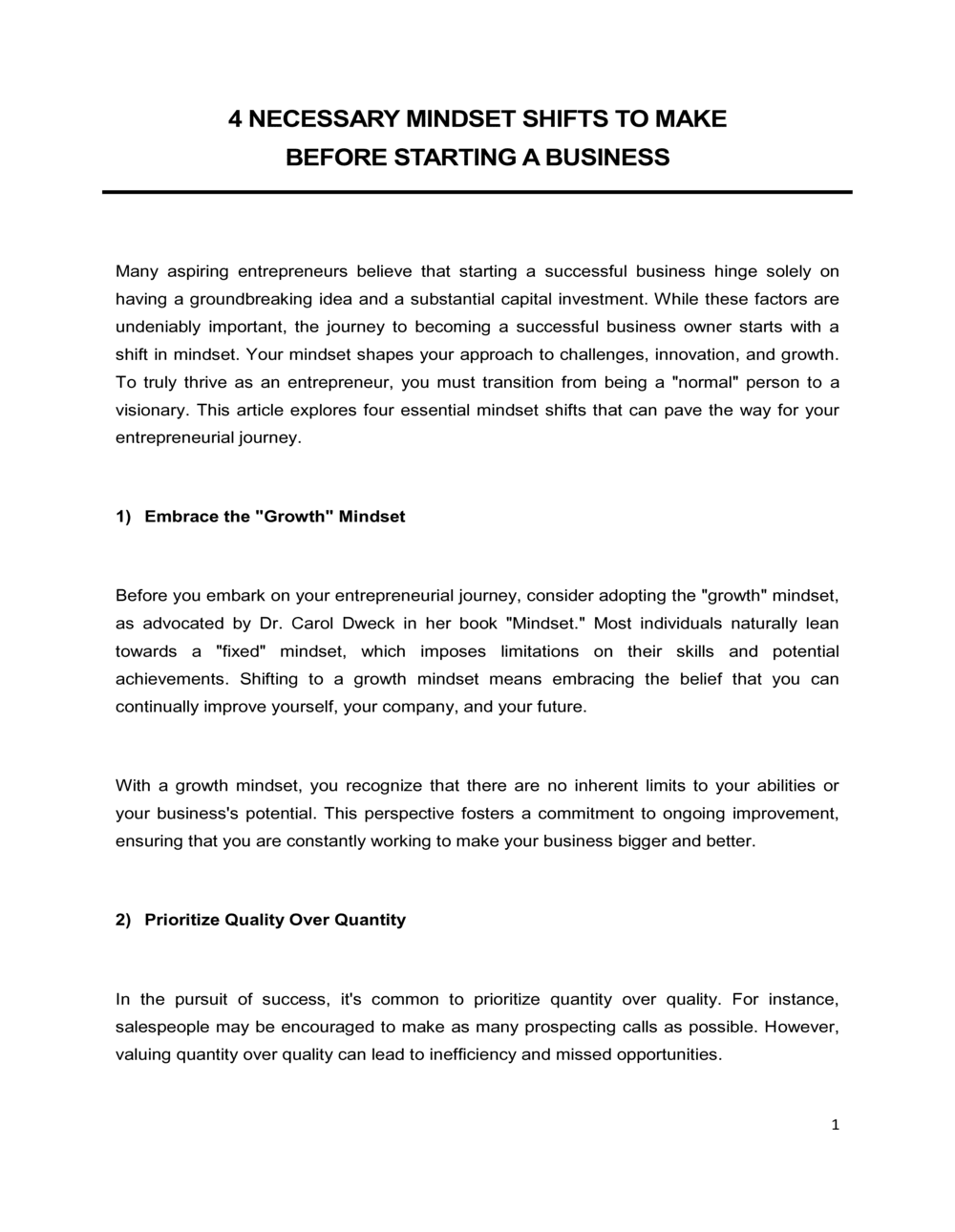
This is a structured Word guide that walks aspiring founders through the four core mindset shifts required before launching a business β€” moving from employee thinking to owner thinking, from certainty-seeking to risk tolerance, from lone-operator to systems builder, and from income-focus to value-creation focus. It is a free Word download you can edit online and export as PDF for personal use, coaching sessions, or entrepreneurship programs.
When you need it
Use it before writing your business plan, before resigning from your job, or before investing capital in a new venture. It is equally useful for coaches and mentors working with first-time founders who are carrying employee-era assumptions into business ownership.
What's inside
Four fully developed mindset modules, each with a plain-language explanation of the shift required, a self-assessment exercise, a common resistance pattern and how to overcome it, and a practical action step. An introductory framing section and a closing commitment exercise round out the guide.

What is "4 Necessary Mindset Shifts To Make Before Starting a Business"?

4 Necessary Mindset Shifts To Make Before Starting a Business is a structured self-guided framework that walks aspiring entrepreneurs through the four internal transitions most predictive of early-stage business success: shifting from employee thinking to owner thinking, from certainty-seeking to calculated risk acceptance, from lone-operator habits to systems-building, and from income-first priorities to value-creation focus. Unlike a business plan or feasibility study, this guide works on the founder rather than the business idea β€” surfacing the assumptions, resistance patterns, and behavioral defaults that determine whether a new business survives its first year. It is available as a free Word download, editable online and exportable as PDF for personal use, coaching sessions, or group programs.

Why You Need This Document

The majority of first-time business failures are not caused by bad ideas or poor timing β€” they are caused by founders who carried employment-era thinking into ownership without examining it. An employee who launches a business while still expecting defined tasks, predictable income, and someone else to make the hard calls will reproduce all the frustrations of employment with none of the security. Without deliberately addressing these four shifts before launch, you are likely to under-invest in systems, over-rely on personal effort, misread risk as binary, and optimize for cash today at the expense of customers who would have paid you for years. This guide makes the preparation work concrete and measurable β€” not motivational, but behavioral β€” so that when you sit down to write your business plan or sign your first client, you are operating from the assumptions that business ownership actually requires.

Which variant fits your situation?

If your situation is…Use this template
Preparing a full strategic launch plan, not just a mindset resetBusiness Plan
Validating a business idea before committing to launchBusiness Feasibility Study
Quickly stress-testing the core concept on one pageOne-Page Business Plan
Setting personal and professional goals alongside the mindset workPersonal Development Plan
Formalizing a SWOT analysis to ground the mindset shifts in market realitySWOT Analysis
Mapping out the first 90 days after the decision to launch is made90-Day Action Plan
Building a structured coaching engagement around this guideCoaching Action Plan

Common mistakes to avoid

❌ Treating the guide as reading material rather than a workbook

Why it matters: Passive reading produces intellectual agreement but no behavioral change. Founders who read without completing the exercises retain the framing but not the shift.

Fix: Enforce a no-advance rule: do not proceed to the next section until the exercise for the current one is written out in full, not just mentally acknowledged.

❌ Completing all four shifts in a single sitting

Why it matters: Each shift requires reflection time to surface genuine resistance. Rushing through all four in one session produces optimistic self-assessments that evaporate under real business pressure.

Fix: Allocate one shift per day over four days minimum. Return to each section's self-assessment 48 hours later and check whether your initial answers still feel accurate.

❌ Skipping the commitment exercise at the end

Why it matters: Without a written commitment tied to observable behavior, the guide produces awareness with no mechanism for change β€” the same outcome as reading a blog post.

Fix: Treat the commitment exercise as the deliverable of the entire guide. The preceding sections are preparation; the commitment page is the output.

❌ Using the guide after already launching, rather than before

Why it matters: Addressing mindset gaps after launch is harder because existing habits are now reinforced by daily business operations, not just employment conditioning.

Fix: If you are already operating, complete the guide anyway β€” but pair each shift with a specific current business decision you can apply it to immediately, rather than a hypothetical future scenario.

❌ Conflating mindset work with positive thinking

Why it matters: Founders who equate 'growth mindset' with optimism skip the hard analytical work β€” risk assessment, systems design, value validation β€” that the shifts actually require.

Fix: Treat each shift as a change in decision-making criteria, not a change in attitude. The test is behavioral: does your next decision reflect the shift, or does it reflect the old pattern?

❌ Completing the guide alone without external feedback

Why it matters: Self-assessments are vulnerable to blind spots. A founder who does not know what they do not know will score themselves accurately on the shifts they have already partially made and miss the ones they cannot yet see.

Fix: Share your completed self-assessments with a mentor, coach, or peer who knows you professionally. Ask them to challenge any score that seems inconsistent with behavior they have observed.

The 8 key sections, explained

Introduction: Why mindset precedes strategy

Shift 1 β€” From employee thinking to owner thinking

Shift 2 β€” From certainty-seeking to calculated risk acceptance

Shift 3 β€” From lone operator to systems builder

Shift 4 β€” From income focus to value-creation focus

Self-assessment exercises

Common resistance patterns and how to overcome them

Commitment exercise and 30-day practice plan

How to fill it out

  1. 1

    Read the introduction before completing any section

    The introduction establishes the evidence base for why mindset precedes strategy. Reading it first frames every subsequent exercise so the work feels purposeful rather than procedural.

    πŸ’‘ Block 30 uninterrupted minutes for this step β€” reading it in fragments between tasks defeats its purpose.

  2. 2

    Complete the self-assessment for shift 1 before moving on

    Work through the employee-to-owner shift prompts fully before proceeding to shift 2. Each shift builds on the previous one β€” skipping ahead produces incomplete self-knowledge.

    πŸ’‘ If your score on shift 1 is below 6 out of 10, spend an extra day on the exercises before advancing.

  3. 3

    Identify your primary resistance pattern for each shift

    In the resistance patterns section, mark the one objection that resonates most strongly for each shift. Write one paragraph in your own words explaining why that objection feels true to you.

    πŸ’‘ The objection that feels most personal β€” the one that prompts mild defensiveness β€” is the one that matters most. Start there.

  4. 4

    Rewrite each resistance pattern using the provided reframe

    Take the reframe language from the guide and adapt it to your specific situation. Replace generic placeholders with your actual business idea, industry, and constraints.

    πŸ’‘ Reframes work best when they are specific. 'Risk is manageable' is less useful than 'If this fails, I can return to employment within 90 days with my skills intact.'

  5. 5

    Score yourself on all four shifts before writing the commitment

    Complete all four self-assessments before drafting the commitment exercise. The 30-day plan should address your lowest-scoring shift first.

    πŸ’‘ Prioritize the shift with the largest gap between current score and 10 β€” that gap is your highest-leverage development area.

  6. 6

    Write a specific, observable commitment statement

    Fill in the commitment template with a named shift, a concrete daily behavior, and a measurable outcome you can verify within 30 days.

    πŸ’‘ Share the completed commitment with one person β€” a coach, mentor, or accountability partner β€” to convert a private intention into a social commitment.

  7. 7

    Revisit the guide at the 30-day mark

    Return to the self-assessment scores after 30 days of practice and re-score each shift. Note which scores improved and which stalled, and diagnose why before starting a second 30-day cycle.

    πŸ’‘ A score that does not improve after 30 days of deliberate practice signals a deeper belief that the exercises did not surface β€” consider working through it with a coach.

Frequently asked questions

What are the 4 necessary mindset shifts before starting a business?

The four shifts are: (1) from employee thinking to owner thinking β€” moving from task execution to outcome accountability; (2) from certainty-seeking to calculated risk acceptance β€” learning to evaluate and manage risk rather than avoid it; (3) from lone operator to systems builder β€” designing processes that let the business scale beyond your personal capacity; and (4) from income focus to value-creation focus β€” solving a real problem for a specific customer before optimizing for revenue. Each shift is a change in decision-making criteria, not just attitude.

Why does mindset matter before starting a business?

Most early-stage business failures are not caused by bad products or poor market timing β€” they are caused by founders who apply employment-era thinking to ownership challenges. An employee waits for direction; an owner creates it. An employee avoids risk; an owner evaluates it. Addressing these assumptions before launch prevents the most common and costly behavioral errors in the first 12 months of operation.

Who should use this guide?

First-time founders preparing to leave employment, side-hustle entrepreneurs ready to go full-time, business coaches working with pre-launch clients, and entrepreneurship educators building curriculum around practical self-assessment. It is also useful for existing business owners who are hitting growth ceilings that trace back to unexamined founding assumptions β€” the shifts apply at any stage.

How long does it take to complete the guide?

A thorough completion takes 4–7 days, working through one shift per day and returning to each self-assessment after 48 hours to check whether initial answers still hold. Rushing through all four sections in a single sitting produces surface-level responses that do not reflect actual behavioral patterns. The commitment exercise and 30-day plan add another 30–60 minutes at the end.

Is this guide a substitute for a business plan?

No β€” this guide addresses internal preparation; a business plan addresses external strategy. Think of them as sequential: complete the mindset work first so that the assumptions embedded in your business plan reflect owner thinking rather than employee thinking. A business plan written before the mindset shifts are made will often underestimate risk, overestimate personal capacity, and under-invest in systems.

What is the difference between a growth mindset and an owner mindset?

A growth mindset is the general belief that abilities can be developed through effort β€” a concept from educational psychology applicable to any domain. An owner mindset is specifically about business decision-making: accepting full accountability for outcomes, building systems rather than performing tasks, and measuring success by value created rather than hours worked. The two are compatible and mutually reinforcing, but they address different dimensions of founder readiness.

Can this guide be used in a coaching or group workshop setting?

Yes β€” the self-assessment exercises and resistance pattern sections are designed to generate discussion in a coaching context. The guide works as a pre-session homework assignment, with the coach using the completed self-assessments as the basis for the session. In group settings, the resistance patterns section is particularly effective as a shared discussion prompt, since the same six objections surface consistently across different founder profiles.

What happens if I score low on all four shifts?

Low scores across all four shifts are common for first-time founders β€” they indicate strong employment conditioning rather than a fixed personal limitation. The guide is designed precisely for this starting point. Prioritize the shift with the largest gap from 10, build one observable daily behavior around it for 30 days, then reassess. A single well-practiced shift creates momentum that accelerates the others.

How does this guide relate to a personal development plan?

This guide is narrower and more targeted than a full personal development plan β€” it focuses exclusively on the four mindset shifts most directly predictive of early-stage business success. A personal development plan covers broader life and career goals across multiple domains. Use this guide as the entrepreneurship-specific input to a personal development plan, not as a replacement for it.

How this compares to alternatives

vs Business Plan

A business plan is an external-facing strategic document covering market analysis, financials, and go-to-market strategy. This mindset guide is internal preparation β€” it addresses the assumptions the founder brings to the business plan. Use this guide first so the business plan reflects owner thinking from the start.

vs Personal Development Plan

A personal development plan covers broad life and career goals across multiple domains β€” health, relationships, skills, and finances. This guide is narrower: it targets only the four mindset shifts most predictive of business launch success. Use this guide as the entrepreneurship-specific input to a broader personal development plan.

vs Business Feasibility Study

A feasibility study evaluates whether a specific business idea is viable β€” market size, cost structure, competitive landscape. This guide evaluates whether the founder is prepared to operate a business at all, regardless of the idea. Both are pre-launch tools, but they address different dimensions of readiness.

vs SWOT Analysis

A SWOT analysis maps external market conditions and internal organizational capabilities. This mindset guide addresses a dimension the SWOT does not: the founder's internal assumptions and behavioral patterns. Complete the mindset guide before conducting the SWOT so that the strengths and weaknesses sections reflect honest self-knowledge rather than aspirational self-assessment.

Industry-specific considerations

Professional Services

Consultants and lawyers transitioning from employment or partnership to independent practice face an especially sharp employee-to-owner shift, since billable-hours thinking directly conflicts with systems-building and value-creation framing.

Technology / SaaS

Technical founders frequently score high on systems thinking but low on the income-to-value-creation shift, building products before validating that a paying customer exists for the problem being solved.

Retail / E-commerce

Product-focused founders often underestimate the owner-mindset shift required to manage suppliers, cash flow, and customer acquisition simultaneously rather than focusing exclusively on the product.

Coaching and Education

This guide is a direct curriculum asset for entrepreneurship coaches and accelerator programs, serving both as a client-facing tool and as a structured intake assessment for new cohort members.

Template vs pro β€” what fits your needs?

PathBest forCostTime
Use the templateSelf-directed founders preparing for launch who want a structured, evidence-based reflection frameworkFree4–7 days (4–6 hours total)
Template + professional reviewFounders working with a business coach who wants to use the completed guide as the basis for one or two coaching sessions$150–$500 per coaching session1–2 weeks including session scheduling
Custom draftedAccelerator programs or business schools that need a branded, curriculum-integrated version with custom exercises and facilitation guides$1,000–$5,000 for custom curriculum development2–4 weeks

Glossary

Employee Mindset
A set of assumptions carried from employment β€” trading time for a fixed wage, avoiding risk, and expecting defined tasks β€” that conflicts with the demands of business ownership.
Owner Mindset
A perspective that prioritizes outcomes over hours worked, accepts accountability for results, and views the business as a system to build rather than a job to perform.
Risk Tolerance
The degree of uncertainty and potential financial loss an individual can accept without abandoning a course of action.
Delayed Gratification
The ability to forgo immediate rewards β€” such as a steady salary β€” in favor of larger long-term returns from a growing business.
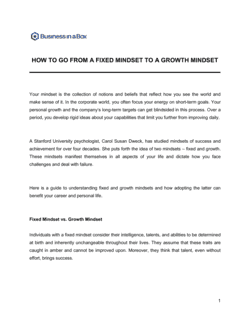
Fixed Mindset
The belief that abilities and intelligence are static traits, leading to avoidance of challenges and fear of failure β€” directly counterproductive to entrepreneurship.
Growth Mindset
The belief that skills and capabilities can be developed through effort and learning, enabling founders to treat setbacks as data rather than verdicts.
Systems Thinking
The practice of designing repeatable processes and structures so that the business can operate and scale independently of the founder's direct involvement.
Value Creation
The process of solving a real problem for a customer in a way that generates more benefit than it costs to deliver β€” the engine of sustainable business revenue.
Scarcity Mindset
The belief that resources, customers, or opportunities are fundamentally limited, leading to defensive decisions that cap business growth.
Abundance Mindset
The belief that markets, opportunities, and resources can expand through creativity and collaboration β€” enabling bolder strategic decisions.
Self-Efficacy
A founder's belief in their own capacity to execute specific tasks and achieve business goals, directly correlated with persistence through early-stage setbacks.

Part of your Business Operating System

This document is one of 3,000+ business & legal templates included in Business in a Box.

  • Fill-in-the-blanks β€” ready in minutes
  • Compatible with all office suites
  • Export to PDF and share electronically

Create your document in 3 simple steps.

From template to signed document β€” all inside one Business Operating System.
1
Download or open template

Access over 3,000+ business and legal templates for any business task, project or initiative.

2
Edit and fill in the blanks with AI

Customize your ready-made business document template and save it in the cloud.

3
Save, Share, Send, Sign

Share your files and folders with your team. Create a space of seamless collaboration.

Save time, save money, and create top-quality documents.

β˜…β˜…β˜…β˜…β˜…

"Fantastic value! I'm not sure how I'd do without it. It's worth its weight in gold and paid back for itself many times."

Managing Director Β· Mall Farm
Robert Whalley
Managing Director, Mall Farm Proprietary Limited
β˜…β˜…β˜…β˜…β˜…

"I have been using Business in a Box for years. It has been the most useful source of templates I have encountered. I recommend it to anyone."

Business Owner Β· 4+ years
Dr Michael John Freestone
Business Owner
β˜…β˜…β˜…β˜…β˜…

"It has been a life saver so many times I have lost count. Business in a Box has saved me so much time and as you know, time is money."

Owner Β· Upstate Web
David G. Moore Jr.
Owner, Upstate Web

Run your business with a system β€” not scattered tools

Stop downloading documents. Start operating with clarity. Business in a Box gives you the Business Operating System used by over 250,000 companies worldwide to structure, run, and grow their business.

Start freeΒ Β·Β No credit card required