- Business Model
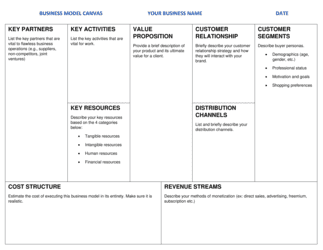
- The mechanism by which a company creates, delivers, and captures value — defining who pays, how much, and in exchange for what.
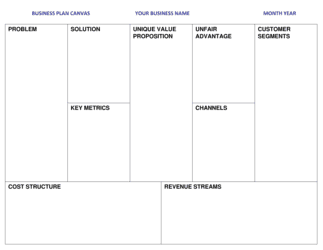
- Revenue Model
- The specific method a business uses to generate income from its value proposition, such as subscriptions, transaction fees, licensing, or advertising.
- Value Proposition
- The specific outcome or benefit a product or service delivers to a defined customer segment that makes them willing to pay for it.
- Customer Segment
- A distinct group of customers who share common needs, behaviors, or characteristics and are served by the same value proposition.
- Cost Structure
- All costs incurred to operate a business model, categorized as fixed (independent of volume) or variable (scaling with output or sales).
- Gross Margin
- Revenue minus the direct cost of goods sold or services delivered, expressed as a percentage of revenue — a key indicator of model scalability.
- Unit Economics
- Revenue and cost metrics at the level of a single customer or transaction, including customer acquisition cost (CAC) and lifetime value (LTV).
- Scalability
- A model's ability to grow revenue faster than costs — a subscription SaaS business scales more easily than a services business that requires proportional headcount.
- Switching Costs
- The friction a customer faces when moving from one product or provider to another — high switching costs improve retention and pricing power.
- Freemium
- A model where a basic version is offered free to acquire users at scale, with revenue generated by converting a subset to a paid tier.
- Marketplace Model
- A platform that connects buyers and sellers, capturing value through transaction fees, listing fees, or subscription access rather than owning inventory.