Social and Community Service Manager Job Description Template

Free Word download • Edit online • Save & share with Drive • Export to PDF

2 pages20–30 min to fillDifficulty: StandardSignature requiredLegal review recommended
Learn more ↓
FreeSocial and Community Service Manager Job Description Template

At a glance

What it is
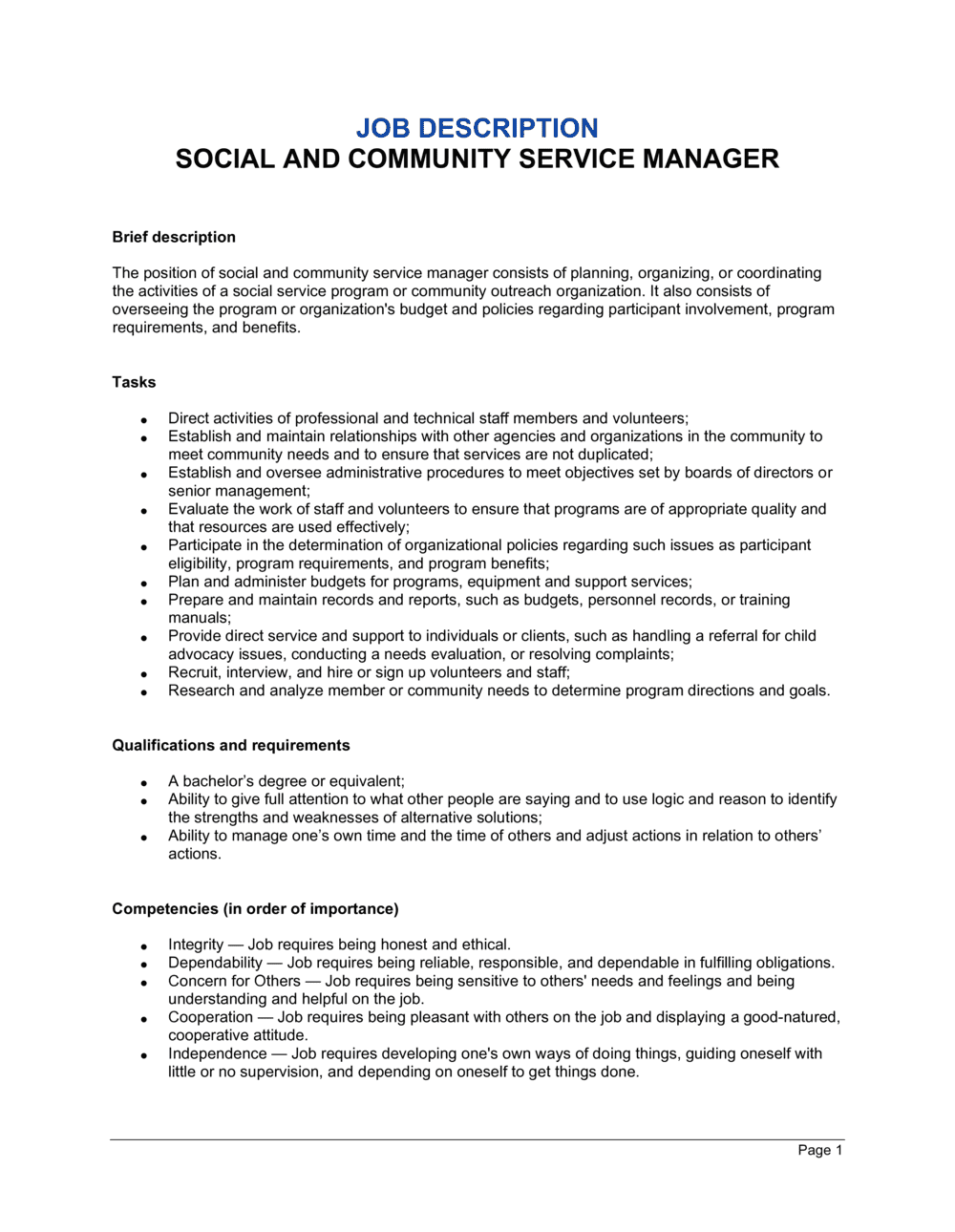
A Social and Community Service Manager Job Description is a formal employment document that defines the role, responsibilities, qualifications, reporting structure, and performance expectations for a manager overseeing social or community service programs. This free Word download gives organizations a structured, legally grounded template they can edit online and export as PDF for use in hiring, onboarding, and performance management.
When you need it
Use it when hiring or onboarding a manager responsible for coordinating social service programs, community outreach initiatives, or human services operations. It is also the authoritative reference document for annual performance reviews and role reclassification processes.
What's inside
Role overview and reporting structure, core duties and program responsibilities, required and preferred qualifications, compensation and benefits summary, regulatory compliance obligations, and acknowledgment signature block. The document is formatted to integrate directly into an employment contract or stand alone as a binding role definition.

What is a Social and Community Service Manager Job Description?

A Social and Community Service Manager Job Description is a formal employment document that defines the duties, qualifications, reporting structure, compliance obligations, and compensation expectations for a manager responsible for planning, directing, and coordinating social service programs or community initiatives. It functions as the authoritative role definition used in hiring, onboarding, performance management, and regulatory compliance — and is typically incorporated by reference into the accompanying employment contract. In settings involving vulnerable populations, it also documents the employee's mandated reporter obligations and any licensure or background check requirements attached to the position.

Why You Need This Document

Without a written, signed job description, organizations face compounding risk across hiring, operations, and legal compliance. A vague or absent role definition leaves the organization without a documented basis for performance improvement plans, disciplinary actions, or terminations — each of which becomes legally vulnerable in wrongful dismissal or discrimination claims when duties and expectations were never formally recorded. Social service settings carry additional exposure: omitting mandated reporter language does not eliminate the legal duty to report abuse or neglect, but it removes the organization's evidence that the employee was informed of the obligation. Pay transparency violations in states like California and Colorado can reach $10,000 per posting. This template closes all of those gaps in under an hour — giving HR teams a structured, compliant foundation they can adapt to any program, population, or jurisdiction without starting from scratch.

Which variant fits your situation?

If your situation is…Use this template
Hiring a manager for a government-funded public assistance programGovernment Program Manager Job Description
Recruiting a director-level leader overseeing multiple program managersDirector of Community Services Job Description
Defining a frontline case manager role rather than a supervisory oneSocial Worker Job Description
Engaging a consultant to manage a short-term community initiativeIndependent Contractor Agreement
Onboarding a manager who also requires a confidentiality agreementNon-Disclosure Agreement (NDA)
Hiring a full-time permanent employee to pair with this job descriptionEmployment Contract
Creating a volunteer coordinator role within a community service organizationVolunteer Coordinator Job Description

Common mistakes to avoid

❌ Omitting mandated reporter designation

Why it matters: Social service managers in most US states and Canadian provinces are legally required to report suspected abuse or neglect. Not documenting this obligation in the job description means the organization cannot prove the employee was informed of the duty — creating liability exposure in any subsequent investigation.

Fix: Add a standalone clause naming the applicable statute, the reporting timeline, and the designated authority the manager must contact. Have the employee initial this clause separately.

❌ Using a generic job description copied from another organization

Why it matters: Generic descriptions frequently misstate FLSA classification, omit jurisdiction-specific compliance requirements, or list qualifications that don't match the actual role — triggering misclassification penalties or disparate impact claims.

Fix: Customize every section to match your actual program structure, population served, regulatory environment, and compensation band before posting or presenting to a candidate.

❌ Failing to separate required from preferred qualifications

Why it matters: Treating preferred credentials as screening criteria during hiring without documented justification creates legal exposure for disparate impact discrimination — particularly when the preferred credential correlates with race, national origin, or disability status.

Fix: Keep required and preferred sections clearly labeled and document in your internal hiring file why each required credential is genuinely necessary for role performance.

❌ No salary range on the job description in pay-transparency jurisdictions

Why it matters: California, Colorado, New York, Washington, and several other states require salary ranges on job postings. Violations carry civil penalties and create audit triggers with state labor agencies.

Fix: Insert the approved compensation band before publishing the posting. If the range is internally sensitive, consult HR — in most jurisdictions, a broad range (e.g., $55,000–$75,000) satisfies the requirement.

❌ Vague supervisory authority language

Why it matters: Descriptions that say 'may supervise staff' rather than naming the number and type of direct reports leave the manager without clear authority to conduct performance reviews, approve leave, or initiate disciplinary action — undermining operational accountability.

Fix: State the exact number of direct reports, their titles, and the manager's specific authority — performance review, hire/fire recommendation, timesheet approval — explicitly.

❌ Inflated physical requirements not tied to actual job tasks

Why it matters: Stating that the role requires lifting 50 lbs when the actual maximum is occasional lifting of 20 lbs files materials artificially narrows the qualified candidate pool and creates ADA defense problems if a candidate with a disability is screened out on that basis.

Fix: Audit physical demands against what the role actually requires. Use standard ADA language — 'occasionally lift up to [X] lbs' — and tie each requirement to a specific job task.

The 10 key clauses, explained

Position title, department, and reporting line

In plain language: States the exact job title, the department or program the role belongs to, and the direct supervisor the manager reports to.

Sample language
Position Title: Social and Community Service Manager | Department: [PROGRAM/DEPARTMENT NAME] | Reports To: [SUPERVISOR TITLE] | FLSA Status: Exempt

Common mistake: Using an informal working title instead of the title that appears on payroll and HR records — this creates mismatches during background checks and benefits enrollment.

Role summary and organizational purpose

In plain language: A 3–5 sentence overview of why the role exists, the population it serves, and how it fits within the organization's mission.

Sample language
[ORGANIZATION NAME] is seeking a Social and Community Service Manager to lead [PROGRAM NAME], which serves [TARGET POPULATION] in [SERVICE AREA]. The Manager will oversee program delivery, staff supervision, and community partnerships to advance [MISSION STATEMENT].

Common mistake: Writing a role summary so broad it could describe any nonprofit manager — failing to specify the target population or service type undermines fit and generates unqualified applicants.

Essential duties and responsibilities

In plain language: A detailed, prioritized list of the core tasks the manager is expected to perform regularly, including staff supervision, program evaluation, reporting, and stakeholder engagement.

Sample language
Essential duties include: (1) supervising [X] direct-report staff; (2) managing program budget of $[AMOUNT]; (3) preparing monthly outcome reports for [FUNDER/BOARD]; (4) conducting community needs assessments; (5) maintaining compliance with [REGULATORY BODY] standards.

Common mistake: Listing more than 12 duties without flagging which are essential versus marginal — courts and HR arbitrators apply a reasonableness standard when evaluating ADA accommodation claims, and an unweighted list provides no guidance.

Required qualifications

In plain language: The minimum education, experience, and licensure the candidate must possess on day one of employment.

Sample language
Required: Bachelor's degree in Social Work, Public Administration, or a related field; minimum [X] years of experience managing social service programs; valid [STATE] driver's license; demonstrated experience supervising a team of [X] or more.

Common mistake: Setting education requirements higher than the role actually demands — a blanket master's degree requirement for a role where a bachelor's plus experience is genuinely sufficient may constitute disparate impact discrimination in some jurisdictions.

Preferred qualifications

In plain language: Additional credentials or experience that strengthen a candidate's application but are not required for hire — used to differentiate among qualified applicants.

Sample language
Preferred: Master's degree in Social Work (MSW) or Public Administration (MPA); Licensed Clinical Social Worker (LCSW) or Licensed Professional Counselor (LPC); bilingual in [LANGUAGE]; experience with [SPECIFIC FUNDER OR REPORTING SYSTEM].

Common mistake: Treating preferred qualifications as a secondary required list during screening — screening out candidates who lack preferred credentials without documented justification creates legal exposure.

Compensation, benefits, and classification

In plain language: States the salary range or hourly rate, pay frequency, FLSA classification, and a summary reference to the organization's benefits program.

Sample language
Compensation: $[MIN]–$[MAX] annually, paid bi-weekly. FLSA Classification: Exempt. Benefits include health, dental, vision, [X] days PTO, and participation in [RETIREMENT PLAN NAME] as described in the Employee Handbook.

Common mistake: Omitting the salary range entirely — pay transparency laws in California, Colorado, New York, and several other states now require salary ranges on job postings, and violations carry civil penalties.

Regulatory compliance and mandated reporter obligations

In plain language: Identifies the specific licensing, regulatory, and reporting obligations attached to the role, including mandatory reporting duties under applicable law.

Sample language
The Manager is designated a mandated reporter under [STATE] [STATUTE NAME] and must report suspected abuse, neglect, or exploitation within [X] hours of reasonable suspicion. The Manager must maintain compliance with [FUNDING AGENCY] program standards and submit to background checks as required by [REGULATION].

Common mistake: Failing to include mandated reporter language for social service roles — omitting it does not eliminate the legal obligation, but it removes the organization's documentation that the employee was informed of the duty.

Supervisory responsibilities

In plain language: Defines the number and type of staff the manager supervises, their hiring and evaluation authority, and their responsibility for team development.

Sample language
The Manager directly supervises [X] full-time and [X] part-time staff, including [TITLES]. Responsibilities include conducting annual performance reviews, approving timesheets, participating in hiring decisions, and implementing disciplinary actions in accordance with the Employee Handbook.

Common mistake: Using vague language like 'may supervise staff as needed' — this creates ambiguity about managerial authority and makes it harder to enforce performance management decisions.

Physical demands and work environment

In plain language: Describes the physical requirements of the role — sitting, lifting, travel — and the primary work setting, essential for ADA compliance and insurance purposes.

Sample language
This position requires the ability to sit for extended periods, travel to [COMMUNITY SITES] up to [X]% of working time, and occasionally lift materials up to [X] lbs. Work is performed primarily in an office environment with regular community site visits.

Common mistake: Inflating physical requirements to exclude candidates with disabilities — courts examine whether stated requirements correspond to actual job tasks, and overstated demands undermine ADA defense.

Acknowledgment and signature block

In plain language: A signature line where the employee confirms they have read, understood, and received a copy of the job description — creating a dated record for HR files.

Sample language
I acknowledge that I have read and received a copy of this job description and understand that it does not constitute a contract of employment. Employee Signature: _______________ Date: _______. Supervisor Signature: _______________ Date: _______.

Common mistake: Including language in the acknowledgment that the employee 'agrees to perform all duties listed' — this can be read as a promise of job security, conflicting with at-will status in US jurisdictions.

How to fill it out

  1. 1

    Enter the organization name, position title, and reporting line

    Replace all placeholders with the organization's registered legal name, the exact payroll title for the position, the department or program, and the direct supervisor's title.

    💡 Confirm the job title against your compensation band structure before finalizing — reclassification requests are easier to handle before the hire than after.

  2. 2

    Write the role summary around your specific program and population

    Identify the program the manager will lead, the population served (e.g., at-risk youth, adults with disabilities, unhoused individuals), and the geographic service area. Tie the summary to the organization's mission statement.

    💡 A role summary that names the specific population and program attracts candidates with relevant experience and filters out generalist applicants.

  3. 3

    List essential duties in order of time allocation

    Draft 8–12 duty statements, starting with the most time-intensive. Flag each as 'essential' or 'marginal' in your internal HR file even if you don't include that designation in the public posting.

    💡 Use action verbs — 'supervises,' 'prepares,' 'evaluates' — rather than passive constructions. Active verbs make duties clearer and stronger in performance reviews.

  4. 4

    Set qualifications at the minimum genuinely needed for the role

    Review comparable roles at peer organizations and confirm that your education and experience requirements are consistent with actual role demands. Separate required from preferred credentials clearly.

    💡 For grant-funded roles, check whether the funder specifies minimum staff qualifications — some federal and state grants require specific credentials as a condition of funding.

  5. 5

    Enter the compensation range and FLSA classification

    Insert the approved salary band for the role, confirm the FLSA exempt or non-exempt classification with your HR or legal advisor, and reference the employee benefits program by name.

    💡 Check your state's pay transparency law before posting — as of 2025, over 10 US states require salary ranges on job postings, with penalties up to $10,000 per violation.

  6. 6

    Add jurisdiction-specific compliance and mandated reporter language

    Insert the applicable state or provincial statute name for mandated reporting obligations, the regulatory body whose standards apply (e.g., state Department of Social Services), and any required background check language.

    💡 If the role is funded by a federal grant (e.g., CDBG, Title IV-E), review the grant agreement for specific staff qualification and reporting requirements to include.

  7. 7

    Obtain signatures before or on the first day of employment

    Both the employee and the direct supervisor should sign and date the acknowledgment block. File the signed copy in the employee's HR file and provide the employee with their own copy.

    💡 Do not present the job description for signature after the employee has been working for several weeks — post-start signature creates a fresh-consideration issue for any restrictive covenants in the accompanying employment contract.

Frequently asked questions

What is a social and community service manager job description?

A social and community service manager job description is a formal document defining the duties, qualifications, reporting structure, compliance obligations, and compensation for a manager responsible for overseeing social service programs or community initiatives. It establishes the legal and operational framework for the role, serving as the reference document for hiring, performance management, and regulatory compliance in nonprofit, government, and healthcare settings.

Is a job description a legally binding document?

A job description is not typically a contract of employment on its own, but it carries significant legal weight. Courts and labor authorities reference job descriptions in ADA accommodation disputes, FLSA misclassification cases, wrongful termination claims, and discrimination complaints. A poorly drafted description — or the absence of one — can create liability in any of these proceedings. The acknowledgment signature block further strengthens the document's evidentiary standing.

What qualifications are typically required for a social and community service manager?

Most positions require a bachelor's degree in social work, public administration, psychology, or a related field, plus two to five years of progressively responsible experience in a social service setting. Many organizations prefer or require a master's degree (MSW or MPA) for senior roles. Licensure requirements — such as LCSW or LPC — depend on whether the manager provides clinical supervision. Bilingual skills are increasingly listed as required, not preferred, in communities with significant non-English-speaking populations.

What is a mandated reporter, and why does it appear in a social service job description?

A mandated reporter is a professional legally required to report suspected child abuse, elder abuse, or neglect to a designated government authority. In the US, social service managers are mandated reporters under state child welfare and adult protective services statutes in all 50 states. Including this obligation in the job description documents that the employee was informed of the duty at hire — a key element in the organization's defense if a failure-to-report allegation arises. Omitting it does not eliminate the legal obligation.

Should a social and community service manager be classified as exempt or non-exempt under the FLSA?

Most social and community service managers meet the FLSA executive or administrative exemption criteria — they regularly supervise two or more employees, exercise independent judgment on significant matters, and earn above the current salary threshold ($684 per week as of 2025). However, the exemption analysis is fact-specific. Managers who primarily perform direct service work alongside their team rather than genuine supervisory functions may not qualify. Confirm the classification with an HR advisor or employment attorney before finalizing the job description.

Do I need a lawyer to create a job description for this role?

For most straightforward domestic hires, a well-structured template reviewed against your specific program requirements is sufficient. Engage an employment attorney when the role is grant-funded with federal staffing requirements, when the manager will provide clinical supervision requiring licensure, when you are hiring in a jurisdiction with complex pay transparency or language laws, or when the role involves work with vulnerable populations subject to heightened background check regulations.

How often should a social and community service manager job description be updated?

Review and update job descriptions annually or whenever the role changes materially — new program responsibilities, changes in reporting structure, updated regulatory requirements, or reclassification. An outdated job description used in a performance improvement or termination process can be challenged if the documented duties no longer match what the employee was actually asked to do. Date every revised version and file the prior version in the employee's HR record.

What is the difference between a job description and an offer letter?

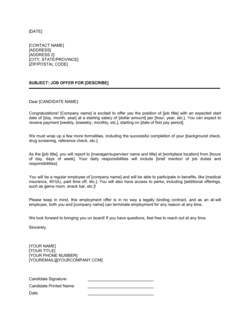
A job description defines the role — duties, qualifications, reporting structure, and compliance obligations. An offer letter confirms the specific terms offered to a named candidate — salary, start date, and contingencies such as background check or reference clearance. Both documents are needed: the job description governs the role; the offer letter governs the hire. Relying on the offer letter alone leaves the organization without a documented basis for performance management against specific role expectations.

Are there pay transparency laws that affect how I post this job description?

Yes. As of 2025, California, Colorado, New York, Washington, Illinois, and several other states require employers to disclose a salary range on job postings — including internal postings in some jurisdictions. Some laws also require disclosure of the pay range upon request, even if not posted. Violations carry civil penalties ranging from $500 to $10,000 per violation depending on the state. Review the applicable law for each location where the position will be posted before publishing.

How this compares to alternatives

vs Employment Contract

An employment contract is the binding agreement governing the entire employment relationship — compensation, IP assignment, non-compete, and termination. A job description defines the role's duties and qualifications and is typically incorporated by reference into the contract. Neither document replaces the other: the contract creates enforceable obligations; the job description provides the operational content that governs performance management.

vs Offer Letter

An offer letter confirms the specific terms of employment offered to a named candidate — salary, start date, and contingencies. It does not describe duties, qualifications, or compliance obligations in detail. A job description fills that gap and should be attached to or referenced in the offer letter so the candidate acknowledges both documents at hire.

vs Independent Contractor Agreement

An independent contractor agreement engages a self-employed individual for defined project work with no employment entitlements — no benefits, no overtime, no mandated reporter classification as an employee. Misclassifying a social service manager as a contractor triggers payroll tax liability, benefit exposure, and potential violations of state licensing laws requiring licensed professionals to practice as employees in supervised settings.

vs Employee Performance Review

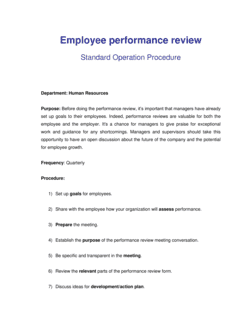
A performance review evaluates how well the employee has met the expectations defined in the job description over a review period. The job description is the foundational document; the performance review measures against it. Without a current, accurate job description, performance reviews lack an objective baseline and become legally vulnerable in wrongful termination or discrimination claims.

Industry-specific considerations

Nonprofit and Social Services

Program managers in nonprofits typically oversee grant-funded initiatives with funder-specific staffing and reporting requirements embedded directly in the job description.

Government and Public Administration

Public sector roles require civil service classification, union agreement alignment, and detailed KSA documentation that follows standardized government position description formats.

Healthcare and Social Work

Healthcare-adjacent roles often require licensure conditions precedent (LCSW, LPC), HIPAA confidentiality obligations, and clinical supervision scope-of-practice boundaries in the job description.

Education and Youth Services

Roles serving minors require enhanced background check language, mandated reporter obligations under child welfare statutes, and safe-messaging compliance for mental health programs.

Jurisdictional notes

United States

Social service managers are mandated reporters under child welfare and adult protective services statutes in all 50 states, with reporting timelines ranging from 24 to 72 hours. FLSA exempt classification must be verified against the current salary threshold ($684/week as of 2025). Pay transparency laws in California, Colorado, New York, Washington, and Illinois require salary ranges on job postings. Roles serving federally funded programs must comply with applicable grant-specific staffing and documentation standards.

Canada

Mandatory reporting obligations for child protection exist under provincial child welfare legislation in all provinces, with specific duties attached to social service professionals. Employment standards in each province set minimum notice and termination entitlements that must not be undercut by job description language. Quebec requires that job descriptions and employment documents be available in French for employees in the province. Pay equity legislation in Ontario and federally regulated employers requires documented job evaluation to support compensation decisions.

United Kingdom

Employers must provide a written statement of employment particulars — which incorporates the job description — on or before day one under the Employment Rights Act 1996. Roles involving work with children or vulnerable adults require Disclosure and Barring Service (DBS) checks, which must be referenced in the job description. The Equality Act 2010 requires that qualifications requirements be objectively justified as proportionate to a legitimate aim. Mandated reporting obligations under the Children Act 1989 and the Care Act 2014 apply to social service professionals.

European Union

The EU Transparent and Predictable Working Conditions Directive requires written employment particulars including a description of duties within seven days of hire. GDPR applies to any personal data about clients or service users that the manager will access, and this must be referenced in the role's confidentiality obligations. Several member states — including Germany, France, and the Netherlands — require works council consultation before creating or materially changing managerial positions. Minimum qualification requirements for social work practice are set at the member state level and vary significantly across the EU.

Template vs lawyer — what fits your deal?

PathBest forCostTime
Use the templateNonprofits, small agencies, and HR teams hiring for standard domestic social service manager rolesFree30–60 minutes
Template + legal reviewRoles with federal grant funding requirements, licensure conditions, or positions in pay-transparency jurisdictions$200–$500 for an HR advisor or employment attorney review1–3 days
Custom draftedGovernment agencies with civil service classification requirements, unionized workplaces, or multi-jurisdiction organizations with complex compliance obligations$500–$2,000+1–2 weeks

Glossary

Job Description
A formal document outlining the duties, qualifications, reporting relationships, and expectations associated with a specific employment position.
Essential Functions
The core duties of a role that the employee must be able to perform, with or without reasonable accommodation — a legally significant distinction under the ADA and equivalent statutes.
Reporting Structure
The chain of supervisory authority above and below the position, identifying who the manager reports to and which staff they directly supervise.
Scope of Practice
The defined boundaries of professional activities a role holder is authorized to perform, particularly important in licensed or regulated social service settings.
FLSA Classification
The Fair Labor Standards Act designation — exempt or non-exempt — that determines whether the employee is entitled to overtime pay under US federal law.
KSAs (Knowledge, Skills, and Abilities)
The specific competencies required to perform a job effectively, commonly used in public sector and nonprofit hiring processes.
At-Will Employment
Employment that either party may end at any time for any lawful reason without advance notice — applicable in most US states but not in Canada, the UK, or the EU.
Reasonable Accommodation
A modification to the work environment or role requirements that enables a qualified employee with a disability to perform essential job functions without undue hardship to the employer.
Mandated Reporter
A professional, including many social service managers, who is legally required to report suspected abuse, neglect, or exploitation to a designated authority.
Program Manager
An employee responsible for planning, coordinating, and evaluating a specific service program or set of community initiatives, including budget and staff oversight.
Certification and Licensure Requirements
Credentials required by law or organizational policy as conditions of employment, such as Licensed Clinical Social Worker (LCSW) or Certified Nonprofit Professional (CNP).

Part of your Business Operating System

This document is one of 3,000+ business & legal templates included in Business in a Box.

  • Fill-in-the-blanks — ready in minutes
  • 100% customizable Word document
  • Compatible with all office suites
  • Export to PDF and share electronically

Create your document in 3 simple steps.

From template to signed document — all inside one Business Operating System.
1
Download or open template

Access over 3,000+ business and legal templates for any business task, project or initiative.

2
Edit and fill in the blanks with AI

Customize your ready-made business document template and save it in the cloud.

3
Save, Share, Send, Sign

Share your files and folders with your team. Create a space of seamless collaboration.

Save time, save money, and create top-quality documents.

★★★★★

"Fantastic value! I'm not sure how I'd do without it. It's worth its weight in gold and paid back for itself many times."

Managing Director · Mall Farm
Robert Whalley
Managing Director, Mall Farm Proprietary Limited
★★★★★

"I have been using Business in a Box for years. It has been the most useful source of templates I have encountered. I recommend it to anyone."

Business Owner · 4+ years
Dr Michael John Freestone
Business Owner
★★★★★

"It has been a life saver so many times I have lost count. Business in a Box has saved me so much time and as you know, time is money."

Owner · Upstate Web
David G. Moore Jr.
Owner, Upstate Web

Run your business with a system — not scattered tools

Stop downloading documents. Start operating with clarity. Business in a Box gives you the Business Operating System used by over 250,000 companies worldwide to structure, run, and grow their business.

Free Forever Plan · No credit card required