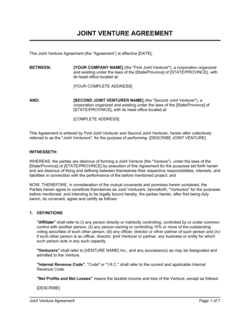
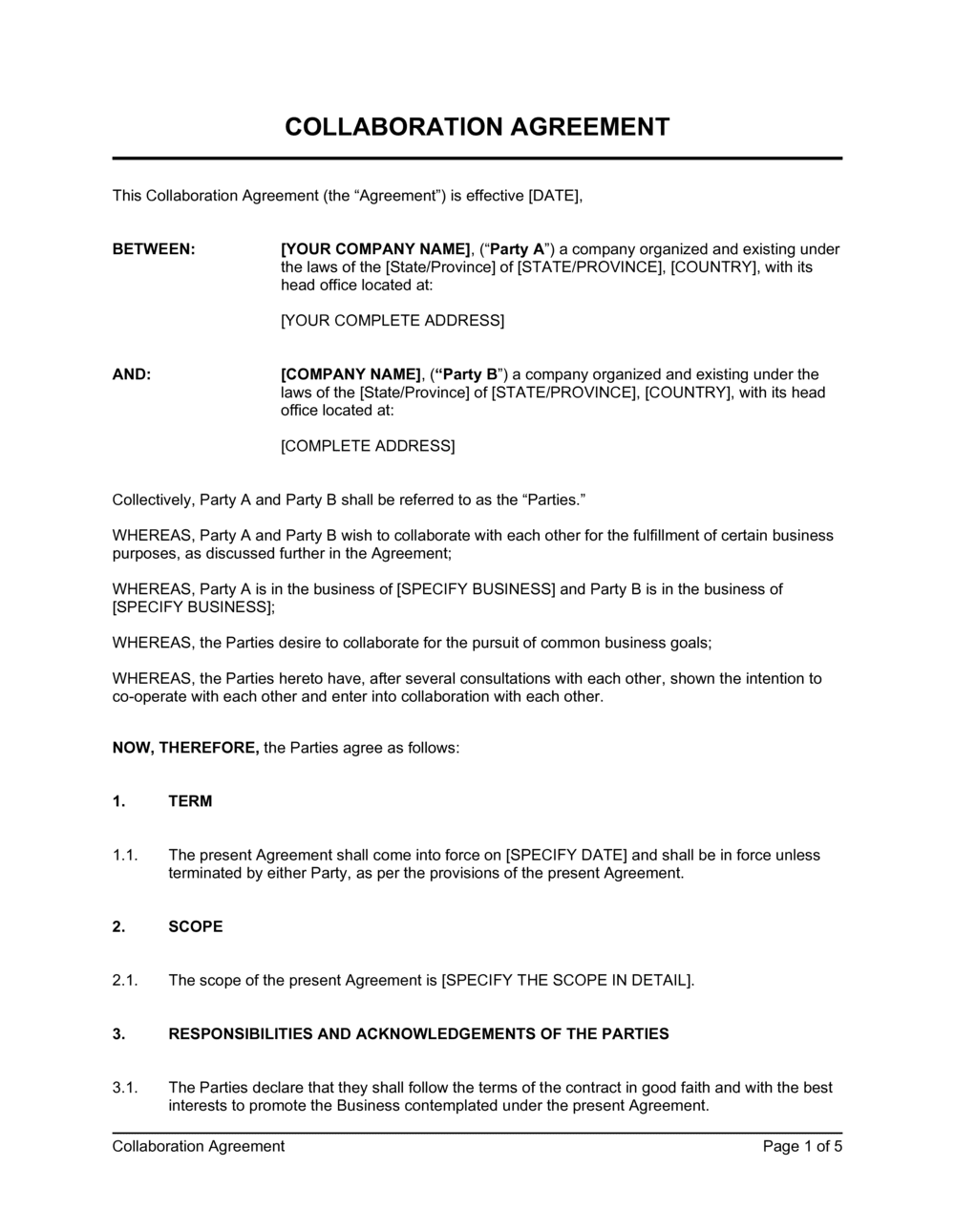
Collaboration Agreement Template

Free Word download β€’ Edit online β€’ Save & share with Drive β€’ Export to PDF

5 pagesβ€’25–35 min to fillβ€’Difficulty: Complexβ€’Signature requiredβ€’Legal review recommended
Learn more ↓
FreeCollaboration Agreement Template

At a glance

What it is
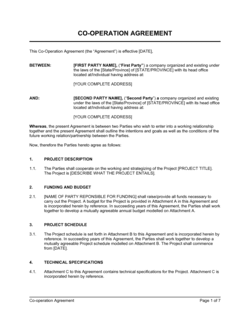
A Collaboration Agreement is a legally binding contract between two or more parties who agree to work together on a defined project, product, or initiative without forming a new legal entity. This free Word download covers contributions, decision-making authority, IP ownership, revenue sharing, exclusivity, confidentiality, and exit rights in a single document you can edit online and export as PDF.
When you need it
Use it whenever two or more businesses, freelancers, or creators join forces on a specific project β€” co-developing a product, co-authoring content, pitching a joint bid, or launching a co-branded initiative β€” and need to establish clear ownership and responsibilities before work begins.
What's inside
Parties and project scope, each party's contributions and responsibilities, decision-making and approval rights, IP ownership and licensing, revenue or profit-sharing formula, confidentiality obligations, exclusivity terms, and exit and termination provisions.

What is a Collaboration Agreement?

A Collaboration Agreement is a legally binding contract between two or more parties who agree to work together on a defined project, product, or initiative without forming a separate legal entity. It establishes each party's contributions, decision-making authority, IP ownership, revenue-sharing formula, confidentiality obligations, and exit rights in a single enforceable document. Unlike a joint venture agreement β€” which creates a new company or partnership β€” a collaboration agreement keeps each party legally independent while governing how they operate together for the duration of a specific project.

Why You Need This Document

Without a written collaboration agreement, every critical question defaults to jurisdiction-specific legal rules that rarely match what either party intended. Jointly created IP becomes co-owned by default in most common-law countries, meaning either party can exploit it independently and neither owes the other an accounting of revenues. Contributions made without a documented schedule give one party no legal recourse if the other underperforms. Revenue disputes over what counts as an allowable deduction become credibility contests rather than contract interpretation. A signed collaboration agreement, executed before the first work session or confidential disclosure, closes all of these gaps β€” giving both parties a clear, enforceable framework that protects what they bring to the table and defines exactly what they are building together.

Which variant fits your situation?

If your situation is…Use this template
Two parties co-developing a software product or SaaS applicationCo-Development Agreement
Two businesses pursuing a long-term strategic alliance rather than a single projectJoint Venture Agreement
Sharing confidential information before a collaboration is confirmedNon-Disclosure Agreement
One party licensing their IP to the other for a fee rather than sharing ownershipIntellectual Property License Agreement
Engaging a freelancer or contractor as part of the collaboration rather than as a co-partyIndependent Contractor Agreement
Two businesses forming a separate legal entity to pursue the opportunityJoint Venture Agreement
Co-authoring written content, courses, or media for shared distributionCo-Authorship Agreement

Common mistakes to avoid

❌ Vague project scope with open-ended language

Why it matters: Phrases like 'and related activities' or 'as mutually agreed' give parties conflicting expectations about what work and IP are covered, leading to disputes over ownership and payment.

Fix: Write a specific, bounded scope in Schedule A and include an explicit list of what is excluded. Amend the schedule formally if scope changes.

❌ Defaulting to joint IP ownership without defining exploitation rights

Why it matters: In most common-law jurisdictions, either co-owner can independently exploit jointly owned IP without the other's consent or any obligation to account for revenues β€” making joint ownership commercially useless or actively harmful.

Fix: Choose sole ownership with a licensed-back grant, or include an explicit joint-exploitation clause that requires mutual consent and revenue accounting.

❌ No deadlock resolution mechanism

Why it matters: When two parties have equal veto rights and disagree, the project stalls indefinitely β€” burning time, money, and the relationship β€” with no contractual path out.

Fix: Include a tiered escalation clause: project leads attempt resolution first, then senior officers within 10 business days, then binding mediation or a casting-vote mechanism.

❌ Using 'profits' in the revenue-sharing clause without defining allowable deductions

Why it matters: One party can load the project with overhead allocations, management fees, or soft costs that reduce 'profits' to zero β€” leaving the other party with nothing despite strong gross revenues.

Fix: Define Net Revenues with an exhaustive list of permitted deductions, a cap on each category, and an audit right so the non-reporting party can verify the numbers.

❌ No survival clause for IP and confidentiality obligations

Why it matters: Without explicit survival language, a party can argue that IP ownership and confidentiality protections lapse when the agreement terminates β€” exposing trade secrets and creating IP ownership ambiguity.

Fix: Add a survival clause stating that the IP ownership, confidentiality, indemnification, and revenue-sharing sections survive termination for a specified period or indefinitely.

❌ Signing after confidential information has already been exchanged

Why it matters: Confidential information disclosed before the agreement is signed is typically not protected by the agreement's confidentiality clause, leaving early disclosures legally unprotected.

Fix: Execute the agreement β€” or at minimum a standalone NDA β€” before the first substantive meeting. If information was already shared, add a clause expressly extending coverage to pre-signing disclosures.

The 10 key clauses, explained

Parties, recitals, and project scope

In plain language: Identifies each party's full legal name, the background context for the collaboration, and the specific project, product, or initiative the agreement covers.

Sample language
This Collaboration Agreement is entered into on [DATE] between [PARTY A LEGAL NAME], a [STATE/COUNTRY] [ENTITY TYPE] ('Party A'), and [PARTY B LEGAL NAME], a [STATE/COUNTRY] [ENTITY TYPE] ('Party B'). The parties intend to collaborate on [PROJECT DESCRIPTION] (the 'Project'), as further described in Schedule A.

Common mistake: Describing the project scope too broadly β€” phrases like 'and related activities' invite scope creep and disputes about what work is covered by the agreement's IP and revenue-sharing provisions.

Contributions and responsibilities

In plain language: States exactly what each party will contribute β€” money, labor, technology, data, facilities, or distribution β€” and who is responsible for each deliverable.

Sample language
Party A shall contribute: [CONTRIBUTION A] by [DATE]. Party B shall contribute: [CONTRIBUTION B] by [DATE]. Each party shall designate a project lead responsible for day-to-day coordination. Detailed deliverables, milestones, and timelines are set out in Schedule B.

Common mistake: Listing contributions at a high level without attaching a schedule of milestones and deadlines. Vague contribution clauses make it impossible to determine when a party is in default.

Decision-making and governance

In plain language: Defines who makes day-to-day decisions, which decisions require joint approval, and how deadlocks are broken.

Sample language
Day-to-day operational decisions may be made by each party's designated project lead. The following decisions require written approval from both parties: [LIST KEY DECISIONS]. In the event of a deadlock on a joint-approval matter, the parties shall escalate to [CEO / SENIOR OFFICER] of each party for resolution within [10] business days; if unresolved, either party may invoke the dispute resolution clause.

Common mistake: Granting both parties equal veto rights on all decisions without a deadlock mechanism. Equal veto with no resolution path brings the project to a halt the first time the parties disagree.

Background IP

In plain language: Clarifies that IP each party owned before the collaboration remains their sole property and that the other party receives only a limited license to use it for the project.

Sample language
Each party retains full ownership of its Background IP. Each party grants the other a non-exclusive, royalty-free, limited license to use its Background IP solely for the purposes of the Project during the Term. No Background IP is transferred by this Agreement.

Common mistake: Failing to define or schedule Background IP before signing. Without a list, disputes arise over whether a pre-existing asset was brought in as Background IP or was created as part of the project.

Foreground IP ownership and licensing

In plain language: Allocates ownership of all IP created during the collaboration β€” either to one party, jointly, or by category β€” and grants back any licenses needed by the non-owning party.

Sample language
All Foreground IP created jointly shall be owned [JOINTLY / SOLELY BY PARTY A / SOLELY BY PARTY B]. Where Foreground IP is owned solely by one party, that party grants the other a [non-exclusive / exclusive] license to use such IP for [PURPOSE] on the terms set out in Schedule C. Each party waives any moral rights in Foreground IP to the maximum extent permitted by law.

Common mistake: Defaulting to 'joint ownership' without addressing exploitation rights. In most jurisdictions, either co-owner can independently exploit jointly owned IP without accounting to the other β€” making joint ownership a trap unless usage rights are expressly defined.

Revenue sharing and costs

In plain language: States the formula for dividing gross or net revenues from the project's output, defines allowable costs, and sets the payment and reporting cadence.

Sample language
Net Revenues from the Project shall be divided: Party A [X]%, Party B [X]%. 'Net Revenues' means gross receipts less [DEFINED ALLOWABLE COSTS]. Party A shall maintain project accounts and provide monthly statements to Party B within [15] days of month end. Payment shall be made within [30] days of each statement.

Common mistake: Using 'profits' instead of 'net revenues' without defining allowable deductions. Parties routinely disagree on what costs may be deducted, turning a revenue-sharing clause into a permanent accounting dispute.

Confidentiality

In plain language: Requires both parties to protect each other's confidential information shared during the collaboration and restricts its use to project purposes.

Sample language
Each party shall hold the other's Confidential Information in strict confidence, use it solely for the purposes of this Agreement, and not disclose it to any third party without prior written consent. 'Confidential Information' means all non-public technical, financial, customer, and business information disclosed by one party to the other in connection with the Project.

Common mistake: Omitting a definition of Confidential Information and relying on a blanket clause. Without a definition, parties disagree over what was actually protected, and courts apply a reasonableness standard that may exclude critical information.

Exclusivity

In plain language: Restricts one or both parties from working with competing parties on a substantially similar project during the collaboration period.

Sample language
During the Term, [each party / Party A] shall not, without prior written consent, engage any third party to develop or produce a product or service substantially similar to the Project Output within [GEOGRAPHIC SCOPE / MARKET SEGMENT].

Common mistake: Including a mutual exclusivity clause without scoping it to the specific market or product category. An overbroad exclusivity clause can prevent a party from pursuing unrelated work and may be struck down as an unreasonable restraint of trade.

Term, termination, and exit

In plain language: Sets the duration of the agreement, the conditions under which either party may exit early, and what happens to IP, revenue, and obligations after termination.

Sample language
This Agreement commences on [START DATE] and continues until [END DATE / COMPLETION OF PROJECT], unless earlier terminated. Either party may terminate for cause upon [30] days' written notice if the other party materially breaches and fails to cure within [15] days. Either party may terminate for convenience on [60] days' written notice. On termination, each party shall return or destroy the other's Confidential Information, and Foreground IP ownership and revenue obligations shall survive as set out in Schedule C.

Common mistake: No survival clause for IP ownership and confidentiality. Without explicit survival language, a party could argue that IP and confidentiality obligations expire when the agreement does.

Liability, indemnification, and governing law

In plain language: Limits each party's liability to the other, specifies indemnification obligations for third-party claims, and states the jurisdiction whose law governs disputes.

Sample language
Neither party shall be liable to the other for indirect, consequential, or punitive damages arising from this Agreement. Each party shall indemnify and hold harmless the other from third-party claims arising from its own breach, negligence, or infringement. This Agreement is governed by the laws of [STATE / PROVINCE / COUNTRY]. Disputes shall be resolved by [binding arbitration / courts of [JURISDICTION]].

Common mistake: No liability cap. Without a cap β€” typically set to the total fees paid or payable under the agreement β€” an uncapped indemnity exposes parties to unlimited liability for a contract that may generate modest revenue.

How to fill it out

  1. 1

    Identify and name all parties precisely

    Enter each party's full registered legal name β€” not a trading name or brand. Include entity type (LLC, Ltd, Inc.) and jurisdiction of incorporation. For individual collaborators, use legal name and address.

    πŸ’‘ Pull the exact entity name from a corporate registry search before signing β€” a mismatch between the contract and the registered entity can complicate enforcement.

  2. 2

    Define the project scope in Schedule A

    Write a specific, bounded description of the project β€” what will be produced, what is explicitly excluded, and the geographic or market scope. Attach this as Schedule A referenced in the main body.

    πŸ’‘ If the scope is hard to write in two paragraphs, the project is not sufficiently defined. Nail down scope before signing, not during execution.

  3. 3

    Schedule each party's contributions and milestones

    List every contribution β€” cash, labor, IP, data, or access β€” with the responsible party, quantity or quality standard, and due date. Attach this as Schedule B.

    πŸ’‘ Use absolute calendar dates rather than relative ones ('60 days from signing') to prevent disputes when the signing date slips.

  4. 4

    List Background IP before signing

    Have each party prepare a written inventory of the pre-existing IP they are bringing to the project. Attach it as an exhibit. Be specific: name the software version, creative work, dataset, or patent.

    πŸ’‘ A Background IP list protects both parties β€” the owner keeps their asset, and the other party has certainty about what they can use.

  5. 5

    Choose and document the Foreground IP ownership model

    Decide whether new IP will be owned solely by one party, split by category, or held jointly. If jointly, specify in Schedule C who can exploit it, how, and whether accounting to the other party is required.

    πŸ’‘ Sole ownership with a licensed-back grant is usually cleaner than joint ownership β€” it eliminates the ambiguity of independent exploitation rights.

  6. 6

    Set the revenue-sharing formula and reporting cadence

    Define Net Revenues precisely β€” list every allowable deduction by category and cap. State the split percentage, the reporting party, the statement deadline, and the payment deadline.

    πŸ’‘ Require the reporting party to keep project accounts separate from their general business accounts to make monthly statements auditable.

  7. 7

    Calibrate exclusivity to scope and duration

    If exclusivity is needed, restrict it to the specific product category or market segment the project targets and set a fixed end date β€” typically coterminous with the project term or no more than 12 months post-completion.

    πŸ’‘ Do not include mutual exclusivity as a default. Only the party whose competitive risk justifies it should bear the restriction.

  8. 8

    Sign before any work or confidential information is exchanged

    Both parties must sign before the first meeting where project details, IP, or business data are disclosed. Retroactive execution creates gaps in confidentiality and IP protection.

    πŸ’‘ Use an electronic signature with a timestamp and audit trail β€” many jurisdictions accept e-signatures as legally equivalent to wet signatures for commercial agreements.

Frequently asked questions

What is a collaboration agreement?

A collaboration agreement is a legally binding contract between two or more parties who agree to work together on a specific project, product, or initiative without forming a separate legal entity. It governs each party's contributions, decision-making rights, IP ownership, revenue sharing, confidentiality, exclusivity, and exit terms. It is distinct from a joint venture agreement, which typically creates a new company or partnership structure.

When do I need a collaboration agreement?

Use one whenever two or more parties are contributing meaningful resources β€” money, IP, labor, or data β€” to a shared project, and the outcome will produce IP, revenue, or deliverables with real commercial value. Common triggers include co-developing a product, jointly bidding on a contract, co-authoring content, or launching a co-branded campaign. Without a written agreement, disputes over ownership and revenue default to jurisdiction-specific legal rules that rarely match what either party intended.

What is the difference between a collaboration agreement and a joint venture agreement?

A collaboration agreement governs cooperation on a specific project without creating a new legal entity. A joint venture agreement typically establishes a separate company, partnership, or limited liability vehicle through which the parties conduct business together. Collaboration agreements are faster to execute and more flexible; joint ventures are more appropriate for long-term, capital-intensive, or heavily regulated undertakings where a shared entity provides liability protection or tax structuring benefits.

Who owns the IP created during a collaboration?

Ownership of IP created during a collaboration β€” known as Foreground IP β€” depends entirely on what the agreement says. In the absence of a written allocation, most common-law jurisdictions default to joint ownership, which gives both parties independent exploitation rights with no obligation to account to each other. For most collaborations, sole ownership assigned to one party with a licensed-back grant to the other is cleaner and less likely to cause disputes.

Does a collaboration agreement need to be signed by a lawyer?

No β€” a well-drafted template is sufficient for most straightforward two-party project collaborations. Legal review is advisable when the project involves significant IP with long-term commercial value, when one party is contributing substantial capital, when the parties are in different jurisdictions, or when exclusivity restrictions are material to either party's business. A 1–2 hour lawyer review typically costs $300–$700 and can prevent disputes worth far more.

Can a collaboration agreement be terminated early?

Yes, if the agreement includes termination provisions β€” which it should. A well-drafted agreement will allow termination for cause (material breach uncured after notice) and termination for convenience (no-fault exit with adequate notice, typically 30–90 days). The agreement should also specify what happens to Foreground IP, confidentiality obligations, and any outstanding revenue splits when either termination trigger is activated.

Is a collaboration agreement enforceable in multiple countries?

The agreement's enforceability across jurisdictions depends on the governing-law clause and the nature of the obligations. In general, commercial contracts are enforceable internationally when the agreement specifies a governing law, the parties are identifiable legal entities, and the obligations are lawful in both jurisdictions. IP ownership and non-compete restrictions are the most likely to vary in enforceability by country. For cross-border collaborations, consider specifying arbitration in a neutral jurisdiction rather than relying on local courts.

What happens to background IP if the collaboration fails?

Background IP β€” IP each party owned before the collaboration β€” should remain with its original owner regardless of how the project ends. A properly drafted collaboration agreement will state this explicitly and include a provision requiring each party to return or destroy the other's Background IP materials on termination. If Background IP is not expressly listed and protected, a dispute over what was contributed versus what was created during the project can cloud ownership post-termination.

Do I need a separate NDA before signing a collaboration agreement?

Not necessarily β€” a collaboration agreement typically includes a confidentiality clause that protects information exchanged during the project. However, if parties need to share sensitive information before the collaboration agreement is finalized β€” for example, during due diligence or scoping discussions β€” a standalone NDA should be executed first. Some collaboration agreements can be drafted to extend confidentiality protection to pre-signing disclosures by including explicit retroactive coverage language.

How this compares to alternatives

vs Joint Venture Agreement

A joint venture agreement creates a separate legal entity β€” a new company or partnership β€” through which the parties do business together. A collaboration agreement keeps each party legally independent and governs cooperation on a specific project only. Joint ventures suit long-term, capital-intensive endeavors; collaboration agreements suit defined, time-limited projects where forming a new entity would add unnecessary complexity.

vs Non-Disclosure Agreement

An NDA protects confidential information exchanged between parties but creates no obligations around IP ownership, contributions, or revenue sharing. A collaboration agreement includes confidentiality provisions but also governs every other dimension of working together. Use an NDA alone during early exploratory discussions; switch to a collaboration agreement once the project is defined and work is about to begin.

vs Independent Contractor Agreement

An independent contractor agreement engages a service provider to deliver work for a fee β€” the contractor has no ownership stake in the output. A collaboration agreement treats both parties as co-contributors with shared rights and obligations. If one party is being paid to contribute rather than co-owning the outcome, an independent contractor agreement is the correct instrument.

vs Intellectual Property License Agreement

An IP license agreement grants one party permission to use another party's existing IP in exchange for royalties or a fee β€” no joint creation, no contributions, no shared governance. A collaboration agreement governs the creation of new IP together and allocates ownership of what is built. Use a license agreement when one party owns IP the other wants to use; use a collaboration agreement when both parties are building something new together.

Industry-specific considerations

Technology / SaaS

Co-development agreements covering software ownership by module, API integration rights, data licensing, and revenue sharing on jointly marketed SaaS products.

Creative and media

Co-production of courses, podcasts, films, or publications requires explicit allocation of moral rights, distribution channel exclusivity, and royalty-split formulas by revenue stream.

Professional services

Agency or consultant teaming arrangements for joint bids and project delivery require clear sub-contracting boundaries, client non-solicitation terms, and confidentiality for client data.

Life sciences and research

Academic and commercial research collaborations must address publication rights, patent filing obligations, sponsored research obligations, and regulatory data ownership.

Jurisdictional notes

United States

No single federal statute governs collaboration agreements β€” they are treated as commercial contracts under state law, with the UCC applying to any goods components. IP assignment is governed by the Copyright Act and patent law; absent a written assignment, jointly created works are co-owned with independent exploitation rights. Non-compete and exclusivity restrictions vary sharply by state β€” California broadly restricts them. Choose a specific state's law as the governing law rather than leaving it to default rules.

Canada

Collaboration agreements in Canada are governed by provincial contract law. In Quebec, civil law principles apply and French-language versions are required for provincially regulated entities. Under Canadian copyright law, jointly authored works are co-owned, and neither co-owner can exploit the work without the other's consent β€” stricter than the US default. IP assignment clauses must be in writing to be effective. Non-solicitation and exclusivity restrictions are enforceable if reasonable in scope and duration.

United Kingdom

In the UK, collaboration agreements are binding commercial contracts governed by English, Scottish, or Northern Irish law depending on the parties' location. Under the Copyright, Designs and Patents Act 1988, jointly created works vest in both authors, and consent of all co-owners is required for exploitation β€” making a sole-ownership-plus-license structure preferable. Post-Brexit, EU IP registrations no longer automatically cover the UK; collaborations producing registered IP should address UK and EU filings separately.

European Union

EU member state contract law governs collaboration agreements, with significant variation across jurisdictions. GDPR applies wherever personal data is shared between parties during the collaboration β€” a data processing or data sharing agreement may be required alongside the collaboration agreement. Moral rights are stronger and less waivable in most EU jurisdictions than in common-law countries. Exclusivity clauses must not restrict competition in a way that infringes Article 101 TFEU, particularly for larger market participants.

Template vs lawyer β€” what fits your deal?

PathBest forCostTime
Use the templateTwo-party project collaborations with modest IP value, clear scope, and a single jurisdictionFree30–60 minutes
Template + legal reviewCollaborations involving significant IP, cross-border parties, material exclusivity restrictions, or revenue above $50K$300–$7002–5 days
Custom draftedMulti-party collaborations, life sciences or regulated-industry projects, long-term arrangements with complex IP portfolios or substantial capital contributions$2,000–$8,000+1–4 weeks

Glossary

Collaboration Agreement
A contract governing the terms under which two or more parties work together on a defined project without creating a new legal entity.
Joint Venture
A separate legal structure formed by two or more parties to pursue a shared business opportunity β€” distinct from a collaboration agreement, which does not create a new entity.
Background IP
Intellectual property owned by a party before the collaboration begins, which that party brings into the project but does not transfer ownership of.
Foreground IP
Intellectual property created during the collaboration β€” its ownership must be explicitly allocated in the agreement or it defaults to joint ownership under most laws.
Revenue Sharing
A formula stating how gross or net revenues generated from the collaboration's output are divided among the parties.
Exclusivity
A clause preventing one or both parties from working with competing parties on a similar project during a defined period.
Decision-Making Authority
The rules determining which party has final say on specific types of decisions β€” typically separated into day-to-day operational decisions and major strategic approvals.
Moral Rights
Non-economic rights of a creator to attribution and integrity of their work, which in many jurisdictions cannot be assigned and must be expressly waived.
Indemnification
A contractual obligation for one party to compensate the other for losses or liabilities arising from a specified breach or act.
Force Majeure
A clause excusing a party from performance obligations when an unforeseeable event outside their control β€” such as a natural disaster or government action β€” prevents them from performing.
Deadlock
A situation where two parties with equal decision-making rights cannot reach agreement, requiring a pre-agreed resolution mechanism such as escalation, mediation, or a casting vote.
Termination for Convenience
A right allowing one or both parties to end the agreement without cause by giving a defined period of written notice.

Part of your Business Operating System

This document is one of 3,000+ business & legal templates included in Business in a Box.

  • Fill-in-the-blanks β€” ready in minutes
  • 100% customizable Word document
  • Compatible with all office suites
  • Export to PDF and share electronically

Create your document in 3 simple steps.

From template to signed document β€” all inside one Business Operating System.
1
Download or open template

Access over 3,000+ business and legal templates for any business task, project or initiative.

2
Edit and fill in the blanks with AI

Customize your ready-made business document template and save it in the cloud.

3
Save, Share, Send, Sign

Share your files and folders with your team. Create a space of seamless collaboration.

Save time, save money, and create top-quality documents.

β˜…β˜…β˜…β˜…β˜…

"Fantastic value! I'm not sure how I'd do without it. It's worth its weight in gold and paid back for itself many times."

Managing Director Β· Mall Farm
Robert Whalley
Managing Director, Mall Farm Proprietary Limited
β˜…β˜…β˜…β˜…β˜…

"I have been using Business in a Box for years. It has been the most useful source of templates I have encountered. I recommend it to anyone."

Business Owner Β· 4+ years
Dr Michael John Freestone
Business Owner
β˜…β˜…β˜…β˜…β˜…

"It has been a life saver so many times I have lost count. Business in a Box has saved me so much time and as you know, time is money."

Owner Β· Upstate Web
David G. Moore Jr.
Owner, Upstate Web

Run your business with a system β€” not scattered tools

Stop downloading documents. Start operating with clarity. Business in a Box gives you the Business Operating System used by over 250,000 companies worldwide to structure, run, and grow their business.

Start freeΒ Β·Β No credit card required