Compliance Agreement Template

Free Word download β€’ Edit online β€’ Save & share with Drive β€’ Export to PDF

3 pagesβ€’25–30 min to fillβ€’Difficulty: Standardβ€’Signature requiredβ€’Legal review recommended
Learn more ↓
FreeCompliance Agreement Template

At a glance

What it is
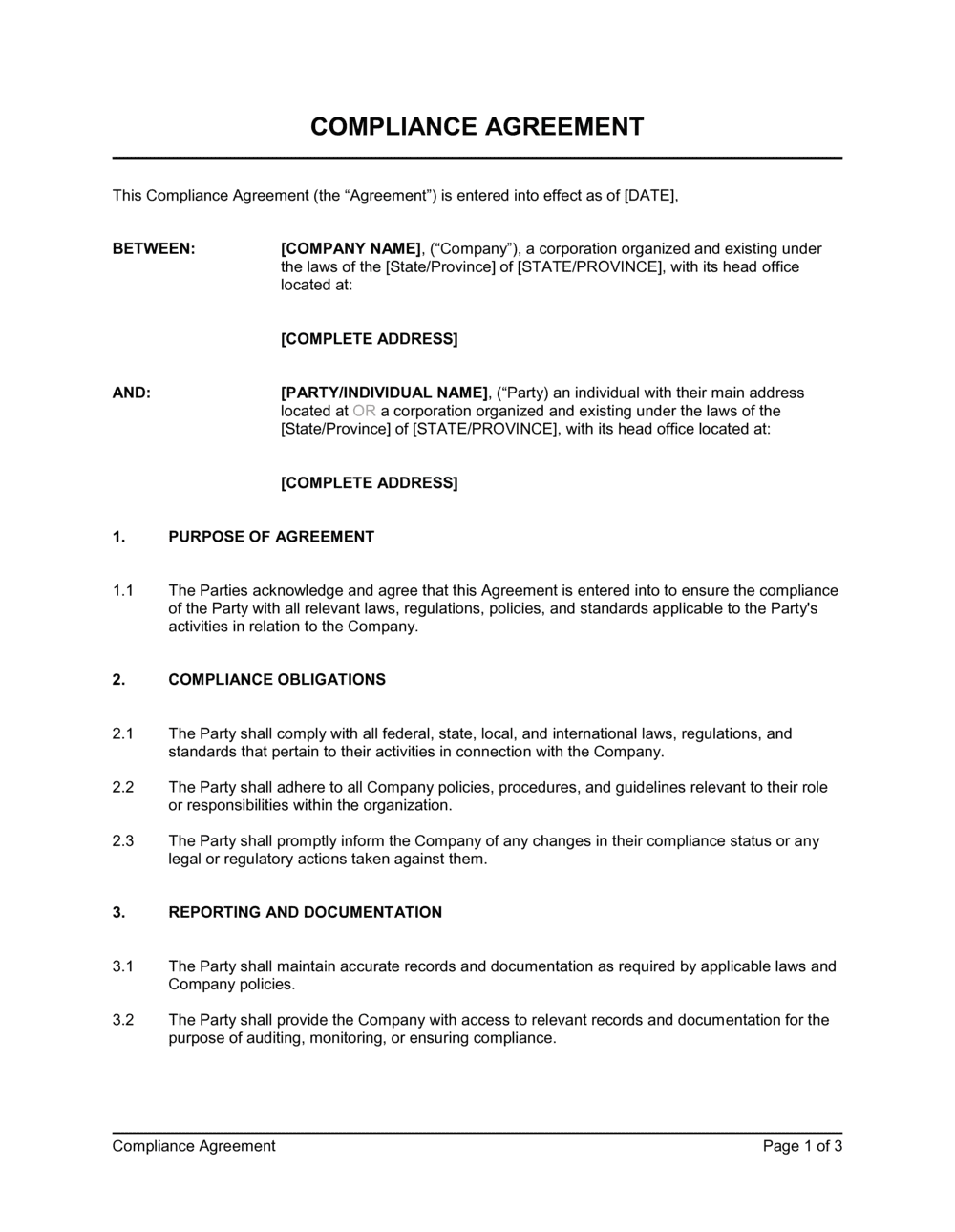
A Compliance Agreement is a legally binding contract in which one or both parties formally commit to adhering to specific laws, regulations, internal policies, or industry standards. This free Word download gives you a structured starting point covering obligations, representations, monitoring rights, reporting requirements, and remedies for breach β€” ready to edit online and export as PDF.
When you need it
Use it when onboarding a vendor or contractor whose activities could expose your organization to regulatory liability, when a regulator requires a written commitment as a condition of licensing or settlement, or when internal policy requires documented acknowledgment of compliance obligations from employees, partners, or third parties.
What's inside
Parties and recitals, defined compliance obligations and applicable regulatory frameworks, representations and warranties, monitoring and audit rights, reporting and recordkeeping requirements, remedies and consequences for breach, term and termination provisions, and governing law with dispute resolution.

What is a Compliance Agreement?

A Compliance Agreement is a legally binding contract in which one or both parties formally commit to adhering to specific laws, regulations, industry standards, or internal policies relevant to their business relationship. Unlike a general services or vendor contract that governs commercial terms, a compliance agreement focuses specifically on the regulatory dimension of the relationship β€” defining which obligations apply, how compliance will be monitored and documented, what the counterparty must report and when, and what consequences follow if those obligations are not met. It functions as both a risk management instrument and a due diligence record, demonstrating to regulators, auditors, and courts that an organization took affirmative steps to ensure its counterparties operate within the required legal and policy framework.

Why You Need This Document

Without a signed compliance agreement, your organization's exposure to a counterparty's regulatory failures is largely undefined. If a vendor mishandles protected health data, a contractor violates anti-bribery rules, or a subcontractor breaches export control requirements, the absence of a written compliance commitment makes it significantly harder to terminate the relationship, pursue indemnification, or demonstrate to a regulator that you exercised appropriate oversight. Regulatory authorities in the US, Canada, the UK, and the EU increasingly treat third-party compliance management as a direct obligation of the contracting organization β€” not just of the third party itself. A GDPR enforcement action, an FCPA investigation, or an OSHA compliance review can all extend liability to the principal when no documented compliance framework was in place. This template gives you a structured, enforceable starting point that establishes clear obligations, preserves your audit and termination rights, and creates the paper trail that protects your organization if a counterparty's conduct is ever called into question.

Which variant fits your situation?

If your situation is…Use this template
Requiring a vendor or supplier to comply with your data protection standardsData Processing Agreement
Documenting an employee's acknowledgment of workplace policiesEmployee Policy Acknowledgment Form
Formalizing a regulatory settlement or consent order commitmentConsent Order Agreement
Ensuring a contractor meets anti-bribery and anti-corruption standardsAnti-Bribery Compliance Agreement
Binding a business partner to confidentiality alongside compliance obligationsNon-Disclosure Agreement
Establishing ongoing compliance requirements within a vendor relationshipVendor Agreement
Documenting health and safety compliance obligations for a contractorHealth and Safety Compliance Agreement

Common mistakes to avoid

❌ Listing compliance obligations without citing specific statutes

Why it matters: Generic language like 'all applicable laws' gives the counterparty maximum interpretive flexibility and makes breach difficult to prove β€” a regulator or court needs to know exactly which obligation was violated.

Fix: Name every relevant statute, regulation, and standard by its official title and section number in a dedicated obligations schedule, updated whenever the regulatory landscape changes.

❌ No immediate termination right for uncurable breaches

Why it matters: A mandatory cure period for serious violations β€” fraud, criminal conduct, or a regulatory sanction β€” leaves the company contractually bound to a counterparty whose conduct may be escalating enforcement risk in real time.

Fix: Add a separate uncurable breach clause listing specific triggering events (criminal indictment, regulatory license revocation, material fraud) that permit immediate termination without a notice or cure window.

❌ Omitting third-party flow-down liability

Why it matters: Counterparties routinely subcontract regulated activities. Without a clause making the counterparty directly liable for subcontractor failures, the company cannot recover losses caused by a party it never contracted with.

Fix: Require the counterparty to impose equivalent compliance obligations on all subcontractors and agents, and confirm in writing that it remains directly liable to the company for any subcontractor breach.

❌ Setting a vague breach notification window

Why it matters: Phrases like 'promptly notify' or 'without undue delay' are litigated in virtually every compliance breach dispute and produce inconsistent results β€” some courts allow weeks, others require hours.

Fix: Specify the exact number of hours or business days for initial breach notification, aligned to the most demanding statutory requirement applicable to the regulated activity.

❌ Mutual indemnification where the risk is one-sided

Why it matters: If the compliance risk flows primarily from the counterparty's activities β€” a vendor handling regulated data, a contractor operating in a licensed environment β€” a mutual indemnification clause dilutes the company's recovery position and may cap claims incorrectly.

Fix: Use one-directional indemnification from counterparty to company for compliance failures, and limit the company's indemnity exposure to claims arising solely from the company's own breach.

❌ No governing-law clause or a purely opportunistic jurisdiction selection

Why it matters: Courts and regulators in the US, Canada, and EU regularly override governing-law selections that have no meaningful connection to the regulated activity β€” particularly when mandatory local employment or consumer protection law applies.

Fix: Select the jurisdiction where the regulated activity primarily occurs or where both parties primarily operate, and confirm this choice is consistent with any mandatory regulatory requirements in that jurisdiction.

The 10 key clauses, explained

Parties and Recitals

In plain language: Identifies the full legal names of all parties and briefly explains the context and purpose of the compliance commitments being made.

Sample language
This Compliance Agreement ('Agreement') is entered into as of [DATE] between [COMPANY LEGAL NAME], a [STATE/JURISDICTION] [ENTITY TYPE] ('Company'), and [COUNTERPARTY LEGAL NAME] ('Counterparty'). The parties enter into this Agreement to establish and document the compliance obligations applicable to Counterparty's activities on behalf of or in connection with Company.

Common mistake: Using a trade name or brand name instead of the registered legal entity name. If the entity named does not match the signing party's registration, enforcement and indemnification claims become difficult to pursue.

Defined Compliance Obligations

In plain language: Lists the specific laws, regulations, standards, and internal policies the counterparty must comply with, with enough precision that a court could assess adherence.

Sample language
Counterparty shall comply with all applicable laws and regulations, including but not limited to: (a) [APPLICABLE STATUTE OR REGULATION], (b) [INDUSTRY STANDARD, e.g., ISO 27001 / HIPAA / GDPR], and (c) Company's [POLICY NAME] as updated from time to time and communicated in writing to Counterparty.

Common mistake: Referencing obligations only by category β€” 'all applicable laws' β€” without naming the specific statutes or standards relevant to the relationship. Vague obligations are harder to enforce and give the counterparty too much interpretive latitude.

Representations and Warranties

In plain language: The counterparty confirms at signing that it currently meets the compliance standards required, has the necessary licenses and authorizations, and is not subject to any pending enforcement action.

Sample language
Counterparty represents and warrants that as of the Effective Date: (a) it holds all licenses, permits, and authorizations required to perform its obligations; (b) it is not the subject of any pending or threatened regulatory action; and (c) its current operations are in compliance with all obligations set forth in Section [X].

Common mistake: Omitting a warranty that the counterparty is not already under investigation or subject to a prior consent order. Discovering a pre-existing enforcement matter after signing exposes the company to reputational and regulatory risk.

Monitoring and Audit Rights

In plain language: Grants the company the right to audit the counterparty's records, systems, or facilities to verify ongoing compliance, with defined notice requirements and cost allocation.

Sample language
Company reserves the right, upon [15] days' written notice, to audit Counterparty's relevant records, systems, and facilities to verify compliance with this Agreement. Counterparty shall cooperate fully with any such audit. Costs of routine audits shall be borne by Company; costs of audits triggered by a suspected breach shall be borne by Counterparty.

Common mistake: Including audit rights without specifying the notice period, scope, or who bears the cost. An open-ended audit right can be disruptive and may be resisted β€” specificity reduces friction and makes the right more enforceable.

Reporting and Recordkeeping

In plain language: Requires the counterparty to maintain records demonstrating compliance and to report any known or suspected violations to the company within a defined timeframe.

Sample language
Counterparty shall maintain complete and accurate records sufficient to demonstrate compliance with this Agreement for a period of [5] years from the date of each relevant activity. Counterparty shall notify Company in writing within [72] hours of discovering any actual or suspected violation of this Agreement or any applicable law.

Common mistake: Setting a notification window of 'promptly' or 'as soon as practicable' rather than a specific number of hours or days. Vague timing language is routinely tested during breach disputes β€” courts look for certainty.

Third-Party and Subcontractor Compliance

In plain language: Requires the counterparty to flow down compliance obligations to any subcontractors, agents, or affiliates involved in the activities covered by the agreement.

Sample language
Counterparty shall ensure that any subcontractor, agent, or affiliate engaged in activities within the scope of this Agreement is bound by obligations no less stringent than those set forth herein. Counterparty remains directly liable to Company for any compliance failure by such third parties.

Common mistake: Requiring flow-down obligations without retaining the counterparty's direct liability for subcontractor failures. If the counterparty can shift all blame to a subcontractor, the company's enforcement position collapses.

Remedies for Breach and Cure Period

In plain language: Defines what happens when a compliance obligation is violated β€” including the notice process, the cure period, and the remedies available if the breach is not cured.

Sample language
Upon discovery of a material breach, Company shall provide written notice to Counterparty specifying the nature of the breach. Counterparty shall have [30] days from receipt of notice to cure the breach. If the breach is not cured within the cure period, Company may, at its election: (a) terminate this Agreement immediately; (b) seek specific performance; or (c) pursue indemnification as provided in Section [X].

Common mistake: Failing to distinguish between material and non-material breaches. Treating all violations equally β€” from minor recordkeeping lapses to serious regulatory violations β€” either over-triggers termination rights or under-protects against serious failures.

Indemnification

In plain language: Requires the counterparty to compensate the company for any losses, regulatory fines, legal costs, or damages arising from the counterparty's compliance failure.

Sample language
Counterparty shall indemnify, defend, and hold harmless Company and its officers, directors, and employees from any claims, penalties, fines, or damages arising out of or related to Counterparty's failure to comply with its obligations under this Agreement or any applicable law.

Common mistake: Mutual indemnification clauses when one party β€” typically the regulated counterparty β€” bears the compliance risk. Mutual indemnification can dilute the company's recovery position and create perverse incentives.

Term and Termination

In plain language: Sets the duration of the compliance obligations and the conditions under which either party may terminate the agreement, including immediate termination rights for serious breaches.

Sample language
This Agreement shall commence on the Effective Date and continue for [TERM] unless earlier terminated. Either party may terminate with [30] days' written notice. Company may terminate immediately upon written notice if Counterparty commits a material breach that is not capable of cure or fails to cure a curable breach within the period specified in Section [X].

Common mistake: No immediate termination right for uncurable breaches. If a counterparty is found to have committed fraud, bribery, or a serious regulatory violation, a 30-day cure notice requirement leaves the company exposed during that window.

Governing Law and Dispute Resolution

In plain language: Specifies which jurisdiction's law governs the agreement and how disputes are resolved β€” litigation, arbitration, or mediation β€” with a venue clause.

Sample language
This Agreement shall be governed by the laws of [STATE / PROVINCE / COUNTRY], without regard to conflict-of-law principles. Any dispute arising under this Agreement shall be resolved by [binding arbitration / litigation] in [CITY, JURISDICTION], except that either party may seek injunctive relief in any court of competent jurisdiction.

Common mistake: Selecting a governing jurisdiction with no meaningful connection to either party's operations. Courts in the US, Canada, and EU regularly override governing-law selections that are purely opportunistic β€” particularly when mandatory regulatory law is at stake.

How to fill it out

  1. 1

    Identify the parties and the compliance context

    Enter the full registered legal name, entity type, and jurisdiction of incorporation for both parties. In the recitals, briefly describe the business relationship and the regulatory context that requires this agreement.

    πŸ’‘ Cross-reference corporate registry filings for both parties before inserting names β€” trade names and legal entity names differ more often than expected.

  2. 2

    List the specific compliance obligations by statute and standard

    Name every applicable law, regulation, industry standard, and internal policy by its full official title. For each, note whether it is a current requirement or a condition being imposed by this agreement.

    πŸ’‘ If the relationship spans multiple jurisdictions, create a Schedule A listing obligations by jurisdiction rather than embedding them all in the body clause.

  3. 3

    Draft the representations and warranties

    Have the counterparty confirm in writing that it currently holds all required licenses, is not under enforcement investigation, and that its existing operations meet the standards being agreed to.

    πŸ’‘ Ask the counterparty to attach copies of key licenses or certifications as an exhibit β€” this creates a baseline record against which future audits can be compared.

  4. 4

    Define audit rights with notice and cost terms

    Set a specific advance-notice period (15–30 days is standard for routine audits), define the scope of what can be reviewed, and allocate audit costs between parties depending on whether the audit is routine or triggered by suspected breach.

    πŸ’‘ Include a right to audit subcontractors on the same terms β€” third-party compliance failures are the most common source of corporate regulatory liability.

  5. 5

    Set reporting timelines and recordkeeping periods

    Specify the exact number of hours or days the counterparty has to report a discovered violation, and the number of years records must be retained. Align these periods with the requirements of the applicable regulatory framework.

    πŸ’‘ For HIPAA-covered entities, a 72-hour breach notification window is a regulatory minimum β€” do not set a contractual window longer than the applicable statutory requirement.

  6. 6

    Configure the breach, cure, and remedies sequence

    Distinguish curable from uncurable breaches. Set a cure period of 15–30 days for minor violations. Reserve immediate termination rights for fraud, criminal conduct, or regulatory sanctions. List the full menu of remedies available β€” termination, specific performance, and indemnification.

    πŸ’‘ Add a remediation plan requirement for curable breaches β€” requiring the counterparty to submit a written corrective action plan within the cure period creates accountability and a paper trail.

  7. 7

    Select the governing law and dispute resolution method

    Choose a jurisdiction with a substantive connection to the agreement β€” where the regulated activity occurs or where the company is headquartered. Decide between arbitration and litigation based on confidentiality needs, cost tolerance, and the likely value of disputes.

    πŸ’‘ If confidentiality of regulatory matters is important, arbitration with a confidentiality clause is preferable to court litigation β€” court filings are public records in most jurisdictions.

  8. 8

    Execute before the regulated activity begins

    Both parties must sign the agreement before any work or activity subject to the compliance obligations commences. Retroactive compliance agreements are difficult to enforce and may not satisfy regulatory requirements.

    πŸ’‘ Use a tracked-execution method β€” e-signature with a timestamp audit trail β€” so you can demonstrate to a regulator exactly when each party accepted the obligations.

Frequently asked questions

What is a compliance agreement?

A compliance agreement is a binding contract in which one or both parties formally commit to adhering to specific laws, regulations, internal policies, or industry standards. It documents the scope of compliance obligations, sets out audit and reporting rights, and establishes consequences for breach. Businesses use compliance agreements with vendors, contractors, employees, and regulated counterparties to manage regulatory exposure and demonstrate due diligence to oversight bodies.

When do I need a compliance agreement?

You typically need a compliance agreement when engaging a vendor or contractor whose activities could expose your organization to regulatory liability β€” such as data processors, healthcare subcontractors, or financial services providers. Regulators may also require a signed compliance agreement as a condition of licensing, certification, or settlement. Internally, compliance agreements are used to formalize employee or partner acknowledgment of mandatory legal obligations.

What is the difference between a compliance agreement and a standard contract?

A standard contract governs the commercial terms of a transaction β€” price, deliverables, timelines, and liability. A compliance agreement focuses specifically on regulatory and policy obligations: which laws apply, how they must be met, how compliance is monitored, and what happens when a violation occurs. The two documents are often used together β€” a vendor agreement governs the commercial relationship, while a compliance agreement governs the regulatory dimension of that same relationship.

Is a compliance agreement legally enforceable?

A compliance agreement is generally enforceable as a contract when it meets the standard requirements: offer, acceptance, consideration, and the legal capacity of both parties to enter the agreement. Courts in most jurisdictions treat signed compliance agreements as binding obligations, and regulators may use them as evidence of a party's formal commitments during enforcement proceedings. Enforceability depends on the specificity of the obligations β€” vague language weakens enforcement.

What remedies are available if a compliance agreement is breached?

Typical remedies include termination of the agreement, indemnification for losses and regulatory fines, specific performance requiring the counterparty to take corrective action, and injunctive relief to stop ongoing violations. For serious or uncurable breaches β€” such as criminal conduct or regulatory license revocation β€” immediate termination without a cure period is standard. Liquidated damages clauses are sometimes used when the cost of a compliance failure is predictable in advance.

Do I need a lawyer to draft a compliance agreement?

For routine vendor or contractor compliance acknowledgments, a high-quality template is typically sufficient. Engage a lawyer when the agreement is required by a regulatory authority as part of a settlement, when the counterparty operates in a heavily regulated industry such as healthcare or financial services, when the compliance obligations span multiple jurisdictions, or when the potential indemnification exposure is material. A template review by counsel typically costs $400–$800 and is worthwhile for high-risk relationships.

What recordkeeping obligations should a compliance agreement include?

A compliance agreement should require the counterparty to maintain records sufficient to demonstrate compliance for a defined retention period β€” typically five to seven years, aligned to the statute of limitations under the applicable regulatory framework. Records should cover the activities subject to compliance, audit results, incident reports, and any corrective actions taken. The agreement should specify the format and accessibility requirements for those records during an audit.

How often should a compliance agreement be reviewed and updated?

Review compliance agreements at least annually and whenever a material change occurs in the applicable regulatory framework β€” new legislation, agency guidance, or a change in the counterparty's scope of activities. Agreements that reference specific statutes by name become outdated quickly when regulations are amended. Build in a clause requiring both parties to negotiate in good faith to update the obligations schedule when the underlying regulatory requirements change.

How this compares to alternatives

vs Non-Disclosure Agreement

An NDA governs the protection and handling of confidential information between parties. A compliance agreement governs adherence to laws, regulations, and internal policies across a broader set of activities. In regulated industries, the two documents are often executed together β€” the NDA covers data confidentiality while the compliance agreement covers the regulatory framework. Neither document substitutes for the other.

vs Vendor Agreement

A vendor agreement establishes the commercial terms of a supplier relationship β€” scope of work, pricing, delivery, and warranties. A compliance agreement sits alongside it to impose specific regulatory and policy obligations that go beyond commercial terms. For vendors in regulated sectors such as healthcare, financial services, or defense, a standalone compliance agreement is used in addition to, not instead of, the vendor agreement.

vs Independent Contractor Agreement

An independent contractor agreement defines the work relationship, deliverables, and payment terms for a self-employed individual or entity. A compliance agreement supplements this by imposing specific legal and regulatory compliance obligations where the contractor's work touches licensed, regulated, or policy-sensitive activities. Contractors in healthcare, finance, or government supply chains routinely execute both documents.

vs Employment Contract

An employment contract governs the full employment relationship, including confidentiality and general policy compliance. A standalone compliance agreement is used when a specific regulatory obligation β€” data protection, anti-bribery, licensing compliance β€” requires a more detailed and independently enforceable commitment than an employment contract's general conduct clause provides. Regulated industries often use both documents for employees in sensitive roles.

Industry-specific considerations

Healthcare and Life Sciences

HIPAA and HITECH obligations, business associate agreements, FDA regulatory compliance, and breach notification windows aligned to 72-hour statutory requirements.

Financial Services

Anti-money laundering (AML), Know Your Customer (KYC), FINRA or FCA regulatory obligations, and enhanced audit rights covering transaction records.

Technology and SaaS

Data protection and GDPR compliance, SOC 2 certification requirements, subprocessor flow-down obligations, and incident response notification timelines.

Manufacturing and Supply Chain

Environmental health and safety (EHS) compliance, trade sanctions and export control obligations, supplier code of conduct requirements, and labor standards flow-down.

Jurisdictional notes

United States

US compliance agreements must be tailored to the applicable federal and state regulatory frameworks β€” HIPAA for healthcare, Gramm-Leach-Bliley for financial services, FCPA for anti-bribery, and state privacy laws such as the CCPA for data handling. Federal enforcement agencies including the DOJ, FTC, and SEC regularly require written compliance agreements as part of settlement resolutions. Some states impose mandatory compliance program requirements for specific industries that go beyond what a template can address without legal review.

Canada

Canadian compliance agreements must account for federal legislation β€” PIPEDA or the successor Bill C-27 for privacy, the Corruption of Foreign Public Officials Act for anti-bribery, and FINTRAC obligations for financial entities β€” as well as provincial requirements that vary significantly between Alberta, British Columbia, and Quebec. Quebec's Law 25 imposes data protection obligations with strict 72-hour breach notification requirements that should be explicitly reflected in any compliance agreement covering Quebec operations. Contracts in Quebec may require a French-language version for provincially regulated entities.

United Kingdom

UK compliance agreements are shaped by the UK GDPR and Data Protection Act 2018, the Bribery Act 2010 β€” which imposes strict liability on organizations for failure to prevent bribery by associated persons β€” and FCA regulatory requirements for financial services firms. The Bribery Act makes an 'adequate procedures' defense available to organizations, and a well-drafted compliance agreement with a counterparty is evidence of such procedures. Post-Brexit, UK and EU compliance requirements diverge progressively and should be addressed in separate jurisdiction-specific schedules.

European Union

EU compliance agreements are heavily influenced by GDPR, which requires documented data processing obligations, breach notification within 72 hours to the supervisory authority, and specific contractual terms for controllers and processors. Beyond GDPR, the EU AI Act, the Corporate Sustainability Due Diligence Directive, and sector-specific frameworks impose compliance obligations that vary by member state implementation. Agreements covering regulated financial services must align with EBA and ESMA guidance. Fines for GDPR non-compliance can reach €20 million or 4% of global annual turnover, making audit and recordkeeping clauses especially critical.

Template vs lawyer β€” what fits your deal?

PathBest forCostTime
Use the templateStandard vendor, contractor, or employee compliance acknowledgments in a single domestic jurisdictionFree30–60 minutes
Template + legal reviewCompliance agreements required by a regulator, covering cross-border obligations, or involving material indemnification exposure$400–$8002–5 days
Custom draftedRegulatory settlement compliance agreements, heavily regulated industries, or multi-jurisdictional supply chain compliance programs$2,000–$8,000+1–4 weeks

Glossary

Compliance Obligation
A specific legal, regulatory, or policy requirement that a party formally commits to meet under the terms of the agreement.
Representations and Warranties
Statements of fact made by a party at signing, confirming that they currently meet the compliance standards required by the agreement.
Audit Rights
A contractual provision granting one party the right to inspect the other's records, facilities, or systems to verify ongoing compliance.
Material Breach
A failure to meet a core obligation under the agreement that is significant enough to justify termination or enforcement action.
Cure Period
A defined window of time β€” typically 15 to 30 days β€” given to a breaching party to correct a violation before formal remedies are triggered.
Regulatory Framework
The body of laws, rules, and guidance issued by a government authority or industry body that the agreement requires a party to follow.
Indemnification
A clause requiring one party to compensate the other for losses, fines, or liabilities arising from a compliance failure.
Recordkeeping Requirements
Obligations to create, maintain, and produce documentation that demonstrates ongoing compliance with applicable laws or policies.
Third-Party Compliance
The requirement that a party ensure its subcontractors, agents, or affiliates also adhere to the compliance standards set out in the agreement.
Consent Order
A formal agreement between a regulatory authority and a regulated entity committing the entity to specific corrective actions, often used to resolve enforcement proceedings.
Remediation Plan
A documented corrective action plan submitted by the breaching party to address a compliance failure and prevent recurrence.

Part of your Business Operating System

This document is one of 3,000+ business & legal templates included in Business in a Box.

  • Fill-in-the-blanks β€” ready in minutes
  • 100% customizable Word document
  • Compatible with all office suites
  • Export to PDF and share electronically

Create your document in 3 simple steps.

From template to signed document β€” all inside one Business Operating System.
1
Download or open template

Access over 3,000+ business and legal templates for any business task, project or initiative.

2
Edit and fill in the blanks with AI

Customize your ready-made business document template and save it in the cloud.

3
Save, Share, Send, Sign

Share your files and folders with your team. Create a space of seamless collaboration.

Save time, save money, and create top-quality documents.

β˜…β˜…β˜…β˜…β˜…

"Fantastic value! I'm not sure how I'd do without it. It's worth its weight in gold and paid back for itself many times."

Managing Director Β· Mall Farm
Robert Whalley
Managing Director, Mall Farm Proprietary Limited
β˜…β˜…β˜…β˜…β˜…

"I have been using Business in a Box for years. It has been the most useful source of templates I have encountered. I recommend it to anyone."

Business Owner Β· 4+ years
Dr Michael John Freestone
Business Owner
β˜…β˜…β˜…β˜…β˜…

"It has been a life saver so many times I have lost count. Business in a Box has saved me so much time and as you know, time is money."

Owner Β· Upstate Web
David G. Moore Jr.
Owner, Upstate Web

Run your business with a system β€” not scattered tools

Stop downloading documents. Start operating with clarity. Business in a Box gives you the Business Operating System used by over 250,000 companies worldwide to structure, run, and grow their business.

Start freeΒ Β·Β No credit card required