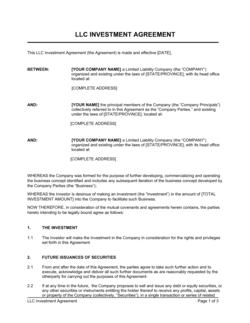
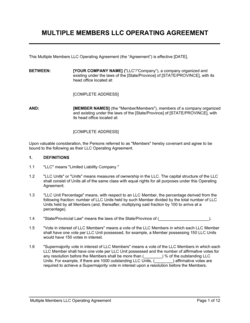
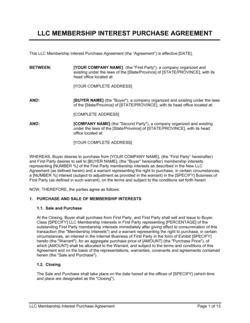
LLC Member Withrawal Agreement Template

Free Word download • Edit online • Save & share with Drive • Export to PDF

8 pages30–40 min to fillDifficulty: ComplexSignature requiredLegal review recommended
Learn more ↓
FreeLLC Member Withrawal Agreement Template

At a glance

What it is
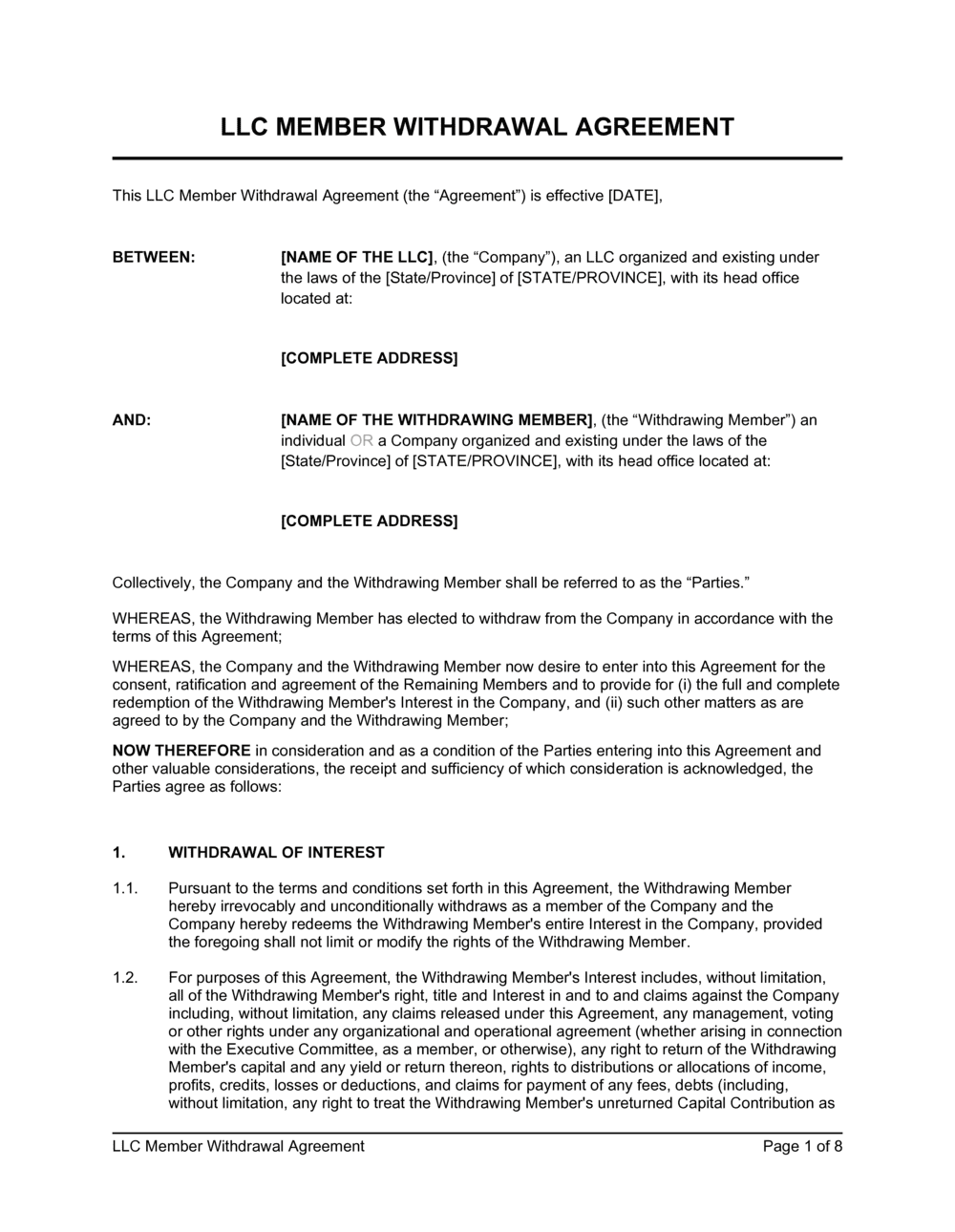
An LLC Member Withdrawal Agreement is a legally binding document that formally governs the voluntary exit of a member from a limited liability company. This free Word download covers the buyout of the withdrawing member's ownership interest, the mechanics of transferring that interest to remaining members or the LLC itself, mutual releases of claims, and post-withdrawal restrictions on competition and confidentiality.
When you need it
Use it whenever a member voluntarily chooses to leave an LLC — whether due to retirement, a strategic disagreement, a career change, or a negotiated exit — and the parties need a clean, documented separation that extinguishes the departing member's rights and obligations. It is also required when the LLC's operating agreement mandates a written withdrawal procedure.
What's inside
The agreement includes the withdrawal effective date, the agreed buyout price and payment schedule, the mechanics of interest transfer, mutual releases of all claims between the withdrawing member and the LLC, ongoing confidentiality obligations, post-withdrawal non-compete and non-solicitation restrictions, indemnification provisions, and the governing law clause.

What is an LLC Member Withdrawal Agreement?

An LLC Member Withdrawal Agreement is a legally binding contract that formally governs the voluntary exit of a member from a limited liability company. It documents the effective date of the member's dissociation, the agreed buyout price for their ownership interest and the method by which that price was determined, the mechanics of transferring the interest to the LLC or remaining members, mutual releases of all claims arising from the membership relationship, and post-departure restrictions on competition and disclosure of confidential information. Unlike an informal handshake exit, a properly executed withdrawal agreement eliminates ambiguity about when the member's rights and obligations ended, what they were paid, and what they are prohibited from doing afterward.

Why You Need This Document

Without a written withdrawal agreement, a departing member's exit is governed entirely by the LLC's operating agreement and state-default LLC statutes — frameworks that rarely anticipate the specific facts of a real exit and almost never produce outcomes both sides consider fair. The consequences of an undocumented withdrawal are concrete: a former member can claim they still hold an economic interest if no formal transfer was recorded, dispute the buyout amount years later with no agreed valuation date to point to, and remain personally liable on LLC guarantees they believed were settled at closing. Remaining members face equal exposure — a departed member who is not bound by a written non-compete can immediately solicit the LLC's clients or join a direct competitor with no legal remedy available. This template closes all four gaps in a single document, giving every party a clean, enforceable record of exactly what was agreed, on what date, and under what terms.

Which variant fits your situation?

If your situation is…Use this template
A member is withdrawing and the remaining members are buying out the interestLLC Member Withdrawal Agreement
The LLC itself is purchasing the departing member's interest as a redemptionLLC Interest Redemption Agreement
A member is being removed involuntarily rather than withdrawing voluntarilyLLC Member Removal Agreement
Two or more members are buying out a third member and restructuring ownershipLLC Membership Interest Purchase Agreement
The entire LLC is dissolving rather than one member exitingLLC Dissolution Agreement
A new member is being admitted to replace the withdrawing memberLLC Membership Admission Agreement
The withdrawal triggers an amendment to the existing operating agreementLLC Operating Agreement Amendment

Common mistakes to avoid

❌ Failing to check the operating agreement before drafting

Why it matters: Most operating agreements include withdrawal restrictions, right-of-first-refusal clauses, or required notice periods that, if ignored, make the withdrawal agreement ineffective or expose remaining members to breach-of-contract claims.

Fix: Read the operating agreement in full before any withdrawal conversation begins. Note every procedural requirement and build compliance into the withdrawal agreement's timeline and recitals.

❌ No valuation date for the buyout price

Why it matters: If the closing is delayed by weeks or months, the LLC's value may shift materially — and without a fixed valuation date, both parties have grounds to argue the price should be recalculated.

Fix: State the specific valuation date in the buyout clause and tie payment to that date. If closing occurs later, include a simple true-up formula for material changes.

❌ Ignoring the withdrawing member's personal guarantees on LLC debt

Why it matters: A former member who personally guaranteed an LLC loan remains personally liable until the lender formally releases them — the withdrawal agreement cannot unilaterally discharge a third-party lender's rights.

Fix: Identify every personal guarantee the withdrawing member signed before closing. Either obtain a formal release from the lender or include an indemnification from the remaining members covering any future guarantee calls.

❌ Overbroad non-compete that is unenforceable as written

Why it matters: A non-compete that covers all industries, has unlimited geography, or applies to a passive member with no competitive knowledge will be struck down entirely in most jurisdictions — leaving the LLC with no restriction at all.

Fix: Limit the restriction to the specific business activity, customer segment, and geographic market the member actually worked in. Document the business justification in the recitals to support enforcement.

❌ No provision for the withdrawing member's final tax distributions

Why it matters: If the LLC is a pass-through entity, the withdrawing member will receive a final K-1 reflecting their share of income, loss, and deductions through the withdrawal date — without a distribution to cover the resulting tax liability, they pay tax on phantom income.

Fix: Include a clause obligating the LLC to distribute sufficient funds to cover the withdrawing member's estimated tax liability on their final K-1 allocation, or negotiate a tax gross-up as part of the buyout price.

❌ Releasing all claims without carving out the buyout obligation

Why it matters: A poorly drafted mutual release that does not expressly exclude the buyout payment obligation can be read to release the LLC from its duty to pay — defeating the entire purpose of the agreement.

Fix: Explicitly carve out all obligations created by the withdrawal agreement itself from the mutual release language. State: 'The release in this Section does not apply to any obligations arising under this Agreement.'

The 10 key clauses, explained

Parties and recitals

In plain language: Identifies the LLC by its full legal name and state of organization, names the withdrawing member, lists remaining members, and records the background facts — including the date the operating agreement was executed and the member's current ownership percentage.

Sample language
This LLC Member Withdrawal Agreement ('Agreement') is entered into as of [DATE] by and among [LLC NAME], a [STATE] limited liability company ('Company'), [WITHDRAWING MEMBER NAME] ('Withdrawing Member'), and the undersigned remaining members ('Remaining Members'). Withdrawing Member currently holds a [X]% membership interest in the Company.

Common mistake: Omitting the state of organization. State LLC statutes govern withdrawal rights by default, and the wrong state's rules being applied can invalidate the agreement entirely.

Withdrawal effective date

In plain language: Specifies the exact date on which the member's interest, authority to bind the LLC, voting rights, and entitlement to future distributions all cease.

Sample language
Withdrawing Member's membership in the Company shall terminate effective as of [EFFECTIVE DATE] ('Withdrawal Date'). From and after the Withdrawal Date, Withdrawing Member shall have no further right, title, or interest in the Company or its assets.

Common mistake: Setting the effective date after the agreement is signed but before the buyout is paid. This creates a gap period where the member is technically out but the LLC still holds their money — triggering default interest and disputes.

Buyout price and valuation method

In plain language: States the agreed buyout amount, the valuation methodology used to reach it (agreed value, book value, or independent appraisal), and any adjustments for outstanding loans or capital contributions.

Sample language
In full consideration for the transfer of Withdrawing Member's [X]% membership interest, the Company shall pay Withdrawing Member the sum of $[AMOUNT] ('Buyout Price'), determined by [METHOD: mutual agreement / independent appraisal / capital account balance as of DATE], less any outstanding loans owed by Withdrawing Member to the Company as of the Withdrawal Date.

Common mistake: Agreeing on a fixed dollar amount without specifying the valuation date. If the closing is delayed, the LLC's value may have changed materially, and neither party will have a clear basis for adjustment.

Payment terms and schedule

In plain language: Describes how and when the buyout price will be paid — lump sum at closing, installments secured by a promissory note, or a combination — and the interest rate on any deferred balance.

Sample language
The Buyout Price shall be paid as follows: (a) $[AMOUNT] in immediately available funds on the Withdrawal Date; and (b) the remaining $[AMOUNT] in [NUMBER] equal monthly installments of $[AMOUNT] commencing on [DATE], bearing interest at [X]% per annum, evidenced by the Promissory Note attached hereto as Exhibit A.

Common mistake: No interest rate on deferred payments. The IRS may impute interest at the applicable federal rate (AFR) regardless — and a missing rate creates a dispute over what was intended.

Transfer of membership interest

In plain language: Formally assigns the withdrawing member's interest to the LLC or named remaining members, and confirms that the transfer is recorded in the LLC's books and the operating agreement is amended accordingly.

Sample language
Effective on the Withdrawal Date, Withdrawing Member hereby assigns, transfers, and conveys all of Withdrawing Member's right, title, and interest in the Company, including all [X]% membership interest, to [TRANSFEREE(S)] ('Transferee'). The Company shall update its books and records and amend the Operating Agreement to reflect this transfer within [X] business days.

Common mistake: Failing to amend the operating agreement or update the LLC's internal ledger after closing. An unchanged operating agreement can be used by the former member to argue they still hold an interest.

Mutual release of claims

In plain language: Both parties release each other from all claims, debts, and obligations arising from the membership relationship up to the effective date, except for obligations expressly preserved in the agreement.

Sample language
Each party hereby releases and forever discharges the other party from any and all claims, demands, liabilities, and causes of action of any nature, known or unknown, arising out of or relating to Withdrawing Member's membership in the Company prior to the Withdrawal Date, excluding any obligations created by this Agreement.

Common mistake: Including a one-sided release that only protects the LLC. Courts in several states have refused to enforce one-sided releases, and a mutual release is more commercially defensible.

Confidentiality

In plain language: Prohibits the withdrawing member from disclosing or using the LLC's confidential information — trade secrets, customer data, financials, and proprietary processes — after departure.

Sample language
Withdrawing Member agrees that, for a period of [X] years following the Withdrawal Date, Withdrawing Member shall not disclose, use, or exploit any Confidential Information of the Company. 'Confidential Information' means all non-public information relating to the Company's business, customers, finances, technology, or operations.

Common mistake: No defined survival period for confidentiality. Without a stated duration, courts vary on how long the obligation runs — some treating it as perpetual (enforceable for trade secrets) and others limiting it to a reasonable period.

Non-compete and non-solicitation

In plain language: Restricts the withdrawing member from competing with the LLC or soliciting its clients and employees within a defined territory and timeframe after withdrawal.

Sample language
For [X] months following the Withdrawal Date, Withdrawing Member shall not (a) directly or indirectly engage in any business that competes with the Company within [GEOGRAPHIC AREA]; or (b) solicit, recruit, or hire any employee, contractor, or client of the Company.

Common mistake: Using the same non-compete duration and geography for all members regardless of their role or access to competitive information. A silent minority member with no client relationships being bound to a 24-month non-compete is routinely struck down as unreasonable.

Indemnification

In plain language: Allocates responsibility for any liabilities or claims that arise after withdrawal — specifying which pre-withdrawal obligations remain with the withdrawing member and which the LLC will assume.

Sample language
Withdrawing Member shall indemnify and hold harmless the Company and Remaining Members from any claims, losses, or liabilities arising from Withdrawing Member's acts or omissions prior to the Withdrawal Date. The Company shall indemnify Withdrawing Member for any liabilities arising from the Company's operations after the Withdrawal Date.

Common mistake: No carve-out for personal guarantees. If the withdrawing member personally guaranteed LLC debt, the indemnification clause must address who bears that obligation — or the former member remains exposed indefinitely.

Governing law and dispute resolution

In plain language: Specifies which state's LLC law governs the agreement and whether disputes are resolved by arbitration, mediation, or litigation, and in which venue.

Sample language
This Agreement shall be governed by the laws of the State of [STATE], without regard to its conflict-of-laws principles. Any dispute arising under this Agreement shall be resolved by [binding arbitration / mediation followed by litigation] in [CITY, STATE]. The prevailing party shall be entitled to recover reasonable attorneys' fees.

Common mistake: Choosing a governing law state that differs from where the LLC is organized. Most state LLC statutes mandate that the law of the state of organization governs membership interests — a conflicting choice-of-law clause may be disregarded by a court.

How to fill it out

  1. 1

    Confirm the withdrawal is voluntary and permitted under the operating agreement

    Review the LLC's operating agreement for any withdrawal restrictions, required notice periods, or right-of-first-refusal provisions that must be satisfied before a member can exit. If the operating agreement is silent, refer to the default rules of the LLC's state of organization.

    💡 Some operating agreements require unanimous consent of all remaining members before a withdrawal is effective — obtain that consent in writing before dating the agreement.

  2. 2

    Agree on and document the buyout price and valuation method

    Determine the buyout amount using an agreed method — book value based on capital accounts, a mutual agreed-upon figure, or an independent third-party appraisal. Document the method and the valuation date in the agreement so neither party can later dispute how the number was reached.

    💡 If the parties cannot agree on value, a single independent appraiser selected jointly and paid equally by both sides is faster and cheaper than litigation.

  3. 3

    Set the withdrawal effective date precisely

    Choose a specific calendar date on which the member's interest, voting rights, and entitlement to distributions end. Confirm this date aligns with any tax year or fiscal quarter considerations that affect the member's final K-1.

    💡 For tax purposes, a year-end withdrawal date (December 31) simplifies the final K-1 allocation — mid-year exits require a closing-of-books election or per-day proration.

  4. 4

    Define the payment schedule and attach a promissory note if needed

    If the full buyout cannot be paid at closing, draft a payment schedule specifying each installment amount, due date, interest rate, and default provisions. Attach the promissory note as Exhibit A and reference it in the payment terms clause.

    💡 Secure any deferred buyout with a lien on the LLC's assets or a personal guarantee from the remaining members — an unsecured note becomes a collection problem if the LLC struggles financially.

  5. 5

    Draft the non-compete and non-solicitation terms proportionate to the member's role

    Tailor the geographic scope, restricted activities, and duration to the withdrawing member's actual involvement — their access to clients, trade secrets, and competitive knowledge. A managing member with deep client relationships warrants broader restrictions than a passive investor.

    💡 12 months is the most consistently enforced duration in most US states; anything beyond 24 months should be supported by documented business justification in the recitals.

  6. 6

    Execute the agreement before the effective date

    All parties — the withdrawing member, each remaining member or the LLC manager, and any guarantors on a promissory note — must sign before or on the withdrawal effective date. Post-dated signatures raise consideration issues and can leave the mutual release and restrictive covenants unenforceable.

    💡 Use a notarized signature block if the transfer of interest will be recorded with a state agency or if real property is held by the LLC.

  7. 7

    Update the operating agreement and LLC records

    After execution, amend the operating agreement to remove the withdrawing member and reallocate the ownership percentages. Update the LLC's internal membership ledger, file any required state notices, and notify banks, lenders, and key counterparties of the membership change.

    💡 Some states require a formal amendment to the articles of organization if membership changes trigger a change in management structure — check your state's filing requirements within 30 days of the withdrawal date.

Frequently asked questions

What is an LLC member withdrawal agreement?

An LLC member withdrawal agreement is a legally binding contract that documents a member's voluntary exit from a limited liability company. It specifies the effective date of withdrawal, the buyout price for the departing member's ownership interest, the mechanics of transferring that interest to the LLC or remaining members, mutual releases of claims, and ongoing restrictions on competition and disclosure of confidential information. Without this document, the withdrawal is governed solely by state law defaults and the existing operating agreement — which may not reflect what the parties actually agreed.

Is a member allowed to withdraw from an LLC at any time?

Whether a member can withdraw freely depends on the LLC's operating agreement and applicable state law. Many operating agreements restrict voluntary withdrawal — requiring advance notice, consent of remaining members, or satisfaction of a right-of-first-refusal process. In states that have adopted the Uniform Limited Liability Company Act (ULLCA), a member generally has the power to dissociate at any time but may owe damages to the LLC if the withdrawal violates the operating agreement. Always review both documents before proceeding.

How is the buyout price for a withdrawing member calculated?

The most common methods are the member's capital account balance as of the withdrawal date, a mutually agreed fixed amount, or a value determined by an independent appraisal. Operating agreements often specify the method — if yours is silent, a third-party appraisal is the most defensible approach for disputes. The buyout price is typically adjusted for any loans owed by the withdrawing member to the LLC and may be discounted for minority interest or lack of marketability depending on the parties' negotiation.

Does a member withdrawal agreement need to be notarized?

In most cases, notarization is not required for the agreement itself to be enforceable. However, if the LLC holds real property and the membership interest transfer triggers a deed or title update, notarized signatures may be required by the applicable state's recording laws. Some lenders and banks also require notarized documentation before updating their records to remove the withdrawing member. Review your state's requirements and any lender obligations before the signing date.

What happens to the withdrawing member's personal guarantees after exit?

Personal guarantees on LLC debt are obligations between the guarantor and the lender — the withdrawal agreement cannot release a third-party lender's rights. A departing member remains personally liable on any guarantee until the lender provides a formal written release. As a practical matter, the remaining members should either secure a lender release before closing or include a clear indemnification clause requiring them to cover the withdrawing member if a guarantee is ever called post-exit.

Are non-compete clauses in an LLC member withdrawal agreement enforceable?

Enforceability depends on jurisdiction and the scope of the restriction. Courts generally uphold non-competes that are reasonable in duration (6–24 months), limited in geographic scope to where the LLC actually operates, and tied to activities the member was genuinely involved in. California, Minnesota, and North Dakota impose near-total bans on post-departure non-competes even in membership exit contexts. Overbroad clauses risk being struck down entirely rather than narrowed, so calibrate restrictions to the member's actual competitive exposure.

What is the difference between a withdrawal agreement and a member buyout agreement?

The terms are often used interchangeably, but they emphasize different mechanics. A withdrawal agreement focuses on the member's voluntary dissociation from the LLC — terminating their status, rights, and obligations. A buyout agreement emphasizes the purchase of the departing member's ownership interest, typically by remaining members or the LLC. A well-drafted exit document covers both: it formalizes the withdrawal and governs the purchase, transfer, payment, and post-departure restrictions in a single integrated agreement.

Does a member withdrawal require a formal amendment to the LLC operating agreement?

Yes, in practice. The operating agreement governs membership composition, ownership percentages, and voting rights — all of which change when a member exits. Failing to amend the operating agreement leaves a discrepancy between the governing document and the actual membership structure, which can create confusion in future transactions, financing events, or disputes. Most withdrawal agreements include a clause requiring the operating agreement to be amended within a specified number of business days of the withdrawal date.

What tax consequences should the parties consider in a member withdrawal?

The withdrawing member typically recognizes gain or loss on the difference between the buyout price and their adjusted basis in the LLC interest. The LLC is a pass-through entity, so the departing member will receive a final K-1 reflecting their share of income and deductions through the withdrawal date — potentially creating a tax liability on income they have not received in cash. The parties should negotiate a tax distribution clause or gross-up provision to address this. Consult a tax advisor before finalizing buyout terms, particularly when installment payments are involved.

Can a member be forced to withdraw from an LLC?

Involuntary removal is a separate legal action from voluntary withdrawal and requires specific authority in the operating agreement or under state law. In most jurisdictions, a member cannot be expelled without a basis set out in the operating agreement — such as breach of fiduciary duty, bankruptcy, or failure to make required capital contributions. A member withdrawal agreement is only appropriate where the exit is voluntary. Forced exits typically require a different document and, in contentious situations, court involvement.

How this compares to alternatives

vs LLC Dissolution Agreement

A dissolution agreement winds down the entire LLC — liquidating assets, paying creditors, and distributing remaining proceeds to all members before terminating the entity. A withdrawal agreement removes one member while the LLC continues operating. Use dissolution when the business itself is ending; use a withdrawal agreement when one member exits and the company survives.

vs LLC Operating Agreement

An operating agreement establishes the ongoing governance framework for the LLC — membership rights, voting, distributions, and default withdrawal procedures. A withdrawal agreement is a transaction-specific document that implements a specific member's exit under those rules. The withdrawal agreement typically triggers an amendment to the operating agreement but does not replace it.

vs Independent Contractor Agreement

An independent contractor agreement governs a services relationship between the LLC and a non-member. A withdrawal agreement governs the exit of an owner. If a departing member will continue providing services to the LLC after withdrawal, a separate independent contractor agreement should be executed alongside the withdrawal agreement.

vs Buy-Sell Agreement

A buy-sell agreement is a standing governance document executed in advance that pre-sets the terms under which membership interests can be transferred in any future triggering event — death, disability, bankruptcy, or voluntary exit. A withdrawal agreement is the transaction document that implements a specific exit. For LLCs without a buy-sell agreement, the withdrawal agreement must negotiate all pricing and transfer terms from scratch.

Industry-specific considerations

Professional Services

Medical, legal, and accounting practice LLCs require state licensing board notifications when a licensed member departs, and the non-solicitation clause must specifically cover existing clients and referral relationships.

Real Estate Investment

Property-holding LLCs must address whether the withdrawal triggers a change-of-ownership assessment for property tax purposes and whether lender consent is required under due-on-transfer clauses in any mortgage.

Technology / SaaS

IP assignment confirmation is critical — the withdrawal agreement should include a clause confirming the departing member assigns any residual claims to code, algorithms, or product IP developed during membership.

Construction and Trades

Contractor licensing held personally by the withdrawing member may need to be transferred or relinquished, and any project-specific bonds or surety agreements listing the member must be updated with the surety's consent.

Jurisdictional notes

United States

LLC withdrawal rights are governed by state law — most states follow the Uniform Limited Liability Company Act (ULLCA), but Delaware, California, and New York have material deviations. At-will withdrawal is permitted in many ULLCA states but may trigger liability for wrongful dissociation if the operating agreement restricts it. Non-compete enforceability varies sharply: California bans them in almost all post-membership contexts, while most other states apply a reasonableness standard.

Canada

Canada does not have a direct equivalent to the US LLC; the closest structures are the limited partnership or the corporation in most provinces. Alberta and British Columbia permit Limited Liability Partnerships (LLPs) for professional practices. Withdrawal from these structures is governed by the applicable partnership act or shareholder agreement rather than an LLC statute. Quebec civil law applies distinct rules for business exit, and French-language documentation may be required for provincially-regulated entities.

United Kingdom

The UK does not have an LLC structure; the equivalent entity is the Limited Liability Partnership (LLP) governed by the Limited Liability Partnerships Act 2000, or a private limited company (Ltd). Member withdrawal from an LLP is governed by the LLP agreement and the LLP Act. Post-withdrawal restrictions must be reasonable in scope and duration to be enforceable under UK contract law, and the Competition Act 1998 may apply to commercially sensitive confidentiality obligations.

European Union

EU member states each have their own equivalent of the LLC — the GmbH in Germany, SARL in France, and SRL in Spain and Italy, among others. Exit and buyout rights are governed by national company law rather than a unified EU framework. Post-withdrawal non-compete restrictions typically require financial compensation to the departing member under several EU jurisdictions, including Germany and France, to be enforceable. GDPR obligations attach to any confidentiality clause covering personal data of clients or employees.

Template vs lawyer — what fits your deal?

PathBest forCostTime
Use the templateSingle-state LLCs with straightforward ownership structures, no real property, and an agreed buyout priceFree1–2 hours
Template + legal reviewMulti-member LLCs, installment buyouts, personal guarantee releases, or members with significant client relationships$400–$8002–5 days
Custom draftedLLCs with complex capital structures, real property holdings, disputed valuations, or members in regulated industries$1,500–$5,000+1–3 weeks

Glossary

Withdrawing Member
The LLC member who is voluntarily relinquishing their ownership interest and exiting the company under the terms of the agreement.
Membership Interest
A member's ownership stake in an LLC, expressed as a percentage or number of units, entitling them to a share of profits, losses, and distributions.
Buyout Price
The agreed amount the LLC or remaining members will pay the withdrawing member in exchange for their membership interest.
Effective Date of Withdrawal
The specific calendar date on which the member's interest, voting rights, and obligations formally terminate.
Mutual Release
A clause in which both the withdrawing member and the LLC waive all existing and future claims against each other arising from the membership relationship.
Non-Compete Clause
A post-withdrawal restriction preventing the departing member from operating or joining a competing business within a defined geography and time period.
Non-Solicitation Clause
A restriction preventing the withdrawing member from recruiting the LLC's employees, contractors, or clients after departure.
Dissociation
The legal term under the Uniform Limited Liability Company Act (ULLCA) for a member's separation from an LLC, whether voluntary or involuntary.
Promissory Note
A written instrument in which the LLC or remaining members promise to pay the buyout amount in installments over a defined schedule, used when full payment cannot be made at closing.
Indemnification
An obligation by which one party agrees to compensate the other for specified losses, liabilities, or legal costs arising from defined events post-withdrawal.
Capital Account
The running ledger tracking a member's contributions, share of profits and losses, and distributions — used as the baseline for calculating the buyout price.

Part of your Business Operating System

This document is one of 3,000+ business & legal templates included in Business in a Box.

  • Fill-in-the-blanks — ready in minutes
  • 100% customizable Word document
  • Compatible with all office suites
  • Export to PDF and share electronically

Create your document in 3 simple steps.

From template to signed document — all inside one Business Operating System.
1
Download or open template

Access over 3,000+ business and legal templates for any business task, project or initiative.

2
Edit and fill in the blanks with AI

Customize your ready-made business document template and save it in the cloud.

3
Save, Share, Send, Sign

Share your files and folders with your team. Create a space of seamless collaboration.

Save time, save money, and create top-quality documents.

★★★★★

"Fantastic value! I'm not sure how I'd do without it. It's worth its weight in gold and paid back for itself many times."

Managing Director · Mall Farm
Robert Whalley
Managing Director, Mall Farm Proprietary Limited
★★★★★

"I have been using Business in a Box for years. It has been the most useful source of templates I have encountered. I recommend it to anyone."

Business Owner · 4+ years
Dr Michael John Freestone
Business Owner
★★★★★

"It has been a life saver so many times I have lost count. Business in a Box has saved me so much time and as you know, time is money."

Owner · Upstate Web
David G. Moore Jr.
Owner, Upstate Web

Run your business with a system — not scattered tools

Stop downloading documents. Start operating with clarity. Business in a Box gives you the Business Operating System used by over 250,000 companies worldwide to structure, run, and grow their business.

Free Forever Plan · No credit card required