Vehicle Lease Agreement Template

Free Word download β€’ Edit online β€’ Save & share with Drive β€’ Export to PDF

6 pagesβ€’25–35 min to fillβ€’Difficulty: Complexβ€’Signature requiredβ€’Legal review recommended
Learn more ↓
FreeVehicle Lease Agreement Template

At a glance

What it is
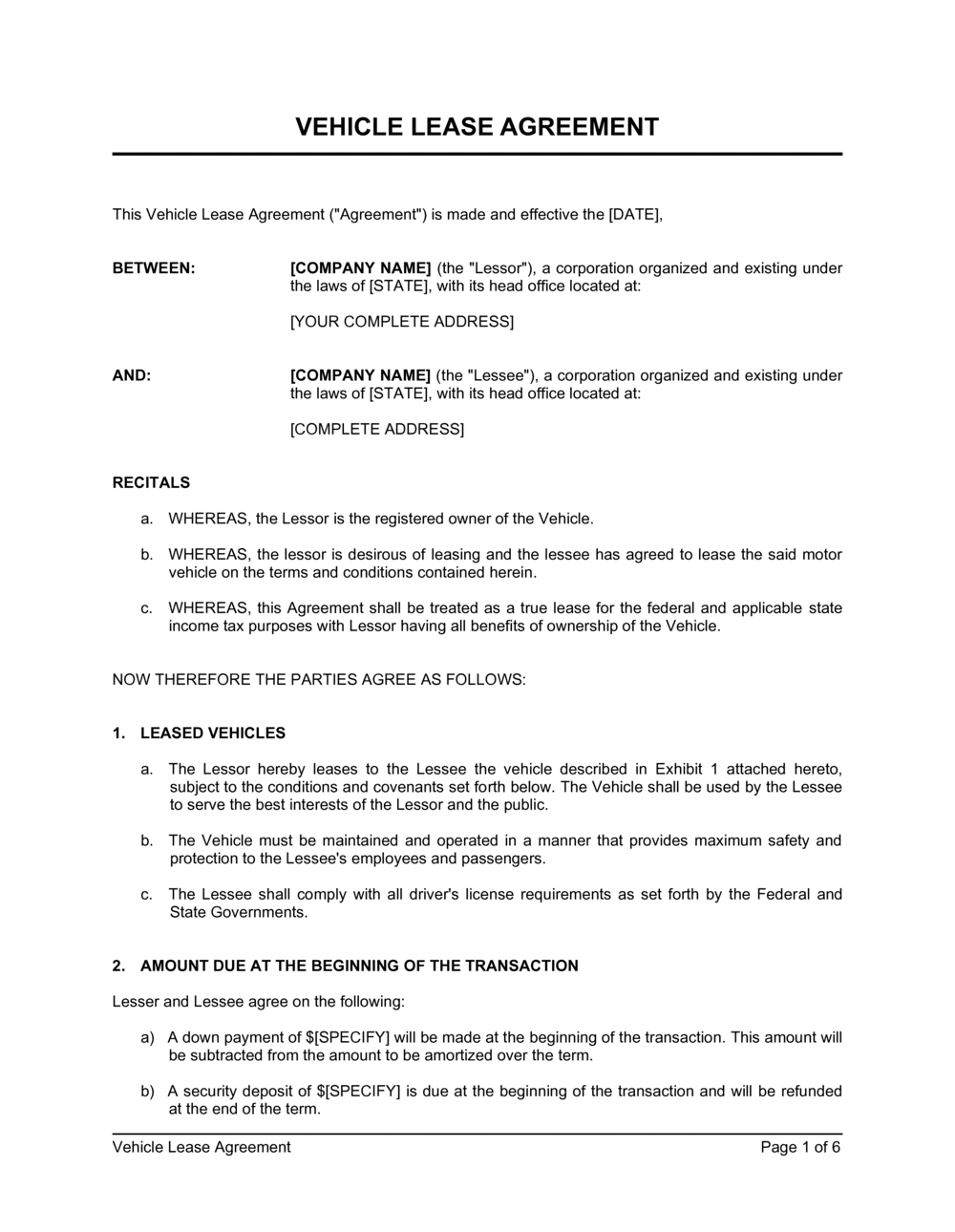
A Vehicle Lease Agreement is a legally binding contract between a lessor (the vehicle owner or dealer) and a lessee (the individual or business using the vehicle) that governs the terms of the lease. This free Word download covers monthly payment, lease term, mileage allowance, insurance obligations, maintenance responsibilities, end-of-lease options, and early-termination fees in a single structured document you can edit online and export as PDF.
When you need it
Use it any time a vehicle is being leased rather than sold outright β€” whether a dealership is leasing to a consumer, a fleet owner is leasing vehicles to a business, or a private party is arranging a vehicle lease with an individual. It is also essential when a business leases vehicles for employees or commercial operations.
What's inside
Vehicle description and identification details, lease term and monthly payment schedule, security deposit and capitalized cost, mileage allowance and excess-mileage fees, maintenance and repair responsibilities, insurance requirements, end-of-lease purchase option, and early-termination conditions including applicable fees.

What is a Vehicle Lease Agreement?

A Vehicle Lease Agreement is a legally binding contract between a lessor β€” the party that owns the vehicle β€” and a lessee β€” the party that pays to use it β€” that governs every material term of the lease relationship. It identifies the specific vehicle by VIN, sets the monthly payment and lease term, defines the mileage allowance and excess-mileage fee rate, allocates maintenance and insurance responsibilities, and specifies what options the lessee has when the lease ends: return, purchase, or renew. Unlike a purchase agreement, a vehicle lease transfers only the right of use, not ownership, making it the appropriate document any time a vehicle changes hands temporarily in exchange for periodic payments.

Why You Need This Document

Without a written vehicle lease agreement, every ambiguity in the arrangement defaults to a dispute β€” and disputes over leased vehicles are almost always about money. A lessee who returns a vehicle with 8,000 miles over the cap can claim the allowance was never clearly stated; a lessor who withholds a security deposit faces a wrongful-withholding claim if no itemized deduction process was defined in writing. The insurance gap is equally serious: if a lessee drives an uninsured vehicle because the contract did not require proof of coverage at signing, any accident during that window exposes the lessor to direct liability. Early termination is a further flashpoint β€” a vague or missing early-termination clause leaves both parties arguing over fair compensation with no contractual anchor. This template closes all four gaps before keys change hands, giving both parties a signed record of exactly what was agreed, in the condition the vehicle was handed over, and what each party owes if anything goes wrong.

Which variant fits your situation?

If your situation is…Use this template
Leasing a personal passenger car to an individual consumerVehicle Lease Agreement (Consumer)
Leasing a fleet of vehicles to a business entityFleet Vehicle Lease Agreement
Renting a vehicle for a short period β€” days or weeksVehicle Rental Agreement
Selling a vehicle outright with payment terms over timeVehicle Purchase Agreement
Leasing a heavy commercial or transport vehicleCommercial Vehicle Lease Agreement
Allowing an employee to use a company-owned vehicleCompany Vehicle Use Agreement
Leasing equipment including vehicles for business operationsEquipment Lease Agreement

Common mistakes to avoid

❌ Omitting the VIN from the vehicle description

Why it matters: Without the VIN, the contract cannot definitively identify the specific vehicle, making it nearly impossible to enforce obligations tied to vehicle condition, mileage, or title.

Fix: Always include the full 17-character VIN in the vehicle description clause and verify it against the physical vehicle before signing.

❌ No documented vehicle condition inspection at handover

Why it matters: Without a signed condition report at the start of the lease, the lessor cannot prove which damage existed before the lessee took possession β€” creating an unwinnable dispute at return.

Fix: Complete a written vehicle condition checklist with photographs, signed by both parties, at both handover and return. Attach it as an exhibit to the agreement.

❌ Setting a flat early-termination fee regardless of remaining term

Why it matters: A flat fee that exceeds the actual loss to the lessor may be deemed an unenforceable penalty clause in several US states, Canadian provinces, and under EU consumer-protection law.

Fix: Define the early-termination fee as a calculated formula β€” remaining payments plus any depreciation shortfall β€” and include a reasonable cap to withstand a penalty-clause challenge.

❌ Failing to require proof of insurance at signing

Why it matters: A lessee who promises to obtain insurance but has not yet done so leaves the vehicle uninsured during the gap β€” any damage or accident in that window falls to the lessor.

Fix: Require the lessee to provide a current insurance certificate naming the lessor as additional insured before keys are handed over, not merely a promise to obtain coverage.

❌ Not specifying what happens at the end of the lease term

Why it matters: A lessee who continues driving the vehicle after expiry without a clear holdover clause can dispute the terms of continued use, the applicable rate, and their obligation to return the vehicle.

Fix: Include a holdover clause converting the lease to month-to-month on the same terms if the vehicle is not returned, and state the return process and timeline explicitly.

❌ Using a governing law jurisdiction unconnected to where the vehicle is used

Why it matters: Consumer-protection statutes in several US states (including California's Vehicle Leasing Act) and Canadian provinces apply local law regardless of the governing-law clause β€” creating a conflict the lessor will lose.

Fix: Set governing law to the jurisdiction where the vehicle will be registered and primarily operated, and confirm that the agreed terms meet or exceed local statutory minimums.

The 10 key clauses, explained

Vehicle description and identification

In plain language: Identifies the specific vehicle being leased by make, model, year, trim level, color, and VIN, leaving no ambiguity about what is covered by the agreement.

Sample language
The vehicle covered by this Agreement is a [YEAR] [MAKE] [MODEL] [TRIM], color [COLOR], Vehicle Identification Number (VIN): [VIN NUMBER], license plate: [PLATE NUMBER] ('Vehicle').

Common mistake: Omitting the VIN and relying only on make and model. Without the VIN, disputes over which vehicle is covered β€” or its exact condition at signing β€” cannot be resolved by reference to the contract alone.

Lease term and commencement date

In plain language: States the exact start and end date of the lease, the total number of months, and what happens if the lessee continues to use the vehicle after expiry.

Sample language
The lease term commences on [START DATE] and expires on [END DATE], a period of [NUMBER] months ('Lease Term'). Continued use of the Vehicle after the Lease Term without a written renewal constitutes a month-to-month tenancy at the same monthly payment rate.

Common mistake: Not specifying what happens at the end of the term. Without a holdover clause, a lessee who keeps the vehicle without renewal can claim ambiguous terms to avoid returning it or paying a fair rate.

Monthly payment and payment schedule

In plain language: Sets the monthly lease payment amount, the day of the month it is due, the accepted payment methods, and any late-payment fee that applies after a defined grace period.

Sample language
Lessee shall pay Lessor a monthly lease payment of $[AMOUNT] due on the [DAY] of each calendar month beginning [FIRST PAYMENT DATE]. Payments more than [X] days late incur a late fee of $[AMOUNT] or [X]% of the overdue payment, whichever is greater.

Common mistake: Stating the payment amount without specifying the due date or grace period. Courts have found informal payment schedules insufficiently definite to support a late-fee claim.

Security deposit

In plain language: Defines the amount of the security deposit, the conditions under which the lessor may apply it to cover costs, and the timeline and conditions for its return after lease end.

Sample language
Lessee shall pay a security deposit of $[AMOUNT] upon signing. Lessor may apply the deposit to unpaid payments, excess mileage fees, or damage beyond normal wear and tear. The remaining balance shall be returned within [30] days of Vehicle return, with an itemized statement of any deductions.

Common mistake: Failing to define the return timeline for the security deposit. Many jurisdictions impose statutory deadlines β€” and a vague contract does not protect the lessor from a wrongful-withholding claim.

Mileage allowance and excess mileage fees

In plain language: Sets the total miles or kilometers permitted over the lease term, the per-unit fee for any excess, and the method for calculating and collecting the charge at lease end.

Sample language
Lessee is permitted a total of [NUMBER] miles ([NUMBER] miles per year) over the Lease Term. Mileage exceeding this allowance shall be charged at $[AMOUNT] per mile, assessed at lease termination based on the odometer reading at Vehicle return.

Common mistake: Setting mileage allowance only as an annual figure without stating the total for the full term. A lessee who drives less in Year 1 may assume unused miles carry over β€” unless the contract explicitly prohibits it.

Maintenance and repair responsibilities

In plain language: Allocates maintenance obligations between lessor and lessee β€” typically routine maintenance to the lessee and major mechanical repairs covered by warranty to the lessor β€” and specifies the standards the vehicle must meet.

Sample language
Lessee shall maintain the Vehicle in good working order and perform all manufacturer-recommended routine maintenance, including oil changes every [X] miles, tire rotation, and brake inspections. Lessee shall not perform modifications without Lessor's prior written consent.

Common mistake: Leaving maintenance responsibility undefined. When the vehicle is returned with deferred maintenance, both parties claim the other was responsible β€” resulting in deposit disputes that could have been prevented by a single paragraph.

Insurance requirements

In plain language: Requires the lessee to maintain minimum levels of liability, collision, and comprehensive insurance throughout the lease term, name the lessor as an additional insured, and provide proof of coverage on request.

Sample language
Lessee shall maintain, at Lessee's expense, automobile insurance covering: (a) liability of not less than $[AMOUNT] per occurrence; (b) collision and comprehensive coverage with a deductible not exceeding $[AMOUNT]; and (c) [LESSOR NAME] named as additional insured. Proof of coverage shall be provided within [5] days of request.

Common mistake: Specifying minimum coverage amounts without requiring the lessor to be named as an additional insured. If the lessee is in an accident and the lessor is not on the policy, a claim requires separate litigation against the lessee.

Early termination

In plain language: States the conditions under which either party may end the lease before the agreed term and the fee or calculation method that applies when the lessee terminates early.

Sample language
If Lessee terminates this Agreement prior to the Lease Term expiry, Lessee shall pay an early termination fee equal to [X] months' remaining payments plus any excess mileage, damage charges, and the difference between the Vehicle's current market value and its remaining book value.

Common mistake: Setting a flat early-termination fee without accounting for market-value depreciation. If the vehicle has depreciated faster than expected, a flat fee may leave the lessor significantly undercompensated.

End-of-lease options

In plain language: Describes the choices available to the lessee at lease end: return the vehicle, exercise a purchase option at the pre-agreed residual value, or renew the lease for an additional term.

Sample language
At the end of the Lease Term, Lessee may: (a) return the Vehicle in accordance with Section [X]; (b) purchase the Vehicle at the pre-agreed residual value of $[AMOUNT]; or (c) renew this Agreement for a mutually agreed term at a payment to be determined at that time.

Common mistake: Omitting the purchase-option price from the original contract. A verbal promise of a buyout price at lease end is difficult to enforce and leads to disputes when the vehicle has appreciated or market conditions have changed.

Governing law and dispute resolution

In plain language: Specifies the jurisdiction whose laws govern the agreement and the mechanism for resolving disputes β€” arbitration, mediation, or court β€” including venue and which party bears costs.

Sample language
This Agreement is governed by the laws of [STATE / PROVINCE / COUNTRY]. Any dispute arising under this Agreement shall first be subject to mediation; if unresolved within [30] days, the parties agree to binding arbitration in [CITY], each bearing their own costs unless the arbitrator awards otherwise.

Common mistake: Selecting a governing law jurisdiction with no connection to where the vehicle is registered or used. Several US states and Canadian provinces apply local consumer-protection rules regardless of what the contract states.

How to fill it out

  1. 1

    Identify both parties with their legal names and addresses

    Enter the lessor's full legal name (individual or registered business entity) and the lessee's full legal name and current address. For business lessees, include the entity type and state or province of registration.

    πŸ’‘ For commercial leases, match the lessee entity name exactly to the name on their business registration β€” mismatches create enforcement gaps if you need to pursue a default.

  2. 2

    Complete the vehicle description with the VIN

    Enter the year, make, model, trim, color, license plate number, and 17-character VIN. Confirm the VIN by checking the dashboard or door jamb β€” not just paperwork.

    πŸ’‘ Run a vehicle history report (Carfax or equivalent) before signing and attach a copy to the agreement so both parties have a shared record of the vehicle's condition and title history.

  3. 3

    Set the lease term, start date, and monthly payment

    Enter the exact start date, end date, total number of months, and the monthly payment amount. Calculate the payment based on capitalized cost minus residual value, divided by the term, plus a financing component.

    πŸ’‘ State the capitalized cost and residual value in the agreement even if they are not labeled as such β€” this gives both parties a reference point for any purchase-option dispute at lease end.

  4. 4

    Define the mileage allowance and excess-mileage rate

    Enter the total mileage permitted over the full lease term, the equivalent annual rate for reference, and the per-mile fee for any excess. Confirm whether unused miles carry over between years.

    πŸ’‘ For commercial leases where annual mileage is hard to predict, consider a higher mileage allowance upfront rather than a low cap with high overage fees β€” disputes at lease end are costly for both parties.

  5. 5

    Specify insurance minimums and name the lessor as additional insured

    Enter the required liability coverage floor (typically $100,000–$300,000 per occurrence for consumer leases), the maximum collision deductible, and the lessor's name as it should appear on the insurance certificate.

    πŸ’‘ Request an insurance certificate at signing β€” not just a promise to obtain coverage. A lapse between signing and first payment is a common gap.

  6. 6

    Confirm maintenance responsibilities and prohibited modifications

    List the specific maintenance tasks the lessee is responsible for (oil changes, tire rotation, fluid checks) and explicitly prohibit modifications β€” tinting, lift kits, aftermarket exhaust β€” without prior written consent.

    πŸ’‘ Attach the manufacturer's maintenance schedule as an exhibit so 'recommended routine maintenance' has a defined meaning neither party can dispute.

  7. 7

    Set the early-termination fee formula

    Calculate the early-termination fee as a formula (e.g., remaining monthly payments plus depreciation shortfall) rather than a flat amount, so it scales with how early the lessee exits.

    πŸ’‘ Include a cap on the early-termination fee β€” an uncapped formula may be deemed an unenforceable penalty clause in some jurisdictions.

  8. 8

    Have both parties sign before the vehicle is handed over

    Both the lessor and lessee must sign and date the agreement before keys are exchanged. Conduct a condition inspection and document existing damage with photographs attached to the signed agreement.

    πŸ’‘ Use a vehicle condition checklist signed by both parties at handover and at return β€” this single document resolves the majority of end-of-lease damage disputes.

Frequently asked questions

What is a vehicle lease agreement?

A vehicle lease agreement is a legally binding contract between a lessor (the vehicle owner) and a lessee (the user) that sets out the terms for using a vehicle over a defined period in exchange for regular payments. It covers monthly payment amount, lease term, mileage allowance, maintenance obligations, insurance requirements, and what happens at the end of the lease β€” including purchase options and return conditions.

What is the difference between a vehicle lease and a vehicle purchase?

A lease gives the lessee the right to use the vehicle for a defined term without transferring ownership β€” the lessee pays for depreciation and financing, not the full vehicle value. A purchase transfers title to the buyer upon completion of payment. Leasing typically results in lower monthly payments but leaves the lessee with no ownership equity at the end of the term unless a purchase option is exercised.

What should a vehicle lease agreement include?

A complete vehicle lease agreement should include a full vehicle description with VIN, lease term start and end dates, monthly payment and due date, security deposit terms, mileage allowance and excess-mileage fees, maintenance responsibilities, insurance minimums, early-termination fee formula, end-of-lease options (return, purchase, or renew), and governing law. Missing any of these creates gaps courts fill against the drafter β€” usually the lessor.

Who is responsible for maintenance under a vehicle lease?

Under a standard vehicle lease, routine maintenance β€” oil changes, tire rotation, fluid top-ups, and other manufacturer-recommended service β€” is the lessee's responsibility. Major repairs covered by an active manufacturer warranty are typically the lessor's or manufacturer's concern. The lease agreement should specify which tasks fall to which party to prevent disputes at lease return.

What happens if the lessee exceeds the mileage allowance?

Excess mileage fees are charged at a per-mile rate defined in the lease agreement, typically assessed at lease end based on the odometer reading. Common rates range from $0.10 to $0.30 per mile for consumer leases and higher for commercial vehicles. Lessees who anticipate exceeding the allowance should negotiate a higher mileage cap upfront β€” buying extra miles at inception is generally cheaper than paying overage fees at return.

Can a vehicle lease be terminated early?

Yes, but early termination typically triggers a fee defined in the agreement β€” usually covering remaining depreciation, the difference between the vehicle's current market value and its book value, and any unpaid payments. The exact formula should be stated in the agreement. In some consumer-lease jurisdictions, statutory limits on early-termination fees apply regardless of what the contract says.

Does a vehicle lease agreement need to be notarized?

Notarization is generally not required for a vehicle lease agreement to be enforceable in most US states, Canadian provinces, the UK, or the EU. However, some jurisdictions require the lessor's name to be registered on the vehicle title, and commercial vehicle leases may require additional documentation for financing or registration purposes. Always check local requirements before finalizing the agreement.

What is a residual value and why does it matter?

The residual value is the estimated fair market value of the vehicle at the end of the lease term, set at the time the lease is signed. It directly affects the monthly payment β€” a higher residual value means lower monthly payments because the lessee is only paying for the depreciation down to that value. It also sets the price for a purchase option at lease end. A residual value that turns out to be lower than actual market value at return benefits the lessee exercising a buyout.

What is the difference between a vehicle lease agreement and a vehicle rental agreement?

A vehicle rental agreement covers short-term use β€” typically days to a few weeks β€” with daily or weekly rates and minimal lessee obligations around maintenance or insurance (coverage is often included or available at point of rental). A lease agreement covers medium- to long-term use, typically 12 to 60 months, with the lessee responsible for maintaining the vehicle and carrying their own insurance throughout the term.

How this compares to alternatives

vs Vehicle Rental Agreement

A vehicle rental agreement covers short-term use β€” days to a few weeks β€” with daily or weekly rates and minimal lessee obligations around maintenance and insurance. A vehicle lease agreement governs medium- to long-term arrangements of 12 to 60 months where the lessee is responsible for upkeep and their own insurance. Use a rental agreement for occasional, short-duration needs and a lease agreement for ongoing business or personal vehicle use.

vs Equipment Lease Agreement

An equipment lease agreement covers a broad range of business assets β€” machinery, technology, tools β€” under general commercial lease principles. A vehicle lease agreement includes vehicle-specific terms such as VIN identification, mileage allowances, odometer-based overage fees, and insurance requirements tied to automotive liability standards. Use the vehicle-specific template for any leased motor vehicle rather than a generic equipment lease.

vs Vehicle Purchase Agreement

A vehicle purchase agreement transfers ownership to the buyer upon payment, creating a title-transfer obligation. A vehicle lease agreement transfers only the right to use the vehicle for a defined period, with ownership remaining with the lessor. If the intent is to sell the vehicle β€” even on installment terms β€” use a purchase agreement; if the vehicle is to be returned at term end, use a lease agreement.

vs Company Vehicle Use Policy

A company vehicle use policy is an internal HR document governing how employees may use employer-owned or leased vehicles β€” personal use rules, fuel cards, accident reporting. It is not a contract between lessor and lessee. When a business leases vehicles from an external party, both documents are needed: the lease agreement with the lessor and the internal policy for employees who drive the vehicle.

Industry-specific considerations

Automotive dealerships

Consumer leases with standardized money factor, residual value tables, and manufacturer-backed end-of-lease purchase programs governed by the federal Consumer Leasing Act.

Fleet and logistics

Multi-vehicle agreements with fleet maintenance schedules, centralized insurance riders, and mileage caps calibrated to commercial route data rather than individual driver estimates.

Construction and trades

Heavy vehicle and equipment leases with specialized maintenance clauses covering commercial-grade wear, after-market modifications for job-site use, and lien-filing coordination.

Professional services

Company vehicle policies tied to leases for client-facing roles, with expense reimbursement coordination, personal-use allocation, and fringe-benefit tax treatment for employees.

Jurisdictional notes

United States

Consumer vehicle leases in the US are regulated by the federal Consumer Leasing Act (Regulation M), which requires disclosure of the capitalized cost, money factor, residual value, and total lease obligation before signing. Several states layer additional requirements β€” California's Vehicle Leasing Act imposes stricter disclosures and caps certain fees. Commercial vehicle leases are generally not subject to Regulation M but remain governed by applicable state UCC provisions.

Canada

Vehicle leasing in Canada is regulated provincially. Ontario's Consumer Protection Act and British Columbia's Business Practices and Consumer Protection Act require specific cost-of-leasing disclosures and grant consumers a cooling-off right for certain lease types. Quebec requires all consumer contracts β€” including vehicle leases β€” to be drafted in French for provincial applicability. Commercial leases fall under the PPSA framework for each province and may require registration of a security interest in the vehicle.

United Kingdom

UK vehicle leases are regulated under the Consumer Credit Act 1974 for consumer agreements and by FCA conduct rules for finance leases. Personal Contract Hire (PCH) arrangements must comply with FCA disclosure requirements, including a clear statement of total payable. The Consumer Rights Act 2015 applies where the lessor is a trader and the lessee is a consumer, providing implied rights that cannot be contracted out. VAT applies at 20% on lease payments, with businesses typically able to reclaim 50% on cars used for mixed personal and business purposes.

European Union

EU vehicle leases involving consumers are governed by the Consumer Credit Directive (2008/48/EC) and its 2023 recast, which require pre-contractual information on APR, total cost, and early-repayment rights. GDPR applies to personal data collected during the lease process, including telematics data from connected vehicles. Member states vary significantly in their treatment of early-termination fees β€” France, Germany, and the Netherlands each impose local caps or formula requirements that override contract terms less favorable to the consumer.

Template vs lawyer β€” what fits your deal?

PathBest forCostTime
Use the templatePrivate party leases, small business leasing one or two vehicles, or straightforward consumer leases in a single jurisdictionFree30–45 minutes
Template + legal reviewFleet leases, commercial vehicle arrangements, or leases crossing state or provincial lines$300–$7002–4 days
Custom draftedLarge fleet operators, regulated industries, cross-border commercial leases, or agreements with complex residual-value and buyout structures$1,000–$3,500+1–3 weeks

Glossary

Lessor
The party that owns the vehicle and grants the right to use it to the lessee in exchange for periodic payments.
Lessee
The party that pays to use the vehicle under the terms of the lease agreement without acquiring ownership.
Capitalized Cost
The total agreed price of the vehicle being leased, analogous to the purchase price in a sale β€” the starting point for calculating monthly payments.
Residual Value
The estimated fair market value of the vehicle at the end of the lease term, used to determine the lease payment and the cost of a purchase-option buyout.
Money Factor
The financing rate used to calculate the interest component of a lease payment, equivalent to an annual percentage rate divided by 2,400.
Mileage Allowance
The maximum number of miles or kilometers the lessee may drive during the lease term without incurring additional per-mile fees.
Excess Mileage Fee
A per-mile or per-kilometer charge assessed when the lessee exceeds the agreed mileage allowance at lease-end or termination.
Security Deposit
A refundable sum held by the lessor to cover excess wear-and-tear, unpaid payments, or other lessee obligations at lease end.
Early Termination Fee
A contractually defined charge owed when the lessee ends the lease before the agreed term expires, typically covering remaining depreciation and financing charges.
Wear and Tear
Normal, expected deterioration of a vehicle through ordinary use β€” distinguished from damage, which is the lessee's financial responsibility at lease end.
Purchase Option
A contractual right allowing the lessee to buy the vehicle at a pre-agreed price β€” usually the residual value β€” at or before the end of the lease term.

Part of your Business Operating System

This document is one of 3,000+ business & legal templates included in Business in a Box.

  • Fill-in-the-blanks β€” ready in minutes
  • 100% customizable Word document
  • Compatible with all office suites
  • Export to PDF and share electronically

Create your document in 3 simple steps.

From template to signed document β€” all inside one Business Operating System.
1
Download or open template

Access over 3,000+ business and legal templates for any business task, project or initiative.

2
Edit and fill in the blanks with AI

Customize your ready-made business document template and save it in the cloud.

3
Save, Share, Send, Sign

Share your files and folders with your team. Create a space of seamless collaboration.

Save time, save money, and create top-quality documents.

β˜…β˜…β˜…β˜…β˜…

"Fantastic value! I'm not sure how I'd do without it. It's worth its weight in gold and paid back for itself many times."

Managing Director Β· Mall Farm
Robert Whalley
Managing Director, Mall Farm Proprietary Limited
β˜…β˜…β˜…β˜…β˜…

"I have been using Business in a Box for years. It has been the most useful source of templates I have encountered. I recommend it to anyone."

Business Owner Β· 4+ years
Dr Michael John Freestone
Business Owner
β˜…β˜…β˜…β˜…β˜…

"It has been a life saver so many times I have lost count. Business in a Box has saved me so much time and as you know, time is money."

Owner Β· Upstate Web
David G. Moore Jr.
Owner, Upstate Web

Run your business with a system β€” not scattered tools

Stop downloading documents. Start operating with clarity. Business in a Box gives you the Business Operating System used by over 250,000 companies worldwide to structure, run, and grow their business.

Start freeΒ Β·Β No credit card required