Terms of Service Agreement Template

Free Word download β€’ Edit online β€’ Save & share with Drive β€’ Export to PDF

2 pagesβ€’25–30 min to fillβ€’Difficulty: Standardβ€’Signature requiredβ€’Legal review recommended
Learn more ↓
FreeTerms of Service Agreement Template

At a glance

What it is
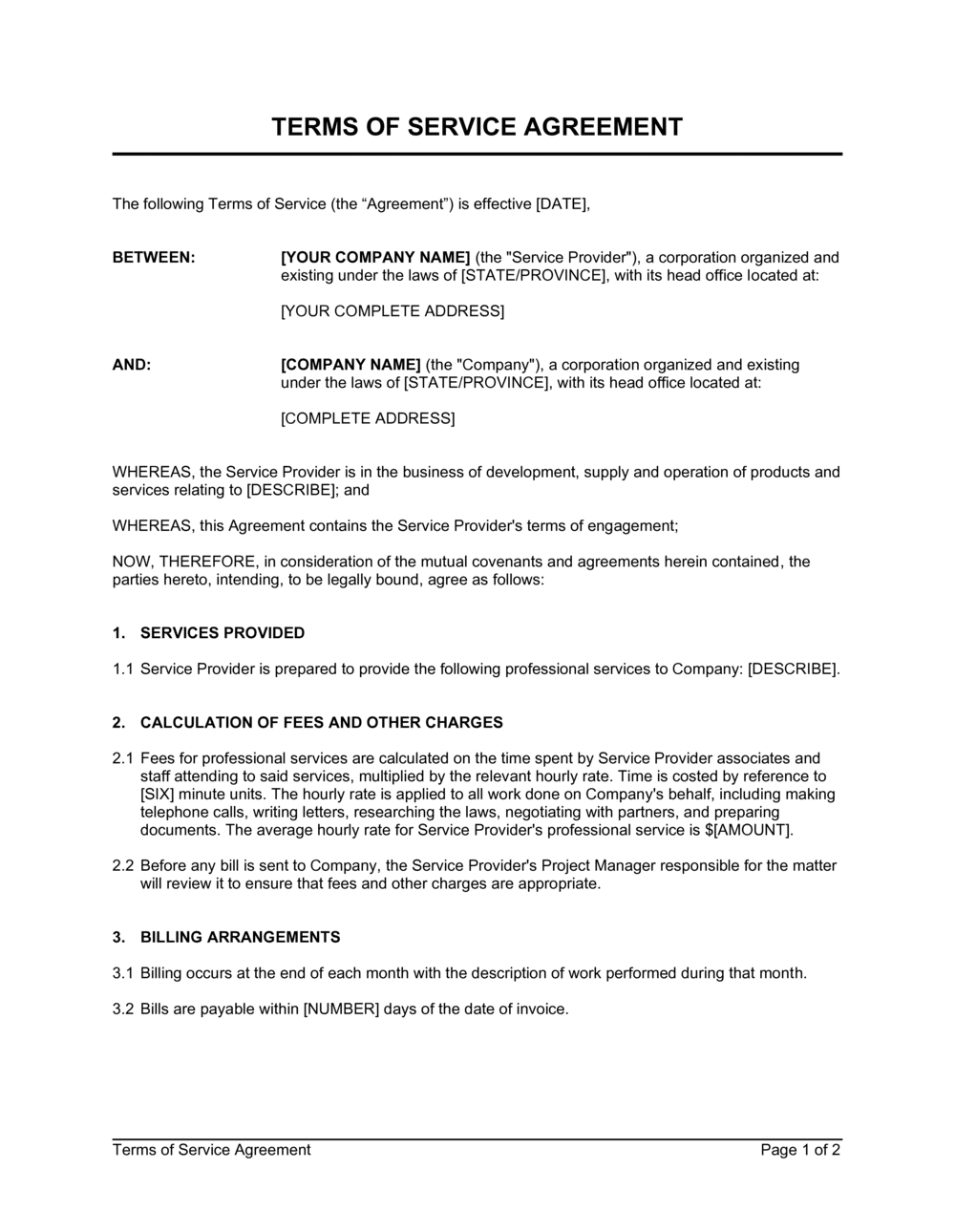
A Terms of Service Agreement is a legally binding contract between a service provider β€” typically a website, app, or SaaS business β€” and any user who accesses or uses that service. This free Word download gives you a structured, editable starting point covering acceptable use, IP ownership, liability limitations, dispute resolution, and termination, which you can customize online and publish directly to your site or platform.
When you need it
Use it before launching any publicly accessible website, web application, mobile app, or SaaS product β€” or immediately if you are already operating without one. It is also required whenever you update your service in ways that materially change user rights or obligations.
What's inside
Acceptance of terms, account registration and eligibility, permitted and prohibited uses, intellectual property ownership, disclaimers and limitation of liability, indemnification, dispute resolution and arbitration, governing law, and termination conditions.

What is a Terms of Service Agreement?

A Terms of Service Agreement is a legally binding contract between a service provider β€” typically the operator of a website, mobile app, or SaaS platform β€” and any individual or entity that accesses or uses that service. It establishes the rules of the relationship: what users may and may not do, who owns the content and intellectual property on the platform, what the provider's liability is capped at, how disputes will be resolved, and when either party may terminate access. Unlike a negotiated B2B contract, a ToS is a standard-form document presented uniformly to all users β€” its enforceability depends on users having clear notice of its existence and a documented opportunity to accept or decline before using the service.

Why You Need This Document

Operating a website, app, or online service without a Terms of Service Agreement leaves you exposed on every front that matters. Without a liability limitation clause, a single service outage or data error can expose you to uncapped damages from any user who claims a loss. Without an intellectual property clause, your platform's content, code, and data have no contractual protection against reproduction or redistribution. Without an acceptable-use policy, you have no contractual basis to terminate abusive users, remove harmful content, or enforce platform rules. Without a dispute resolution clause, every user grievance defaults to litigation in the user's home court β€” potentially in a jurisdiction you have never operated in. A well-structured Terms of Service Agreement closes all four gaps, creates the paper trail that makes enforcement realistic, and signals to users, investors, and regulators that your platform is operated professionally.

Which variant fits your situation?

If your situation is…Use this template
Running a public-facing website or blog with no user accountsWebsite Terms of Use
Operating a SaaS product with paid subscription tiersSaaS Terms of Service Agreement
Running an e-commerce store selling physical or digital goodsE-Commerce Terms and Conditions
Collecting user data and needing a companion privacy documentPrivacy Policy
Operating a two-sided marketplace with buyers and sellersMarketplace Terms of Service
Offering a free mobile app with in-app purchasesMobile App End User License Agreement (EULA)
Providing an API to third-party developersAPI Terms of Use

Common mistakes to avoid

❌ Using browsewrap-only acceptance with no affirmative consent

Why it matters: Courts in the US and EU have refused to enforce ToS agreements where users had no clear notice or opportunity to review the terms before accessing the service. Without documented consent, your limitation-of-liability and arbitration clauses may be unenforceable.

Fix: Implement a clickwrap mechanism β€” a checkbox labeled 'I agree to the Terms of Service' linked to the full document β€” at account creation or purchase, and log the timestamp and IP address of each acceptance.

❌ Failing to address user-generated content rights

Why it matters: If your platform lets users upload content and your ToS does not include a license-back clause, you technically have no right to display, store, distribute, or moderate that content β€” exposing you to copyright infringement claims from your own users.

Fix: Add a clause granting the company a worldwide, royalty-free, sublicensable license to use, display, and distribute user-submitted content solely for operating and improving the service.

❌ Setting a liability cap disproportionately low

Why it matters: A flat $50 or $100 liability cap applied to users paying $10,000 per year in subscription fees has been challenged as unconscionable in several US jurisdictions, and courts have struck it down entirely rather than reducing it to a reasonable amount.

Fix: Set the cap at the greater of a reasonable floor (e.g., $250) or fees paid in the preceding 12 months. For enterprise tiers, tier the cap proportionately to the subscription value.

❌ Not specifying which clauses survive termination

Why it matters: Without a survival clause, your IP ownership, confidentiality, indemnification, and limitation-of-liability provisions may lapse the moment a user's account is closed β€” giving former users a clean break from obligations they should carry indefinitely.

Fix: Add a dedicated survival clause listing by name every section that continues after termination: IP ownership, indemnification, limitation of liability, dispute resolution, and payment obligations.

❌ Omitting an auto-renewal disclosure for paid subscriptions

Why it matters: Several US states (California, New York, Illinois) and the EU Omnibus Directive require conspicuous pre-purchase disclosure of auto-renewal terms. Violations trigger consumer protection enforcement actions, chargebacks, and class-action exposure.

Fix: Add a bold, standalone auto-renewal notice in the fees section β€” not just a reference in the general terms β€” and send a renewal reminder email at least 30 days before each billing date.

❌ Using a one-size-fits-all ToS without jurisdiction-specific carve-outs

Why it matters: A governing-law clause selecting a single US state is frequently unenforceable against consumers in the EU, UK, and California, who retain statutory rights regardless of contractual choice-of-law provisions.

Fix: Add jurisdiction-specific addenda or carve-out paragraphs for EU consumers (GDPR, unfair terms), UK consumers (Consumer Rights Act), and California residents (CCPA) acknowledging their statutory rights cannot be waived.

The 10 key clauses, explained

Acceptance of Terms

In plain language: Explains how users consent to the agreement β€” by creating an account, clicking 'I Agree,' or simply using the service β€” and states that continued use constitutes ongoing acceptance.

Sample language
By accessing or using [SERVICE NAME] ('Service'), you agree to be bound by these Terms of Service ('Terms'). If you do not agree, you must discontinue use immediately. Continued use following any update to these Terms constitutes acceptance of the revised Terms.

Common mistake: Relying on browsewrap-only acceptance with no visible link or affirmative action. Courts in the US and EU have declined to enforce ToS agreements where users had no clear notice of or opportunity to review the terms.

Eligibility and Account Registration

In plain language: Defines who may use the service β€” minimum age, legal capacity, geographic restrictions β€” and places responsibility on users for maintaining accurate account credentials.

Sample language
You must be at least [AGE] years old and legally capable of entering contracts in your jurisdiction to create an account. You are responsible for maintaining the confidentiality of your account credentials and for all activity under your account.

Common mistake: Setting a minimum age of 13 without implementing COPPA-compliant parental consent mechanisms. If your service collects any data from users under 13 in the US, COPPA requires documented parental consent β€” not just a terms clause.

License Grant and Intellectual Property

In plain language: Grants users a limited, non-exclusive license to use the service while confirming that all platform content, trademarks, and code remain the provider's property.

Sample language
[COMPANY NAME] grants you a limited, non-exclusive, non-transferable, revocable license to access and use the Service solely for your internal business or personal purposes. All content, trademarks, software, and data on the Service are the exclusive property of [COMPANY NAME] or its licensors.

Common mistake: Failing to address user-generated content (UGC) ownership. If users upload content, the ToS must include a license-back clause β€” otherwise the provider has no right to display, store, or moderate that content.

Acceptable Use and Prohibited Conduct

In plain language: Lists what users may and may not do on the platform β€” covering illegal activity, scraping, spam, abuse, and impersonation β€” and reserves the right to terminate accounts for violations.

Sample language
You agree not to: (a) use the Service for any unlawful purpose; (b) transmit unsolicited commercial messages; (c) scrape, crawl, or extract data without written permission; (d) impersonate any person or entity; or (e) upload content that infringes third-party intellectual property rights.

Common mistake: Writing a generic prohibited-use list without tailoring it to the platform's actual risk vectors. A marketplace needs seller-fraud prohibitions; a SaaS product needs API-abuse restrictions. Generic lists leave real gaps.

Fees, Payment, and Subscription Terms

In plain language: Covers pricing, billing cycles, auto-renewal, refund policy, and what happens if payment fails β€” for any paid tier of the service.

Sample language
Subscription fees are billed [monthly / annually] in advance and are non-refundable except as required by applicable law. [COMPANY NAME] reserves the right to modify pricing with [30] days' notice. Failure to pay may result in suspension or termination of your account.

Common mistake: Omitting an auto-renewal disclosure. Several US states and the EU require conspicuous disclosure of auto-renewal terms before purchase. Burying it in a standard clause exposes the provider to regulatory action and chargebacks.

Disclaimers and Warranty Exclusions

In plain language: States that the service is provided 'as is' without warranties of merchantability, fitness for a particular purpose, or uninterrupted availability β€” limiting the provider's exposure for service failures.

Sample language
THE SERVICE IS PROVIDED 'AS IS' AND 'AS AVAILABLE' WITHOUT WARRANTIES OF ANY KIND, EXPRESS OR IMPLIED, INCLUDING BUT NOT LIMITED TO WARRANTIES OF MERCHANTABILITY, FITNESS FOR A PARTICULAR PURPOSE, OR NON-INFRINGEMENT. [COMPANY NAME] DOES NOT WARRANT THAT THE SERVICE WILL BE ERROR-FREE OR UNINTERRUPTED.

Common mistake: Failing to use all-caps or otherwise conspicuous formatting for warranty disclaimers. Under the UCC and many common-law jurisdictions, warranty disclaimers must be conspicuous to be enforceable β€” standard body text does not qualify.

Limitation of Liability

In plain language: Caps the provider's total financial liability to the user, typically at the amount the user paid in the preceding 12 months, and excludes indirect, consequential, or punitive damages.

Sample language
TO THE MAXIMUM EXTENT PERMITTED BY LAW, [COMPANY NAME]'S TOTAL LIABILITY FOR ANY CLAIM ARISING OUT OF OR RELATED TO THESE TERMS SHALL NOT EXCEED THE GREATER OF $[AMOUNT] OR THE FEES PAID BY YOU IN THE 12 MONTHS PRECEDING THE CLAIM. IN NO EVENT SHALL [COMPANY NAME] BE LIABLE FOR INDIRECT, INCIDENTAL, SPECIAL, OR CONSEQUENTIAL DAMAGES.

Common mistake: Setting the liability cap at a flat $100 regardless of subscription value. Courts occasionally strike down caps that are so disproportionately low as to be unconscionable, particularly in B2B SaaS agreements where users pay thousands per year.

Indemnification

In plain language: Requires users to defend and hold the provider harmless from legal claims arising from the user's breach of the ToS, violation of law, or infringement of third-party rights.

Sample language
You agree to indemnify, defend, and hold harmless [COMPANY NAME] and its officers, directors, employees, and agents from any claims, damages, or expenses β€” including reasonable attorneys' fees β€” arising from your use of the Service, your breach of these Terms, or your violation of any third-party rights.

Common mistake: Including a mutual indemnification clause without reviewing it for balance. In consumer-facing services, broad mutual indemnification language can trigger regulatory scrutiny in the EU and several US states as an unfair contract term.

Dispute Resolution and Governing Law

In plain language: Specifies whether disputes go to arbitration or court, designates the forum and governing law, and typically includes a class-action waiver.

Sample language
Any dispute arising under these Terms shall be resolved by binding arbitration under the [AAA / JAMS] rules in [CITY, STATE], except that either party may seek injunctive relief in any court of competent jurisdiction. These Terms are governed by the laws of [STATE / COUNTRY], without regard to its conflict-of-laws provisions. You waive any right to participate in a class action.

Common mistake: Including a class-action waiver without pairing it with a conspicuous arbitration notice. In California, the EU, and the UK, class-action waivers embedded in standard ToS without clear disclosure face heightened enforceability challenges.

Termination and Effect of Termination

In plain language: States the conditions under which either party may terminate the agreement, the notice required, and what rights and obligations survive termination β€” particularly data deletion, payment obligations, and IP.

Sample language
[COMPANY NAME] may suspend or terminate your access to the Service at any time for any reason with [X] days' notice, or immediately for cause. Upon termination, your license to use the Service ends immediately. Sections covering IP, indemnification, limitation of liability, and dispute resolution survive termination.

Common mistake: Failing to specify which clauses survive termination. Without a survival clause, confidentiality, IP, and indemnification obligations may lapse the moment the account is closed β€” defeating the purpose of including them.

How to fill it out

  1. 1

    Identify your legal entity and service name

    Replace every instance of [COMPANY NAME] with your registered legal entity name β€” not your brand or trade name. Confirm the service name matches what users see in your app or on your site.

    πŸ’‘ If your brand name differs from your legal entity, include a parenthetical on first use: 'Acme Inc. (operating as NovaTool) ("Company")' β€” this prevents confusion in any enforcement scenario.

  2. 2

    Set user eligibility and age requirements

    Determine the minimum age for your service. If you collect any data from users under 13 (US) or 16 (EU/UK under GDPR), you need COPPA or GDPR-compliant parental consent mechanisms in addition to this clause.

    πŸ’‘ If your service is strictly B2B, replace an age minimum with a 'legal authority to bind a business entity' requirement to close the personal-use gap.

  3. 3

    Define the license scope for your platform

    Specify whether the license is for personal use, internal business use, or both. If users upload, post, or submit content, add a license-back clause granting you the rights to store, display, and moderate that content.

    πŸ’‘ For marketplaces or social platforms, use a broad license-back clause that covers sublicensing to other users β€” otherwise displaying one user's content to another may infringe the uploader's copyright.

  4. 4

    Tailor the acceptable-use prohibitions to your platform

    Start with the general prohibitions in the template, then add platform-specific restrictions. A marketplace needs anti-fraud and counterfeit-goods language; a SaaS product needs API-rate-limit and reverse-engineering restrictions.

    πŸ’‘ Mirror your AUP language in your enforcement policy so moderators apply the same standard the ToS sets β€” inconsistent enforcement is a common source of user disputes.

  5. 5

    Fill in fees, billing cycles, and auto-renewal terms

    Enter your actual pricing, billing frequency, and refund policy. Disclose auto-renewal conspicuously β€” ideally in bold or a separate highlighted notice β€” and specify the number of days' notice you will give before renewing.

    πŸ’‘ In the EU, auto-renewal for subscriptions over 12 months requires explicit re-consent under the Omnibus Directive. Check your markets before setting a standard renewal clause.

  6. 6

    Set your liability cap and verify it against revenue

    Enter a liability cap that is proportionate to the fees your users pay. A common formula is the greater of a flat floor (e.g., $100) or fees paid in the preceding 12 months. Courts are more likely to uphold caps that bear a rational relationship to the contract value.

    πŸ’‘ For enterprise SaaS tiers, consider a tiered cap β€” higher-paying tiers get a higher cap β€” to avoid the 'unconscionable' challenge that flat micro-caps invite.

  7. 7

    Choose your dispute resolution forum and governing law

    Select the jurisdiction whose courts or arbitration providers you can realistically access. For US-based companies, Delaware or your state of incorporation is common. For global services, consider whether arbitration is enforceable in your primary user markets.

    πŸ’‘ If you have significant EU users, California users, or UK users, note the specific carve-outs for those jurisdictions in the governing-law clause β€” blanket foreign-law choices are frequently unenforceable against consumers in those regions.

  8. 8

    Implement a visible acceptance mechanism before publishing

    Do not simply post the ToS β€” implement a clickwrap mechanism (checkbox + 'I Agree' button, or a mandatory screen at registration) that records user consent with a timestamp. Store acceptance logs for at least 3 years.

    πŸ’‘ A/B test the placement of the 'I Agree' checkbox. Studies show consent rates are highest when the checkbox is adjacent to the registration or purchase button, not buried below the fold.

Frequently asked questions

What is a Terms of Service Agreement?

A Terms of Service Agreement is a legally binding contract between a service provider and users that governs how the service may be accessed and used. It defines user rights, prohibited conduct, intellectual property ownership, payment terms, liability limits, and how disputes are resolved. Any business operating a website, app, or SaaS product needs one before accepting users or payments.

Is a Terms of Service Agreement legally required?

No single law universally mandates a ToS for every website, but several regulations effectively require certain provisions. COPPA requires specific notice if your service collects data from users under 13. GDPR and CCPA require transparent data-processing disclosures. App stores (Apple, Google) require a ToS as a condition of listing. Operating without one also leaves you without enforceable liability limits, IP protections, or dispute resolution terms.

What is the difference between Terms of Service and a Privacy Policy?

Terms of Service govern the rules of using the service β€” acceptable conduct, payments, IP, liability, and dispute resolution. A Privacy Policy governs how you collect, use, store, and share personal data. Both documents are legally distinct and typically required separately. GDPR, CCPA, and most app store policies require a Privacy Policy in addition to any ToS. Publishing one does not substitute for the other.

What is the difference between clickwrap and browsewrap?

Clickwrap requires an affirmative user action β€” checking a box or clicking 'I Agree' β€” to signal consent before accessing a service. Browsewrap implies consent from the mere act of using a website, with a passive link to the ToS somewhere on the page. US and EU courts consistently enforce clickwrap agreements and frequently refuse to enforce browsewrap agreements where users had no clear notice of the terms. Always use clickwrap for material obligations like liability limits and arbitration.

Does a Terms of Service Agreement need to be signed?

Traditional wet or electronic signatures are not required for most consumer-facing ToS agreements β€” a documented clickwrap acceptance with a timestamp and IP log is considered legally sufficient in most jurisdictions. However, B2B SaaS agreements with negotiated terms, enterprise contracts, and any ToS that incorporates a data processing agreement (DPA) typically warrant a formal e-signature using a platform like DocuSign to create a clear evidentiary record.

Can I copy a competitor's Terms of Service?

Copying another company's ToS verbatim is copyright infringement and carries legal risk beyond the obvious. More importantly, a ToS copied from a different business will contain terms calibrated to that company's products, liability profile, and jurisdiction β€” not yours. Key gaps (missing user-generated content clauses, wrong governing-law state, inapplicable payment terms) can leave critical areas unprotected or create obligations you did not intend. Use a reputable template and tailor it to your actual service.

How often should a Terms of Service Agreement be updated?

Review your ToS whenever you launch a new feature, enter a new market, change your pricing model, or become aware of a new legal requirement affecting your industry. At minimum, an annual review is standard. Each update should be versioned with a 'Last Updated' date, distributed to users via email or in-app notice, and reconsented to via clickwrap if the changes are material β€” particularly if you are altering dispute resolution, liability limits, or data use.

Are arbitration clauses and class-action waivers enforceable?

In the US, the Supreme Court has broadly upheld arbitration clauses and class-action waivers in consumer contracts under the Federal Arbitration Act, with some state-level exceptions. California has historically been hostile to class-action waivers absent an opt-out mechanism. In the EU and UK, class-action waivers in standard consumer contracts are generally unenforceable as unfair terms. The FTC and CFPB continue to scrutinize mandatory arbitration in consumer financial services specifically.

Do I need a lawyer to draft a Terms of Service Agreement?

For a simple blog or informational website with no user accounts or payments, a well-built template is typically sufficient. Engage a lawyer when your service collects sensitive personal data, processes payments across multiple jurisdictions, operates a marketplace with third-party sellers, or when liability exposure is material. A 2–4 hour attorney review of a template typically costs $400–$800 and is worthwhile for any SaaS, fintech, or healthcare-adjacent product.

How this compares to alternatives

vs Privacy Policy

A Privacy Policy governs how you collect, store, use, and share personal data β€” it is a data-handling disclosure document, not a user conduct contract. A Terms of Service Agreement governs acceptable use, IP ownership, payment terms, liability, and dispute resolution. Both are legally distinct, both are required for most online services, and publishing one does not satisfy the obligation for the other.

vs End User License Agreement (EULA)

A EULA is specifically designed for software licensing β€” it grants the user a license to install and run the software while restricting copying, reverse engineering, and redistribution. A Terms of Service Agreement governs access to an online service or platform and typically covers account management, payment, and platform conduct in addition to IP. SaaS products often need both.

vs Service Level Agreement (SLA)

An SLA is a performance commitment document β€” it sets uptime targets, response-time guarantees, and the remedies (credits, refunds) available when those targets are missed. A Terms of Service Agreement sets the general rules of use and limits the provider's liability. SLAs typically operate as an exhibit or addendum to a ToS or Master Services Agreement for enterprise customers.

vs Master Services Agreement (MSA)

An MSA is a bilateral negotiated contract between two businesses covering an ongoing service relationship β€” each party signs it and negotiates the terms. A Terms of Service Agreement is a unilateral standard-form contract the provider presents to all users on a take-it-or-leave-it basis. Enterprise customers often require an MSA to replace or supplement a public ToS for their specific relationship.

Industry-specific considerations

SaaS / Technology

API rate limits, uptime SLA disclaimers, data processing addendum references, and tiered subscription auto-renewal disclosures are all SaaS-specific additions that a generic ToS template must accommodate.

E-commerce / Retail

Order acceptance, pricing error corrections, product availability disclaimers, return and refund eligibility, and sales tax obligations by jurisdiction require tailored language beyond a standard ToS.

Healthcare / MedTech

HIPAA-compliant language is required for any service handling protected health information β€” a standard ToS liability disclaimer does not satisfy the BAA requirement, which must be a separate executed agreement.

Financial Services / Fintech

Regulatory disclosures (SEC, FINRA, FCA), investment risk warnings, AML/KYC obligation acknowledgments, and CFPB-compliant arbitration notice requirements make fintech ToS agreements substantially more complex than standard templates.

Jurisdictional notes

United States

The Federal Arbitration Act broadly supports mandatory arbitration and class-action waivers in consumer ToS agreements, though California courts apply heightened unconscionability scrutiny and require a clear opt-out mechanism to uphold waivers. COPPA requires documented parental consent for users under 13. State-specific auto-renewal laws in California, New York, and Illinois require conspicuous pre-purchase disclosure and easy cancellation.

Canada

PIPEDA (and Quebec's Law 25, which imposes GDPR-like requirements) mandates that data collection and processing terms be disclosed clearly β€” typically in a Privacy Policy that should be cross-referenced in the ToS. Canadian courts apply consumer protection statutes provincially, and standard-form contracts may be subject to review under Quebec's Consumer Protection Act. Mandatory arbitration clauses that oust provincial consumer protection tribunals are unenforceable in Quebec and British Columbia.

United Kingdom

The Consumer Rights Act 2015 requires that standard consumer contract terms be fair, transparent, and prominent β€” unfair terms, including disproportionate liability exclusions, are not binding on consumers. The UK GDPR (post-Brexit equivalent of EU GDPR) requires a separate, compliant Privacy Policy. Arbitration clauses in consumer contracts must comply with the Arbitration Act 1996 and may be challenged as unfair terms under the CRA.

European Union

The EU Unfair Contract Terms Directive renders standard-form terms that create significant imbalances in consumer rights unenforceable β€” this covers broad liability exclusions, mandatory foreign-law choices, and class-action waivers. GDPR requires a separate, detailed Privacy Policy and Data Processing Agreement; GDPR obligations cannot be satisfied within a ToS alone. The Digital Services Act (DSA) imposes additional transparency and content-moderation obligations on larger platforms operating in the EU.

Template vs lawyer β€” what fits your deal?

PathBest forCostTime
Use the templateInformational websites, early-stage apps, and small e-commerce stores with standard offerings in a single jurisdictionFree1–2 hours
Template + legal reviewSaaS products, marketplaces, or any service collecting personal data or processing recurring payments across multiple jurisdictions$400–$8002–5 business days
Custom draftedFintech, healthtech, enterprise SaaS with negotiated terms, or platforms operating under industry-specific regulation$2,000–$8,000+2–4 weeks

Glossary

Terms of Service (ToS)
A binding contract that defines the rules users must agree to in order to access and use a product, website, or service.
Clickwrap Agreement
A method of obtaining user consent by requiring an affirmative action β€” such as checking a box or clicking 'I Agree' β€” before accessing a service.
Browsewrap Agreement
An implied consent model where use of a site is treated as acceptance of its terms, without requiring an explicit user action; generally less enforceable than clickwrap.
Limitation of Liability
A clause that caps the maximum amount the service provider can be held financially responsible for, typically expressed as a dollar amount or a multiple of fees paid.
Indemnification
A user's obligation to compensate the service provider for losses, damages, or legal costs arising from the user's breach of the agreement or misuse of the service.
Acceptable Use Policy (AUP)
A section or separate document defining what users may and may not do with a service β€” covering prohibited content, activities, and behaviors.
Intellectual Property (IP) Ownership
The clause establishing who owns the platform's content, code, trademarks, and data, and what license β€” if any β€” the user receives to use them.
Arbitration Clause
A provision requiring disputes to be resolved through binding arbitration rather than litigation, typically waiving the right to a jury trial and class action.
Class Action Waiver
A clause preventing users from joining or initiating class-action lawsuits against the service provider, requiring disputes to be handled individually.
Severability
A standard provision stating that if one clause in the agreement is found unenforceable, the rest of the agreement remains in full force.
Governing Law
The jurisdiction whose laws apply to the interpretation and enforcement of the agreement, regardless of where the user is located.
Force Majeure
A clause excusing a party's non-performance when caused by extraordinary events outside their control, such as natural disasters, cyberattacks, or government action.

Part of your Business Operating System

This document is one of 3,000+ business & legal templates included in Business in a Box.

  • Fill-in-the-blanks β€” ready in minutes
  • 100% customizable Word document
  • Compatible with all office suites
  • Export to PDF and share electronically

Create your document in 3 simple steps.

From template to signed document β€” all inside one Business Operating System.
1
Download or open template

Access over 3,000+ business and legal templates for any business task, project or initiative.

2
Edit and fill in the blanks with AI

Customize your ready-made business document template and save it in the cloud.

3
Save, Share, Send, Sign

Share your files and folders with your team. Create a space of seamless collaboration.

Save time, save money, and create top-quality documents.

β˜…β˜…β˜…β˜…β˜…

"Fantastic value! I'm not sure how I'd do without it. It's worth its weight in gold and paid back for itself many times."

Managing Director Β· Mall Farm
Robert Whalley
Managing Director, Mall Farm Proprietary Limited
β˜…β˜…β˜…β˜…β˜…

"I have been using Business in a Box for years. It has been the most useful source of templates I have encountered. I recommend it to anyone."

Business Owner Β· 4+ years
Dr Michael John Freestone
Business Owner
β˜…β˜…β˜…β˜…β˜…

"It has been a life saver so many times I have lost count. Business in a Box has saved me so much time and as you know, time is money."

Owner Β· Upstate Web
David G. Moore Jr.
Owner, Upstate Web

Run your business with a system β€” not scattered tools

Stop downloading documents. Start operating with clarity. Business in a Box gives you the Business Operating System used by over 250,000 companies worldwide to structure, run, and grow their business.

Start freeΒ Β·Β No credit card required