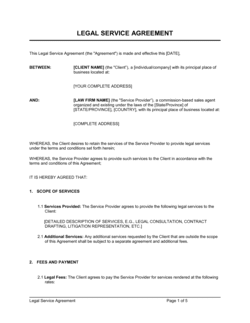
Residential Service Agreement Template

Free Word download β€’ Edit online β€’ Save & share with Drive β€’ Export to PDF

5 pagesβ€’25–35 min to fillβ€’Difficulty: Complexβ€’Signature requiredβ€’Legal review recommended
Learn more ↓
FreeResidential Service Agreement Template

At a glance

What it is
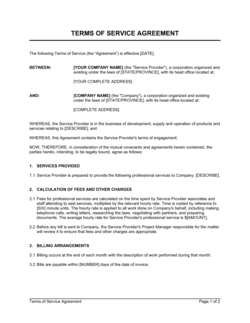
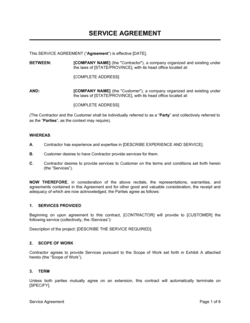
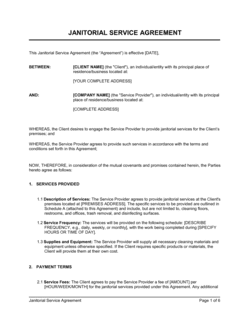
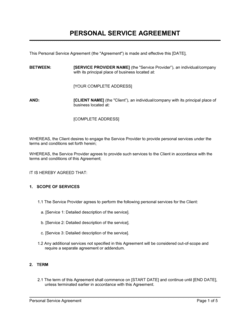
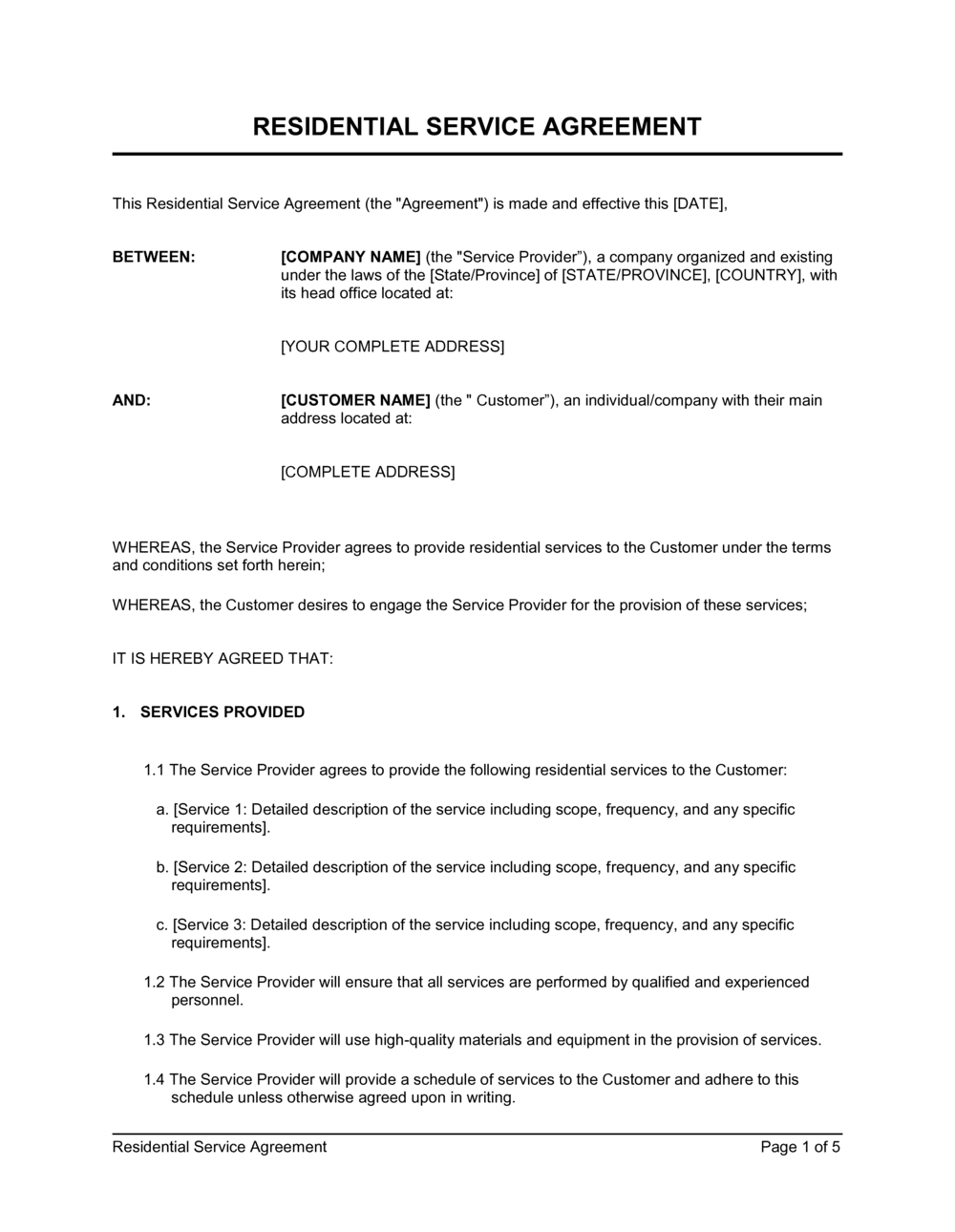
A Residential Service Agreement is a legally binding contract between a home service provider and a homeowner that defines the scope of work, payment terms, scheduling, liability limits, and termination rights for services performed at a private residence. This free Word download gives you a structured, attorney-reviewed starting point you can edit online and export as PDF to sign with clients before any work begins.
When you need it
Use it any time you are engaged to perform recurring or one-time services at a private home β€” landscaping, cleaning, pest control, HVAC maintenance, pool service, or similar β€” and need a written record of agreed terms that protects both parties if a dispute arises.
What's inside
Parties and property address, detailed scope of work, service schedule, compensation and payment terms, liability and indemnification, insurance requirements, warranty of workmanship, cancellation and termination rights, and governing law with dispute resolution provisions.

What is a Residential Service Agreement?

A Residential Service Agreement is a legally binding contract between a professional home service provider and a homeowner that establishes the terms under which services will be performed at a private residence. It specifies exactly what work will be done, how often, for what fee, and under what conditions either party can exit the arrangement β€” replacing informal verbal understandings with an enforceable written record. Unlike a general-purpose service contract, a residential service agreement addresses the unique context of working in someone's home: right-of-entry authorization, property access protocols, liability for damage to personal property, and consumer protection disclosures that often apply specifically to services sold at or delivered to private residences.

Why You Need This Document

Operating without a signed residential service agreement exposes both the provider and the homeowner to risks that a single page of written terms eliminates. Providers who rely on verbal agreements have no enforceable basis to collect cancellation fees when clients cancel last-minute, no documented scope of work when a homeowner disputes what was promised, and no liability cap when a damage claim arrives. Homeowners without a written agreement have no guaranteed remedy period for deficient work, no clear record of what was included in the quoted price, and no agreed process for resolving disputes short of litigation. State and provincial consumer protection laws in the US, Canada, and the UK impose mandatory disclosure and cancellation requirements on residential service contracts β€” failing to meet them can expose a provider to regulatory penalties and give the homeowner grounds to void the contract entirely. This template gives service businesses a professional, jurisdiction-aware starting point that covers every critical term, so the first service visit begins on a foundation both parties have reviewed and agreed to in writing.

Which variant fits your situation?

If your situation is…Use this template
Providing a one-time service visit rather than ongoing recurring workService Agreement (One-Time)
Performing a large home renovation or construction projectHome Improvement Contract
Engaging a subcontractor to perform residential work on your behalfSubcontractor Agreement
Providing commercial property maintenance rather than residentialCommercial Maintenance Agreement
Offering a maintenance service plan with tiered annual pricingMaintenance Service Contract
Acting as an independent contractor for a homeowner rather than a business entityIndependent Contractor Agreement
Providing landscaping design and installation as a discrete projectLandscaping Contract

Common mistakes to avoid

❌ Describing the scope of work too broadly

Why it matters: Phrases like 'general lawn care' or 'standard cleaning' mean different things to every client. When the homeowner's expectation and your practice diverge, you have no written standard to point to β€” and disputes almost always resolve in the client's favor.

Fix: List every included task by name β€” 'mow, edge, and blow clippings from hard surfaces' rather than 'lawn maintenance' β€” and add an explicit exclusions list for tasks you will not perform.

❌ No cancellation notice period or fee

Why it matters: Without a minimum notice window, clients can cancel a scheduled visit the morning of with no obligation. Recurring-service providers lose not just the revenue but the blocked time they cannot fill on short notice.

Fix: Require written notice of at least 24–48 hours for individual visit cancellations and 14–30 days for terminating the recurring service, with a flat fee for non-compliance disclosed in the agreement.

❌ Omitting a liability cap

Why it matters: Without a contractual limit, a single incident β€” a broken fixture, a flooded basement, a damaged vehicle in the driveway β€” can expose the provider to damages far exceeding the value of the contract.

Fix: Cap liability at the total fees paid in the three to six months preceding the claim, and confirm the cap does not exceed the applicable general liability insurance policy limit.

❌ No right-of-entry clause for recurring services

Why it matters: Providers who access a property while the homeowner is away β€” even on a scheduled basis β€” have no documented authorization. If something goes missing or damaged, the absence of a written access grant complicates the provider's defense.

Fix: Include a right-of-entry clause stating that the homeowner authorizes access during scheduled service windows, and document the specific access method in writing at onboarding.

❌ Using a trade name instead of the registered entity name

Why it matters: If the contract names 'Dave's Lawn Care' but the registered entity is 'Greenfield Property Services LLC,' enforcing the contract against the right legal entity β€” or claiming under the right insurance policy β€” can be complicated.

Fix: Use the exact legal entity name as it appears on the state business registry and contractor license. You may add 'doing business as [TRADE NAME]' in parentheses.

❌ No entire-agreement clause

Why it matters: Verbal promises made during the sales process β€” a lower rate, a specific crew member, extra services included β€” become potential contract terms in litigation if the written agreement does not clearly state it supersedes all prior understandings.

Fix: Include a standard entire-agreement clause and ensure any promises made during the sales process are either documented in the written contract or confirmed not to apply.

The 10 key clauses, explained

Parties and property identification

In plain language: Names the service provider (company or individual) and the homeowner as legal parties, and identifies the property address where services will be performed.

Sample language
This Residential Service Agreement is entered into as of [DATE] between [SERVICE PROVIDER NAME], a [STATE] [ENTITY TYPE] ('Provider'), and [HOMEOWNER FULL NAME] ('Client'), for services performed at [PROPERTY ADDRESS] ('Property').

Common mistake: Using a trade name instead of the provider's registered legal entity name. If a dispute reaches court or a licensing board, the party named in the contract must match the entity on file β€” a mismatch can invalidate enforcement.

Scope of work and exclusions

In plain language: Describes exactly what the provider will do, what materials or equipment are included, and explicitly lists tasks that fall outside the agreement to prevent scope creep.

Sample language
Provider shall perform the following services at the Property: [DETAILED SERVICE LIST]. The following are expressly excluded from this Agreement: [EXCLUSIONS LIST]. Any additional work requires a signed Change Order.

Common mistake: Describing services in broad terms like 'general maintenance.' Vague scope language is the single most common trigger for homeowner disputes and non-payment β€” be specific enough that a third party could verify completion.

Service schedule and access

In plain language: Sets the frequency, days, and time windows for service visits and grants the provider the right to access the property as needed.

Sample language
Services shall be performed [WEEKLY / MONTHLY / AS SCHEDULED] on [DAY(S)] between [START TIME] and [END TIME]. Client grants Provider and Provider's personnel the right to enter the Property during scheduled service windows without requiring Client's presence.

Common mistake: Omitting a right-of-entry clause for recurring services. Without it, providers have no clear authorization to access the property when the homeowner is away, creating liability exposure if something goes wrong during an unaccompanied visit.

Compensation and payment terms

In plain language: States the service fee, payment frequency, accepted payment methods, and the consequence β€” including interest or suspension of services β€” for late payment.

Sample language
Client shall pay Provider $[AMOUNT] per [visit / month / quarter], due within [NUMBER] days of invoice. Invoices unpaid after [NUMBER] days accrue interest at [RATE]% per month. Provider may suspend services after [NUMBER] days of non-payment without waiving the right to collect amounts owed.

Common mistake: Stating only the rate without specifying the invoicing trigger and due date. 'Payment due upon completion' is interpreted differently by every client; a specific due date with a late-fee clause cuts average collection time significantly.

Liability limitation and indemnification

In plain language: Caps the provider's maximum financial exposure for property damage or injury claims and requires each party to indemnify the other against losses caused by their own negligence.

Sample language
Provider's total liability under this Agreement shall not exceed the total fees paid by Client in the [THREE / SIX] months preceding the claim. Each party shall indemnify and hold harmless the other from claims arising out of their own negligence or willful misconduct.

Common mistake: No liability cap at all, or a cap that is set higher than the provider's general liability insurance limit. If a claim exceeds the policy, the provider's personal or business assets are exposed.

Insurance requirements

In plain language: Confirms the provider carries adequate general liability and workers' compensation insurance throughout the agreement term and may require the homeowner to be named as an additional insured.

Sample language
Provider shall maintain, at minimum, commercial general liability insurance of $[AMOUNT] per occurrence and workers' compensation coverage as required by [STATE] law. Provider shall furnish a certificate of insurance upon request.

Common mistake: Referencing insurance without specifying a coverage amount or type. A homeowner who suffers a loss cannot verify adequacy from a vague clause β€” and many jurisdictions require specific minimums for licensed contractors.

Warranty of workmanship

In plain language: The provider's guarantee that work will be performed in a professional manner, with a specific remedy period during which defects will be corrected at no charge.

Sample language
Provider warrants that all services will be performed in a workmanlike manner consistent with industry standards. If Client notifies Provider of a deficiency within [NUMBER] days of service, Provider shall re-perform the deficient work at no additional charge.

Common mistake: Omitting the remedy period entirely. Without a defined window, homeowners can claim defective work months or years later β€” a 7–30 day written-notice requirement limits exposure while still giving the client a fair remedy.

Cancellation and termination

In plain language: Sets the notice period required to cancel recurring services, states any cancellation fee, and defines grounds for immediate termination by either party.

Sample language
Either party may terminate recurring services with [NUMBER] days' written notice. Cancellations with less than [NUMBER] hours' notice of a scheduled visit are subject to a cancellation fee of $[AMOUNT]. Provider may terminate immediately for non-payment or Client's material breach.

Common mistake: No minimum cancellation notice period. Without one, clients can cancel the morning of a scheduled visit β€” after the provider has blocked the time and purchased materials β€” with no obligation to compensate for the loss.

Dispute resolution and governing law

In plain language: Specifies which jurisdiction's laws govern the contract and requires the parties to attempt mediation or arbitration before filing a lawsuit.

Sample language
This Agreement is governed by the laws of [STATE / PROVINCE]. Any dispute shall first be submitted to non-binding mediation in [CITY]. If mediation fails, disputes shall be resolved by binding arbitration administered by [AAA / other] in [CITY], except claims for injunctive relief or amounts under the small-claims-court threshold.

Common mistake: Choosing a governing law that differs from where the property is located. Consumer protection laws and contractor licensing rules are jurisdiction-specific β€” courts in the property's location often apply local law regardless of what the contract states.

Entire agreement and amendments

In plain language: Confirms that this written contract supersedes all prior verbal or written understandings, and that any changes must be in writing and signed by both parties.

Sample language
This Agreement constitutes the entire agreement between the parties regarding the services described herein and supersedes all prior representations, proposals, and understandings. Amendments are valid only if in writing and signed by both parties.

Common mistake: No entire-agreement clause. Without it, verbal promises made during the sales process β€” a discounted rate, extra services, a specific employee doing the work β€” can be introduced as contract terms in a dispute.

How to fill it out

  1. 1

    Enter legal entity names and the property address

    Use your registered business name β€” not a trade name β€” as the Provider. Enter the homeowner's full legal name and the complete property address where services will be delivered.

    πŸ’‘ Cross-check your state contractor license or business registration to confirm the exact entity name before the client signs.

  2. 2

    Define the scope of work with specifics

    List every task to be performed, the frequency, and any materials or equipment included. Then add an explicit exclusions list for tasks you will not perform under this agreement.

    πŸ’‘ If you offer tiered service levels, attach them as Schedule A rather than describing them in the body β€” it makes upgrades easier to document without amending the main contract.

  3. 3

    Set the service schedule and access terms

    Enter the specific days and time windows for visits. If you will need access when the homeowner is absent, include the right-of-entry clause and note how access will be granted β€” key, keypad code, or lockbox.

    πŸ’‘ For recurring services, confirm that the access method is documented in writing β€” verbal key-code sharing creates security and liability risks if something goes missing.

  4. 4

    Complete the compensation and invoicing fields

    State the fee amount, billing cycle (per visit, monthly, or quarterly), invoice delivery method, specific due date, and the late-fee rate. Include the service-suspension trigger for non-payment.

    πŸ’‘ Net 15 or Net 21 payment terms are standard for residential service providers β€” Net 30 is common in commercial but causes cash flow problems for small residential businesses.

  5. 5

    Set the liability cap and insurance minimums

    Enter the liability cap β€” typically the total fees paid in the prior three to six months β€” and confirm it does not exceed your general liability insurance limit. State the required coverage types and minimum dollar amounts.

    πŸ’‘ Review your insurance policy before completing this clause β€” setting a cap that exceeds your policy limit exposes personal assets.

  6. 6

    Define the warranty period and remedy process

    Enter the number of days a client has to report deficient work in writing, and state that your obligation is limited to re-performing the specific deficient task β€” not a refund or third-party repair cost.

    πŸ’‘ A 7-day written-notice requirement is enforceable in most jurisdictions and is short enough that defects are still verifiable when you respond.

  7. 7

    Set the cancellation notice period and fee

    Enter the number of days' notice required to cancel recurring services without penalty, and the flat fee or percentage charged for last-minute cancellations within your defined window.

    πŸ’‘ A $50–$75 short-notice cancellation fee on a residential cleaning or landscaping contract recovers roughly half the lost revenue and is accepted by most clients when disclosed upfront.

  8. 8

    Sign before the first service visit

    Both parties must sign and date the agreement before any work begins. For recurring services, execute a new agreement each time the scope, pricing, or schedule changes materially.

    πŸ’‘ Use an e-signature tool to timestamp execution and store the signed copy in a client file β€” unsigned agreements are common but difficult to enforce when a dispute arises years later.

Frequently asked questions

What is a residential service agreement?

A residential service agreement is a legally binding contract between a home service provider and a homeowner that governs the terms of services performed at a private residence. It defines the scope of work, service schedule, fees, payment terms, liability limits, insurance requirements, and cancellation rights. A signed agreement protects both parties if the quality of work, payment, or scheduling becomes a source of dispute.

What types of services does a residential service agreement cover?

The agreement is used for any repeating or one-time professional service performed at a home β€” including landscaping and lawn care, house cleaning, pest control, pool and spa maintenance, HVAC tune-ups, gutter cleaning, window washing, and handyman services. It is not appropriate for large renovation or construction projects, which require a more detailed home improvement or construction contract.

Is a residential service agreement legally required?

No federal law mandates a written service agreement for residential work in the US, but many states require written contracts for home improvement projects above a dollar threshold β€” typically $500–$1,000. Even where not legally required, a signed agreement is the most effective way to document agreed terms and enforce payment or cancellation rights. Several Canadian provinces and UK consumer regulations impose mandatory written disclosure requirements for door-to-door or distance-sold services.

What is the difference between a residential service agreement and a home improvement contract?

A residential service agreement covers ongoing or recurring maintenance services β€” cleaning, landscaping, pest control β€” performed at a home. A home improvement contract governs renovation or construction work that alters the structure or systems of the property. Home improvement contracts are typically subject to stricter statutory requirements, mandatory disclosures, and contractor licensing rules that do not apply to general service agreements.

Should I include a liability cap in my residential service agreement?

Yes. A liability cap limits the provider's maximum financial exposure to a defined amount β€” typically the total fees paid in the prior three to six months β€” preventing a single incident from generating a claim that far exceeds the contract's value. The cap should not exceed the provider's general liability insurance policy limit. Without a cap, a damaged floor, flooded basement, or injured guest could result in damages many times the annual contract value.

Can a homeowner cancel a residential service agreement at any time?

That depends entirely on the cancellation terms written into the agreement. Without a written notice requirement, a homeowner can typically cancel without penalty under consumer protection principles in most jurisdictions. A properly drafted agreement requires advance written notice β€” commonly 14–30 days for recurring services β€” and may impose a short-notice cancellation fee for individual visits cancelled inside the window. Courts generally enforce reasonable cancellation terms that are disclosed clearly before signing.

Does a residential service agreement need to be notarized?

No. A residential service agreement does not require notarization in any major jurisdiction to be legally enforceable. Both parties' signatures β€” wet or electronic β€” are sufficient to create a binding contract. Notarization is reserved for instruments like deeds, mortgages, and statutory declarations. An e-signature with a timestamp provides adequate evidence of execution for most residential service disputes.

What should I do if a homeowner refuses to sign the agreement?

Treat refusal as a significant risk signal. Without a signed agreement, you have no enforceable record of scope, price, cancellation terms, or liability limits. Consider whether to decline the engagement or limit the work to a single paid visit rather than a recurring commitment. If you proceed, at minimum confirm key terms in writing via email before starting, which can serve as evidence of the agreed arrangement even without a formal contract signature.

How do I handle scope changes after the agreement is signed?

Use a written change order signed by both parties before performing any additional work. A change order should describe the new or modified tasks, any change to the fee, and the date the parties agreed. Verbal authorization to expand scope is the most common source of non-payment disputes in residential service β€” the homeowner often recalls agreeing to a different price or a narrower scope than the provider performed.

How this compares to alternatives

vs Home Improvement Contract

A home improvement contract governs construction or renovation work that structurally alters the property β€” kitchen remodels, additions, roofing replacement. It is subject to stricter statutory requirements in most states, including mandatory rescission periods and specific disclosure language. A residential service agreement covers routine maintenance and recurring services that do not alter the structure, and carries lighter regulatory requirements.

vs Independent Contractor Agreement

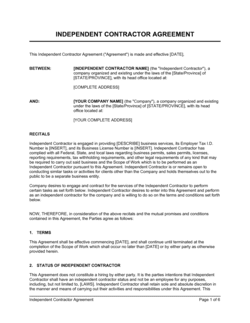
An independent contractor agreement defines the working relationship between a business and a self-employed individual and focuses on worker classification, IP, and non-solicitation. A residential service agreement is a client-facing document between a service business and a homeowner, focused on scope, payment, and liability. They address different legal relationships and are often used together β€” one governing the worker, the other governing the client.

vs Maintenance Agreement

A maintenance agreement typically covers scheduled upkeep of equipment or systems β€” HVAC units, commercial machinery, or elevators β€” often with tiered response times and parts coverage. A residential service agreement is broader in scope, covering any category of home service, and includes homeowner-specific terms like right of entry and property access. Use a maintenance agreement when the primary subject is equipment; use a residential service agreement when the subject is the property and all related services.

vs Subcontractor Agreement

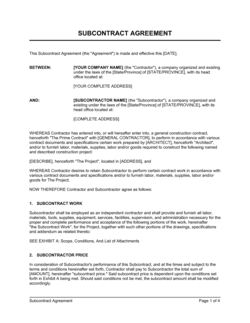
A subcontractor agreement governs the relationship between a general contractor and a company or individual hired to perform a portion of a larger project. A residential service agreement governs the direct relationship between a service provider and a homeowner. If you are a subcontractor working under a general contractor at a residential property, you need a subcontractor agreement with the GC β€” not a residential service agreement with the homeowner.

Industry-specific considerations

Landscaping and lawn care

Seasonal schedule variations, annual contract renewals with price-escalation clauses, and chemical or fertilizer application disclosures required by state pesticide laws.

Residential cleaning

Key and access-code management, breakage liability limits, minimum cancellation windows, and employee background check representations required by homeowner insurers.

HVAC and plumbing

Annual maintenance plan pricing, parts-and-labor warranties, emergency call-out rates, and licensed-technician requirements referenced in state contractor regulations.

Pest control

Chemical application disclosure requirements under federal and state pesticide law, re-service guarantees tied to treatment effectiveness, and occupant and pet re-entry waiting periods.

Jurisdictional notes

United States

Many states require written contracts for home improvement work above a dollar threshold β€” commonly $500 to $1,000 β€” with mandatory disclosures and a 3-day right of rescission for door-to-door sales. Contractor licensing requirements vary by state and by trade; operating without a required license can void the contract and expose the provider to fines. States including California, New York, and Texas have detailed home solicitation and consumer protection statutes that govern residential service contracts.

Canada

Consumer protection legislation in most provinces β€” including Ontario's Consumer Protection Act and BC's Business Practices and Consumer Protection Act β€” requires written contracts for services sold to consumers above a minimum value and mandates a cancellation period of 10 days for direct agreements. Contracts must be in plain language and delivered to the consumer before work begins. Quebec requires contracts to be in French for provincially regulated businesses.

United Kingdom

The Consumer Rights Act 2015 implies terms into residential service contracts that work will be performed with reasonable care and skill, within a reasonable time, and at a reasonable price if not agreed in advance. The Consumer Contracts Regulations 2013 give homeowners a 14-day cancellation right for contracts entered into at a distance or off-premises. Traders must provide key information in writing before work begins, including identity, price, and cancellation rights.

European Union

The EU Consumer Rights Directive requires traders to provide pre-contractual information in writing for off-premises and distance contracts, and grants consumers a 14-day withdrawal right without penalty. Member states may extend these minimums β€” Germany, France, and the Netherlands have additional consumer protection rules for residential services. GDPR applies to any personal data collected during the contracting process, including property addresses and access information.

Template vs lawyer β€” what fits your deal?

PathBest forCostTime
Use the templateIndividual service providers and small businesses offering standard recurring residential services in a single stateFree20–30 minutes
Template + legal reviewMulti-state operations, higher-value service plans, or services in regulated categories like pest control or HVAC$200–$500 for a one-hour attorney review2–5 days
Custom draftedFranchise or multi-location service businesses, services involving hazardous materials, or contracts with HOAs or property management companies$800–$2,500+1–3 weeks

Glossary

Scope of Work
A precise written description of the specific services to be performed, the materials to be used, and any tasks explicitly excluded from the agreement.
Indemnification
A clause in which one party agrees to compensate the other for losses, damages, or legal costs arising from specified events β€” typically the service provider's negligence or breach.
Limitation of Liability
A contractual cap on the maximum amount one party can recover from the other, often set at the total fees paid under the agreement.
Recurring Service
Work performed on a scheduled, repeating basis β€” weekly, monthly, or quarterly β€” rather than as a single engagement.
Right of Entry
The homeowner's written authorization allowing the service provider and their personnel to access the property on scheduled service days, including when the homeowner is not present.
Warranty of Workmanship
The provider's promise that services will be performed in a professional and workmanlike manner, with a defined remedy period if defects appear.
Force Majeure
A clause excusing both parties from performance obligations when extraordinary events outside their control β€” severe weather, natural disasters, or government orders β€” make performance impossible.
Liquidated Damages
A pre-agreed sum payable by one party for a specific breach β€” for example, a cancellation fee equal to one service visit β€” that substitutes for proving actual loss.
Governing Law
The jurisdiction whose laws will be used to interpret and enforce the contract, typically the state or province where the property is located.
Termination for Cause
The right to end the agreement immediately, without advance notice or penalty, when the other party has materially breached the contract β€” such as non-payment or repeated missed service visits.
Change Order
A written amendment to the original scope of work authorizing additional services or materials not included in the initial agreement, signed by both parties before the extra work begins.

Part of your Business Operating System

This document is one of 3,000+ business & legal templates included in Business in a Box.

  • Fill-in-the-blanks β€” ready in minutes
  • 100% customizable Word document
  • Compatible with all office suites
  • Export to PDF and share electronically

Create your document in 3 simple steps.

From template to signed document β€” all inside one Business Operating System.
1
Download or open template

Access over 3,000+ business and legal templates for any business task, project or initiative.

2
Edit and fill in the blanks with AI

Customize your ready-made business document template and save it in the cloud.

3
Save, Share, Send, Sign

Share your files and folders with your team. Create a space of seamless collaboration.

Save time, save money, and create top-quality documents.

β˜…β˜…β˜…β˜…β˜…

"Fantastic value! I'm not sure how I'd do without it. It's worth its weight in gold and paid back for itself many times."

Managing Director Β· Mall Farm
Robert Whalley
Managing Director, Mall Farm Proprietary Limited
β˜…β˜…β˜…β˜…β˜…

"I have been using Business in a Box for years. It has been the most useful source of templates I have encountered. I recommend it to anyone."

Business Owner Β· 4+ years
Dr Michael John Freestone
Business Owner
β˜…β˜…β˜…β˜…β˜…

"It has been a life saver so many times I have lost count. Business in a Box has saved me so much time and as you know, time is money."

Owner Β· Upstate Web
David G. Moore Jr.
Owner, Upstate Web

Run your business with a system β€” not scattered tools

Stop downloading documents. Start operating with clarity. Business in a Box gives you the Business Operating System used by over 250,000 companies worldwide to structure, run, and grow their business.

Start freeΒ Β·Β No credit card required