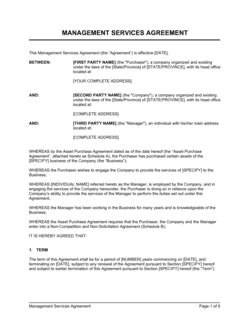
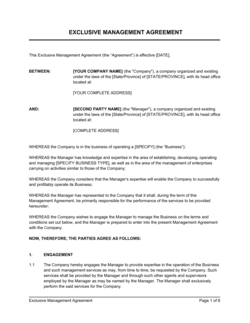
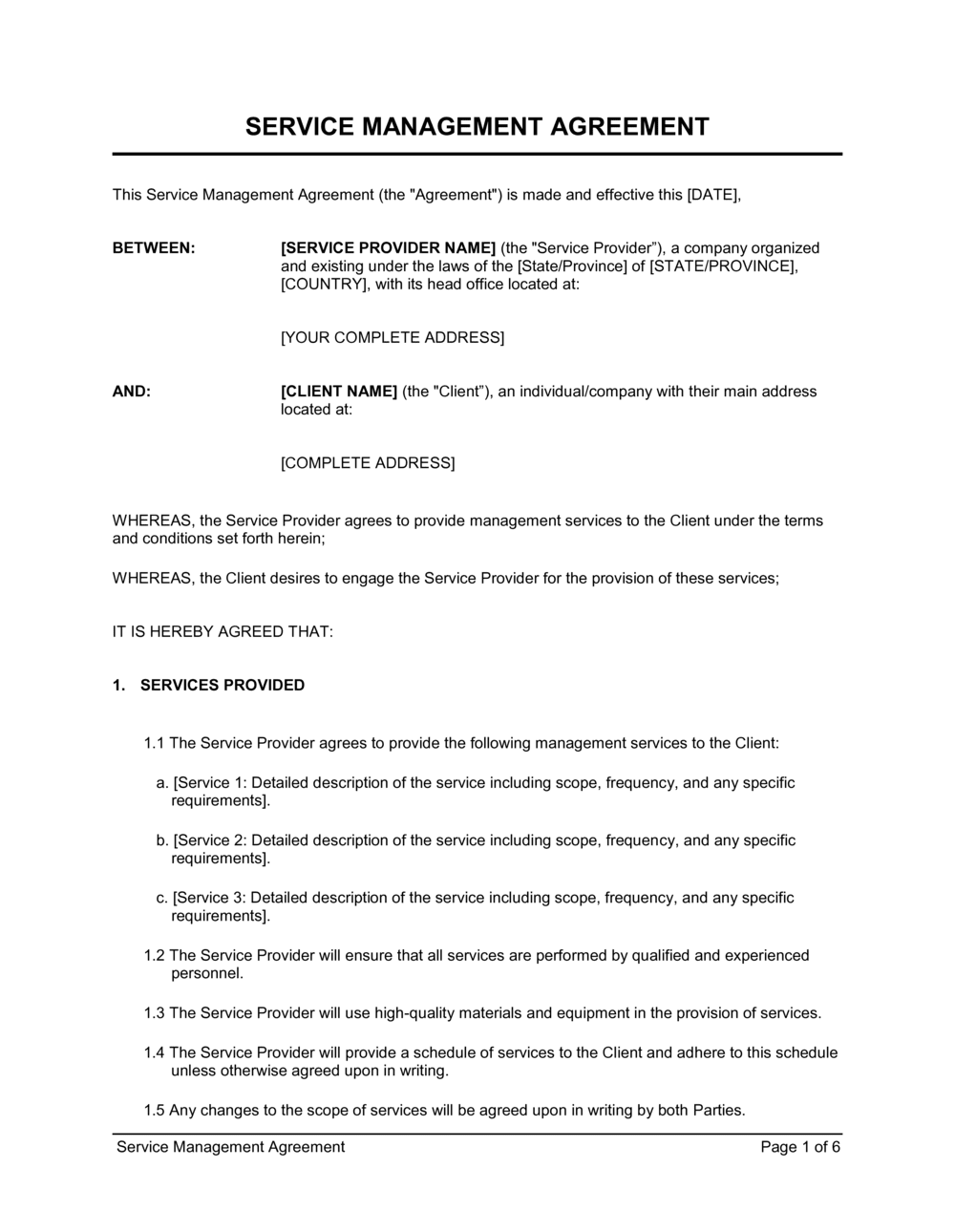
Service Management Agreement Template

Free Word download • Edit online • Save & share with Drive • Export to PDF

6 pages25–35 min to fillDifficulty: ComplexSignature requiredLegal review recommended
Learn more ↓
FreeService Management Agreement Template

At a glance

What it is
A Service Management Agreement is a legally binding contract between a service provider and a client organization that defines the full scope of ongoing managed services, performance standards, fees, liability limits, and termination rights. This free Word download gives you a structured, attorney-reviewed starting point you can edit online and export as PDF for execution between both parties.
When you need it
Use it when engaging or providing ongoing managed services — such as IT infrastructure management, facilities management, or outsourced business operations — where a one-time statement of work is insufficient and continuous performance obligations need to be governed by a binding framework.
What's inside
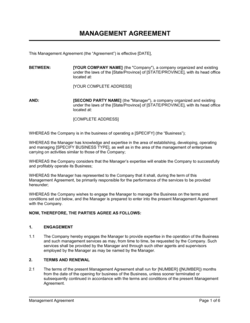
Scope of services and service levels, fees and invoicing schedule, intellectual property ownership, confidentiality obligations, liability caps and indemnification, term, renewal, and termination rights, dispute resolution, and governing law — all structured to protect both the service provider and the client.

What is a Service Management Agreement?

A Service Management Agreement is a legally binding contract between a service provider and a client organization that governs an ongoing, continuous managed services relationship. Unlike a one-time project contract, it defines not just what the provider will deliver but how performance will be measured over time — through service level commitments, escalation procedures, reporting obligations, and defined remedies for underperformance. The agreement covers the full legal framework of the relationship: scope of services, fees and invoicing, intellectual property ownership, confidentiality and data protection, liability limits, and the rights of both parties to renew or terminate. It is used across sectors wherever a business outsources a repeating operational function — IT infrastructure, facilities management, payroll administration, or outsourced business processing — to an external provider.

Why You Need This Document

Operating a managed services relationship without a signed agreement exposes both parties to serious and entirely avoidable risk. For the provider, an undocumented engagement means no enforceable right to collect fees, no protection for proprietary tools and methodologies used during delivery, and no cap on liability if something goes wrong. For the client, there is no mechanism to hold the provider accountable to promised performance standards, no clear path to exit a failing relationship, and no ownership of the systems or deliverables the provider builds. When disputes arise — and in long-running service relationships, they do — the absence of a written agreement means both parties spend months litigating what was verbally agreed rather than resolving what the contract says. A signed Service Management Agreement eliminates that ambiguity before the engagement begins, giving both sides a clear operational framework and a proportionate legal remedy when it is needed. This template gives you a professionally structured starting point that covers every material term, ready to customize and execute in under an hour.

Which variant fits your situation?

If your situation is…Use this template
Providing IT infrastructure and helpdesk support on an ongoing retainerIT Managed Services Agreement
Delivering a discrete project with a defined end dateService Agreement (Project-Based)
Engaging a consultant billed hourly rather than on a retainerConsulting Agreement
Contracting a self-employed individual rather than a companyIndependent Contractor Agreement
Governing a software platform subscription bundled with supportSoftware as a Service (SaaS) Agreement
Outsourcing facilities maintenance and property management servicesFacilities Management Agreement
Documenting performance targets for an existing vendor relationshipService Level Agreement (SLA)

Common mistakes to avoid

❌ Vague scope language that omits exclusions

Why it matters: Without explicit exclusions, clients can argue that any task tangentially related to the service is covered — leading to scope creep that erodes the provider's margins and creates disputes about what was agreed.

Fix: List exclusions in Schedule A as specifically as inclusions. Every service the provider expects to bill as an add-on must appear in the exclusions list.

❌ SLA targets with no defined remedy

Why it matters: An SLA without a remedy is unenforceable as a damages mechanism — the client's only recourse becomes a general breach of contract claim, which is expensive to pursue and hard to quantify.

Fix: Attach a Schedule B that specifies the exact service credit formula for each SLA metric and a cap on aggregate monthly credits.

❌ No IP ownership clause for deliverables

Why it matters: In most jurisdictions, the party that creates a work owns it by default. A client who assumes they own the systems or content the provider built may discover they need a license — or that they cannot take the work to a new provider.

Fix: Explicitly state who owns deliverables in the IP clause. If the client owns them, carve out the provider's pre-existing tools and frameworks with a license back.

❌ Omitting a data processing addendum for personal data

Why it matters: Where the provider processes personal data on the client's behalf, GDPR (EU/UK), PIPEDA (Canada), and similar laws require a documented processing agreement — its absence is a regulatory violation, not merely a contract gap.

Fix: Include a clause requiring both parties to execute a DPA before any personal data is processed, and attach a template DPA as Schedule C.

❌ Auto-renewal notice window shorter than 30 days

Why it matters: A 15- or 30-day notice window is shorter than most corporate procurement approval cycles, meaning clients routinely miss the deadline and are automatically locked into another full term — generating disputes and reputational damage.

Fix: Set the auto-renewal cancellation notice period to at least 60 days and require the provider to send a reminder notice 90 days before the deadline.

❌ One-sided consequential damages waiver

Why it matters: A waiver that protects only the provider will often be rejected by the client's legal team or, in some jurisdictions, treated as an unfair contract term and struck down entirely.

Fix: Make the consequential damages waiver mutual — both parties waive claims for indirect losses — which is far more likely to be accepted and enforced.

The 10 key clauses, explained

Parties, recitals, and effective date

In plain language: Identifies the legal names of the service provider and client, the nature of the relationship, and the date the agreement takes effect.

Sample language
This Service Management Agreement ('Agreement') is entered into as of [EFFECTIVE DATE] between [SERVICE PROVIDER LEGAL NAME], a [STATE/COUNTRY] [ENTITY TYPE] ('Provider'), and [CLIENT LEGAL NAME], a [STATE/COUNTRY] [ENTITY TYPE] ('Client').

Common mistake: Using a trading name instead of the registered legal entity name — if the named party does not match the contracting entity on record, enforcement and insurance coverage can both be compromised.

Scope of services and service schedules

In plain language: Defines precisely what services the provider will deliver, referencing attached schedules or statements of work rather than embedding granular detail in the body.

Sample language
Provider shall perform the services described in Schedule A ('Services') attached hereto and incorporated by reference. Any services not described in Schedule A require a written Change Order executed by both parties.

Common mistake: Writing an overly broad scope such as 'all services reasonably required by the Client' — this eliminates the ability to charge for out-of-scope work and creates unlimited obligation exposure for the provider.

Service level commitments and remedies

In plain language: Sets measurable performance targets, how they are measured, the reporting cadence, and what service credits or remedies the client receives if targets are missed.

Sample language
Provider shall meet the service levels set out in Schedule B ('SLA'). Where Provider fails to meet a target in any calendar month, Client shall receive a service credit equal to [X]% of that month's fees per [METRIC], up to a maximum of [Y]% of monthly fees in aggregate.

Common mistake: Including SLA targets with no defined remedy — courts will not invent a remedy for a missed SLA, leaving the client with a breach claim that is expensive to pursue and hard to quantify.

Fees, invoicing, and payment terms

In plain language: States the monthly or periodic fee, invoicing schedule, accepted payment methods, late payment interest, and any fee adjustment mechanism.

Sample language
Client shall pay Provider a monthly management fee of $[AMOUNT], invoiced on the [1st] day of each month, due Net [30] days. Overdue amounts accrue interest at [1.5]% per month. Fees may be adjusted annually by [CPI / X]% with [60] days' written notice.

Common mistake: Omitting a fee escalation mechanism on multi-year agreements — without one, the provider absorbs inflation and rising costs while the client's fee remains fixed.

Intellectual property ownership and license

In plain language: Clarifies who owns pre-existing IP each party brings to the engagement, who owns newly created work product, and what license rights each party has.

Sample language
Each party retains ownership of its pre-existing IP. Work product created by Provider specifically for Client under this Agreement ('Deliverables') shall be owned by [CLIENT / PROVIDER], subject to Provider retaining a perpetual license to its underlying tools, frameworks, and methodologies.

Common mistake: Failing to address ownership of deliverables at all — in most jurisdictions, the party that created the work retains ownership by default, which means the client may not own the systems or content the provider built for them.

Confidentiality and data protection

In plain language: Obliges both parties to protect each other's confidential information and, where applicable, sets out data processing obligations for personal data handled during the engagement.

Sample language
Each party agrees to keep the other's Confidential Information strictly confidential and not to disclose or use it except as required to perform obligations under this Agreement. To the extent Provider processes personal data on Client's behalf, the parties shall execute a Data Processing Addendum ('DPA') as required by applicable law.

Common mistake: Omitting a data processing addendum when the provider handles personal data — this is a direct violation of GDPR and similar privacy laws and can expose both parties to regulatory penalties.

Liability cap and consequential damages waiver

In plain language: Limits each party's maximum financial exposure under the agreement and excludes liability for indirect losses such as lost profits, lost data, or business interruption.

Sample language
Each party's aggregate liability under this Agreement shall not exceed the total fees paid by Client in the [12] months preceding the claim. Neither party shall be liable for indirect, consequential, or punitive damages, even if advised of the possibility of such loss.

Common mistake: Setting the liability cap below the annual contract value — clients will not sign, and a cap lower than the fees paid provides less protection than the premium would suggest.

Term, renewal, and termination rights

In plain language: States the initial contract term, whether and how it renews automatically, the notice period required to cancel, and the grounds and process for termination for cause.

Sample language
This Agreement commences on the Effective Date and continues for an initial term of [12] months ('Initial Term'), renewing automatically for successive [12]-month periods unless either party provides [60] days' written notice of non-renewal. Either party may terminate for material breach with [30] days' written notice and a [15]-day cure period.

Common mistake: Setting the auto-renewal notice window shorter than the client's internal procurement cycle — clients routinely miss a 30-day notice window and are locked into an unwanted renewal, creating disputes.

Dispute resolution and governing law

In plain language: Specifies the jurisdiction whose law governs the agreement, and whether disputes are resolved by negotiation, mediation, arbitration, or litigation.

Sample language
This Agreement is governed by the laws of [STATE / PROVINCE / COUNTRY]. The parties agree to attempt good-faith negotiation for [30] days before initiating formal proceedings. Any unresolved dispute shall be submitted to binding arbitration under the [AAA / JAMS / ICC] Rules in [CITY].

Common mistake: Choosing a governing law with no connection to either party's operations — courts may decline jurisdiction, and enforcement of judgments across borders becomes significantly more complex.

Force majeure

In plain language: Excuses a party from performance obligations caused by events outside its reasonable control — such as natural disasters, pandemics, or government action — provided prompt notice is given.

Sample language
Neither party shall be in breach for delays or failures caused by events beyond its reasonable control ('Force Majeure Event'), provided the affected party gives written notice within [5] business days of the event and uses reasonable efforts to resume performance.

Common mistake: Using a force majeure clause so broad it covers foreseeable supply chain issues or subcontractor failures — this effectively lets the provider escape performance obligations that should be managed through standard operational risk.

How to fill it out

  1. 1

    Identify both parties with full legal entity names

    Enter the registered legal name, entity type (LLC, Inc., Ltd.), and jurisdiction of incorporation for both the service provider and the client. Do not use trade names or DBA names in the primary parties block.

    💡 Run a quick company registry check to confirm the exact registered name before execution — a mismatch between the contract name and the registered entity can complicate enforcement.

  2. 2

    Draft the scope of services schedule

    Write a precise, bounded description of what the provider will deliver in Schedule A. Use bullet points, categories, and exclusions to eliminate ambiguity. Specify what is out of scope as clearly as what is in scope.

    💡 Every service the provider expects to charge extra for should be explicitly excluded from Schedule A — vague scope language is the root cause of most managed services disputes.

  3. 3

    Define measurable SLA targets and remedies in Schedule B

    For each performance commitment, specify the metric, measurement method, reporting cadence, and the credit or remedy triggered by a miss. Common SLA metrics include uptime percentage, response time, resolution time, and first-call resolution rate.

    💡 Cap total monthly service credits at 15–25% of the monthly fee — a higher cap creates an incentive for clients to manufacture SLA breaches to reduce invoices.

  4. 4

    Set the fee structure and payment terms

    Enter the monthly management fee, invoicing date, net payment period, late interest rate, and the annual fee escalation formula. If the engagement includes variable or consumption-based charges, add a pricing schedule.

    💡 Index annual fee escalations to a published CPI index rather than a fixed percentage — this avoids renegotiation friction while keeping fees fair to both sides.

  5. 5

    Clarify IP ownership for deliverables

    Decide whether deliverables created during the engagement belong to the client or the provider. If the client owns them, confirm whether the provider retains a license to reuse underlying tools or frameworks. Document this in the IP clause and in Schedule A.

    💡 Providers should always carve out ownership of pre-existing tools, templates, and methodologies even when assigning deliverable ownership to the client — otherwise you may be handing over core IP.

  6. 6

    Set the term, renewal window, and termination notice periods

    Enter the initial term length, the auto-renewal period, and the number of days' notice required to cancel. For the termination-for-cause clause, set a cure period of 10–30 days for material breach before termination becomes effective.

    💡 Set the auto-renewal notice period to at least 60 days — this gives both parties enough time to run an internal approval process before being locked into the next term.

  7. 7

    Confirm the liability cap and exclusions

    Set the aggregate liability cap at a minimum of the fees paid in the preceding 12 months. Review the consequential damages waiver to confirm it is mutual — a one-sided waiver will often be struck down or will not be accepted by the other party.

    💡 Check whether your professional liability or errors-and-omissions insurance policy requires a minimum contractual liability cap — some policies are voided if the contractual cap is set below the policy limit.

  8. 8

    Sign before services commence

    Both authorized signatories must execute the agreement before the provider begins delivering services. Performing services before signing creates an implied contract on less favorable terms and may not include the IP, confidentiality, and SLA protections in your template.

    💡 Use a digital signature platform to timestamp execution and store the fully executed agreement alongside the signed schedules — unsigned schedules are a common source of scope disputes.

Frequently asked questions

What is a service management agreement?

A service management agreement is a legally binding contract between a service provider and a client that governs an ongoing managed services relationship. It defines the scope of services, performance standards (SLAs), fees, IP ownership, confidentiality obligations, liability limits, and termination rights. Unlike a one-time project contract, a service management agreement is designed to govern a continuous, repeating service obligation over months or years.

What is the difference between a service management agreement and a service level agreement?

A service management agreement is the master contract governing the entire relationship — parties, fees, IP, liability, and termination. A service level agreement (SLA) is a schedule or addendum within that master contract that sets the specific, measurable performance targets and the remedies if those targets are missed. You need both: the SMA provides the legal framework, and the SLA provides the operational accountability mechanism.

What should a service management agreement include?

At minimum: identification of both parties, a precise scope of services with explicit exclusions, measurable SLA targets with defined remedies, fees and payment terms with an escalation mechanism, IP ownership for deliverables, confidentiality and data protection obligations, a liability cap, a consequential damages waiver, term length and auto-renewal provisions, termination-for-cause and termination-for-convenience rights, and governing law. Missing any of these creates gaps that courts fill using jurisdiction-specific defaults, which are rarely favorable to the provider.

Is a service management agreement legally binding?

A service management agreement is generally enforceable when properly executed by authorized signatories of both parties, supported by consideration (the fees paid in exchange for the services), and not contrary to applicable law. Certain clauses — such as overly broad non-compete restrictions or liability waivers covering gross negligence — may be unenforceable in specific jurisdictions regardless of what the contract says. Consider having the agreement reviewed by a lawyer in the governing jurisdiction before execution.

Who should sign a service management agreement?

Both the service provider and the client must sign through an authorized representative — typically a director, officer, or manager with signatory authority for the entity. Signing through an employee without authority can render the agreement voidable. For high-value engagements, confirm the other party's signatory authority through a corporate registry search or a board resolution if required.

Can I use the same agreement for IT and non-IT managed services?

The core framework — scope, SLAs, fees, IP, confidentiality, liability, and termination — applies to most managed services regardless of sector. However, specific schedules will differ significantly: IT managed services require uptime, response-time, and cybersecurity SLAs, while facilities management agreements require inspection schedules, compliance certifications, and health-and-safety obligations. Adapt Schedule A and Schedule B for each engagement type while keeping the master agreement terms consistent.

What happens if the service provider misses an SLA?

If the SLA schedule specifies a service credit remedy, the client is entitled to the credit automatically upon the provider confirming the miss in its monthly report — no separate legal action is required. If the provider persistently misses SLAs and the agreement includes a termination-for-cause clause triggered by repeated SLA failures, the client may terminate after the applicable notice and cure period. Without a defined SLA remedy, the client must pursue a general breach of contract claim, which is significantly more costly and time-consuming.

How long should a service management agreement last?

Initial terms of 12 to 24 months are most common for managed services engagements. Shorter terms (3–6 months) are appropriate for trial engagements or where the service is easily commoditized. Longer terms (3–5 years) are typical for infrastructure outsourcing where the provider makes significant upfront investment in onboarding and tooling. Always include an auto-renewal clause with a 60-day cancellation notice window and an annual fee escalation mechanism to keep multi-year agreements commercially balanced.

Do I need a lawyer to draft a service management agreement?

For standard domestic engagements with a well-matched scope and a reputable counterparty, a high-quality template is generally sufficient. Engage a lawyer when the annual contract value exceeds $100K, when the engagement involves sensitive personal data requiring GDPR or CCPA compliance, when the client or provider operates across multiple jurisdictions, or when the IP ownership arrangement is complex. A 1–3 hour template review typically costs $300–$900 and is worthwhile for any multi-year or high-value managed services engagement.

How this compares to alternatives

vs Service Agreement

A standard service agreement governs a discrete, project-based engagement with a defined deliverable and end date. A service management agreement governs an ongoing, repeating service relationship with continuous performance obligations and SLA accountability. Use a service agreement for a one-time project; use a service management agreement when the provider will deliver recurring services over months or years.

vs Consulting Agreement

A consulting agreement engages an individual or firm to provide advice, analysis, or recommendations — typically billed hourly or by milestone. A service management agreement governs the operational delivery of defined services against measurable performance standards. Consulting relationships are advisory; managed services relationships are operational, with SLA remedies and liability frameworks reflecting that higher accountability.

vs Independent Contractor Agreement

An independent contractor agreement engages a self-employed individual for task-based or project-based work, with the contractor retaining control over how work is performed. A service management agreement typically engages a company to deliver a defined service standard. Misclassifying a managed service provider as an independent contractor can trigger employment law liability in many jurisdictions.

vs SaaS Agreement

A SaaS agreement governs access to a software platform on a subscription basis, with the provider's obligations limited primarily to platform availability and support response times. A service management agreement governs the active delivery of human-performed or operationally-managed services, with broader scope, IP, and personnel obligations. When a SaaS vendor also provides managed implementation, configuration, or support services, both agreements — or a combined master agreement — may be required.

Industry-specific considerations

Information Technology

Uptime SLAs, cybersecurity incident response times, patch management schedules, and data breach notification obligations are standard schedule inclusions for IT managed service providers.

Facilities Management

Compliance with health-and-safety regulations, inspection and certification schedules, COSHH or hazardous materials handling obligations, and insurance certificate requirements are critical additions for facilities management contracts.

Healthcare

HIPAA Business Associate Agreement obligations, access controls for protected health information, audit log requirements, and breach notification timelines must be incorporated by reference alongside the core agreement.

Financial Services

Regulatory outsourcing requirements (e.g., FCA operational resilience rules, OCC guidance in the US), sub-contractor approval obligations, and audit-right clauses allowing the client or regulator to inspect the provider's operations are standard in financial services managed service contracts.

Retail and E-commerce

Peak-season performance guarantees, PCI-DSS compliance obligations for payment data handling, and integration SLAs covering platform uptime during promotional events are common additions for retail managed service engagements.

Professional Services

Key personnel clauses requiring named consultants to remain on the account, utilization-rate commitments, and deliverable-based milestone billing structures are standard features in professional services management agreements.

Jurisdictional notes

United States

US managed services contracts are governed by state contract law, with no single federal statute regulating the agreement form. California applies strong implied covenants of good faith and fair dealing that can override broadly drafted exclusions of liability. Non-compete and non-solicit clauses attached to service management agreements are subject to the same state-level enforceability rules as employment agreements. For IT managed services handling protected health information, a HIPAA Business Associate Agreement must be executed alongside the core contract.

Canada

Canadian courts apply a common-law reasonableness standard to liability caps and consequential damages waivers — clauses that are unconscionable or that eliminate all meaningful remedy for a material failure may be struck down. PIPEDA (and its successor, the Consumer Privacy Protection Act once in force) requires documented data processing obligations when personal information is handled by a service provider on behalf of a client. In Quebec, the Civil Code governs contracts, and service agreements must comply with the French Language Charter if the client or provider is a Quebec-regulated employer.

United Kingdom

The Unfair Contract Terms Act 1977 and the Consumer Rights Act 2015 regulate the enforceability of exclusion clauses and liability caps in UK service contracts — unreasonable exclusions are void. UK GDPR requires a data processing agreement whenever a service provider processes personal data as a data processor on the client's behalf; failure to have one in place is a direct regulatory breach. IR35 rules may apply if the service provider is structured as a personal service company, potentially reclassifying the engagement as an employment relationship for tax purposes.

European Union

GDPR Article 28 mandates a written data processing agreement whenever a service provider processes personal data on a controller's behalf — this is non-negotiable and must be attached to or referenced in every service management agreement involving EU personal data. The EU AI Act and NIS2 Directive impose additional obligations on managed service providers in scope. Member state contract law varies significantly: German BGB provisions on service contracts (Dienstvertrag) differ materially from French obligations de résultat vs. obligations de moyens distinctions, which affect how SLA liability is assessed in local courts.

Template vs lawyer — what fits your deal?

PathBest forCostTime
Use the templateStandard domestic managed services engagements up to $100K annually where both parties are established businessesFree30–60 minutes to complete
Template + legal reviewEngagements involving personal data, multi-year terms, complex SLAs, or cross-border service delivery$300–$900 for a lawyer review2–5 business days
Custom draftedHigh-value contracts above $250K annually, heavily regulated industries (healthcare, financial services), or multi-jurisdiction outsourcing arrangements$2,000–$8,000+2–4 weeks

Glossary

Service Level Agreement (SLA)
A schedule within the agreement that defines measurable performance targets — such as 99.9% uptime or a 4-hour incident response time — and the remedies if those targets are missed.
Scope of Services
The precise definition of what the service provider is and is not obligated to deliver, typically set out in a schedule or statement of work attached to the main agreement.
Service Credits
Contractual credits issued to the client when the service provider misses an SLA target — usually expressed as a percentage of the monthly fee, capped at a defined maximum.
Liability Cap
A contractual ceiling on the total financial exposure either party can face under the agreement, typically set at the fees paid in the preceding 12 months.
Indemnification
An obligation for one party to compensate the other for specified losses, claims, or damages arising from defined events such as IP infringement or gross negligence.
Change Order
A formal written amendment to the scope of services that documents an agreed change to deliverables, timeline, or fees — preventing scope creep from expanding obligations without compensation.
Termination for Convenience
A right allowing one or both parties to end the agreement before its natural expiry with advance written notice, without needing to demonstrate a breach or cause.
Termination for Cause
The right to end the agreement immediately, or with a short cure period, when the other party commits a material breach such as non-payment or persistent failure to meet SLAs.
Evergreen Renewal
An automatic renewal clause that extends the agreement for a successive term — typically 12 months — unless either party provides written notice to cancel within a specified window before expiry.
Key Personnel
Named or designated individuals at the service provider whose continued involvement is a material obligation, requiring advance notice and client consent before substitution.
Consequential Damages Waiver
A clause excluding either party's liability for indirect losses such as lost profits, lost data, or reputational harm, regardless of whether such losses were foreseeable.

Part of your Business Operating System

This document is one of 3,000+ business & legal templates included in Business in a Box.

  • Fill-in-the-blanks — ready in minutes
  • 100% customizable Word document
  • Compatible with all office suites
  • Export to PDF and share electronically

Create your document in 3 simple steps.

From template to signed document — all inside one Business Operating System.
1
Download or open template

Access over 3,000+ business and legal templates for any business task, project or initiative.

2
Edit and fill in the blanks with AI

Customize your ready-made business document template and save it in the cloud.

3
Save, Share, Send, Sign

Share your files and folders with your team. Create a space of seamless collaboration.

Save time, save money, and create top-quality documents.

★★★★★

"Fantastic value! I'm not sure how I'd do without it. It's worth its weight in gold and paid back for itself many times."

Managing Director · Mall Farm
Robert Whalley
Managing Director, Mall Farm Proprietary Limited
★★★★★

"I have been using Business in a Box for years. It has been the most useful source of templates I have encountered. I recommend it to anyone."

Business Owner · 4+ years
Dr Michael John Freestone
Business Owner
★★★★★

"It has been a life saver so many times I have lost count. Business in a Box has saved me so much time and as you know, time is money."

Owner · Upstate Web
David G. Moore Jr.
Owner, Upstate Web

Run your business with a system — not scattered tools

Stop downloading documents. Start operating with clarity. Business in a Box gives you the Business Operating System used by over 250,000 companies worldwide to structure, run, and grow their business.

Free Forever Plan · No credit card required