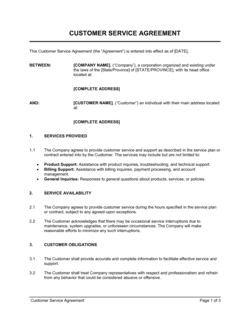
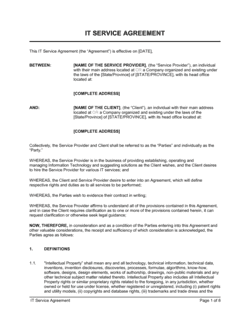
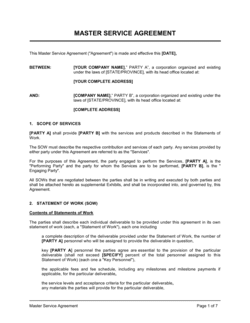
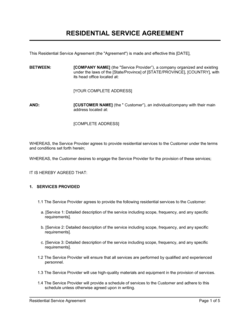
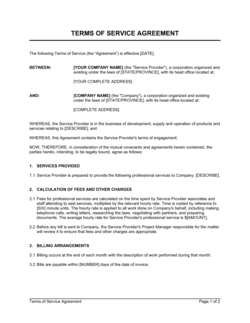
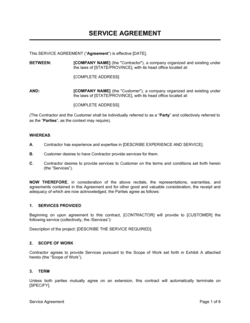
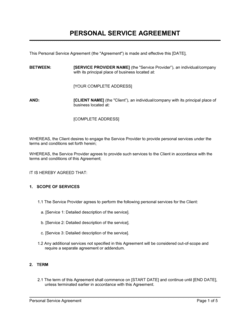
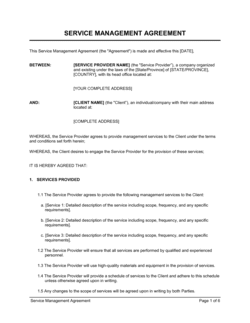
Janitorial Service Agreement Template

Free Word download β€’ Edit online β€’ Save & share with Drive β€’ Export to PDF

6 pagesβ€’25–35 min to fillβ€’Difficulty: Complexβ€’Signature requiredβ€’Legal review recommended
Learn more ↓
FreeJanitorial Service Agreement Template

At a glance

What it is
A Janitorial Service Agreement is a legally binding contract between a cleaning service provider and a client β€” typically a business, property manager, or building owner β€” that defines the exact scope of cleaning services, schedule, compensation, liability limits, and termination rights. This free Word download gives you a professionally structured starting point you can edit online and export as PDF for signature before any cleaning engagement begins.
When you need it
Use it before a janitorial or commercial cleaning company begins recurring or one-time services at any commercial, residential, or institutional property. It is equally essential for the cleaning contractor protecting payment rights and the client ensuring accountability for work quality and property access.
What's inside
Scope of services and cleaning schedule, compensation and payment terms, supplies and equipment responsibilities, insurance and liability provisions, confidentiality and key-access protocols, damage and complaint procedures, independent contractor status, and termination and renewal terms.

What is a Janitorial Service Agreement?

A Janitorial Service Agreement is a legally binding contract between a cleaning service provider and a client β€” typically a business owner, property manager, or building operator β€” that governs every material aspect of a commercial or institutional cleaning engagement. It defines exactly which tasks will be performed, how often, by whom, at what price, and under what liability and insurance conditions. Beyond setting expectations, the agreement creates enforceable obligations on both sides: the Contractor must deliver defined cleaning standards on a defined schedule, and the client must pay on defined terms and provide appropriate access. Without this document, both parties operate on informal assumptions that diverge the moment a dispute arises.

Why You Need This Document

Operating a janitorial engagement without a written agreement exposes both parties to predictable and expensive problems. Contractors face non-payment disputes with no documented scope to prove services were rendered as agreed. Clients face property damage with no clear liability or insurance mechanism to recover losses. When a cleaning crew has unsupervised access to your premises β€” including after hours, in server rooms, near patient records, or inside retail stockrooms β€” defining access protocols, confidentiality obligations, and damage-reporting procedures in writing is not optional. A signed janitorial service agreement also establishes the Contractor's independent contractor status, which is critical for avoiding misclassification liability in jurisdictions with strict worker-classification rules. This template gives both parties a professional, enforceable foundation in under 30 minutes β€” covering scope, payment, insurance, access, and termination β€” so the working relationship starts clearly and stays that way.

Which variant fits your situation?

If your situation is…Use this template
Daily or weekly cleaning of a commercial office buildingJanitorial Service Agreement (Recurring)
One-time deep clean after a construction project or move-outOne-Time Cleaning Service Agreement
Residential home cleaning on a regular scheduleResidential Cleaning Service Agreement
Engaging a freelance independent cleaner rather than a companyIndependent Contractor Agreement
Cleaning services bundled with broader facilities managementFacilities Management Agreement
Government or institutional cleaning tender requiring formal procurementService Level Agreement (SLA)
Subcontracting cleaning work to a secondary vendorSubcontractor Agreement

Common mistakes to avoid

❌ Vague scope of services

Why it matters: A description like 'general office cleaning' with no task checklist creates immediate disputes about what is included. Non-payment and early termination are the typical outcomes.

Fix: Attach a Schedule A with a room-by-room task list and frequency for each item. Have both parties initial it at signing.

❌ No insurance verification before work begins

Why it matters: If a Contractor's uninsured employee is injured on-site or accidentally floods a server room, the client's own insurance absorbs the claim β€” often leading to premium increases and deductible exposure.

Fix: Require a current certificate of insurance β€” naming the client as an additional insured β€” before the first service visit, and set a calendar reminder to renew it annually.

❌ Leaving key-return procedures undefined

Why it matters: When an agreement ends β€” especially acrimoniously β€” a Contractor retaining keys or an active alarm code creates a serious physical security risk the client has no contractual mechanism to address.

Fix: Include an explicit key-return clause requiring all access credentials to be returned within 24 hours of termination, with the client's right to change locks at Contractor's expense if not returned.

❌ Auto-renewal with no advance notice window

Why it matters: Both parties routinely miss auto-renewal deadlines. Clients get locked into another annual term they didn't want; Contractors find themselves bound to below-market pricing.

Fix: Set a notice period of at least 30 days before the renewal date and calendar both parties' deadlines at the time of signing.

❌ Misclassifying an employee as an independent contractor

Why it matters: If the client controls work methods, sets fixed hours, and provides all equipment, the Contractor may be legally deemed an employee β€” exposing the client to back taxes, benefits liability, and wage claims.

Fix: Ensure the agreement grants the Contractor genuine flexibility over how and when services are performed, and avoid providing tools or equipment that imply an employment relationship.

❌ No damage reporting deadline

Why it matters: Without a defined window β€” typically 48 to 72 hours β€” clients can raise damage claims weeks or months after a service visit, making it impossible for the Contractor to investigate or contest the claim.

Fix: Add a clause requiring written notice of any damage or complaint within 48 hours of the relevant service visit, with claims submitted after that window barred.

The 10 key clauses, explained

Parties and effective date

In plain language: Identifies the legal names and addresses of the cleaning service provider and the client, and records the date the agreement takes effect.

Sample language
This Janitorial Service Agreement ('Agreement') is entered into as of [EFFECTIVE DATE] by and between [SERVICE PROVIDER LEGAL NAME], a [STATE/PROVINCE] [ENTITY TYPE] ('Contractor'), and [CLIENT LEGAL NAME], a [STATE/PROVINCE] [ENTITY TYPE] ('Client').

Common mistake: Using a trade name instead of the registered legal entity name. If the Contractor's legal name doesn't match their business license or insurance certificate, claims and payments can be directed to the wrong entity.

Scope of services and cleaning schedule

In plain language: Specifies exactly which cleaning tasks will be performed β€” vacuuming, restroom sanitation, trash removal, window cleaning β€” in which areas, and on which days and times.

Sample language
Contractor shall perform the cleaning services described in Schedule A ('Services') at the premises located at [ADDRESS] ('Premises'). Services shall be performed [DAILY / WEEKLY / AS SPECIFIED IN SCHEDULE A] between the hours of [START TIME] and [END TIME].

Common mistake: Attaching a vague scope like 'general cleaning' without a task checklist. Disputes about what was or wasn't done are the single most common source of non-payment and contract termination in janitorial contracts.

Compensation and payment terms

In plain language: States the service fee β€” flat monthly rate, per-visit fee, or hourly rate β€” the invoicing cycle, and the due date for payment.

Sample language
Client shall pay Contractor a monthly fee of $[AMOUNT], invoiced on the [1st / 15th] of each month and due within [NET 15 / NET 30] days of receipt. Late payments shall accrue interest at [X]% per month on any balance outstanding beyond [X] days.

Common mistake: Omitting a late-fee clause. Without one, there is no contractual deterrent for slow-paying clients, and the Contractor's only remedy is termination or litigation.

Supplies and equipment

In plain language: Defines which party provides cleaning chemicals, equipment, and consumables such as trash bags, paper towels, and soap dispensers.

Sample language
Contractor shall supply all cleaning equipment and cleaning chemicals necessary to perform the Services. Client shall supply and replenish all consumable items including paper products, hand soap, and trash liners, unless otherwise specified in Schedule A.

Common mistake: Leaving supply responsibility ambiguous. When neither party believes they are responsible for consumables, both assume the other will provide them β€” leaving restrooms unstocked and triggering complaints.

Insurance and certificates of insurance

In plain language: Requires the Contractor to maintain minimum general liability and workers' compensation insurance coverage and to provide the client a certificate of insurance before work begins.

Sample language
Contractor shall maintain, at its own expense, commercial general liability insurance of not less than $[AMOUNT] per occurrence and $[AMOUNT] aggregate, and workers' compensation insurance as required by applicable law. Contractor shall provide Client a current certificate of insurance upon request and prior to commencing services.

Common mistake: Accepting a Contractor's verbal assurance of coverage without requiring a COI. If an employee is injured on-site or damages property and the Contractor has no active policy, the client's own property or liability insurance is exposed.

Key access, security, and confidentiality

In plain language: Establishes how the Contractor will access the premises, how access credentials are stored and returned, and prohibits disclosure of confidential client information observed during service.

Sample language
Client shall provide Contractor with [KEYS / ACCESS CARDS / ALARM CODES] necessary to access the Premises during scheduled service hours. Contractor shall not duplicate keys or share access credentials. Contractor and its employees shall keep confidential all proprietary information observed on the Premises.

Common mistake: No key-return or alarm-code-change provision at termination. When an agreement ends β€” especially for cause β€” failing to recover access credentials leaves the property exposed to unauthorized entry.

Damage, complaints, and re-service

In plain language: Describes how damage caused during cleaning must be reported, documented, and compensated, and how the client must raise service quality complaints to trigger a re-clean.

Sample language
Client shall report any damage to property or unsatisfactory service within [48 / 72] hours of the relevant service visit. Contractor shall investigate and, if at fault, remedy damage or re-perform the deficient service at no additional charge within [X] business days.

Common mistake: No complaint or damage-report deadline. Without a notice window, the Contractor faces open-ended claims for damage that may have pre-dated or have nothing to do with their services.

Independent contractor status

In plain language: Confirms that the Contractor is an independent business β€” not an employee β€” and is solely responsible for taxes, benefits, and compliance obligations for their workers.

Sample language
Contractor is an independent contractor and not an employee, agent, or partner of Client. Contractor shall be solely responsible for all federal, state, and local taxes, workers' compensation, and employment-related obligations for itself and its employees.

Common mistake: Controlling how, when, and exactly how the Contractor performs work while also labeling them an independent contractor. Behavioral control is the primary test for employment misclassification β€” and the tax, benefits, and wage-claim liability falls on the client.

Term, renewal, and termination

In plain language: Sets the agreement's start date, initial term, whether it auto-renews, and the notice period required for either party to end the relationship with or without cause.

Sample language
This Agreement commences on [START DATE] and continues for an initial term of [X months/year], renewing automatically on a [MONTHLY / ANNUAL] basis unless either party provides [30] days' written notice of non-renewal. Either party may terminate for cause upon [10] days' written notice if a material breach remains uncured.

Common mistake: Auto-renewal with no notice provision. Clients discover they are locked into another annual term because they missed a 30-day window β€” and Contractors discover a client has stopped paying mid-term with no termination mechanism to recover outstanding fees.

Limitation of liability and indemnification

In plain language: Caps the Contractor's maximum financial exposure for losses arising from the agreement β€” usually limited to fees paid in the prior 3–6 months β€” and requires each party to indemnify the other against third-party claims arising from their own negligence.

Sample language
In no event shall Contractor's total liability exceed the total fees paid by Client in the [3] months preceding the claim. Each party shall indemnify and hold harmless the other from and against any third-party claims arising out of its own negligence or willful misconduct.

Common mistake: No liability cap at all. Without one, a single accidental damage claim β€” flooding from an improperly closed valve, for example β€” could expose a small cleaning business to damages far exceeding the value of the contract.

How to fill it out

  1. 1

    Enter legal entity names and the effective date

    Use the full registered legal name of both the Contractor and the Client β€” not trade names. Confirm entity type (LLC, corporation, sole proprietor) and include mailing addresses.

    πŸ’‘ Cross-reference the Contractor's business license and insurance certificate to confirm the legal name matches before signing.

  2. 2

    Complete Schedule A with a detailed task checklist

    List every cleaning task, the specific area or room it applies to, and the frequency. Separate daily tasks (trash removal, restroom sanitation) from weekly (vacuuming, mopping) and monthly (deep cleaning, window washing).

    πŸ’‘ Have both parties initial Schedule A separately at signing β€” it dramatically reduces 'we didn't agree to that' disputes months into the engagement.

  3. 3

    Set the fee structure and payment terms

    Choose between a flat monthly fee, per-visit rate, or hourly billing. Enter the invoicing date, due date (Net 15 or Net 30), and the late-fee rate for overdue balances.

    πŸ’‘ Flat monthly fees are easier to budget and collect than hourly billing. If the scope is well-defined, flat fees reduce payment disputes by roughly half.

  4. 4

    Define supply and equipment responsibilities

    Mark clearly in Schedule A which supplies are Contractor-provided and which are Client-provided. For consumables like paper products and soap, specify restocking responsibility.

    πŸ’‘ If consumables are the client's responsibility, add a check-in mechanism β€” a brief supply audit at each visit β€” so gaps are caught before they become service complaints.

  5. 5

    Fill in the insurance minimums and request a COI

    Enter the required general liability coverage minimum β€” typically $1M per occurrence for commercial settings β€” and require the Contractor to deliver a valid COI before work begins.

    πŸ’‘ Ask to be named as an additional insured on the Contractor's policy. This ensures the client's property damage claims are covered directly under the policy.

  6. 6

    Document key-access and alarm protocols

    Specify exactly which access credentials will be provided, how they are stored, and the return procedure at termination. Include an obligation to change alarm codes within 48 hours of the agreement ending.

    πŸ’‘ Use a written key-receipt form β€” a single signed document noting the keys or access cards issued β€” to eliminate disputes about what was or wasn't returned.

  7. 7

    Set the term, auto-renewal window, and notice period

    Enter the start date, initial term length, and the notice period required for non-renewal or termination for convenience. Confirm whether termination for cause requires a cure period.

    πŸ’‘ Calendar the auto-renewal notice deadline immediately after signing so neither party is caught off guard.

  8. 8

    Execute before the first service visit

    Both parties must sign β€” and in some jurisdictions, initial Schedule A β€” before the Contractor's first visit. Post-service signatures leave key clauses, particularly the liability cap and indemnification, vulnerable to challenge.

    πŸ’‘ Use an eSign workflow to timestamp execution and store the fully executed copy in a shared records system both parties can access.

Frequently asked questions

What is a janitorial service agreement?

A janitorial service agreement is a legally binding contract between a cleaning service provider and a client that defines the scope of cleaning work, schedule, pricing, insurance requirements, access protocols, and termination rights. It protects both parties: the Contractor gets a clear payment obligation and defined work scope; the client gets enforceable quality and liability standards. Without one, both sides rely on informal expectations that routinely diverge.

What should a janitorial service agreement include?

At minimum: legal names and addresses of both parties, a detailed scope of services with a task checklist, the service schedule, the fee and payment terms, supply and equipment responsibilities, insurance requirements, key-access and security protocols, a damage-claim procedure, independent contractor status, and term, renewal, and termination provisions. A liability cap and indemnification clause are strongly recommended to limit financial exposure on both sides.

Is a janitorial service agreement legally required?

No law mandates a written janitorial contract in most jurisdictions. However, operating without one leaves both parties without enforceable protections β€” the Contractor has no written payment obligation, and the client has no documented standard of performance or recourse for damage. Many commercial property managers and corporate clients require a signed agreement as a condition of vendor onboarding.

Who should sign a janitorial service agreement β€” the owner or the company?

The legal entity β€” LLC, corporation, or registered business β€” should sign on both sides, not the individual owner personally, unless the Contractor is a sole proprietor. Having the entity sign limits personal liability. Confirm the signatory has authority to bind the entity; for larger contracts, a board resolution or officer authorization may be required.

Can a janitorial service agreement be terminated early?

Yes, if the agreement includes a termination for convenience clause with a defined notice period β€” typically 15 to 30 days. Without this clause, early termination by the client may constitute a breach of contract, entitling the Contractor to damages for the remaining contract term. Termination for cause β€” repeated non-performance, non-payment, or security breach β€” typically allows immediate termination after a short cure period.

What insurance should a janitorial contractor carry?

At minimum, a commercial general liability policy β€” typically $1M per occurrence and $2M aggregate for commercial settings β€” and workers' compensation coverage for any employees. Larger contracts or healthcare and government facilities may require higher limits. The client should request to be named as an additional insured on the policy so that property damage claims arising from cleaning activities are covered directly under the Contractor's policy.

Does the agreement cover the Contractor's employees?

The agreement governs the Contractor's obligations but does not directly bind individual cleaning staff. The independent contractor clause confirms that all workers are employed or engaged by the Contractor, not the client. The Contractor remains responsible for their employees' compliance with the agreement's terms β€” including confidentiality, access protocols, and work quality β€” and must carry workers' compensation coverage to address on-site injuries.

What happens if a cleaner damages property during a service visit?

The agreement's damage clause should specify that the client must report damage in writing within a defined window β€” typically 48 hours β€” and that the Contractor must investigate and remedy confirmed damage within a set number of business days. The Contractor's general liability insurance covers property damage claims, which is why verifying active coverage before work begins is essential. The liability cap clause limits the Contractor's total exposure to a defined multiple of fees paid.

Do I need a lawyer to draft a janitorial service agreement?

For standard recurring commercial cleaning arrangements, a high-quality template is typically sufficient. Consider engaging a lawyer when the contract value exceeds $50,000 per year, the premises involve regulated environments such as healthcare or government facilities, the Contractor will have unsupervised access to sensitive areas, or the client requires custom indemnification or insurance terms beyond the template defaults. A 1–2 hour template review typically costs $200–$500 and is worthwhile for high-value or high-access engagements.

How this compares to alternatives

vs Independent Contractor Agreement

An independent contractor agreement is a general-purpose document for engaging any self-employed service provider. A janitorial service agreement is purpose-built for cleaning engagements β€” it adds scope-of-services checklists, supply responsibilities, key-access protocols, damage-claim procedures, and cleaning-specific insurance requirements. Use the janitorial agreement whenever the services are cleaning-specific; use the general contractor agreement for all other service engagements.

vs Service Level Agreement (SLA)

A service level agreement defines measurable performance targets β€” uptime, response times, quality scores β€” and the remedies for missing them. A janitorial service agreement defines the scope and terms of the cleaning relationship itself. The two can complement each other: a janitorial agreement governs the contract while a separate SLA addendum defines inspection standards and complaint-resolution metrics for larger or institutional contracts.

vs Facilities Management Agreement

A facilities management agreement covers a broad range of property services β€” maintenance, security, HVAC, and cleaning β€” under a single vendor relationship. A janitorial service agreement is narrowly scoped to cleaning only. Use a janitorial agreement when cleaning is the sole or primary service; use a facilities management agreement when bundling multiple property services with one provider.

vs Subcontractor Agreement

A subcontractor agreement governs a cleaning company's engagement of a secondary vendor to perform part or all of the contracted work. A janitorial service agreement governs the primary client-to-Contractor relationship. If a janitorial contractor plans to subcontract any cleaning work, they need both β€” the janitorial agreement with the client and a subcontractor agreement with their sub-vendor β€” to maintain accountability and insurance coverage across the chain.

Industry-specific considerations

Commercial Real Estate

Multi-tenant office buildings require per-floor scope schedules, tenant-area access protocols, and after-hours cleaning windows coordinated with building security.

Healthcare and Medical Facilities

Regulated disinfection standards (CDC, OSHA Bloodborne Pathogens), biohazard disposal compliance, and HIPAA-aligned confidentiality for patient areas require enhanced scope and liability provisions.

Retail and Hospitality

High-frequency daily cleaning, customer-facing appearance standards, and variable-hours access tied to store open and close times demand precise scheduling and quality-check mechanisms.

Education and Government

Public procurement rules, background-check requirements for Contractor staff, and performance bond or surety requirements distinguish institutional janitorial contracts from commercial ones.

Jurisdictional notes

United States

Worker classification rules vary significantly by state β€” California's ABC test (AB5) makes it very difficult to classify cleaning workers as independent contractors, while most other states apply the IRS common-law test. OSHA's Bloodborne Pathogen Standard applies to cleaning in healthcare settings. Many states require janitorial contractors to carry a business license and maintain minimum liability coverage as a condition of operating commercially.

Canada

Provincial employment standards legislation sets minimum wage and worker classification thresholds that affect how cleaning staff must be engaged. Ontario and British Columbia have specific tests for dependent contractor status that can override an independent contractor designation. Quebec contracts should be bilingual for provincially regulated employers, and Quebec's Civil Code governs contract interpretation rather than common law.

United Kingdom

The UK's three-tier worker classification β€” employee, worker, and self-employed contractor β€” means many cleaning operatives fall into the 'worker' category, entitling them to minimum wage, holiday pay, and pension auto-enrollment even without full employment status. The Transfer of Undertakings (Protection of Employment) Regulations (TUPE) can apply when a cleaning contract changes hands, requiring the incoming Contractor to inherit existing staff obligations.

European Union

The EU Platform Work Directive and national labor laws in Germany, France, and Spain impose strict limits on classifying cleaning workers as self-employed contractors, with a legal presumption of employment in many member states. GDPR applies if Contractor staff observe or access personal data during cleaning β€” particularly in healthcare, legal, or financial premises β€” requiring a data processing addendum to the agreement.

Template vs lawyer β€” what fits your deal?

PathBest forCostTime
Use the templateSmall cleaning businesses and clients entering standard recurring commercial or office cleaning arrangementsFree20–30 minutes
Template + legal reviewContracts above $25,000 per year, multi-location engagements, or facilities with sensitive access or regulated hygiene requirements$200–$5001–3 days
Custom draftedHealthcare, government, or institutional facilities; contracts with surety bond or performance guarantee requirements; multi-year exclusive arrangements above $100,000$1,000–$3,500+1–2 weeks

Glossary

Scope of Services
A detailed description of exactly which cleaning tasks will be performed, in which areas, and how frequently.
Service Schedule
The agreed calendar or frequency β€” daily, weekly, monthly β€” specifying when each cleaning task must be completed.
Independent Contractor
A self-employed service provider who is not an employee of the client; the client does not withhold taxes or provide benefits.
Liability Cap
A contractual ceiling on the maximum financial damages one party can recover from the other for losses arising from the agreement.
Certificate of Insurance (COI)
A document issued by an insurer confirming a contractor's active coverage for general liability and workers' compensation.
Key Access Protocol
The agreed procedures governing how the cleaning provider obtains, stores, and returns access credentials β€” keys, key cards, or alarm codes β€” to the client's premises.
Damage Claim Procedure
The contractually defined process β€” timeline, documentation, and escalation steps β€” a party must follow when reporting property damage caused during a cleaning visit.
Termination for Cause
The right to end the agreement immediately when the other party commits a specified breach, such as repeated failure to complete scheduled services or non-payment.
Termination for Convenience
The right to end the agreement without cause by giving a defined notice period, typically 15 to 30 days.
Consumables
Supplies that are used up during cleaning β€” paper towels, trash bags, cleaning solutions β€” and the agreement must specify which party is responsible for providing and replenishing them.
Warranty of Workmanship
A contractual promise by the service provider that cleaning will be performed to a defined standard of quality or will be re-performed at no extra charge.

Part of your Business Operating System

This document is one of 3,000+ business & legal templates included in Business in a Box.

  • Fill-in-the-blanks β€” ready in minutes
  • 100% customizable Word document
  • Compatible with all office suites
  • Export to PDF and share electronically

Create your document in 3 simple steps.

From template to signed document β€” all inside one Business Operating System.
1
Download or open template

Access over 3,000+ business and legal templates for any business task, project or initiative.

2
Edit and fill in the blanks with AI

Customize your ready-made business document template and save it in the cloud.

3
Save, Share, Send, Sign

Share your files and folders with your team. Create a space of seamless collaboration.

Save time, save money, and create top-quality documents.

β˜…β˜…β˜…β˜…β˜…

"Fantastic value! I'm not sure how I'd do without it. It's worth its weight in gold and paid back for itself many times."

Managing Director Β· Mall Farm
Robert Whalley
Managing Director, Mall Farm Proprietary Limited
β˜…β˜…β˜…β˜…β˜…

"I have been using Business in a Box for years. It has been the most useful source of templates I have encountered. I recommend it to anyone."

Business Owner Β· 4+ years
Dr Michael John Freestone
Business Owner
β˜…β˜…β˜…β˜…β˜…

"It has been a life saver so many times I have lost count. Business in a Box has saved me so much time and as you know, time is money."

Owner Β· Upstate Web
David G. Moore Jr.
Owner, Upstate Web

Run your business with a system β€” not scattered tools

Stop downloading documents. Start operating with clarity. Business in a Box gives you the Business Operating System used by over 250,000 companies worldwide to structure, run, and grow their business.

Free Forever PlanΒ Β·Β No credit card required