Mechanic Lien Template

Free Word download • Edit online • Save & share with Drive • Export to PDF

3 pages25–30 min to fillDifficulty: StandardSignature requiredLegal review recommended
Learn more ↓
FreeMechanic Lien Template

At a glance

What it is
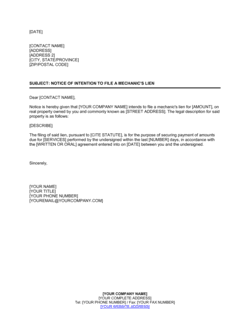
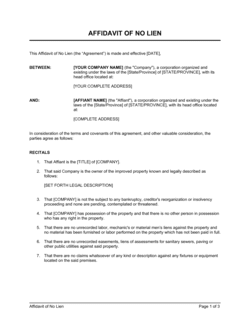
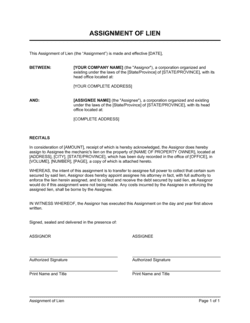
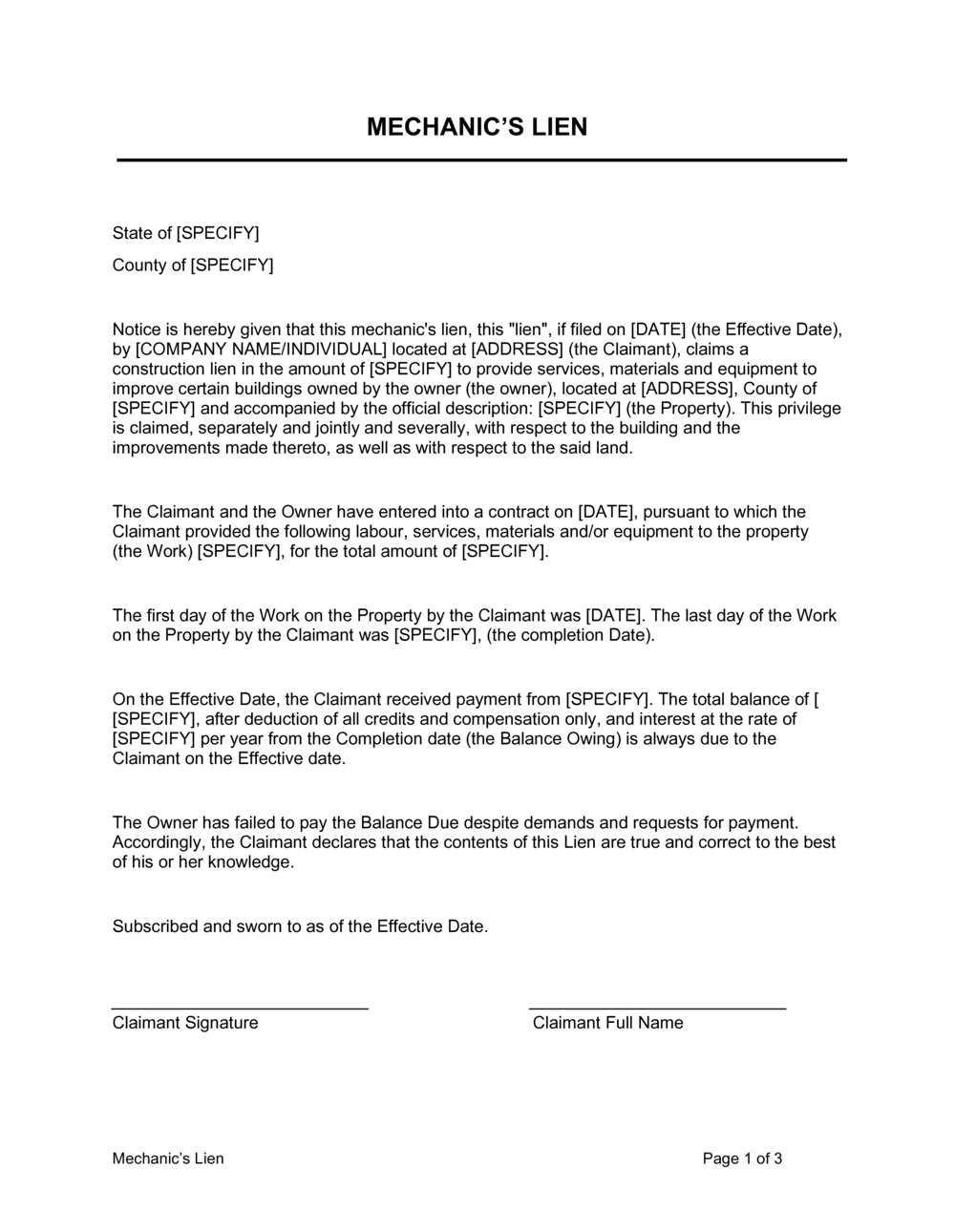
A Mechanic Lien (also called a construction lien or materialman's lien) is a legally binding security interest placed against real property by a contractor, subcontractor, or supplier who has provided labor or materials and has not been paid. This free Word download gives you a structured, state-ready starting point you can edit online and export as PDF before filing with the appropriate county recorder or land registry office.
When you need it
File it when a property owner, general contractor, or developer has failed to pay you for labor or materials within the contractually agreed or statutorily required timeframe. Act quickly — every jurisdiction imposes strict preliminary notice and filing deadlines, typically ranging from 60 to 150 days after last furnishing labor or materials.
What's inside
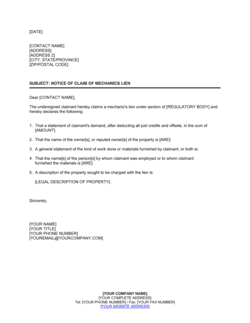
Claimant and property owner identification, legal property description, itemized statement of the amount claimed, description of labor and materials furnished, claim dates, notarization block, and a statement of the contractual relationship between the parties.

What is a Mechanic Lien?

A Mechanic Lien (also called a construction lien or materialman's lien) is a statutory security interest that a contractor, subcontractor, or material supplier can record against real property when they have furnished labor or materials to improve that property and have not been paid. Unlike a contractual remedy, which runs only between parties in privity, a mechanic lien attaches directly to the property's title — encumbering the owner's ability to sell or refinance until the debt is resolved. It gives the claimant the right to pursue foreclosure of the property if the unpaid amount is not satisfied within the statutory enforcement period. The term "mechanic" is historical and refers broadly to skilled tradespeople, not solely to automotive repair professionals.

Why You Need This Document

Without a recorded mechanic lien, an unpaid contractor or supplier is an unsecured creditor — last in line behind mortgage lenders, taxing authorities, and other secured parties if a property owner defaults or files for bankruptcy. The lien transforms that unsecured position into one backed by the property itself, creating immediate and serious consequences for the owner: title cannot transfer cleanly, refinancing stalls, and a prospective buyer will demand lien clearance before closing. That leverage is what converts stalled payment negotiations into actual payment. Every day you wait after completing work moves you closer to a hard statutory deadline that, once missed, cannot be extended — and permanently eliminates your lien rights regardless of how valid the underlying debt is. This template gives you a properly structured starting point to file accurately and on time, protecting payment you have already earned.

Which variant fits your situation?

If your situation is…Use this template
Direct contract with the property owner for labor and materialsMechanic Lien (General Contractor)
No direct contract with the owner — hired by a GC or higher-tier subSubcontractor Mechanic Lien
Supplying materials to a project without performing laborMaterialman's Lien
Serving formal notice before the lien filing deadlinePreliminary Notice (Pre-Lien Notice)
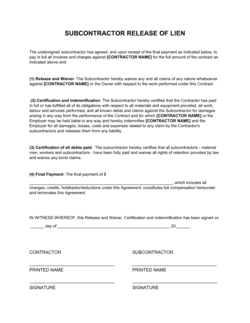
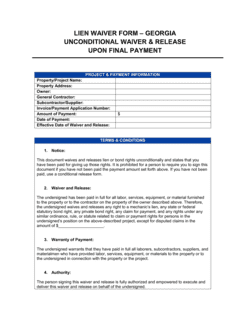
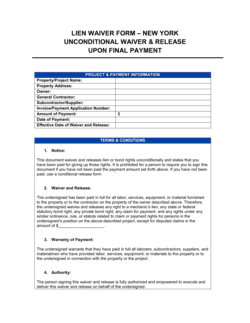
Releasing a lien after payment has been receivedLien Release / Waiver Form
Enforcing an unpaid lien through court actionLien Foreclosure Complaint
Bonding over or removing a disputed lien from titleLien Bond / Substitution Bond

Common mistakes to avoid

❌ Missing the statutory filing deadline

Why it matters: A mechanic lien filed even one day after the statutory deadline is void and cannot be corrected. The claimant permanently loses their lien rights and may have no other practical remedy if the owner is insolvent.

Fix: Calculate the deadline from the last furnishing date on the day work ends, not when payment becomes overdue. Set a calendar reminder at least 15 days before the deadline to allow time for preparation and notarization.

❌ Failing to serve the required preliminary notice

Why it matters: In states that require preliminary notice — including California, Arizona, Florida, and Texas — a lien filed without timely prior notice is unenforceable, regardless of how accurately the lien itself was prepared.

Fix: Serve preliminary notice at the start of every project, not just when payment problems arise. The cost is minimal; losing lien rights on a large project is not.

❌ Overstating the amount claimed

Why it matters: Intentionally inflating a lien claim can constitute a fraudulent lien under statute, exposing the claimant to penalties, attorney's fee awards, and liability for the owner's damages — the opposite of the protection sought.

Fix: Claim only amounts that are invoiced, due, and unpaid. If disputed amounts are included, note them separately and seek legal advice before filing.

❌ Using only a street address instead of a legal property description

Why it matters: County recorders in most jurisdictions will reject a lien that does not contain the legal property description, and the filing deadline will likely have passed before the error is corrected.

Fix: Retrieve the exact legal description from the county assessor's database or the recorded deed before beginning to fill out the form.

❌ Naming the wrong party as property owner

Why it matters: A lien filed against a developer, LLC member, or project manager instead of the actual title holder is void because the lien cannot attach to property owned by someone not named in the claim.

Fix: Always search the county recorder or land registry to confirm the current owner of record immediately before filing — ownership can change during a project.

❌ Failing to serve the owner after recording

Why it matters: Several states require the claimant to serve a copy of the recorded lien on the property owner within a short window after filing — often 15 days. Missing this post-recording service step voids an otherwise valid lien.

Fix: Send the recorded lien to the owner by certified mail on the same day you pick it up from the recorder's office, and retain the certified mail receipt as proof.

The 10 key clauses, explained

Claimant identification

In plain language: States the full legal name, address, and license number (where applicable) of the party asserting the lien — the contractor, subcontractor, or supplier.

Sample language
Claimant: [CLAIMANT LEGAL NAME], a [ENTITY TYPE] licensed under license no. [LICENSE NUMBER], with a principal place of business at [ADDRESS], hereby claims a lien against the property described below.

Common mistake: Using a trade name rather than the registered legal entity name. Courts have dismissed liens where the claimant name did not match the contracting party on record, leaving no recovery.

Property owner identification

In plain language: Identifies the record owner of the property as listed in county or land registry records — not necessarily the party who hired the claimant.

Sample language
The owner of record of the subject property is [OWNER LEGAL NAME], whose address is [OWNER ADDRESS], as identified in [COUNTY] official records.

Common mistake: Naming the developer or project manager as the owner without verifying the title records. Liens filed against the wrong party are typically void and cannot be corrected after the deadline passes.

Legal description of property

In plain language: Provides the full legal description of the encumbered property as it appears in the official land records — lot and block number, parcel ID, metes and bounds, or legal subdivision description.

Sample language
The property subject to this lien is legally described as: Lot [LOT NUMBER], Block [BLOCK NUMBER], [SUBDIVISION NAME], as recorded in Plat Book [X], Page [Y], [COUNTY] County, [STATE], also known as [STREET ADDRESS].

Common mistake: Using only a street address instead of the full legal description. A street address is insufficient for recording in most jurisdictions and can result in rejection of the lien by the county recorder.

Statement of labor and materials furnished

In plain language: Describes the work performed and materials supplied — what was done, when, and the general nature of the contribution to the project.

Sample language
Claimant furnished labor and/or materials of the following general description: [DESCRIPTION OF WORK — e.g., framing, electrical rough-in, roofing materials] for the improvement of the above-described property between [START DATE] and [LAST FURNISHING DATE].

Common mistake: Describing work so vaguely that the statement fails the statutory specificity requirement. Several states require enough detail to identify the nature of the work — 'construction services' alone has been struck in court.

Amount claimed

In plain language: States the exact dollar amount owed and unpaid, broken down by labor and materials where required by the applicable statute.

Sample language
The amount claimed by Claimant for labor and/or materials furnished and unpaid is $[AMOUNT], itemized as follows: Labor — $[LABOR AMOUNT]; Materials — $[MATERIALS AMOUNT]; Total — $[TOTAL AMOUNT].

Common mistake: Claiming more than the actual unpaid amount — for example, including disputed retention or amounts not yet due. Overstating the lien amount can render the entire lien fraudulent and expose the claimant to penalties.

Contractual relationship statement

In plain language: Identifies who hired the claimant — the property owner, general contractor, or a subcontractor — establishing the chain of contracts that connects the claimant to the property.

Sample language
Claimant entered into a contract with [HIRING PARTY NAME], [TITLE/RELATIONSHIP — e.g., General Contractor], whose address is [ADDRESS], for the furnishing of the labor and/or materials described above.

Common mistake: Omitting the contractual relationship statement entirely. Many state statutes require this information, and its absence in a required field is grounds for the lien to be declared invalid.

Preliminary notice compliance statement

In plain language: Certifies that any required preliminary or pre-lien notice was timely served, and identifies the date and method of service.

Sample language
Claimant served a preliminary notice on [DATE] upon [RECIPIENT NAME(S)] by [METHOD — e.g., certified mail, return receipt requested], a copy of which is attached hereto as Exhibit A.

Common mistake: Skipping the preliminary notice compliance statement when the state requires it. Even if notice was actually served, failing to document it on the lien form can undermine enforceability when challenged.

Notarization and verification

In plain language: A sworn verification by the claimant or an authorized officer that the facts stated in the lien are true and correct, executed before a notary public where required by statute.

Sample language
I, [SIGNATORY NAME], [TITLE] of [CLAIMANT NAME], being duly sworn, state that I have read the foregoing claim of lien and that the facts stated therein are true and correct to the best of my knowledge and belief. Signed this [DAY] day of [MONTH], [YEAR].

Common mistake: Signing the lien without notarization in states that require it. Approximately half of US states require notarization for a mechanic lien to be accepted for recording — an unnotarized lien will be rejected at the recorder's office.

Proof of service block

In plain language: Documents when and how a copy of the recorded lien was served on the property owner and, where required, the general contractor and lender — a step separate from the preliminary notice requirement.

Sample language
A copy of this Claim of Lien was served upon [OWNER NAME] at [ADDRESS] by [METHOD — certified mail / personal delivery] on [DATE], as required by [STATE STATUTE CITATION].

Common mistake: Recording the lien without then serving a copy on the owner within the statutory window. Many states — including California and Florida — require post-recording service within 15 days of filing, and failure voids the lien.

Claimant signature and date

In plain language: The authorized signature of the claimant or their representative, with the date of execution, completing the document for filing.

Sample language
Executed by: [CLAIMANT LEGAL NAME] By: [SIGNATURE] [PRINTED NAME], [TITLE] Date: [DATE]

Common mistake: Having the lien signed by a project manager or field supervisor who lacks authority to bind the legal entity. The signature must come from an officer, owner, or authorized agent to be legally effective.

How to fill it out

  1. 1

    Verify the filing deadline for your jurisdiction

    Before filling in a single field, confirm the deadline for filing in the state or province where the project is located. Deadlines run from your last furnishing date and range from 60 days (some states) to 150 days. Missing the deadline extinguishes your lien rights entirely.

    💡 Mark the last furnishing date on the day you finish work and calculate the filing deadline immediately — do not wait for payment to become overdue.

  2. 2

    Pull the legal description from official property records

    Access the county assessor or recorder's website to retrieve the full legal description — lot and block, parcel ID, or metes and bounds — for the project property. Do not rely on the street address alone.

    💡 Copy the legal description verbatim from the recorded deed or assessor record to avoid transcription errors that can invalidate the filing.

  3. 3

    Confirm the record owner's legal name

    Search the county recorder or land registry to identify the current owner of record. The lien must name the title holder, not the developer, project manager, or party who hired you.

    💡 If the property is held by an LLC or trust, name the entity exactly as it appears in the deed — not the individual members or trustees.

  4. 4

    Enter claimant details using your registered legal entity name

    Fill in your full registered business name, address, and contractor license number exactly as they appear on your state license. Cross-reference your state licensing board record if in doubt.

    💡 If you operate under a DBA, use the registered legal entity name, not the trade name — the lien will be challenged on the basis of identity if these do not match.

  5. 5

    Describe the labor and materials furnished with specificity

    Write a description of work that identifies the type of labor and materials, the general scope, and the date range. 'Framing, sheathing, and roofing materials for the residential addition at the subject property from March 1 to April 15, 2026' is sufficient; 'construction work' is not.

    💡 Keep a job log or daily reports — they document the last furnishing date and provide the factual basis for the work description.

  6. 6

    State only the actual unpaid amount owed

    Calculate the unpaid balance carefully. Include only invoiced amounts that are past due — do not include retention not yet due, disputed amounts, or amounts for work not yet completed. Overstating the claim can expose you to bad-faith lien penalties.

    💡 Attach a copy of the unpaid invoices as an exhibit to give the recorder and any challenging party a clear audit trail.

  7. 7

    Confirm preliminary notice compliance and attach proof

    If your state required a preliminary notice, locate your proof of service — certified mail receipt or personal delivery confirmation — and note the service date in the compliance statement. Attach a copy of the notice and proof of service as exhibits.

    💡 If you cannot locate proof of preliminary notice service and the state requires it, consult a construction attorney before filing — the lien may be unenforceable without it.

  8. 8

    Sign, notarize, and record the lien promptly

    Have an authorized officer or owner execute the lien before a notary public where required. File the notarized original with the county recorder or land registry in the county where the property is located, and pay the recording fee (typically $15–$50 per document).

    💡 Use certified mail with return receipt to confirm the date of filing if you cannot appear in person — some counties accept mail filings and will return the stamped copy.

Frequently asked questions

What is a mechanic lien?

A mechanic lien is a statutory security interest placed against real property by a contractor, subcontractor, or material supplier who has not been paid for labor or materials furnished to improve that property. It attaches to the property's title, encumbers the owner's ability to sell or refinance, and gives the claimant the right to pursue foreclosure if the debt is not paid. The term "mechanic" is historical and refers to skilled workers generally, not solely automotive mechanics.

Who can file a mechanic lien?

Generally, any party that furnishes labor, materials, equipment, or professional design services that improve real property can file a mechanic lien — including general contractors, subcontractors of any tier, material suppliers, equipment lessors, architects, and engineers. Eligibility rules vary by state, and some jurisdictions require a valid contractor license as a condition of lien rights. Unlicensed contractors lose lien rights in several states, including California and Washington.

How long do I have to file a mechanic lien?

Deadlines vary significantly by state and by the claimant's position in the contracting chain. In most US states, deadlines run 60 to 150 days from the last date labor or materials were furnished. If the owner records a Notice of Completion, shorter deadlines — typically 30 to 60 days — apply for subcontractors and suppliers. In Canada, provincial deadlines range from 45 days (Alberta) to 90 days (Ontario) from last furnishing. There is no grace period: filing even one day late extinguishes lien rights.

What is a preliminary notice and is it required?

A preliminary notice (also called a pre-lien notice or Notice to Owner) is a statutory notice that must be served on the property owner, general contractor, and/or construction lender before a subcontractor or supplier can file a valid mechanic lien. It is required in roughly 30 US states, including California, Arizona, Florida, and Texas. General contractors with direct contracts with the owner are typically exempt. Failing to serve a required preliminary notice on time makes a later lien unenforceable regardless of the underlying debt.

Can a property owner remove a mechanic lien?

Yes. A property owner can challenge a lien through a court action to discharge, vacate, or reduce an invalid or overstated lien. Alternatively, the owner can "bond over" the lien by substituting a surety bond of equal or greater value — this releases the lien from the property title while preserving the claimant's right to make a claim against the bond. A lien that is not enforced by court action within the statutory lien period (typically 1 to 2 years from filing) expires automatically.

Do I need a lawyer to file a mechanic lien?

For straightforward claims by a general contractor with a direct owner contract in a familiar jurisdiction, a high-quality template is often sufficient. Legal counsel is advisable when the claim is large (over $50,000), when preliminary notice compliance is uncertain, when the property owner is likely to challenge the lien, or when you need to enforce the lien through foreclosure proceedings. Construction attorneys typically charge $500–$2,000 for lien preparation and filing assistance.

What happens if I don't enforce a recorded mechanic lien?

A mechanic lien that is recorded but not enforced through a court foreclosure action within the statutory lien period expires and becomes unenforceable. The lien period varies by state — commonly 1 year from filing in most US states, with some as short as 6 months. Once expired, the claimant loses the right to foreclose but may still pursue a breach of contract claim against the hiring party, subject to the applicable contract statute of limitations.

Is a mechanic lien the same as a construction lien?

Yes — mechanic lien, construction lien, materialman's lien, and contractor's lien all refer to the same statutory remedy. The terminology varies by jurisdiction: most US states use "mechanic lien," Canada and some Caribbean jurisdictions use "construction lien," and the UK uses different statutory mechanisms altogether. The underlying right — a security interest in real property for unpaid construction work — is the same concept across all of these terms.

Can a mechanic lien be filed on a commercial property?

Yes, mechanic lien rights apply to both residential and commercial properties in virtually all US states and Canadian provinces. Some jurisdictions impose additional procedural requirements on residential projects — such as homestead protections in Texas that limit liens on owner-occupied homes to projects contracted by the owner — but the right to file exists for commercial, industrial, and residential construction alike.

How this compares to alternatives

vs Preliminary notice (pre-lien notice)

A preliminary notice is served at the start of a project to preserve the right to file a mechanic lien later — it is not itself a lien and does not encumber title. A mechanic lien is filed after non-payment and does attach to the property. In most states that require it, the preliminary notice is a prerequisite for a valid lien; skipping it means no lien rights regardless of the debt owed.

vs Lien release / waiver form

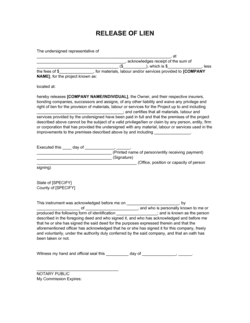
A lien release or waiver extinguishes lien rights — either partially (conditional on payment clearing) or fully (unconditional). It is the opposite of a mechanic lien: the lien asserts a claim; the release removes it. Property owners and lenders routinely require lien waivers as a condition of each progress payment, so contractors must understand both documents together.

vs Demand letter for payment

A demand letter requests payment through negotiation and does not encumber the property's title. A mechanic lien is a recorded legal instrument that attaches to the real property and can ultimately be enforced through foreclosure. A demand letter is typically the first step; a mechanic lien is the escalation when the demand is ignored. Using a demand letter first often resolves the dispute without the cost of lien preparation and filing.

vs Construction contract

A construction contract creates the underlying obligation to pay; a mechanic lien is the enforcement remedy when that obligation is not honored. The contract governs scope, price, and dispute resolution between the parties in privity. The mechanic lien operates independently of the contract and encumbers the property regardless of whether the owner was a party to the claimant's contract, extending protection to subcontractors and suppliers with no direct owner relationship.

Industry-specific considerations

Residential construction

Homestead and owner-occupant protections apply in several states; preliminary notice requirements are strictly enforced and short timelines often surprise first-time residential subcontractors.

Commercial real estate development

Multiple subcontractor tiers, large contract values, and lender-required lien waivers at each draw make lien rights management a core cash-flow tool throughout the project lifecycle.

Specialty trades (electrical, plumbing, HVAC)

Specialty trades are typically second- or third-tier subcontractors with no direct owner contract, making preliminary notice deadlines — often starting from first furnishing — the critical compliance step.

Building materials supply

Materialman's lien rights cover delivered goods even without any labor component; suppliers must track delivery dates carefully because the last furnishing date is a delivery date, not a project completion date.

Jurisdictional notes

United States

Mechanic lien rights are governed by individual state statutes with no federal equivalent. Requirements vary significantly: California requires a 20-day preliminary notice from subcontractors; Texas requires a monthly sworn statement of account; Florida requires a Notice to Owner within 45 days of first furnishing. Filing deadlines run from 60 days (some states) to 150 days from last furnishing. Unlicensed contractors lose lien rights in approximately a dozen states. Always verify the exact requirements for the project state before filing.

Canada

Construction lien rights in Canada are governed provincially under Construction Act statutes. Ontario's Construction Act (2018 reform) introduced prompt payment and adjudication alongside lien rights, with a 60-day filing deadline from last furnishing. Alberta allows 45 days; British Columbia allows 45 days. Quebec uses a similar mechanism called a 'legal hypothec on immovables.' Most provinces require the lien to be preserved (by action or certificate of lis pendens) within a set period after filing, typically 90 days.

United Kingdom

The UK does not have a mechanic lien system equivalent to North America. Unpaid contractors and suppliers instead rely on the Housing Grants, Construction and Regeneration Act 1996 (the Construction Act), which mandates interim payment rights and statutory adjudication. A contractor can also assert a lien over materials or unfixed plant still in their possession. For significant unpaid debts, a charging order against the property may be obtained through court proceedings, but this is a post-judgment remedy rather than a pre-filing right.

European Union

There is no harmonized EU mechanic lien regime. Member states have widely varying approaches: Germany uses the Bauhandwerkersicherung (construction security claim under §650f BGB), which entitles contractors to demand a security deposit from the owner; France provides the privilege du constructeur and the nantissement de marché; the Netherlands allows a conservatoir beslag (conservatory attachment) on property. Contractors working across EU member states should obtain local legal advice, as notice requirements, deadlines, and enforcement mechanisms differ substantially by country.

Template vs lawyer — what fits your deal?

PathBest forCostTime
Use the templateGeneral contractors with direct owner contracts filing straightforward claims under $25,000 in a familiar stateFree plus county recording fee ($15–$50)1–3 hours
Template + legal reviewSubcontractors, multi-tier claims, claims over $25,000, or any project where preliminary notice compliance is uncertain$500–$1,500 (construction attorney review and filing assistance)1–3 days
Custom draftedLarge commercial projects over $100,000, lien enforcement and foreclosure proceedings, or multi-state project portfolios$2,000–$10,000+ (construction litigation counsel)1–4 weeks

Glossary

Mechanic Lien
A security interest in real property granted by statute to contractors, subcontractors, and suppliers who have furnished labor or materials but have not been paid.
Claimant
The contractor, subcontractor, or supplier asserting the lien claim against the property.
Preliminary Notice
A statutory notice required in many jurisdictions that must be served on the owner, general contractor, and lender before a lien can be validly filed — typically within 20 to 30 days of first furnishing.
Last Furnishing Date
The final date on which labor, materials, or services were provided to the project — the clock for filing deadlines starts from this date.
Legal Description
The formal identification of real property as recorded in official county or land registry records, distinct from a street address.
Notice of Completion
A document recorded by the property owner upon project completion that triggers shortened lien filing deadlines — typically 30 to 60 days — for subcontractors and suppliers.
Lien Foreclosure
A court action to enforce an unpaid mechanic lien by compelling the sale of the encumbered property to satisfy the debt.
Lien Waiver
A document signed by a claimant that releases all or part of their lien rights, typically exchanged at the time of payment.
Bonding Over
A process by which a property owner or contractor replaces a recorded lien with a surety bond of equal or greater value, releasing the lien from the property's title while preserving the claimant's claim against the bond.
Lien Period
The window of time — set by state or provincial statute — within which a recorded mechanic lien must be enforced through court action or it expires and becomes unenforceable.
Notice to Owner (NTO)
A preliminary notice form used in several US states (notably Florida) that must be served on the property owner before a subcontractor or supplier can later file a valid lien.

Part of your Business Operating System

This document is one of 3,000+ business & legal templates included in Business in a Box.

  • Fill-in-the-blanks — ready in minutes
  • 100% customizable Word document
  • Compatible with all office suites
  • Export to PDF and share electronically

Create your document in 3 simple steps.

From template to signed document — all inside one Business Operating System.
1
Download or open template

Access over 3,000+ business and legal templates for any business task, project or initiative.

2
Edit and fill in the blanks with AI

Customize your ready-made business document template and save it in the cloud.

3
Save, Share, Send, Sign

Share your files and folders with your team. Create a space of seamless collaboration.

Save time, save money, and create top-quality documents.

★★★★★

"Fantastic value! I'm not sure how I'd do without it. It's worth its weight in gold and paid back for itself many times."

Managing Director · Mall Farm
Robert Whalley
Managing Director, Mall Farm Proprietary Limited
★★★★★

"I have been using Business in a Box for years. It has been the most useful source of templates I have encountered. I recommend it to anyone."

Business Owner · 4+ years
Dr Michael John Freestone
Business Owner
★★★★★

"It has been a life saver so many times I have lost count. Business in a Box has saved me so much time and as you know, time is money."

Owner · Upstate Web
David G. Moore Jr.
Owner, Upstate Web

Run your business with a system — not scattered tools

Stop downloading documents. Start operating with clarity. Business in a Box gives you the Business Operating System used by over 250,000 companies worldwide to structure, run, and grow their business.

Start free · No credit card required