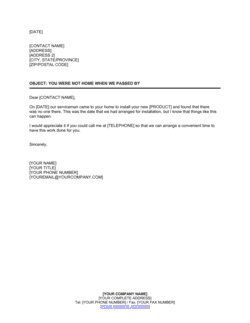
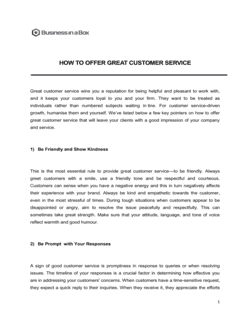
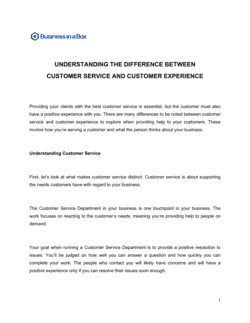
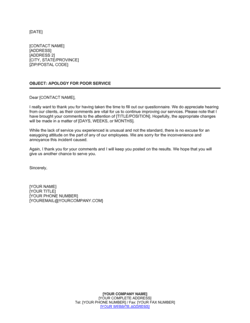
Customer Service Agreement Template

Free Word download • Edit online • Save & share with Drive • Export to PDF

3 pages25–30 min to fillDifficulty: StandardSignature requiredLegal review recommended
Learn more ↓
FreeCustomer Service Agreement Template

At a glance

What it is
A Customer Service Agreement is a legally binding contract between a service provider and a customer that defines exactly what services will be delivered, at what price, under what conditions, and with what remedies if things go wrong. This free Word download gives you a professionally structured starting point you can edit online and export as PDF — covering scope, fees, SLAs, liability limits, and termination in a single document.
When you need it
Use it whenever you engage a customer for ongoing or project-based service delivery and need enforceable written terms. It is equally appropriate for a first-time client relationship and for formalizing terms with a long-standing customer who has been operating on a handshake.
What's inside
Scope of services, fees and payment schedule, service level commitments, intellectual property ownership, confidentiality, limitation of liability, dispute resolution, and termination rights — all in a format designed to be understood and signed without a law degree.

What is a Customer Service Agreement?

A Customer Service Agreement is a legally binding contract between a service provider and a customer that establishes the complete terms of a service relationship in writing. It defines what services will be delivered and when, what the customer will pay and on what schedule, what performance standards apply, who owns the work product created, and what happens if either party fails to meet their obligations. Unlike a simple quote or an email confirmation, a properly executed customer service agreement creates enforceable rights on both sides — from the provider's right to collect overdue fees to the customer's right to receive services that meet agreed standards.

Why You Need This Document

Without a written customer service agreement, a provider who completes a project has no guaranteed right to payment — especially if the customer disputes whether the deliverables met an undefined standard. Scope creep goes unchecked because there is no contractual baseline to measure against. Work product ownership defaults to the creator under copyright law in most jurisdictions, meaning a customer who paid for a custom website or software tool may not legally own it. And a provider delivering services without a liability cap faces potentially unlimited exposure if the customer's business suffers a loss they attribute to the work. This template gives you an enforceable framework in under an hour — one that protects your revenue, defines your obligations clearly, and limits your exposure to claims that would otherwise be bounded only by a court's imagination.

Which variant fits your situation?

If your situation is…Use this template
Delivering ongoing managed services with monthly SLA commitmentsManaged Services Agreement
Engaging a one-time project with fixed scope and priceService Contract (Fixed-Price)
Providing software or platform access alongside servicesSaaS Subscription Agreement
Hiring a freelancer or independent contractor to deliver servicesIndependent Contractor Agreement
Formalizing an ongoing retainer relationship with a professionalRetainer Agreement
Defining support tiers and uptime commitments onlyService Level Agreement (SLA)
Setting master terms governing multiple future work ordersMaster Service Agreement

Common mistakes to avoid

❌ Defining scope in a single vague sentence

Why it matters: Scope-creep disputes are the most common source of client conflict in service agreements. A provider who delivers 'marketing services' has no contractual basis to decline a customer demand for ten extra deliverables.

Fix: Move scope detail to a Schedule A with numbered deliverables, formats, quantities, and explicit exclusions. Reference the schedule in the body clause so it is contractually incorporated.

❌ No limitation of liability clause

Why it matters: Without a liability cap, a provider delivering $8,000 of consulting can face a multi-hundred-thousand-dollar consequential damages claim if the customer's business suffers a loss they attribute to the services.

Fix: Include a mutual limitation of liability capping total exposure at fees paid in the preceding 12 months and excluding consequential, indirect, and punitive damages with an all-caps disclaimer.

❌ Omitting IP ownership language

Why it matters: In most common-law jurisdictions, the creator retains copyright in work product by default. A customer who paid for a custom logo, website, or software product may not legally own it without an explicit written assignment.

Fix: Add a clause expressly assigning ownership of custom deliverables to the customer upon full payment, while identifying any pre-existing provider IP that is licensed but not transferred.

❌ No late-payment mechanism

Why it matters: Without a contractual interest rate and a right to suspend services, providers who send a second invoice to an overdue client have no practical leverage short of litigation.

Fix: Include a late-payment interest rate of 1.5–2% per month on overdue balances and an express right to suspend services after 10 days' written notice of non-payment.

❌ Setting SLAs without a remedy cap

Why it matters: An SLA that promises 99.9% uptime without a capped remedy exposes the provider to unlimited liability for a single outage event — even one caused by a third-party infrastructure failure.

Fix: Pair every SLA metric with a specific, capped service credit — typically expressed as a percentage of the affected month's fees, with an aggregate monthly cap of 15–30%.

❌ Signing after services have already begun

Why it matters: Performing services before the agreement is signed creates ambiguity about which terms govern, and in some jurisdictions implies acceptance of the customer's standard purchase terms — which may be far less favorable to the provider.

Fix: Make execution a prerequisite to starting work. If circumstances require a later signature, document the effective date as retroactive to the actual start date and ensure both parties acknowledge this in writing.

The 10 key clauses, explained

Parties and recitals

In plain language: Identifies the service provider and the customer as legal entities, states the effective date, and briefly describes the purpose of the agreement.

Sample language
This Customer Service Agreement ('Agreement') is entered into as of [EFFECTIVE DATE] between [SERVICE PROVIDER LEGAL NAME], a [STATE/PROVINCE] [ENTITY TYPE] ('Provider'), and [CUSTOMER LEGAL NAME], a [STATE/PROVINCE] [ENTITY TYPE] ('Customer').

Common mistake: Using a trade name or DBA instead of the registered legal entity name. Enforcing IP assignment, non-disclosure, or payment obligations against an unregistered name creates standing problems in litigation.

Scope of services

In plain language: Specifies exactly what the provider will deliver — tasks, deliverables, timelines, and any exclusions — leaving no room for scope creep disputes.

Sample language
Provider shall perform the services described in Schedule A ('Services'). Services do not include [SPECIFIC EXCLUSIONS]. Any work outside the scope of Schedule A requires a written Change Order signed by both parties.

Common mistake: Describing services only in broad terms like 'marketing support' or 'IT services.' Vague scope is the single most common trigger for scope-creep disputes and non-payment claims.

Fees, invoicing, and payment terms

In plain language: States the fee structure (hourly, fixed, retainer, or milestone-based), invoice frequency, due date, and the consequences of late payment.

Sample language
Customer shall pay Provider $[AMOUNT] per [hour / month / milestone] as set out in Schedule B. Invoices are due Net [30] days from the invoice date. Overdue balances accrue interest at [1.5]% per month. Provider may suspend services after [10] days' written notice of non-payment.

Common mistake: Omitting a late-payment interest rate and a suspension-of-services right. Without both, the provider has no practical leverage to collect overdue fees without immediately resorting to litigation.

Service levels and performance standards

In plain language: Defines measurable commitments — response times, uptime targets, defect rates — and what remedy the customer receives if the provider falls short.

Sample language
Provider shall respond to Priority 1 support requests within [4] business hours and resolve them within [24] business hours. If Provider fails to meet the response SLA in any calendar month, Customer shall receive a service credit equal to [X]% of that month's fees, up to a maximum of [X]%.

Common mistake: Setting SLAs without a corresponding credit or remedy cap. An open-ended SLA breach could theoretically expose the provider to unlimited liability for a single missed response time.

Intellectual property ownership

In plain language: Determines who owns work product and deliverables created during the engagement — and whether the customer's pre-existing IP remains theirs.

Sample language
Upon receipt of full payment, Provider assigns to Customer all right, title, and interest in custom deliverables created specifically for Customer under this Agreement. Provider retains ownership of pre-existing tools, frameworks, and background IP. Customer grants Provider a limited license to use Customer's materials solely to perform the Services.

Common mistake: Assuming the customer owns everything simply because they paid for it. Without an explicit assignment clause, the provider retains copyright in most common-law jurisdictions — a fact that surprises clients and triggers expensive post-project disputes.

Confidentiality

In plain language: Prohibits both parties from disclosing or misusing confidential information shared during the engagement, with defined exceptions for information that is already public or independently developed.

Sample language
Each party shall hold the other's Confidential Information in strict confidence and shall not disclose it to any third party without prior written consent. This obligation survives termination of this Agreement for a period of [3] years. Confidential Information excludes information that is or becomes publicly available through no fault of the receiving party.

Common mistake: Failing to define 'Confidential Information' explicitly. Relying on a catch-all without a definition makes the clause difficult to enforce and may not cover operational data or pricing that the disclosing party most wants to protect.

Limitation of liability

In plain language: Caps the total financial exposure of each party — typically at fees paid in the preceding 12 months — and excludes consequential, indirect, or punitive damages.

Sample language
In no event shall either party's total liability exceed the fees paid by Customer in the [12] months preceding the claim. Neither party shall be liable for indirect, incidental, consequential, or punitive damages, even if advised of the possibility of such damages.

Common mistake: No limitation of liability clause at all. Without one, a provider delivering $5,000 of consulting could theoretically face a $500,000 consequential damages claim from a client whose business was disrupted.

Term, termination, and wind-down

In plain language: Sets the duration of the agreement, the conditions under which either party may terminate early (with or without cause), and what happens to in-progress work upon termination.

Sample language
This Agreement commences on the Effective Date and continues for [12] months unless terminated earlier. Either party may terminate for convenience with [30] days' written notice. Provider may terminate for cause immediately if Customer fails to pay an undisputed invoice within [30] days of notice. Upon termination, Provider shall deliver all completed work product and Customer shall pay for all work performed through the termination date.

Common mistake: No wind-down clause specifying what happens to work in progress. Without it, disputes arise over whether partially completed deliverables must be delivered and at what cost.

Dispute resolution and governing law

In plain language: States which jurisdiction's law governs the agreement and how disputes are resolved — mediation, arbitration, or court — including the forum.

Sample language
This Agreement is governed by the laws of [STATE / PROVINCE / COUNTRY]. Any dispute shall first be submitted to non-binding mediation administered by [MEDIATION BODY] in [CITY]. If mediation fails after [30] days, disputes shall be resolved by binding arbitration under the rules of [AAA / JAMS / ICDR], except claims for injunctive relief.

Common mistake: Choosing a governing law with no connection to where services are delivered or the customer operates. Courts in several jurisdictions — particularly employment and consumer-law courts — apply local law regardless of what the contract states.

Warranties and disclaimer

In plain language: Provides a limited warranty that services will meet professional standards for a defined period, then expressly disclaims all other warranties so the provider's exposure is bounded.

Sample language
Provider warrants that Services will be performed in a professional and workmanlike manner consistent with industry standards. EXCEPT AS EXPRESSLY SET OUT ABOVE, PROVIDER DISCLAIMS ALL WARRANTIES, EXPRESS OR IMPLIED, INCLUDING ANY IMPLIED WARRANTY OF MERCHANTABILITY OR FITNESS FOR A PARTICULAR PURPOSE.

Common mistake: Omitting the disclaimer of implied warranties. In many jurisdictions, an implied warranty of fitness for a particular purpose applies by default — without a disclaimer, the provider is exposed to claims tied to the customer's specific business outcomes.

How to fill it out

  1. 1

    Enter legal entity names and the effective date

    Use each party's full registered legal name — not a trading name or brand. Include the entity type (LLC, Inc., Ltd.) and the jurisdiction of incorporation. Set the effective date as the date both parties sign, not the date you started drafting.

    💡 Cross-reference the exact entity name against the corporate registry before execution — a mismatch can void specific clauses in some jurisdictions.

  2. 2

    Draft Schedule A: detailed scope of services

    List every deliverable, task, and activity the provider will perform. Be specific about format, frequency, and acceptance criteria. Then list explicit exclusions — what the agreement does not cover — to prevent scope-creep disputes.

    💡 Write scope from the customer's perspective: 'Customer will receive X by Y date in Z format.' Outcome-framed language cuts disputes more effectively than process-framed language.

  3. 3

    Complete Schedule B: fees and payment schedule

    Enter the fee structure (hourly, fixed, milestone, or monthly retainer), the invoicing frequency, payment due date, late-interest rate, and any deposit or advance payment required before work begins.

    💡 State the currency explicitly for any cross-border engagement. USD and CAD, or GBP and EUR, cause billing disputes when left unspecified.

  4. 4

    Set SLA commitments and credit remedies

    Define each performance metric — response time, resolution time, uptime percentage — and pair each metric with a specific, capped service credit. Ensure the maximum monthly credit is expressed as a percentage of that month's fees, not as an open-ended amount.

    💡 Only commit to SLAs you have the operational infrastructure to track. An SLA you cannot measure is a liability you cannot manage.

  5. 5

    Determine IP ownership and license back

    Decide whether custom deliverables transfer to the customer upon full payment or whether the provider retains ownership and grants a license. Record which pre-existing tools, code libraries, or frameworks the provider retains. If the customer is providing materials, add a license-back clause.

    💡 For software deliverables, specify whether source code or only compiled output transfers — the difference is material in any future maintenance or re-use scenario.

  6. 6

    Set the limitation of liability cap

    Express the liability cap as a multiple of fees paid in the preceding 12 months — typically 1× to 2× for professional services. Confirm that consequential, indirect, and punitive damages are excluded in all-caps language as required for enforceability in many US states.

    💡 If you are a small provider with a high-value client, set the cap at fees paid in the preceding 3 months, not 12 — a $10K monthly retainer with a 12-month cap still exposes you to $120K.

  7. 7

    Define termination notice periods and wind-down obligations

    Set a convenience termination notice period — 30 days is standard for monthly service agreements; 60–90 days for annual retainers. Add a clause requiring the provider to deliver all completed work product and work in progress upon termination and requiring the customer to pay for all work performed through the termination date.

    💡 Include a 30-day cure period for material breach before termination for cause takes effect. It gives both parties a chance to resolve issues without immediate contract termination.

  8. 8

    Sign before services begin

    Both parties must sign the agreement before the provider starts work. Performing services before execution weakens your ability to enforce restrictive clauses — and in some jurisdictions can imply a contract on the customer's standard terms instead.

    💡 Use an e-signature tool to timestamp execution and automatically store the fully signed copy — this eliminates disputes over whether the final version was signed.

Frequently asked questions

What is a customer service agreement?

A customer service agreement is a legally binding contract between a service provider and a customer that defines the services to be delivered, the fees payable, the performance standards the provider must meet, and the rights and obligations of both parties if things go wrong. It replaces verbal understandings and informal email chains with enforceable written terms, reducing the risk of scope disputes, non-payment, and liability exposure for both sides.

What should a customer service agreement include?

At minimum: parties and effective date, detailed scope of services (ideally in a separate schedule), fees and payment terms, service level commitments with remedies, IP ownership, confidentiality, limitation of liability, term and termination rights, dispute resolution, and governing law. Missing any of these creates gaps that courts fill with jurisdiction-specific defaults — often unfavorable to the provider.

Is a customer service agreement legally binding?

Yes — a customer service agreement is generally enforceable as a binding contract when it is signed by both parties, identifies the parties clearly, sets out the agreed terms with sufficient certainty, and is supported by consideration (the exchange of services for payment). Electronic signatures are recognized as legally valid in the US, Canada, the UK, and the EU under applicable e-signature statutes, provided the signing process meets basic authentication requirements.

What is the difference between a customer service agreement and a service level agreement?

A customer service agreement is the master contract governing the entire service relationship — scope, fees, IP, liability, and termination. A service level agreement (SLA) is a specific component — sometimes a standalone document, sometimes a schedule — that defines measurable performance metrics (response times, uptime, error rates) and the service credits or remedies triggered if those metrics are missed. An SLA without a master service agreement has no governing framework for payment, IP, or dispute resolution.

Can I use one customer service agreement for all my clients?

A well-drafted template with a modular scope-of-services schedule works for most standard engagements. Customize the scope (Schedule A) and fee schedule (Schedule B) for each client rather than rewriting the body clauses. For clients in different countries, also review the governing law clause and ensure the liability and IP provisions comply with local law — EU consumer protection rules, for example, restrict certain limitation-of-liability clauses when the customer is an individual.

Who owns the work product created under a customer service agreement?

Ownership depends entirely on what the contract says. In most common-law jurisdictions (US, Canada, UK, Australia), the creator retains copyright by default unless there is an explicit written assignment. This means a customer who paid for a custom website, software tool, or marketing campaign may not legally own the deliverables without an assignment clause in the agreement. Always include explicit IP language — either assigning ownership to the customer upon full payment or confirming a license-only arrangement.

What happens if one party breaches the customer service agreement?

The non-breaching party is typically entitled to written notice and a cure period — commonly 15 to 30 days — before termination for cause takes effect. If the breach is not cured, the non-breaching party may terminate the agreement and pursue remedies under the contract, which are typically capped by the limitation of liability clause. For payment breaches, the provider may also have a contractual right to suspend services and charge late-payment interest without waiting for a full termination process.

Do I need a lawyer to draft a customer service agreement?

For straightforward domestic service engagements at standard commercial rates, a high-quality template is typically sufficient. Consider engaging a lawyer when the engagement involves a high-value contract where the liability cap is material, when you are delivering services in a heavily regulated industry (healthcare, financial services, legal), when the customer operates in a foreign jurisdiction with unfamiliar consumer protection laws, or when the IP created is significant to your business model. A template review by a commercial lawyer typically costs $300–$800 and is worthwhile for any agreement above $50K in value.

How long should a customer service agreement last?

Most customer service agreements run for 12 months with automatic renewal unless either party provides 30–60 days' notice of non-renewal. Project- based agreements terminate on delivery and acceptance of the final deliverable. Retainer agreements commonly renew monthly. The right structure depends on your billing model — monthly retainers suit a termination-for-convenience notice of 30 days, while annual agreements typically require 60–90 days' notice to give both parties time to transition.

How this compares to alternatives

vs Independent Contractor Agreement

An independent contractor agreement governs the relationship between a business and a self-employed individual performing work — focusing on classification, tax treatment, and work-for-hire status. A customer service agreement governs the relationship between a service business and its customers — focusing on deliverables, fees, SLAs, and customer-facing liability. Use a contractor agreement internally for your service delivery team and a customer service agreement externally with the clients they serve.

vs Master Service Agreement

A master service agreement sets overarching terms — liability, IP, confidentiality, and dispute resolution — that govern all future work orders between the same parties. A customer service agreement is self-contained, covering a single engagement or an ongoing relationship in one document. Use a master service agreement when you expect multiple separate projects with the same client over time; use a customer service agreement for a single defined engagement or a standard recurring service.

vs Retainer Agreement

A retainer agreement secures ongoing availability of a professional for a fixed monthly fee, regardless of whether a specific project is active. A customer service agreement defines specific deliverables and performance standards for services being actively rendered. A retainer structure suits advisors and on-call specialists; a customer service agreement suits providers with defined, measurable outputs.

vs Service Level Agreement (SLA)

An SLA is a performance document — it defines metrics, targets, and service credits but contains no provisions for payment, IP, confidentiality, or termination. A customer service agreement is the governing contract that typically incorporates an SLA as a schedule. An SLA standing alone provides operational clarity but no legal framework if the relationship breaks down.

Industry-specific considerations

Information technology and managed services

Response-time SLAs by priority tier, uptime commitments, data security and breach notification obligations, and change-management procedures for system modifications.

Marketing and creative agencies

Deliverable-specific scope schedules, revision limits per deliverable, third-party media and licensing cost pass-throughs, and clear IP assignment upon full payment.

Professional services

Hourly or fixed-fee billing tied to defined engagement phases, professional indemnity insurance requirements, and non-solicitation of key personnel during and after the engagement.

Healthcare and wellness

HIPAA Business Associate Agreement requirements incorporated by reference, data handling and retention obligations, and enhanced confidentiality provisions covering patient information.

Construction and facilities management

Milestone-based payment schedules, lien-waiver provisions, insurance and bonding requirements, and change-order procedures for scope modifications during a project.

Retail and e-commerce

Fulfillment SLAs tied to order processing and shipping windows, product return and refund handling procedures, and consumer protection compliance for B2C service terms.

Jurisdictional notes

United States

Contract law is primarily state-governed, so the choice of governing state matters — Delaware and New York are common for commercial agreements due to predictable case law. Limitation of liability disclaimers must typically appear in all-caps or otherwise conspicuous type to be enforceable under UCC Article 2 principles adopted by most states. California imposes additional consumer protection obligations if any customer is an individual rather than a business entity.

Canada

Common-law provinces (Ontario, BC, Alberta) follow contract principles similar to those in the US, but limitation of liability clauses are scrutinized more closely by courts and may be set aside if deemed unconscionable. Quebec is a civil-law jurisdiction — agreements with Quebec customers should reference the Civil Code of Quebec and may need to be provided in French for provincially regulated entities. PIPEDA (or provincial equivalents) imposes data-handling obligations that should be addressed in the confidentiality clause for any engagement involving personal information.

United Kingdom

The Unfair Contract Terms Act 1977 and the Consumer Rights Act 2015 restrict the enforceability of limitation of liability and exclusion clauses — particularly in B2C contracts, where liability for death or personal injury caused by negligence cannot be excluded. For B2B agreements, liability caps must satisfy a 'reasonableness' test. The Contracts (Rights of Third Parties) Act 1999 should be expressly excluded if you do not intend third parties to enforce agreement terms.

European Union

GDPR applies whenever the provider or customer processes personal data of EU residents — a data processing agreement or addendum is required in addition to the service agreement if any personal data is handled. The EU Unfair Contract Terms Directive restricts certain exclusion clauses in consumer contracts. Member states vary significantly in their treatment of limitation of liability for B2B agreements — French and German courts apply stricter reasonableness standards than many other jurisdictions.

Template vs lawyer — what fits your deal?

PathBest forCostTime
Use the templateStandard domestic service engagements under $50K with a single customer in one jurisdictionFree30–45 minutes
Template + legal reviewCross-border engagements, regulated industries, or contracts above $50K where the liability cap is material$300–$8002–5 days
Custom draftedEnterprise customers, heavily regulated industries (healthcare, fintech), or complex multi-party service arrangements$1,500–$5,000+1–3 weeks

Glossary

Scope of Services
The defined list of tasks, deliverables, and activities the service provider agrees to perform under the contract.
Service Level Agreement (SLA)
A commitment within the contract specifying measurable performance standards — such as response time within 4 hours or 99.9% uptime — and the remedies available if those standards are not met.
Limitation of Liability
A clause capping the maximum financial exposure of one or both parties — typically expressed as a multiple of fees paid — regardless of the nature of the claim.
Indemnification
An obligation by one party to compensate the other for specific losses, claims, or damages arising from defined circumstances such as gross negligence or IP infringement.
Intellectual Property (IP) Ownership
The clause that determines who owns work product, deliverables, or custom developments created during the engagement — the service provider, the customer, or jointly.
Force Majeure
A clause excusing a party from performance obligations when failure is caused by events outside their reasonable control, such as natural disasters, government actions, or infrastructure outages.
Termination for Cause
The right to end the agreement immediately — without notice or payment in lieu — when the other party commits a material breach that is not cured within a defined remedy period.
Termination for Convenience
The right to end the agreement without cause by providing a defined notice period, typically 30 or 60 days, with no penalty beyond fees owed for work already performed.
Change Order
A written amendment to the original scope of services authorizing additional work, cost, or timeline adjustments — both parties must sign before the additional work begins.
Confidential Information
Non-public data, materials, or know-how shared by one party with the other during the engagement, which the receiving party is contractually prohibited from disclosing or misusing.
Warranty
A contractual promise that services will be performed in a workmanlike manner consistent with industry standards for a defined period, after which no further obligations apply.

Part of your Business Operating System

This document is one of 3,000+ business & legal templates included in Business in a Box.

  • Fill-in-the-blanks — ready in minutes
  • 100% customizable Word document
  • Compatible with all office suites
  • Export to PDF and share electronically

Create your document in 3 simple steps.

From template to signed document — all inside one Business Operating System.
1
Download or open template

Access over 3,000+ business and legal templates for any business task, project or initiative.

2
Edit and fill in the blanks with AI

Customize your ready-made business document template and save it in the cloud.

3
Save, Share, Send, Sign

Share your files and folders with your team. Create a space of seamless collaboration.

Save time, save money, and create top-quality documents.

★★★★★

"Fantastic value! I'm not sure how I'd do without it. It's worth its weight in gold and paid back for itself many times."

Managing Director · Mall Farm
Robert Whalley
Managing Director, Mall Farm Proprietary Limited
★★★★★

"I have been using Business in a Box for years. It has been the most useful source of templates I have encountered. I recommend it to anyone."

Business Owner · 4+ years
Dr Michael John Freestone
Business Owner
★★★★★

"It has been a life saver so many times I have lost count. Business in a Box has saved me so much time and as you know, time is money."

Owner · Upstate Web
David G. Moore Jr.
Owner, Upstate Web

Run your business with a system — not scattered tools

Stop downloading documents. Start operating with clarity. Business in a Box gives you the Business Operating System used by over 250,000 companies worldwide to structure, run, and grow their business.

Free Forever Plan · No credit card required