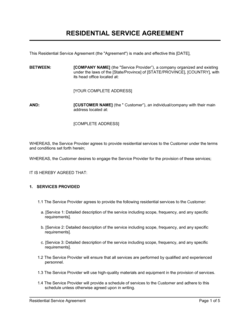
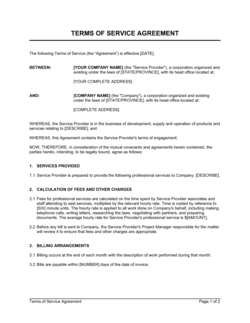
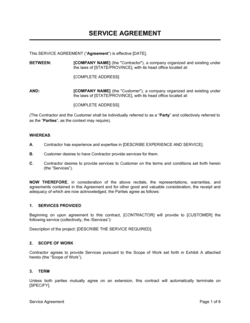
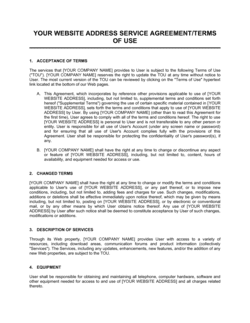
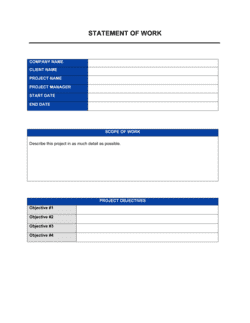
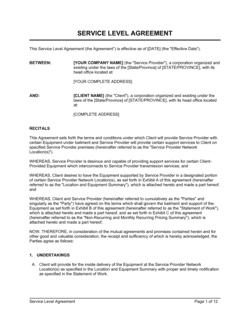
IT Service Agreement Template

Free Word download • Edit online • Save & share with Drive • Export to PDF

8 pages30–40 min to fillDifficulty: ComplexSignature requiredLegal review recommended
Learn more ↓
FreeIT Service Agreement Template

At a glance

What it is
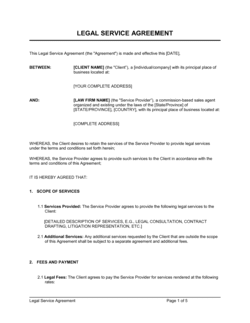
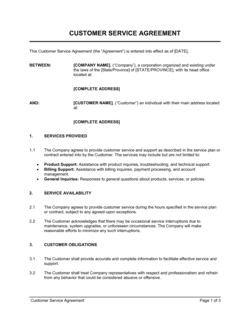
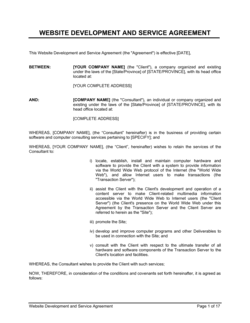
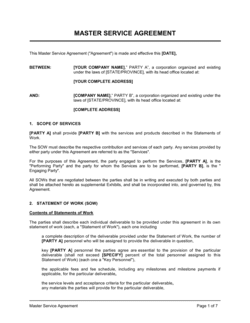
An IT Service Agreement is a legally binding contract between a customer and an IT services provider — such as a managed service provider (MSP), systems integrator, or IT consultancy — that defines the scope of work, deliverables, service fees, response and resolution SLAs, security obligations, data handling requirements, and term. This free Word download gives you a professionally structured starting point you can edit online and export as PDF for signature.
When you need it
Use it before any managed services engagement, IT project, or ongoing support retainer begins — whenever a provider will have access to your systems, data, or infrastructure. It is equally important for the provider to issue it as a standard engagement document for every new client.
What's inside
Scope of services and excluded work, fee structure and invoicing schedule, response and resolution SLA tiers, security and data handling obligations, confidentiality, IP ownership of deliverables, limitation of liability, indemnification, term, and termination conditions.

What is an IT Service Agreement?

An IT Service Agreement is a legally binding contract between a customer and an IT services provider — such as a managed service provider (MSP), systems integrator, or IT consultancy — that establishes the complete terms governing the working relationship. It defines the scope of services and explicit exclusions, the fee structure and invoicing schedule, response and resolution SLAs by priority tier, security controls, data handling and ownership obligations, IP rights over custom deliverables, limitation of liability, and termination conditions. Unlike an informal statement of work or a simple offer letter, a properly drafted IT service agreement creates enforceable obligations on both sides and removes the ambiguity that generates costly disputes when systems go down, data is breached, or scope expands beyond what was originally discussed.

Why You Need This Document

Operating without an IT service agreement exposes both the provider and the customer to compounding risks. A provider working under a verbal arrangement or a thin SOW has no contractual basis to limit liability if a migration goes wrong and the customer claims lost revenue — awards for consequential damages in IT disputes regularly exceed the total contract value. The customer, meanwhile, has no enforceable SLA to cite when response times slip, no written obligation compelling the provider to return data on termination, and no IP assignment ensuring that custom scripts and configurations actually belong to them. Regulatory exposure compounds the risk: HIPAA, GDPR, and state breach notification laws require specific contract language between controllers and processors that a generic agreement will not cover. This template gives IT providers a professional, enforceable starting point for every new client engagement and gives customers the baseline protections — SLAs, security obligations, data return, and a liability cap — that any competent IT engagement requires.

Which variant fits your situation?

If your situation is…Use this template
Recurring managed services with monthly flat-fee pricingManaged Services Agreement
One-time IT project with defined deliverables and a fixed feeIT Project Agreement
Break-fix or on-call support billed hourlyIT Support Contract
Software development or custom application buildSoftware Development Agreement
Cloud infrastructure management and DevOps servicesCloud Services Agreement
Third-party vendor with access to customer personal dataData Processing Agreement
Protecting confidential system architecture before initial discussionsNon-Disclosure Agreement

Common mistakes to avoid

❌ Vague security language with no defined controls

Why it matters: A clause requiring 'industry-standard security' without defining the specific controls provides no enforceable benchmark. If a breach occurs, neither party can objectively determine whether the provider was in compliance.

Fix: List specific controls — MFA for all privileged access, AES-256 encryption, critical patch application within 72 hours — and reference a recognized framework such as NIST CSF or CIS Controls as the minimum baseline.

❌ No explicit exclusions list in the scope section

Why it matters: Without a written exclusions list, customers interpret ambiguous phrases like 'managing the network' to include hardware replacement, third-party vendor coordination, and after-hours on-site visits — all of which represent significant provider cost.

Fix: Add a dedicated exclusions subsection to Schedule A listing at least five categories of work not covered — hardware procurement, licensing, physical cabling, end-user training, and third-party application support are the most common.

❌ Uncapped SLA service credits

Why it matters: During a catastrophic incident or extended outage, uncapped credits can accumulate to a value exceeding the monthly fee, making the contract a net negative for the provider even while they work to resolve the issue.

Fix: Cap aggregate monthly service credits at a defined percentage of the monthly fee — 15–20% is the standard range — and exclude from credit calculations any downtime caused by the customer, third-party outages, or force majeure events.

❌ No data-return-or-destruction obligation on termination

Why it matters: Customer data left on provider systems, backup tapes, or cloud storage after contract end creates ongoing regulatory exposure — particularly under GDPR, HIPAA, and PIPEDA — and gives the provider inadvertent leverage over the departing customer.

Fix: Include a clause requiring the provider to return all customer data in a portable format and confirm destruction of all copies within 30 days of termination, with written certification.

❌ Auto-renewal with a short or poorly disclosed cancellation window

Why it matters: A 30-day cancellation notice on a 12-month contract regularly results in customers being locked into an unwanted renewal year because procurement, legal, or finance did not review the contract in time.

Fix: Use a 60-day minimum cancellation notice window and require the provider to send a written renewal reminder no later than 90 days before the renewal date.

❌ One-sided limitation of liability clause

Why it matters: Applying the liability cap only to the provider and leaving the customer's liability uncapped creates a negotiating obstacle and, if the customer is a large enterprise, a meaningful financial risk to the provider for errors in environment documentation or access provisioning.

Fix: Apply the liability cap mutually and define the carve-outs — fraud, gross negligence, willful misconduct, and IP infringement — symmetrically for both parties.

The 10 key clauses, explained

Parties, recitals, and definitions

In plain language: Identifies the customer and provider as legal entities, states the purpose of the agreement, and defines the key terms used throughout the document.

Sample language
This IT Service Agreement ('Agreement') is entered into as of [EFFECTIVE DATE] between [PROVIDER LEGAL NAME], a [STATE/COUNTRY] [ENTITY TYPE] ('Provider'), and [CUSTOMER LEGAL NAME], a [STATE/COUNTRY] [ENTITY TYPE] ('Customer').

Common mistake: Using trade names instead of registered legal entity names. If the contracting entity doesn't match the entity that invoices or employs the technicians, enforcing the agreement — especially the limitation of liability — becomes complicated.

Scope of services and exclusions

In plain language: Describes exactly what the provider will do, references any Statement of Work (SOW), and explicitly lists what is out of scope to prevent scope creep disputes.

Sample language
Provider shall perform the services described in Schedule A ('Services'). Any work not expressly listed in Schedule A — including hardware procurement, third-party licensing, and on-site visits outside [REGION] — is excluded and subject to a separate Change Order.

Common mistake: Omitting an explicit exclusions list and relying on 'the services described in Schedule A' alone. Without written exclusions, customers routinely request adjacent work as included, and disputes arise over what 'managing the network' actually covers.

Fees, invoicing, and payment terms

In plain language: States the monthly retainer or project fee, invoicing frequency, due date, accepted payment methods, and the consequences of late payment.

Sample language
Customer shall pay Provider a monthly fee of $[AMOUNT] due within [30] days of invoice date. Invoices are issued on the 1st of each month. Overdue balances accrue interest at [1.5]% per month. Provider may suspend services after [15] days of non-payment with [5] days' written notice.

Common mistake: No service-suspension clause for non-payment. Without it, the provider must continue performing while pursuing collections — and courts in some jurisdictions require continued performance absent a clear contractual right to suspend.

Service level commitments (SLAs)

In plain language: Defines response and resolution time targets by incident priority tier, specifies how priority is determined, and sets the remedy — typically a service credit — when targets are missed.

Sample language
Priority 1 (critical — system down): Response within [1] hour, resolution within [4] hours. Priority 2 (high — major degradation): Response within [4] hours, resolution within [1] business day. Service credits of [5]% of monthly fee apply per missed SLA, up to a maximum of [15]% per month.

Common mistake: Promising SLA credits without capping the aggregate monthly credit. Uncapped credits can exceed the monthly fee for a single bad month, creating a financial liability larger than the contract value.

Security obligations and incident response

In plain language: Sets minimum security standards the provider must maintain — encryption, access controls, vulnerability patching cadence — and specifies how quickly a security incident must be reported to the customer.

Sample language
Provider shall maintain industry-standard security controls including [AES-256] encryption for data in transit and at rest, multi-factor authentication for all administrative access, and patch critical vulnerabilities within [72] hours of disclosure. Provider shall notify Customer of any confirmed security incident within [24] hours of discovery.

Common mistake: Referencing 'industry-standard security' without defining what that means. Vague security language is unenforceable and provides no basis for a breach claim if the provider's controls prove inadequate.

Data handling, confidentiality, and ownership

In plain language: Governs how the provider accesses, stores, and disposes of customer data; prohibits use of customer data for any purpose other than service delivery; and clarifies that customer data remains customer property at all times.

Sample language
All Customer Data remains the sole property of Customer. Provider shall access Customer Data only as necessary to perform the Services, shall not transfer it to third parties without written consent, and shall return or destroy all Customer Data within [30] days of agreement termination.

Common mistake: No data-return-or-destruction clause. Without it, customer data can remain on provider systems, cloud backups, or subcontractor environments indefinitely after the agreement ends — creating regulatory exposure for both parties.

Intellectual property ownership of deliverables

In plain language: Specifies who owns custom work product — scripts, configurations, documentation, or code — created by the provider during the engagement.

Sample language
All custom deliverables created specifically for Customer under this Agreement ('Custom Deliverables') are assigned to Customer upon receipt of full payment. Provider retains ownership of its pre-existing tools, methodologies, and general-purpose scripts ('Provider IP'), and grants Customer a non-exclusive license to use Provider IP embedded in Custom Deliverables.

Common mistake: No IP ownership clause at all, leaving the customer with a perpetual license risk — particularly for custom scripts or configurations that become embedded in critical infrastructure. Providers who retain all IP can restrict the customer's ability to switch vendors.

Limitation of liability

In plain language: Caps the provider's maximum financial exposure to the customer, typically at the total fees paid in the prior 12 months, and excludes liability for consequential, incidental, or punitive damages.

Sample language
Provider's total aggregate liability under this Agreement shall not exceed the total fees paid by Customer in the [12] months immediately preceding the claim. In no event shall either party be liable for indirect, incidental, consequential, or punitive damages, even if advised of the possibility of such damages.

Common mistake: No mutual limitation — applying the cap only to the provider. A customer who suffers a breach but also causes a provider loss (e.g., by providing inaccurate environment details) may face uncapped exposure without a mutual clause.

Term, renewal, and termination

In plain language: Sets the initial contract term, auto-renewal conditions, required notice periods for cancellation, and the circumstances allowing either party to terminate for cause or convenience.

Sample language
This Agreement commences on [START DATE] and continues for an initial term of [12] months, renewing automatically for successive [12]-month periods unless either party provides [60] days' written notice before renewal. Either party may terminate for cause upon [30] days' written notice if a material breach remains uncured.

Common mistake: Auto-renewal without a minimum notice period that is realistic for procurement cycles. A 30-day cancellation window on a 12-month contract often lapses before the customer's procurement or legal team has reviewed the renewal, creating an unwanted additional year of commitment.

Governing law, dispute resolution, and general provisions

In plain language: Specifies the jurisdiction whose laws govern the agreement, whether disputes go to arbitration or court, and standard boilerplate covering entire agreement, amendments, and waiver.

Sample language
This Agreement is governed by the laws of [STATE/PROVINCE/COUNTRY]. Disputes shall first be submitted to non-binding mediation before either party may initiate arbitration or litigation. This Agreement constitutes the entire agreement between the parties and supersedes all prior representations or understandings.

Common mistake: Choosing a governing law with no connection to where either party operates. Some jurisdictions have consumer-protection or data-privacy statutes that apply regardless of the contractual choice of law — selecting a neutral state does not always provide the protection the provider expects.

How to fill it out

  1. 1

    Identify the parties and effective date

    Enter the full registered legal names of the provider and customer entities, their principal addresses, and the date the agreement takes effect. Confirm the entity type (LLC, Inc., Ltd.) matches official registration records.

    💡 If the provider operates under a trade name, add a 'doing business as' reference — e.g., '[PROVIDER LEGAL NAME], doing business as [TRADE NAME]' — to avoid confusion on invoices.

  2. 2

    Draft Schedule A: scope of services and exclusions

    List every specific service the provider will perform — systems monitored, platforms managed, ticket categories covered — and add an explicit exclusions section listing adjacent work that is out of scope.

    💡 Walk through the last three client escalations and ask whether each request would fall inside or outside the scope you've drafted. Gaps become disputes.

  3. 3

    Set fees, invoicing schedule, and late-payment terms

    Enter the monthly or project fee, the invoicing date, the payment due date (Net 15 or Net 30 are standard for IT MSPs), the interest rate for overdue balances, and the notice period before service suspension.

    💡 Net 15 significantly improves MSP cash flow compared to Net 30 — propose it as the default for new clients rather than waiting to negotiate.

  4. 4

    Define SLA tiers and service credit remedies

    Create at minimum three priority tiers — critical, high, and standard — and assign response and resolution time targets to each. Set a service credit percentage for each missed SLA and cap the aggregate monthly credit.

    💡 Tie SLA priority definitions to measurable impact (e.g., 'more than 50% of users unable to access core systems') rather than subjective terms like 'urgent' or 'important.'

  5. 5

    Specify security controls and incident notification windows

    List the specific security controls the provider will maintain — MFA, encryption standards, patch cadence — and set a precise notification window for security incidents (24 hours is common; some regulated industries require faster).

    💡 If the customer is subject to HIPAA, PCI-DSS, or SOC 2 requirements, align the security clause with those frameworks by name and reference any applicable compliance obligations.

  6. 6

    Address data handling, IP ownership, and subcontractors

    Confirm that customer data remains customer property, add a data-return-or-destruction timeline on termination, specify who owns custom deliverables, and state whether subcontractors are permitted and under what conditions.

    💡 If the provider uses any offshore subcontractors, name them or the categories in a Schedule — GDPR and Canadian PIPEDA require customers to know where their data is processed.

  7. 7

    Set the limitation of liability cap and mutual exclusions

    Cap total liability at 12 months of fees paid, apply the cap mutually to both parties, and list the carve-outs — fraud, willful misconduct, and data breach caused by the provider's negligence are commonly excluded from the cap.

    💡 Providers should not carve out liability for all data breaches — courts increasingly refuse to enforce limitation clauses for gross negligence in security incidents, and attempting to do so can undermine the entire clause.

  8. 8

    Confirm term, auto-renewal notice, and termination triggers

    Set the initial term (12 months is standard), the auto-renewal period, the cancellation notice window (60 days is common), and the cure period for material breach before termination for cause is effective.

    💡 Add a calendar reminder for 75 days before each contract anniversary to review whether to renew, renegotiate, or cancel — the notice window closes faster than it appears.

Frequently asked questions

What is an IT service agreement?

An IT service agreement is a legally binding contract between a customer and an IT services provider — such as an MSP, consultancy, or systems integrator — that defines the scope of services, fees, SLAs, security obligations, data handling requirements, and termination conditions. It governs both ongoing managed services engagements and discrete IT projects, replacing informal statements of work with enforceable obligations on both sides.

What should an IT service agreement include?

At minimum: parties and definitions, scope of services with explicit exclusions, fee structure and payment terms, SLA tiers with response and resolution time targets, security controls and incident notification requirements, data handling and ownership, IP ownership of custom deliverables, limitation of liability, indemnification, term and auto-renewal conditions, termination rights, and governing law. Missing any of these — particularly the scope exclusions and liability cap — creates disputes that are expensive to resolve.

What is a service level agreement (SLA) in an IT contract?

An SLA is the section of the IT service agreement that commits the provider to specific, measurable performance targets — typically response time (how quickly the provider acknowledges an incident) and resolution time (how quickly normal service is restored) for each priority tier. SLAs also define the remedy — usually a service credit — when targets are missed, and the conditions under which credits are not owed, such as outages caused by the customer or by third-party infrastructure.

Is an IT service agreement the same as a managed services agreement?

The terms are used interchangeably, but there is a practical distinction. A managed services agreement specifically covers ongoing, recurring infrastructure management under a flat monthly fee. An IT service agreement is broader — it can govern project-based work, break-fix support, consulting engagements, or a combination of all three. A well-drafted IT service agreement typically includes a Schedule A that defines whether the engagement is managed services, project-based, or time-and-materials.

Who owns the work product created by an IT provider?

Ownership depends entirely on the contract. Without an explicit IP clause, the general default in most jurisdictions is that the creator — the provider — owns the work product unless it qualifies as a work-made-for-hire under applicable copyright law. Customers should insist on an IP assignment clause transferring ownership of custom deliverables upon full payment, while allowing the provider to retain a license to reuse pre-existing tools and methodologies.

What liability cap is standard in an IT service agreement?

The most widely used cap is 12 months of fees paid immediately preceding the claim. Some providers negotiate a cap of 3–6 months for lower-risk engagements; high-risk roles involving sensitive data or critical infrastructure sometimes see 24-month caps. Carve-outs for the cap — meaning situations where the cap does not apply — typically include fraud, willful misconduct, gross negligence in a security breach, and IP infringement.

Do I need a separate data processing agreement for GDPR compliance?

Yes. If the IT provider processes personal data of EU residents on behalf of the customer, GDPR Article 28 requires a separate Data Processing Agreement (DPA) — or a clearly delineated DPA addendum within the main contract — that specifies the categories of data, processing purposes, subprocessors, security measures, and data subject rights obligations. Relying solely on a confidentiality clause in the main agreement is not sufficient for GDPR compliance.

Can I use an IT service agreement for a cloud or SaaS project?

Yes, with additions. Cloud and SaaS engagements should add provisions for uptime guarantees (expressed as a monthly percentage), scheduled maintenance windows, data portability on termination, and the provider's obligations regarding the security of the underlying cloud infrastructure. If the provider is a reseller of third-party cloud services, the agreement should clarify which SLAs are pass-through obligations from the upstream provider and which are the MSP's own commitments.

What notice period should the IT service agreement require for cancellation?

Sixty days is the standard notice period for monthly managed services contracts with a 12-month initial term. Shorter windows — 30 days — are appropriate for month-to-month or break-fix arrangements. Longer windows — 90 days — are common for enterprise agreements with complex transition obligations. Pair the cancellation notice period with a contractual requirement for the provider to deliver transition assistance for a defined period after notice is given.

Does an IT service agreement need to be reviewed by a lawyer?

For standard managed services engagements with an SMB customer and straightforward scope, a high-quality template with tailored SLAs and scope schedules is typically sufficient. Legal review is strongly recommended when the customer is in a regulated industry (healthcare, finance), when the engagement involves access to highly sensitive data, when the contract value exceeds $100K annually, or when the customer demands significant modifications to the liability and indemnification provisions.

How this compares to alternatives

vs Non-Disclosure Agreement

An NDA protects confidential information shared during preliminary discussions but creates no obligations around service delivery, SLAs, fees, or liability. An IT service agreement includes confidentiality provisions as one clause among many — making a standalone NDA redundant once the service agreement is signed. Use the NDA before contract negotiations begin; replace it with the service agreement once terms are agreed.

vs Software Development Agreement

A software development agreement governs the creation of a specific software application — with milestones, acceptance testing, and source code ownership as its core concerns. An IT service agreement governs ongoing infrastructure management, support, and consulting services. If the engagement involves both managed services and a custom build, both agreements are typically needed, or the service agreement is extended with a software development SOW.

vs Independent Contractor Agreement

An independent contractor agreement governs a self-employed individual performing defined tasks — it focuses on worker classification, payment, and basic IP assignment. An IT service agreement is designed for a business-to-business services relationship and adds SLAs, security obligations, data handling, limitation of liability, and indemnification that are absent from a standard contractor agreement. Using a contractor agreement for an MSP relationship leaves critical protections off the table.

vs Service Level Agreement (standalone)

A standalone SLA document defines performance metrics and remedies but is not a complete contract — it lacks fee terms, IP ownership, limitation of liability, and termination rights. An IT service agreement incorporates SLA commitments as one clause within a full contractual framework. A standalone SLA is appropriate as an addendum to an existing master services agreement, not as a replacement for the underlying contract.

Industry-specific considerations

Healthcare and life sciences

HIPAA Business Associate Agreement required as an addendum; security incident notification window often contractually compressed to 24 hours or less; access controls for EHR systems must be explicitly defined.

Financial services

PCI-DSS compliance obligations must be referenced by name; customer audit rights over provider security controls are common; regulatory change management clauses address evolving compliance requirements.

Professional services

Client data segregation and conflict-of-interest provisions are critical when the MSP serves multiple competing firms; project milestone billing and acceptance criteria are standard for consulting engagements.

Retail and e-commerce

PCI-DSS scope for payment card environments, peak-season SLA uptime commitments tied to promotional calendars, and e-commerce platform integration support are typical addenda.

Manufacturing and industrial

OT and SCADA network segmentation obligations, on-site response time SLAs for production-critical systems, and vendor-neutral hardware sourcing clauses address the unique IT/OT convergence risks.

SaaS and technology companies

Cloud infrastructure management SLAs tied to product uptime commitments, CI/CD pipeline security requirements, and clear IP ownership of DevOps tooling and automation scripts.

Jurisdictional notes

United States

No single federal statute governs IT services contracts, but sector-specific regulations impose obligations on providers — HIPAA for healthcare data, GLBA for financial services, and state breach notification laws (all 50 states have them) require rapid incident disclosure. California's CPRA and other state privacy laws may require a data processing addendum even for B2B engagements. Non-compete clauses for individual technicians vary sharply by state.

Canada

PIPEDA and its provincial equivalents (particularly Quebec's Law 25, which imposes GDPR-like requirements) require a written contract governing personal data processing — a standalone DPA or addendum is essential for any engagement touching Quebec data. Provinces vary on limitation periods for contract claims (2 years in most, 6 years in some). French-language contract requirements apply to provincially regulated businesses in Quebec.

United Kingdom

The UK GDPR (retained post-Brexit) requires a written controller-processor contract for any personal data processing. The ICO expects contracts to specify security measures, subprocessor controls, and data subject rights obligations. The Investigatory Powers Act and NIS Regulations impose additional obligations on providers managing network and information systems for certain sectors. Limitation clauses excluding liability for death or personal injury caused by negligence are unenforceable under the Unfair Contract Terms Act 1977.

European Union

GDPR Article 28 mandates a Data Processing Agreement for any IT provider acting as a processor of personal data — it must be a separate document or clearly delineated addendum. The NIS2 Directive (effective October 2024) imposes incident reporting obligations within 24 hours for significant incidents affecting essential and important entities. Member states vary on enforceability of limitation of liability clauses; German courts, for example, apply the AGB-Recht rules to standard-form contracts and may strike clauses that are unreasonably one-sided.

Template vs lawyer — what fits your deal?

PathBest forCostTime
Use the templateMSPs and IT consultants onboarding SMB clients for standard managed services or project work in a single jurisdictionFree30–60 minutes per engagement
Template + legal reviewEngagements involving regulated industries, sensitive personal data, contracts over $100K annually, or customers requesting material liability modifications$500–$1,5003–5 business days
Custom draftedEnterprise IT outsourcing, multi-jurisdiction deployments, critical infrastructure environments, or contracts where the provider is taking on significant compliance obligations$3,000–$10,000+2–6 weeks

Glossary

Service Level Agreement (SLA)
A contractual commitment specifying the minimum response and resolution times the provider must meet for different categories of incident or request.
Managed Service Provider (MSP)
A company that remotely manages a customer's IT infrastructure and end-user systems under a recurring subscription model.
Response Time
The maximum time between a customer reporting an incident and the provider acknowledging it and beginning active work.
Resolution Time
The maximum time from incident acknowledgment to full restoration of normal service, as defined by priority tier.
Scope of Services
The specific tasks, systems, and deliverables the provider is contracted to perform — everything outside this list is excluded work.
Change Order
A written amendment to the original agreement that documents agreed changes to scope, timeline, or fees before additional work begins.
Limitation of Liability
A clause capping the maximum financial exposure of either party — typically expressed as a multiple of fees paid in a defined period.
Indemnification
An obligation by one party to compensate the other for specified losses, claims, or damages arising from defined events or breaches.
Uptime Guarantee
A contractual commitment — expressed as a percentage, e.g., 99.5% — specifying the minimum availability of a managed system or service per billing period.
Data Processing Agreement (DPA)
A separate contract — required under GDPR and similar laws — governing how a service provider handles personal data on behalf of the customer.
Acceptance Criteria
Specific, measurable conditions that a deliverable must satisfy before the customer is obligated to accept it and trigger the associated payment milestone.
Subcontractor
A third party engaged by the provider to perform part of the contracted services, for whose work the provider typically remains responsible to the customer.

Part of your Business Operating System

This document is one of 3,000+ business & legal templates included in Business in a Box.

  • Fill-in-the-blanks — ready in minutes
  • 100% customizable Word document
  • Compatible with all office suites
  • Export to PDF and share electronically

Create your document in 3 simple steps.

From template to signed document — all inside one Business Operating System.
1
Download or open template

Access over 3,000+ business and legal templates for any business task, project or initiative.

2
Edit and fill in the blanks with AI

Customize your ready-made business document template and save it in the cloud.

3
Save, Share, Send, Sign

Share your files and folders with your team. Create a space of seamless collaboration.

Save time, save money, and create top-quality documents.

★★★★★

"Fantastic value! I'm not sure how I'd do without it. It's worth its weight in gold and paid back for itself many times."

Managing Director · Mall Farm
Robert Whalley
Managing Director, Mall Farm Proprietary Limited
★★★★★

"I have been using Business in a Box for years. It has been the most useful source of templates I have encountered. I recommend it to anyone."

Business Owner · 4+ years
Dr Michael John Freestone
Business Owner
★★★★★

"It has been a life saver so many times I have lost count. Business in a Box has saved me so much time and as you know, time is money."

Owner · Upstate Web
David G. Moore Jr.
Owner, Upstate Web

Run your business with a system — not scattered tools

Stop downloading documents. Start operating with clarity. Business in a Box gives you the Business Operating System used by over 250,000 companies worldwide to structure, run, and grow their business.

Start free · No credit card required