Vehicle Fleet Policy Template

Free Word download β€’ Edit online β€’ Save & share with Drive β€’ Export to PDF

3 pagesβ€’20–25 min to fillβ€’Difficulty: Standard
Learn more ↓
FreeVehicle Fleet Policy Template

At a glance

What it is
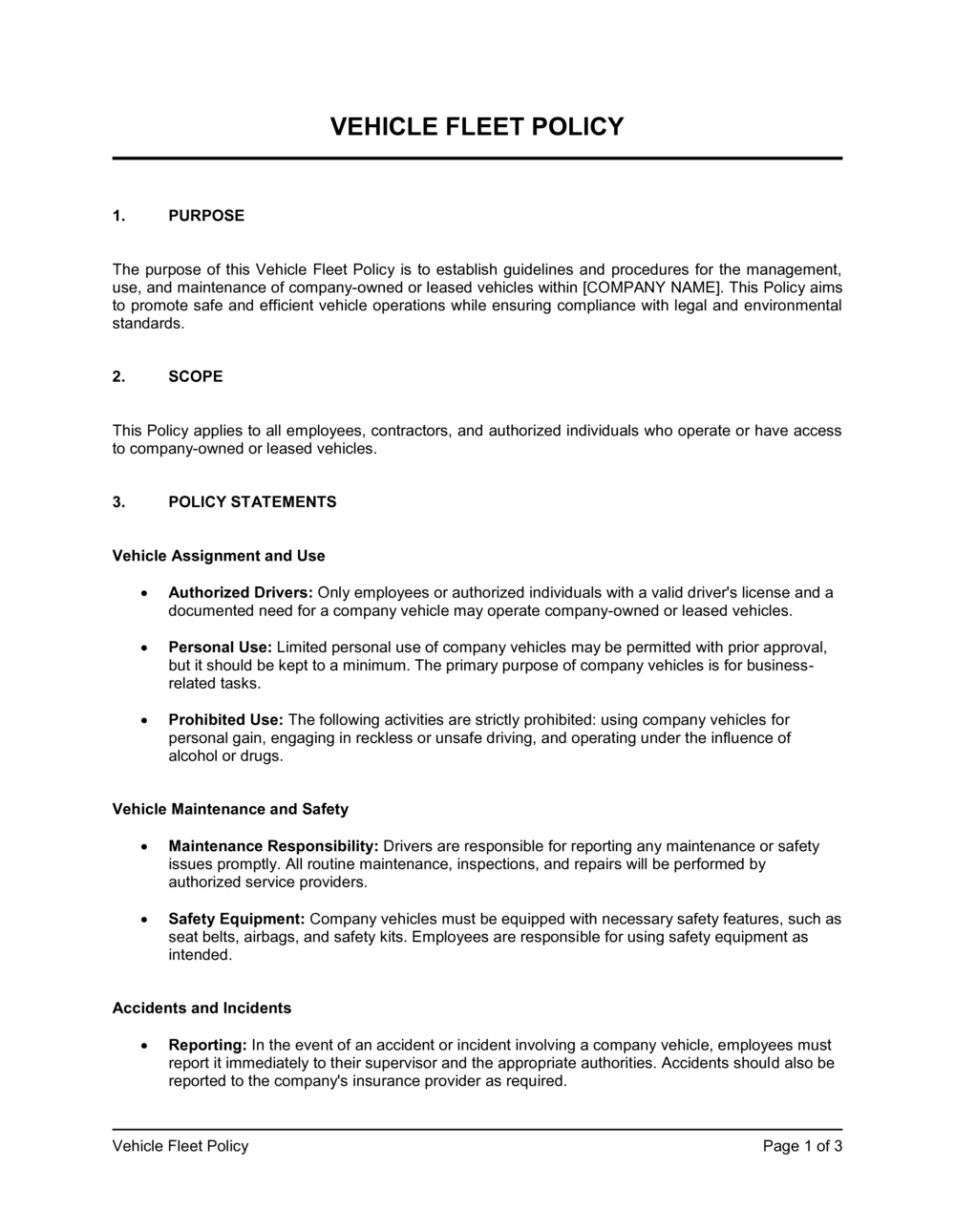
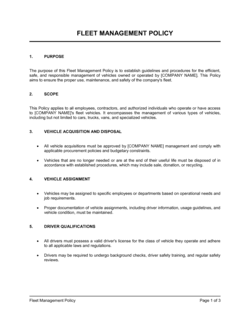
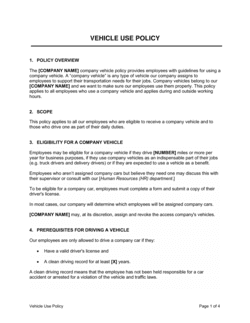
A Vehicle Fleet Policy is an internal operational document that sets the rules governing how company-owned or leased vehicles are assigned, used, maintained, and returned. This free Word download gives you a ready-to-edit framework covering driver eligibility, personal use restrictions, fuel and expenses, accident reporting, and compliance obligations β€” exportable as PDF for distribution to all drivers.
When you need it
Use it when your business operates two or more vehicles and needs a single authoritative reference to standardize driver behavior, protect insurance coverage, and meet duty-of-care obligations. It is also required by most commercial auto insurers as a condition of fleet coverage.
What's inside
Driver eligibility and authorization, permitted and prohibited vehicle uses, maintenance and inspection schedules, fuel and expense reimbursement rules, accident and incident reporting procedures, traffic violation handling, telematics and GPS monitoring notice, and policy enforcement and consequences for non-compliance.

What is a Vehicle Fleet Policy?

A Vehicle Fleet Policy is an internal operational document that establishes the rules, responsibilities, and procedures governing the use of vehicles owned, leased, or rented by a company. It defines who is authorized to drive, what vehicles may be used for, how fuel and maintenance are managed, and exactly what steps must be taken when an accident or violation occurs. Rather than leaving these questions to informal expectation, a written fleet policy creates a documented standard that protects the company from liability, satisfies commercial auto insurance requirements, and gives every driver a clear and consistent reference point.

Why You Need This Document

Operating a vehicle fleet without a written policy exposes your business to compounding risks at every level. Insurers routinely dispute or deny claims when no documented driver vetting or vehicle inspection process exists. Without clear personal-use rules, employees assume broader entitlements than the insurance policy covers β€” creating gaps in coverage at exactly the moment a claim is filed. Vicarious liability means your organization can be held responsible for accidents caused by drivers you never formally qualified or trained. For companies with telematics-equipped vehicles, the absence of a written monitoring disclosure creates privacy law exposure in several jurisdictions. A complete vehicle fleet policy closes each of these gaps in a single document β€” and because it requires a driver signature before first use, you have documented proof that every authorized driver understood and accepted the terms.

Which variant fits your situation?

If your situation is…Use this template
Single employee assigned an exclusive company carCompany Vehicle Use Agreement
Employees using personal vehicles for business travelMileage Reimbursement Policy
Renting vehicles for occasional business travelTravel and Expense Policy
Heavy equipment or specialized vehicle fleetEquipment Use Policy
Drivers requiring ongoing safety training documentationDriver Safety Training Record
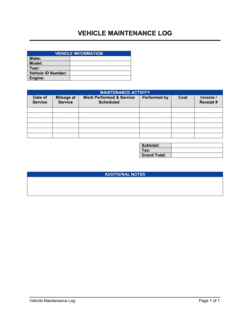
Full fleet maintenance scheduling and trackingFleet Maintenance Log
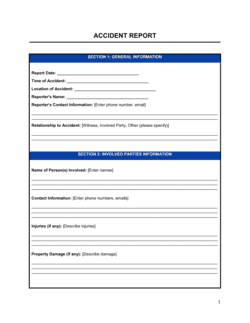
Accident or incident documentation after an event occursVehicle Accident Report

Common mistakes to avoid

❌ No MVR rechecks after initial hire

Why it matters: A driver's record can deteriorate significantly after onboarding β€” suspensions, DUIs, and accumulated violations go undetected until an accident triggers an insurance investigation that reveals the company had no ongoing verification process.

Fix: Schedule annual MVR checks for all authorized drivers and pull an immediate check whenever a driver self-reports a violation or is involved in an incident.

❌ Vague personal-use language

Why it matters: If the policy does not explicitly state whether commuting, personal errands, or family use are permitted, employees will interpret ambiguity in their favor β€” and insurers may dispute claims arising from undisclosed personal use.

Fix: State personal use permissions in plain binary terms: 'Personal use is prohibited at all times' or 'Personal use is permitted for the assigned driver only, Monday–Friday between 6 PM and 8 AM, within 50 miles of the employee's home address.'

❌ Assigning maintenance responsibility without a checklist

Why it matters: Telling drivers they are responsible for vehicle condition without giving them a documented checklist means responsibility cannot be enforced β€” and deferred maintenance defects become the company's liability in a negligence claim.

Fix: Attach a pre-trip inspection checklist and require drivers to log completed checks in a vehicle log book or fleet management app.

❌ No signed driver acknowledgment requirement

Why it matters: Without a signature, employees can credibly claim the policy was never communicated to them, which undermines disciplinary actions and weakens the company's defense in liability claims.

Fix: Require every authorized driver to sign an acknowledgment form before their first vehicle use and re-sign whenever the policy is updated.

The 9 key sections, explained

Purpose and scope

Driver eligibility and authorization

Permitted and prohibited uses

Fuel, tolls, and expense reimbursement

Maintenance and inspections

Accident, damage, and incident reporting

Traffic violations and fines

Telematics and monitoring

Policy enforcement and consequences

How to fill it out

  1. 1

    Define your fleet scope and vehicle inventory

    List every vehicle covered by the policy β€” owned, leased, and regularly rented. Include make, model, year, and VIN where possible. Decide whether rental vehicles used occasionally also fall under the policy.

    πŸ’‘ A fleet inventory table in an appendix lets you update vehicle details without amending the policy body each time a vehicle is added or retired.

  2. 2

    Set driver eligibility criteria

    Specify minimum license class, maximum violation history (e.g., no more than two moving violations in 36 months), minimum driver age, and MVR check frequency. Align these thresholds with your commercial auto insurer's requirements.

    πŸ’‘ Ask your insurance broker for their minimum acceptable MVR criteria before writing your own β€” exceeding their floor protects coverage; falling below it can void a claim.

  3. 3

    Clarify permitted and prohibited uses

    State explicitly whether personal use and commuting are allowed. If personal use is permitted, specify boundaries β€” evenings only, primary driver only, no out-of-state travel β€” and note any resulting tax implications for employees.

    πŸ’‘ A simple table with 'Permitted / Requires Approval / Prohibited' for each use category (commuting, personal errands, family use, international travel) removes ambiguity instantly.

  4. 4

    Document fuel and expense procedures

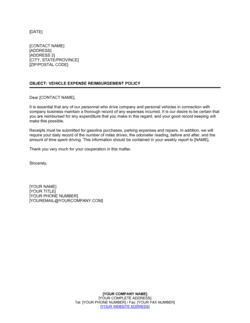
    Specify whether you use company fuel cards, direct reimbursement, or a fleet account. Set the receipt submission window, state the mileage reimbursement rate for personal vehicles used on business (if applicable), and describe how personal charges are handled.

    πŸ’‘ Set a per-transaction fuel card limit and require the driver to enter a mileage odometer reading at each fill-up β€” this alone deters and detects personal use immediately.

  5. 5

    Write the maintenance and inspection schedule

    Define the pre-trip inspection checklist drivers complete before each use, the mileage or calendar intervals for scheduled servicing, and who is responsible for booking and tracking each service.

    πŸ’‘ Attach a one-page pre-trip checklist as an appendix β€” tyres, lights, fluids, wipers, mirrors β€” so drivers have a concrete reference rather than a vague obligation.

  6. 6

    Specify the accident reporting procedure step by step

    Write the post-accident steps as a numbered list in chronological order: safety, emergency services, information exchange, photography, internal notification (with a name and phone number), and form completion deadline.

    πŸ’‘ Print the accident reporting steps on a laminated card kept in each vehicle's glove box β€” drivers under stress do not reliably remember a policy they read once.

  7. 7

    Add the telematics disclosure and consent language

    If your vehicles have GPS or telematics, include a clear written disclosure of what is monitored, who can access the data, and how long it is retained. Have drivers acknowledge this section separately.

    πŸ’‘ Check local privacy regulations before deployment β€” some jurisdictions require separate written consent for employee location monitoring, distinct from a general policy acknowledgment.

  8. 8

    Require a signed acknowledgment before first vehicle use

    Add an acknowledgment page at the end of the policy for the driver to sign and date, confirming they have read, understood, and agree to comply. File the signed copy in the employee's HR record.

    πŸ’‘ Keep a digital copy in your document management system, not only a paper file β€” you will need to retrieve it quickly if a dispute or insurance claim arises.

Frequently asked questions

What is a vehicle fleet policy?

A vehicle fleet policy is an internal business document that establishes the rules governing who may drive company vehicles, how those vehicles may be used, how maintenance and fuel are managed, and how accidents and violations are handled. It protects the company from liability, satisfies insurance requirements, and gives drivers a clear and enforceable framework for responsible vehicle use.

Who needs a vehicle fleet policy?

Any organization that owns, leases, or regularly rents two or more vehicles for business operations needs a written fleet policy. This includes delivery companies, field-service businesses, construction contractors, healthcare providers with mobile staff, and corporate organizations with executive car entitlements. Most commercial auto insurers require a written policy as a condition of fleet coverage.

What should a vehicle fleet policy include?

At minimum: driver eligibility criteria and MVR check requirements, permitted and prohibited uses (including personal use), fuel and expense procedures, maintenance and inspection responsibilities, accident reporting steps, traffic violation consequences, telematics monitoring disclosure, and a signed driver acknowledgment. Policies for larger fleets typically add a vehicle assignment procedure and a replacement or breakdown protocol.

Can employees use company vehicles for personal trips?

That depends entirely on what your fleet policy states. Some employers permit limited personal use β€” typically commuting or after-hours use by the assigned driver only. Others prohibit it entirely. Either position is valid, but it must be stated explicitly. If personal use is permitted, the policy should address the resulting taxable benefit for the employee and confirm that insurance coverage extends to those trips.

How often should MVR checks be conducted?

Annual MVR checks for all authorized drivers are the standard recommended by most commercial auto insurers and fleet risk managers. An additional check should be triggered immediately whenever a driver self-reports a new violation, is involved in an accident, or receives a traffic citation. Relying solely on the pre-employment check leaves the company exposed to liability from drivers whose records have deteriorated since hire.

Does a vehicle fleet policy need to be signed by employees?

Yes. A signed acknowledgment from every authorized driver is essential before they operate any company vehicle. Without a signature on file, the company cannot demonstrate that the driver was aware of the policy's requirements β€” which undermines disciplinary actions and weakens the organization's legal defense in the event of an accident or insurance dispute. Re-signature should be required whenever the policy is materially updated.

Should a vehicle fleet policy cover GPS and telematics monitoring?

Yes, and it should do so explicitly. If your vehicles are equipped with GPS or telematics devices, the policy must disclose what data is collected, who has access, and how long records are retained. In several jurisdictions, monitoring employee location without written notice and consent creates privacy law liability. A clear telematics section in the policy β€” with a separate driver acknowledgment β€” satisfies both operational and compliance requirements.

How is a vehicle fleet policy different from a company vehicle use agreement?

A vehicle fleet policy is the organization-wide rulebook that applies to all drivers and all vehicles. A company vehicle use agreement is an individual-level document signed by a specific employee that assigns them a particular vehicle and records the specific terms of that assignment β€” such as whether personal use is authorized for that individual, the vehicle's current condition, and the driver's personal liability for avoidable damage. Both documents are typically used together for assigned vehicles.

How this compares to alternatives

vs Company Vehicle Use Agreement

A vehicle use agreement is an individual-level document assigning a specific vehicle to a specific employee and recording the terms of that assignment. A fleet policy is the organization-wide rulebook that governs all drivers and vehicles collectively. Businesses with assigned vehicles typically need both: the policy sets the rules, and the agreement records each individual's specific authorization and obligations.

vs Travel and Expense Policy

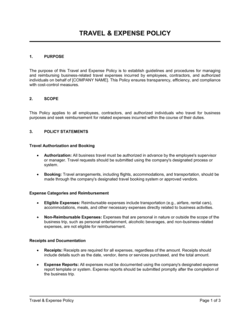
A travel and expense policy governs reimbursement for all business travel costs β€” flights, hotels, meals, and mileage when employees use personal vehicles. A fleet policy covers only company-owned or leased vehicles and goes much further on driver eligibility, maintenance, and incident reporting. Organizations with both a fleet and employee-owned vehicles need both documents.

vs Employee Handbook

An employee handbook may include a brief summary of vehicle use rules, but it cannot substitute for a standalone fleet policy. The handbook lacks the operational depth β€” pre-trip checklists, MVR check schedules, accident reporting chains, and telematics disclosures β€” that fleet management and commercial insurers require. Embed a reference to the fleet policy in the handbook; do not replace one with the other.

vs Driver Safety Training Policy

A driver safety training policy documents the training programs, completion requirements, and retraining triggers for fleet drivers. A fleet policy sets the operating rules; the safety training policy ensures drivers have the skills to follow them. For fleets with five or more drivers, both documents are typically required by insurers and duty-of-care standards.

Industry-specific considerations

Transportation and logistics

High-volume driver management, DOT compliance integration, hours-of-service rules, and commercial driver's license (CDL) verification requirements.

Construction and field services

Mixed fleets of pickup trucks, vans, and heavy equipment; job-site-specific use restrictions; tool and materials transport rules; and after-hours vehicle security.

Healthcare and home services

Community health worker and mobile care vehicles; lone-worker safety check-in procedures; patient confidentiality when transporting records; and HIPAA-compliant dashcam data handling.

Professional services

Executive car entitlements, pool-vehicle booking procedures for client visits, and mileage tracking for client billing and tax deduction purposes.

Template vs pro β€” what fits your needs?

PathBest forCostTime
Use the templateSmall businesses and growing companies setting up a fleet policy for the first time with straightforward domestic vehicle useFree1–3 hours
Template + professional reviewCompanies with 10+ vehicles, employees driving in multiple states or provinces, or fleets subject to DOT or transport authority regulations$300–$800 for an HR or risk management consultant review2–5 business days
Custom draftedLarge fleets in regulated industries (transportation, healthcare, utilities) with complex compliance requirements and significant liability exposure$1,500–$4,000 for a specialized fleet risk consultant or employment lawyer2–4 weeks

Glossary

Authorized Driver
An employee or contractor who has been formally approved by the company to operate a fleet vehicle after passing a license and MVR check.
MVR (Motor Vehicle Record)
An official driving history report issued by a licensing authority showing violations, suspensions, and accidents linked to a driver's license.
Personal Use
Any use of a company vehicle outside of business purposes β€” commuting, errands, or use by family members β€” which may have tax and insurance implications.
Telematics
GPS and onboard diagnostics technology installed in fleet vehicles to record location, speed, idle time, and driving behavior in real time.
Duty of Care
The legal obligation an employer has to take reasonable steps to protect employees and third parties from harm caused by company vehicle operations.
Vicarious Liability
The legal principle under which an employer can be held responsible for damages caused by an employee driving a company vehicle in the course of their duties.
Pool Vehicle
A company vehicle shared among multiple employees on a booking basis, not permanently assigned to a single driver.
Preventive Maintenance Schedule
A calendar- or mileage-based plan specifying when each vehicle must receive inspections, oil changes, tire rotations, and other routine servicing.
Incident Report
A written record completed immediately after a vehicle accident, near-miss, or damage event, capturing date, location, parties involved, and circumstances.
Fair Benefit Valuation
The taxable value assigned by tax authorities to personal use of a company vehicle, which the employee may be required to report as income.

Part of your Business Operating System

This document is one of 3,000+ business & legal templates included in Business in a Box.

  • Fill-in-the-blanks β€” ready in minutes
  • 100% customizable Word document
  • Compatible with all office suites
  • Export to PDF and share electronically

Create your document in 3 simple steps.

From template to signed document β€” all inside one Business Operating System.
1
Download or open template

Access over 3,000+ business and legal templates for any business task, project or initiative.

2
Edit and fill in the blanks with AI

Customize your ready-made business document template and save it in the cloud.

3
Save, Share, Send, Sign

Share your files and folders with your team. Create a space of seamless collaboration.

Save time, save money, and create top-quality documents.

β˜…β˜…β˜…β˜…β˜…

"Fantastic value! I'm not sure how I'd do without it. It's worth its weight in gold and paid back for itself many times."

Managing Director Β· Mall Farm
Robert Whalley
Managing Director, Mall Farm Proprietary Limited
β˜…β˜…β˜…β˜…β˜…

"I have been using Business in a Box for years. It has been the most useful source of templates I have encountered. I recommend it to anyone."

Business Owner Β· 4+ years
Dr Michael John Freestone
Business Owner
β˜…β˜…β˜…β˜…β˜…

"It has been a life saver so many times I have lost count. Business in a Box has saved me so much time and as you know, time is money."

Owner Β· Upstate Web
David G. Moore Jr.
Owner, Upstate Web

Run your business with a system β€” not scattered tools

Stop downloading documents. Start operating with clarity. Business in a Box gives you the Business Operating System used by over 250,000 companies worldwide to structure, run, and grow their business.

Free Forever PlanΒ Β·Β No credit card required